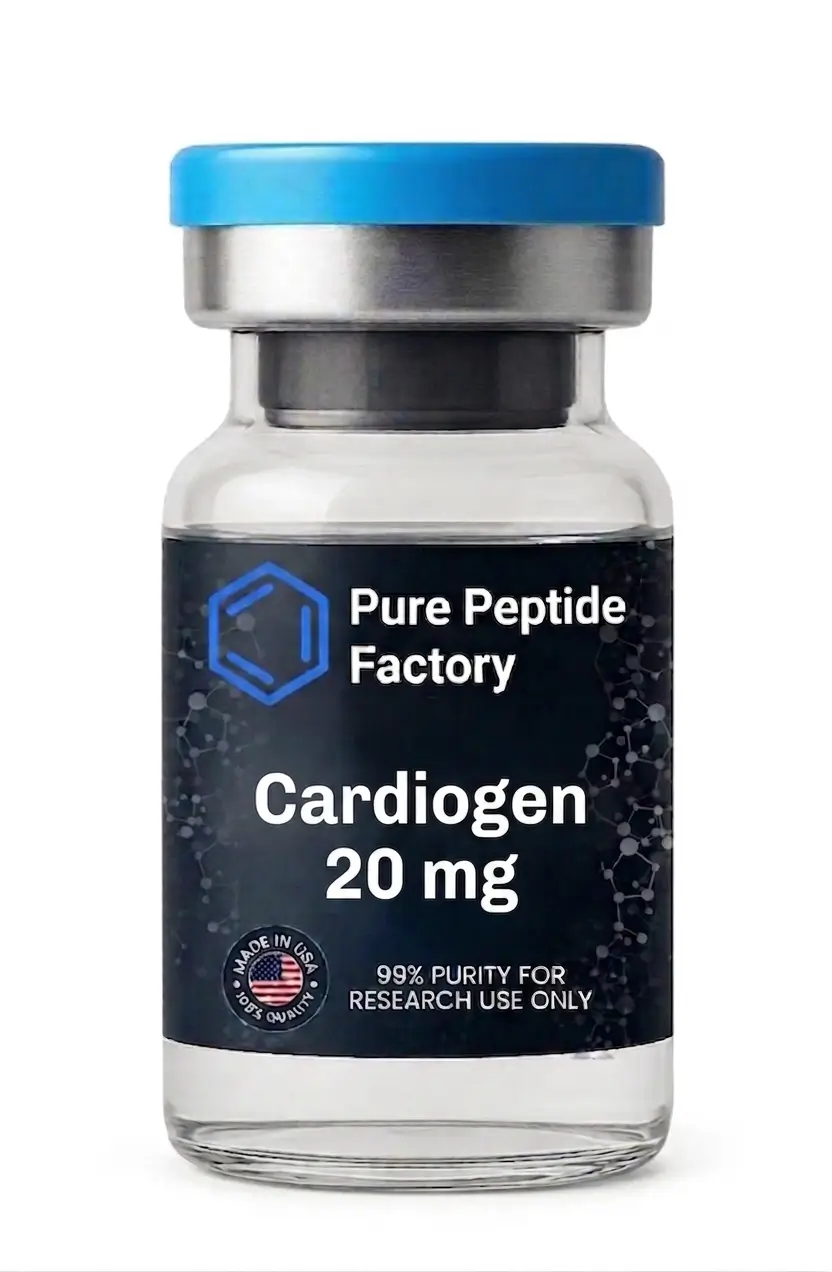
Cardiogen 20 mg
$50.00
Cardiogen peptide — research-grade Khavinson tetrapeptide (Lys-Glu-Asp-Ala) for myocardial metabolism and cardioprotection research. Domestic cold-chain shipping, HPLC verified, 20mg vials. Research use only.
Cardiogen Peptide for Sale: The Khavinson KEDA Tetrapeptide Heart Bioregulator
Cardiogen peptide is the fourth major synthetic bioregulator developed by Vladimir Khavinson and colleagues at the St. Petersburg Institute of Bioregulation and Gerontology. Specifically, the compound is a 4-amino-acid synthetic peptide (Lys-Glu-Asp-Ala, KEDA by single-letter code) designed to target myocardial metabolism and cardioprotection pathways. Furthermore, the Khavinson research framework demonstrated through multiple studies that this tetrapeptide modulates gene expression patterns associated with cardiac stress responses and mitochondrial function (1).
For researchers investigating short peptide bioregulators, myocardial ischemia models, cardiomyocyte metabolism, or the broader Khavinson organ-specific bioregulator framework, the KEDA sequence serves as the heart-targeted compound that complements Cortagen (cerebral cortex), Pinealon (CNS), Epitalon (pineal gland), and Thymalin (thymus) in your research catalog. Pure Peptide Factory stocks research-grade cardiogen peptide in 20mg vials with domestic cold-chain shipping and batch-specific HPLC documentation. When researchers buy the compound for laboratory work, the KEDA sequence requires synthesis verification that matches the published Khavinson research standard.
Why Researchers Buy Cardiogen Peptide from Pure Peptide Factory
Documentation for a Khavinson Heart-Specific Tetrapeptide
Cardiogen peptide is a 4-amino-acid synthetic peptide with a defined sequence (Lys-Glu-Asp-Ala) that determines its tissue-specific gene regulatory effects. As a result, every batch we ship includes a lot-specific HPLC chromatogram and mass spectrometry report verifying the molecular weight target with sequence integrity confirmation. The Certificate of Analysis is downloadable before your compound ships. Therefore, researchers can verify synthesis quality before starting any experimental protocol.
Domestic Cold-Chain for Research Reproducibility
Tetrapeptides like this compound have high surface-to-volume ratios and absorb moisture readily in lyophilized form. Consequently, our customers order the peptide typically paired with bacteriostatic water for reconstitution. We ship from domestic cold-storage using phase-change cooling rated for 96-hour protection. Furthermore, most orders reach your lab within 1 to 3 business days, protecting compound integrity throughout transit.
20mg Configuration Matching Published Research Standards
Our 20mg vial configuration matches the standard research protocol dosing referenced in the Khavinson published literature. Additionally, researchers running combined Khavinson bioregulator studies across Cortagen, Pinealon, Epitalon, and Thymalin can now work with matched vial configurations under identical handling conditions, eliminating batch variability across compound comparisons.
Synthesis Logs Archived for 24 Months
We document and archive every batch. Therefore, if your IRB or compliance office requests chain-of-custody records or synthesis documentation, we can provide them on demand without delaying your study.
What Is Cardiogen Peptide?
The Heart-Targeted KEDA Tetrapeptide from the Khavinson Bioregulator Program
Cardiogen peptide is a synthetic tetrapeptide combining L-lysine, L-glutamic acid, L-aspartic acid, and L-alanine in that specific sequence (KEDA by single-letter code). Specifically, the compound emerged from the Khavinson bioregulator framework, which identified short organ-specific peptides that modulate gene expression in target tissues. By contrast with Cortagen (AEDP, cerebral cortex) and Epitalon (AEDG, pineal gland), this tetrapeptide targets myocardial tissue with documented effects on cardiac metabolism and stress response pathways.
Molecular Profile of Cardiogen Peptide:
- Sequence: Lys-Glu-Asp-Ala (KEDA)
- Single-letter sequence: KEDA
- Molecular Weight: Approximately 458.5 g/mol
- Origin: Designed as a synthetic analog targeting myocardial tissue within the Khavinson bioregulator program
- Synonyms: KEDA tetrapeptide, Lys-Glu-Asp-Ala, cardiogen bioregulator
- Developer: Vladimir Khavinson, St. Petersburg Institute of Bioregulation and Gerontology
- Discovery framework: Khavinson bioregulator program (40+ years of research)
How It Works: Gene Regulation in Cardiac Tissue
The Khavinson laboratory has documented that this peptide modulates gene expression through mechanisms consistent with the broader short peptide bioregulator framework. Specifically, short peptides like KEDA can penetrate cell nuclei and interact with DNA, modulating transcription of genes involved in myocardial metabolism, oxidative stress resistance, and cellular repair. Research published by the Khavinson group suggests that the compound influences mitochondrial biogenesis and energy metabolism in cardiomyocytes (2).
Furthermore, the peptide-DNA interaction model proposes that the tetrapeptide binds specific promoter regions, altering chromatin accessibility and gene expression profiles in heart tissue. Although this direct peptide-DNA mechanism remains debated in Western molecular biology, the functional outcomes on cardiac endpoints reproduce consistently within the Khavinson research framework. As a result, the compound has become a valuable research tool for studying the epigenetic regulation of cardiac function and the reversibility of age-related myocardial changes.
Cardiogen Peptide Benefits in Research Applications
Myocardial Ischemia and Cardioprotection Research
The primary research application for this peptide is preclinical cardiac stress research using rodent models of myocardial ischemia and infarction. Specifically, published research from the Khavinson group documents that administration preserves cardiomyocyte viability and mitochondrial function under hypoxic stress. Therefore, researchers use the compound to study:
- Myocardial infarction size reduction in rodent ischemia-reperfusion models
- Cardiomyocyte survival and apoptosis markers under hypoxia
- Mitochondrial membrane potential and ATP production in stressed cardiac tissue
- Inflammatory cytokine modulation in cardiac injury models
Cardiac Metabolism and Mitochondrial Function
Research with this tetrapeptide extends into myocardial energy metabolism. Specifically, studies examine how the KEDA sequence influences fatty acid oxidation, glucose utilization, and mitochondrial biogenesis in cardiomyocytes. Furthermore, the gene expression changes documented by the Khavinson laboratory include genes involved in oxidative phosphorylation and antioxidant defense. Consequently, the most relevant cardiogen peptide benefits for metabolic research are its effects on cardiac energy homeostasis under stress conditions.
Age-Related Cardiac Remodeling
The Khavinson bioregulator model posits that short peptides can reverse age-related changes in gene expression. Therefore, aging research protocols employ the compound to study the reversibility of fibrosis, hypertrophy, and diastolic dysfunction in aged animal models. Additionally, researchers compare it against other Khavinson compounds to map organ-specific versus systemic aging interventions.
Combination Bioregulator Research
Within the Khavinson framework, the KEDA tetrapeptide belongs to the organ-specific bioregulator family alongside Cortagen (brain), Epitalon (pineal), and Thymalin (immune). As a result, researchers running combination protocols can source all four compounds from our inventory under identical cold-storage and documentation conditions, enabling clean comparison data across tissue targets.
Cardiogen Peptide Dosage in Published Research
The following dosage reference is compiled from Khavinson group publications and serves only as a laboratory research design context. We do not provide human dosing recommendations.
| Research Model | Dose | Route | Frequency | Reference |
|---|---|---|---|---|
| Rodent myocardial ischemia | 100 to 400 mcg/kg | Intraperitoneal or subcutaneous | Daily | Khavinson group studies |
| Cardiomyocyte culture | Nanomolar to micromolar | In vitro | Per assay | Cell culture protocols |
| Khavinson clinical (oral, human) | Per published protocol | Oral | 10-day cycles, repeat every 6 months | Bioregulator framework |
For researchers seeking precise dosing guidance, the published cardiogen peptide dosage literature from the St. Petersburg Institute provides bodyweight-adjusted ranges for rodent models. Additionally, the intermittent cycling model, where peptide intervention occurs in 10-day courses rather than continuously, is central to the Khavinson bioregulator approach.
How to Reconstitute Cardiogen Peptide
Step-by-Step Laboratory Protocol
- Sanitize the vial stopper with 70% isopropyl alcohol.
- Inject bacteriostatic water or sterile saline slowly against the vial wall. Do not aim directly at the lyophilized cake.
- Allow the powder to dissolve without agitation for 1 to 2 minutes. Tetrapeptides dissolve quickly due to their small molecular size.
- Gently swirl until the solution clears. Do not shake vigorously.
- Inspect for clarity and label with date and concentration before use.
Concentration Reference for 20mg Vial:
- 20mg vial + 1mL water = 20mg/mL
- 20mg vial + 2mL water = 10mg/mL
- 20mg vial + 5mL water = 4mg/mL
- 20mg vial + 10mL water = 2mg/mL
For nanomolar cell culture work, prepare serial dilutions from a concentrated stock solution.
Storage Requirements
- Lyophilized powder: 24 months at -20°C, protected from light and moisture.
- Reconstituted solution: 14 days at 2 to 8°C. Do not freeze.
- The small tetrapeptide structure absorbs moisture readily; keep vials sealed and desiccated during long-term storage.
Cardiogen Peptide for Sale: Regulatory and Research Context
Regulatory Status
Cardiogen peptide is registered as a pharmaceutical product in Russia within the Khavinson bioregulator framework. By contrast, the FDA has not approved it in the United States, and no Western pharmaceutical registration exists. Research-grade cardiogen peptide is legally available for laboratory procurement under research-use-only terms. This compound is not for human consumption, veterinary use, or diagnostic application. You must agree to research-use-only terms at checkout.
Independent Validation Status
Most published research on this compound originates from the Khavinson laboratory. Additionally, independent replication by Western research groups remains limited. Therefore, researchers using the peptide should engage with the evidence base critically while acknowledging the consistent reproducibility within the Khavinson research framework. For a comprehensive literature search, see the PubMed database for cardiogen peptide studies.
Product Specifications
Available Configuration
Cardiogen peptide is available in 20mg vials. Select your quantity from the product options above.
Quality Verification
- Purity: 98% minimum (HPLC verified)
- Identity: Mass spectrometry confirmed against the KEDA molecular weight target with sequence verification
- Endotoxin: Less than 0.1 EU/mL
- Sterility: Verified per USP 71
- Form: Lyophilized powder
- Storage: -20°C long-term, 2 to 8°C short-term after reconstitution
Current Batch: #PPF-CDG-0426
Purity: 98.7%
Download: HPLC Certificate | MS Report
Frequently Asked Questions
What is cardiogen peptide used for in research?
Researchers use cardiogen peptide in myocardial ischemia and infarction models, cardiac metabolism and mitochondrial function studies, age-related cardiac remodeling investigations, and combination protocols within the Khavinson bioregulator framework alongside Cortagen, Pinealon, Epitalon, and Thymalin.
Where can I buy cardiogen peptide for research?
Pure Peptide Factory stocks research-grade cardiogen peptide in 20mg vials with batch-specific HPLC and mass spectrometry documentation. Domestic cold-chain shipping delivers most orders within 1 to 3 business days.
What is cardiogen?
Cardiogen is a synthetic 4-amino-acid bioregulator peptide with the sequence Lys-Glu-Asp-Ala (KEDA). Specifically, Vladimir Khavinson and colleagues at the St. Petersburg Institute of Bioregulation and Gerontology developed it as the heart-targeted compound within the organ-specific bioregulator framework.
What are cardiogen peptide benefits in research models?
Published research documents cardioprotection under ischemic stress, improved mitochondrial function, modulation of inflammatory cytokines in cardiac tissue, and gene expression changes consistent with enhanced cardiomyocyte survival and energy metabolism.
What is the cardiogen peptide dosage used in research?
Rodent myocardial ischemia research typically uses 100 to 400 mcg/kg administered intraperitoneally or subcutaneously daily. Cell culture work uses nanomolar to micromolar concentrations. Khavinson clinical protocols use oral dosing in 10-day cycles. Refer to the dosage chart above for full details.
Is cardiogen FDA approved?
No. Cardiogen peptide is registered as a pharmaceutical in Russia but has not received FDA approval. Research-grade cardiogen is legally available for laboratory procurement under research-use-only provisions.
How does cardiogen differ from other Khavinson peptides?
Cardiogen (KEDA) targets myocardial tissue, Cortagen (AEDP) targets cerebral cortex, Epitalon (AEDG) targets pineal gland, and Pinealon (EDR) broadly targets the central nervous system. Each tetrapeptide has a distinct amino acid sequence producing tissue-specific gene expression effects.
How should cardiogen peptide be stored?
Lyophilized powder stores at -20°C for up to 24 months, protected from light and moisture. Reconstituted solution stores at 2 to 8°C for up to 14 days. Do not freeze reconstituted solution.
Order Cardiogen Peptide for Research
Secure Checkout
- Credit card, cryptocurrency, or wire transfer
- Same-day dispatch for orders placed before 2 PM EST
- Cold-chain packaging with phase-change cooling
- Discreet labeling with full tracking
Institutional Accounts
Net-30 terms and purchase order acceptance available for universities and research institutions. Contact us for bulk pricing on 50 vials or more, including matched bulk orders for cardiogen peptide alongside Cortagen, Pinealon, Epitalon, and Thymalin for combined Khavinson bioregulator research protocols.
Add to cart and get research-grade cardiogen peptide delivered with the documentation your myocardial metabolism, cardioprotection, or Khavinson bioregulator research requires.
Related products
-
Crystagen 20 mg
$100.00 -
Humanin 10 mg
Original price was: $147.00.$100.00Current price is: $100.00.