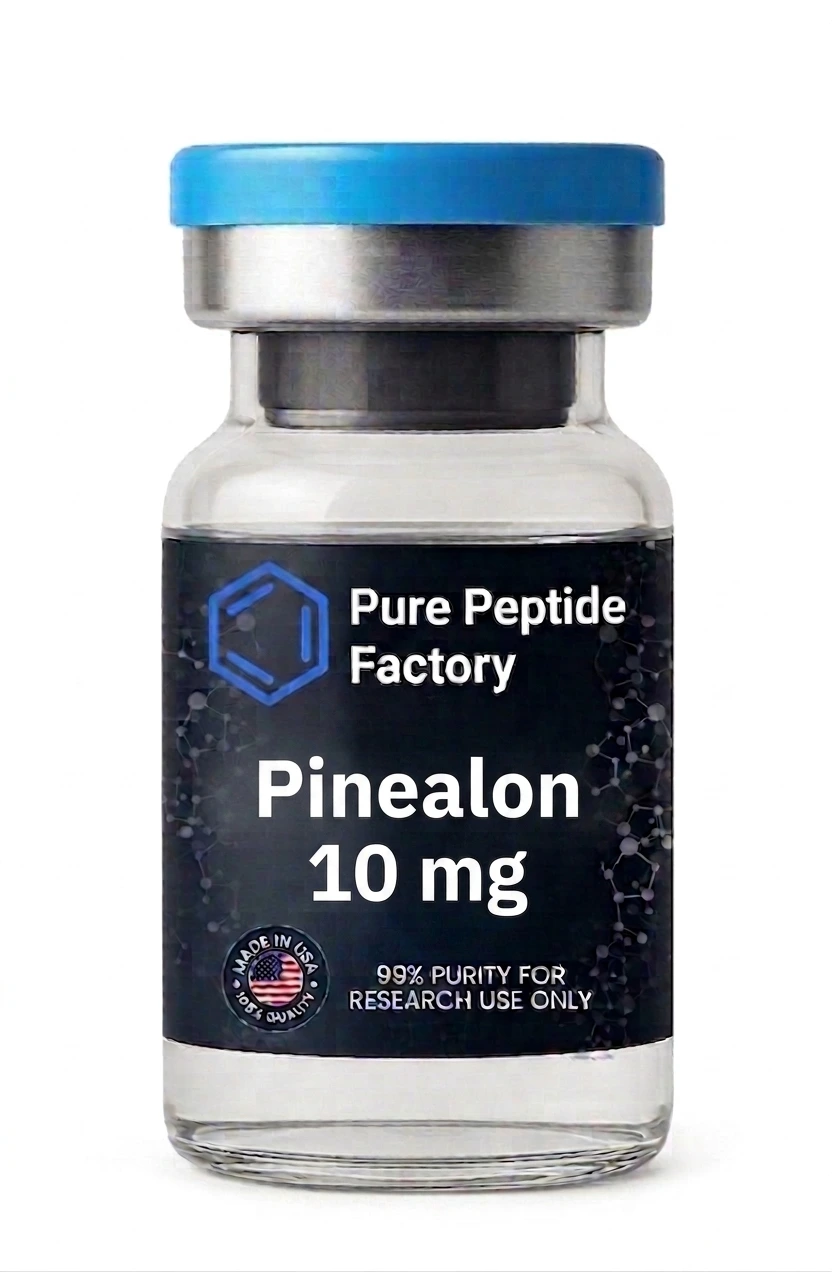
Pinealon 10mg
$130.00
Pinealon peptide for sale at Pure Peptide Factory. This synthetic tripeptide (Glu-Asp-Arg, EDR) was developed by Vladimir Khavinson at the St. Petersburg Institute of Bioregulation and Gerontology. Despite the name, Pinealon was isolated from Cortexin brain cortex extract, not pineal tissue. The compound’s small molecular weight (418.41 g/mol) and PEPT2 transporter affinity give it genuine oral bioavailability, which is rare among peptides. Studied for neuroprotection, cognitive support, and dendritic spine preservation in Alzheimer’s research models. HPLC verified at 98% minimum purity, batch-specific COA. 10mg vials. Research use only.
Pinealon Peptide for Sale: The Khavinson EDR Tripeptide Bioregulator
After Thymalin, Pinealon ranks as the second most-studied peptide in Vladimir Khavinson’s bioregulator research program. The compound is a synthetic tripeptide carrying the sequence Glu-Asp-Arg (EDR), and Khavinson’s team developed it at the St. Petersburg Institute of Bioregulation and Gerontology. However, the name is misleading. Khavinson’s group did not isolate Pinealon from pineal tissue, although researchers often assume so. Instead, they identified it as the active tripeptide fragment of Cortexin, a polypeptide complex extracted from cerebral cortex tissue. This misconception remains one of the most common research-community errors about the compound, and we correct it here.
For researchers studying neuroprotection, cognitive support in aging models, dendritic spine preservation in neurodegenerative protocols, or the broader Khavinson peptide bioregulator framework, Pinealon serves as the CNS-targeted complement to Thymalin (thymic) and Epitalon (pineal/telomerase). When you buy Pinealon for laboratory research, source matters because most vendors mischaracterize the compound’s origin and sequence. Pure Peptide Factory stocks research-grade Pinealon with domestic cold-chain shipping, batch-specific HPLC documentation, and correct compound identity verification.
Why Researchers Buy Pinealon from Pure Peptide Factory
Correct Compound Identity Verification
Several peptide vendors describe Pinealon incorrectly. For example, some call it a “Glu-Asp-Gly” tripeptide, which contains the wrong third residue. Others claim it was “isolated from pineal gland,” which contradicts the actual source tissue. A few even confuse it with Epitalon, although Epitalon is a different tetrapeptide entirely (AEDG). By contrast, we characterize Pinealon correctly as Glu-Asp-Arg (EDR), 418.41 g/mol, derived from Cortexin. Every batch we ship includes a lot-specific HPLC chromatogram and mass spectrometry report verifying the correct molecular weight target.
Domestic Cold-Chain Shipping for a Small Tripeptide
Tripeptides are small molecules with high surface-to-volume ratios. Consequently, they absorb moisture and oxidize more readily than larger peptides. To address this, we ship from domestic cold-storage using phase-change cooling rated for 96-hour protection. As a result, most orders reach your lab within 1 to 3 business days.
10mg Configuration Matching Research Protocol Standards
Our 10mg vial configuration matches the standard research protocol dosing referenced in the Khavinson published literature and most community research protocols. Furthermore, researchers running pineal-thymic axis combination studies with Epitalon and Thymalin work with matched vial configurations under identical handling conditions.
Synthesis Logs Archived for 24 Months
We document and archive every batch. Therefore, if your IRB or compliance office requests chain-of-custody records or synthesis documentation, you can request and receive them on demand.
What Is Pinealon?
A Three-Amino-Acid Peptide with an Unusual Origin Story
Pinealon is a synthetic tripeptide combining L-glutamic acid, L-aspartic acid, and L-arginine in that sequence (EDR by single-letter code). The compound emerged from research on Cortexin, a polypeptide complex extracted from calf cerebral cortex tissue. When Khavinson and colleagues fractionated Cortexin to identify its bioactive components, they isolated EDR as one of the active tripeptides driving the complex’s neuroprotective effects.
Therefore, the “Pinealon” name is historical and somewhat misleading. Khavinson developed the peptide within his broader research program targeting age-related organ decline, and its proposed clinical applications include pineal-axis modulation. However, the source tissue is brain cortex, not pineal gland. Researchers should keep this distinction in mind when designing protocols or interpreting community-published material.
Molecular Profile:
- Sequence: Glu-Asp-Arg (EDR)
- Molecular Formula: C15H26N6O8
- Molecular Weight: 418.41 g/mol
- CAS: 175175-23-2
- Origin: Isolated from Cortexin (cerebral cortex polypeptide complex)
- Synonyms: EDR peptide, Glu-Asp-Arg tripeptide, Khavinson neuroprotective tripeptide
- Developer: Khavinson, Grigoriev, Malinin, and Ryzhak (Israel Patent 194346, 2013)
How Pinealon Works: Three Proposed Mechanisms
Khavinson and colleagues have published extensively on Pinealon’s mechanism. Currently, the evidence supports three converging pathways:
First, antioxidant gene upregulation. In neuronal cell cultures exposed to oxidative stress (hydrogen peroxide, hypoxia models), Pinealon increases expression of antioxidant enzymes including superoxide dismutase 2 (SOD2). Notably, this response appears at nanomolar peptide concentrations, which suggests a high-affinity mechanism rather than non-specific scavenging activity.
Second, dendritic spine preservation. Kraskovskaya and colleagues demonstrated that Pinealon protects dendritic spines in cortical neurons exposed to amyloid-beta synaptotoxicity. Specifically, the 2021 PMC7795577 publication identified DNA binding sites for EDR peptide in the promoter regions of CASP3, NES, GAP43, APOE, SOD2, PPARA, PPARG, and GDX1 genes. Because dendritic spine loss is one of the earliest pathological features of Alzheimer’s disease, Pinealon’s protective effect at this level positions it as a research tool for early-stage neurodegeneration biology.
Third, proposed direct peptide-DNA interaction. The Khavinson laboratory has proposed that ultra-short peptides like Pinealon penetrate cell nuclei and bind directly to specific DNA sequences in gene promoter regions, modulating chromatin structure and transcriptional accessibility. Indeed, molecular modeling work suggests EDR binds hexanucleotide sequences in B-form DNA. However, this mechanism remains debated in Western molecular biology because direct peptide-to-DNA signaling outside the canonical receptor framework is unusual. Therefore, researchers using Pinealon should engage this proposed mechanism with appropriate scientific skepticism while acknowledging that the clinical outcomes remain consistently reproducible.
Why Pinealon Has Genuine Oral Bioavailability
Most peptides degrade in gastric acid and intestinal proteases before reaching systemic circulation. By contrast, Pinealon is one of the rare exceptions. Specifically, the compound’s small molecular weight (~418 Da) and tripeptide structure allow it to use the PEPT2 peptide transporter for active uptake across the intestinal epithelium, similar to how di- and tripeptides from dietary protein digestion enter circulation. Furthermore, the same PEPT2 transporter exists at the blood-brain barrier, which gives Pinealon both oral bioavailability and CNS access.
As a result, oral and capsule administration of Pinealon produces measurable research effects, while equivalent oral protocols for larger peptides like Tirzepatide, Survodutide, and Mazdutide produce minimal effects at standard doses.
Pinealon Research Applications
Neuroprotection in Oxidative Stress Models
The foundational Khavinson et al. (2011) work established Pinealon’s neuroprotective profile in cortical neuron cultures exposed to hydrogen peroxide oxidative stress. At nanomolar concentrations, EDR peptide reduced neuronal death by 20 to 40% compared to untreated controls. Furthermore, the mechanism involved increased expression of antioxidant enzymes alongside reduced reactive oxygen species accumulation and lower necrotic cell counts.
Subsequently, follow-up research extended these findings to in vivo models:
- Mendzheritskii et al. (2014, Advances in Gerontology) examined acute hypoxic hypoxia models and found that Pinealon and Cortexin co-administration regulated cytokine levels and reduced caspase-3 activity in aged rat brain tissue.
- Arutjunyan et al. (2012, Int J Clin Exp Med) studied prenatal hyperhomocysteinemia, demonstrating that maternal Pinealon administration protected rat offspring from cognitive deficits.
- Khavinson’s research on age-related pineal involution showed that Pinealon administration to 24-month-old rats reversed markers of pineal aging, including increased melatonin production and improved pinealocyte morphology.
Alzheimer’s Disease Research
Among recent references, the 2021 publication “EDR Peptide: Possible Mechanism of Gene Expression and Protein Synthesis Regulation Involved in the Pathogenesis of Alzheimer’s Disease” (PMC7795577) ranks as the most important. Specifically, the paper identified gene promoter regions targeted by EDR peptide binding, including CASP3 (apoptosis), NES (nestin neural stem cell marker), GAP43 (axonal growth), APOE (amyloid clearance), SOD2 (oxidative defense), PPARA and PPARG (metabolic regulation), and GDX1.
Building on this, Kraskovskaya and colleagues demonstrated that EDR and KED peptides prevent dendritic spine elimination in 5xFAD mouse models of Alzheimer’s disease. Notably, spine restoration occurred at 400 mcg/kg daily intraperitoneal administration over a 2-month treatment window. Moreover, the effect appeared in both mushroom-shaped mature spines (associated with stable long-term memory) and stubby/thin spines (associated with active synaptic remodeling).
Research applications include:
- 5xFAD mouse model dendritic spine quantification
- Cortical neuron amyloid-beta synaptotoxicity protection
- Hippocampal neurogenesis under oxidative stress
- Comparative protocols with KED peptide and other Khavinson bioregulators
- Behavioral cognitive testing (Morris water maze, novel object recognition) under chronic dosing
Huntington’s Disease Research
In addition, Khavinson et al. (2017, Journal of Neurology and Neuroscience) extended Pinealon research into Huntington’s disease models. EDR peptide preserved striatal neuron viability and reduced markers of neurodegeneration in cell culture models exposed to mutant huntingtin protein. Importantly, the dendritic spine preservation effect from Alzheimer’s models also appeared in Huntington’s tissue. This suggests that Pinealon’s neuroprotective mechanism applies across multiple neurodegeneration types rather than disease-specific pathways.
Cognitive Support and Memory Research
Khavinson and Malinin (2004, Journal of Anti-Aging Medicine) established the cognitive endpoint research framework with their “Spatial memory improvement with Pinealon” publication. In aged animal models, Pinealon administration improved performance on spatial memory tasks including water maze and radial arm maze paradigms. The researchers attributed the effect to neuroprotection of hippocampal neurons critical for spatial encoding.
Research using our compound examines:
- Spatial memory paradigms in aged rodents
- Working memory tasks (delayed response protocols)
- Long-term potentiation (LTP) electrophysiology in hippocampal slices
- BDNF and TrkB expression under Pinealon exposure
Sleep and Circadian Rhythm Research
Although Khavinson did not originally derive Pinealon from pineal tissue, research has examined its effects on melatonin production and circadian biology. Aged rat models show partial restoration of melatonin output following Pinealon administration. Additionally, community research protocols frequently report improved sleep quality, reduced nighttime awakenings, and faster sleep onset with evening dosing, although systematic clinical trial data remains limited.
The proposed mechanism involves indirect support of the pineal-axis through neuronal protection in pineal-projecting circuits and possibly direct effects on AANAT (the rate-limiting enzyme in melatonin synthesis) gene expression.
Pinealon and Glycine: The Khavinson Combination Protocol
A frequently discussed Pinealon research framework involves co-administration with glycine. The combination rests on two complementary mechanisms.
First, Pinealon upregulates antioxidant enzyme expression, preserves dendritic spine integrity, and provides direct neuronal protection through the EDR mechanism described above. Second, glycine functions as an inhibitory neurotransmitter at glycine receptors and as a co-agonist at NMDA glutamate receptors. Furthermore, glycine acts as a metabolic precursor for glutathione synthesis, which complements Pinealon’s antioxidant gene upregulation by supplying substrate for the pathway.
Together, the combined research framework (Khavinson published protocols and community-derived extensions) suggests that Pinealon plus glycine produces enhanced neuroprotection in stress and oxidative challenge models compared to either compound alone. However, researchers examining this combination should isolate the contribution of each compound through control arms before drawing mechanistic conclusions.
We do not provide human dosing recommendations for the combination. The Khavinson published rodent protocol used Pinealon administered alongside glycine over a defined treatment window. When translating this to other species, researchers should account for allometric scaling and the different pharmacokinetic profiles of each compound.
We do not provide human dosing recommendations for the combination. The Khavinson published rodent protocol used Pinealon administered alongside glycine over a defined treatment window. Researchers translating this to other species should account for allometric scaling and the different pharmacokinetic profiles of each compound.
Pinealon Nasal Spray and Oral Administration: Why Both Routes Matter
Most peptide research compounds require injection because oral bioavailability is functionally zero due to gastrointestinal enzymatic degradation. By contrast, Pinealon is one of the few exceptions, which is why both oral and nasal spray administration appear in published research protocols.
Oral administration uses the PEPT2 transporter for active uptake across the intestinal epithelium. Typically, published research protocols and community-derived dosing frameworks call for 10 to 20 mg orally per day in 10 to 20-day cycles. The advantage is patient compliance and dosing convenience. However, bioavailability remains substantially lower than injection routes, and research suggests gastrointestinal degradation reduces absorbed dose despite the PEPT2-mediated uptake.
Intranasal administration bypasses both first-pass metabolism and gastric degradation while delivering compound directly to the CNS through olfactory and trigeminal nerve pathways. Therefore, this is the preferred route for research targeting cerebral effects with minimal peripheral exposure. Some vendors offer nasal spray formulations, which use Pinealon reconstituted in sterile saline at standardized concentrations.
Subcutaneous and intraperitoneal injection routes serve as the standard for rigorous preclinical research where exact dosing matters. Specifically, published rodent protocols commonly use 100 to 400 mcg/kg intraperitoneally for 14 to 60 days depending on endpoint.
Ultimately, the route choice depends on the research question. For CNS-targeted studies, intranasal or injection works best. For systemic effects with patient compliance considerations, oral works. For mechanistic preclinical work, injection.
Pinealon vs Epitalon: Two Khavinson Pineal-Axis Tripeptides
Researchers regularly confuse Pinealon and Epitalon because both are short Khavinson bioregulator peptides associated with pineal-axis research. They are distinct compounds with different mechanisms:
| Feature | Pinealon | Epitalon |
|---|---|---|
| Sequence | Glu-Asp-Arg (EDR) | Ala-Glu-Asp-Gly (AEDG) |
| Length | 3 amino acids | 4 amino acids |
| Molecular Weight | 418.41 g/mol | 390.35 g/mol |
| Source tissue | Cortexin (cerebral cortex) | Pineal gland extract (Epithalamin) |
| Primary target | CNS neurons, dendritic spines | Pineal gland, telomerase |
| Mechanism focus | Antioxidant gene upregulation, neuroprotection | Telomerase activation, circadian regulation |
| Research applications | Alzheimer’s, Huntington’s, cognitive, oxidative stress | Aging, telomere preservation, circadian, anti-tumor |
| Oral bioavailability | Genuine (PEPT2 transporter) | Limited |
In practice, researchers studying pineal-axis aging or neurodegeneration biology often use both compounds in combination protocols. For example, the Khavinson published longevity research framework pairs Epitalon with Thymalin for the major mortality reduction outcomes (4.1x reduction in the 6-year combined protocol). Pinealon enters the framework when CNS-specific effects become the primary endpoint.
Pinealon vs SS-31: Comparing Mitochondrial Approaches to Neuroprotection
Researchers studying neurodegeneration and aging biology compare Pinealon to mitochondria-targeted compounds like SS-31 (elamipretide) for neuroprotection research. Although both produce protective effects in stress models, they operate through fundamentally different mechanisms:
| Feature | Pinealon (EDR) | SS-31 (Elamipretide) |
|---|---|---|
| Type | Tripeptide bioregulator | Synthetic tetrapeptide |
| Origin | Khavinson Cortexin program | Szeto-Schiller series |
| Primary target | Antioxidant gene promoters | Mitochondrial cardiolipin |
| Site of action | Nuclear (proposed peptide-DNA) | Inner mitochondrial membrane |
| Mechanism | Gene expression modulation | Direct mitochondrial protection |
| Oral bioavailability | Genuine via PEPT2 | Limited |
| Clinical status | No Western trials | FDA approved as FORZINITY (2025) for Barth syndrome |
| Best for studying | CNS gene regulation, dendritic spine | Mitochondrial function, sarcopenia, Barth syndrome |
The comparison is not substitutive. Rather, Pinealon and SS-31 answer different research questions. Therefore, researchers running combination protocols sometimes use both compounds to examine layered neuroprotective approaches: Pinealon at the genome/transcription level, SS-31 at the mitochondrial membrane level. We stock both under identical handling protocols for comparative research.
Pinealon Research Protocols and Dosage
Published research protocols and community-derived frameworks provide the dosage reference structure:
| Research Context | Dose | Route | Frequency | Duration |
|---|---|---|---|---|
| Khavinson published clinical (oral) | 20 mg | Oral | Daily | 10-day cycles, every 6 months |
| Cortical neuron cell culture | Nanomolar concentrations | In vitro | Per assay | Acute exposure |
| Rodent neuroprotection (IP) | 100 to 400 mcg/kg | Intraperitoneal | Daily | 14 to 60 days |
| 5xFAD Alzheimer’s mouse | 400 mcg/kg | Intraperitoneal | Daily | 2 months (ages 2 to 4 mo) |
| Aged rat melatonin restoration | Per Khavinson protocol | Subcutaneous or IP | Daily | 10 to 14 days |
| Combination with glycine | Pinealon per protocol + glycine substrate | Per study design | Variable | Per protocol |
| Intranasal CNS research | Per protocol concentration | Intranasal | Variable | Variable |
We do not provide human dosing recommendations. The dosing references above are synthesized from peer-reviewed Khavinson group publications and are provided for laboratory research design context only.
Pinealon Reddit Community Discussions
Reddit and peptide research forum discussions of Pinealon focus on several common research-community questions. Adding context to these helps researchers separate community-derived protocols from peer-reviewed Khavinson research:
- The “isolated from pineal gland” misconception appears constantly in Reddit threads. However, Khavinson’s group isolated Pinealon from Cortexin (brain cortex extract), not pineal tissue. The name refers to proposed pineal-axis modulation in research applications.
- Oral versus injection efficacy is a recurring discussion. Although Pinealon’s PEPT2-mediated oral bioavailability is genuine, injection routes still produce higher systemic exposure for the same dose. Therefore, research protocols requiring quantified systemic levels should use injection.
- Comparison with Semax and Selank appears frequently because all three are nootropic-class research compounds. Specifically, Semax acts on BDNF and TrkB signaling, while Selank modulates GABAergic anxiety pathways. By contrast, Pinealon operates through antioxidant gene upregulation and dendritic spine preservation rather than acute neurotransmitter modulation.
- Cycling protocols in community discussions typically follow the Khavinson published framework: 10 to 20-day courses repeated every 6 months rather than continuous administration. Importantly, this matches the bioregulator model where peptide intervention is intermittent rather than chronic.
- Combination with Epitalon and Thymalin appears in longevity-focused threads. For context, the Khavinson published 6-year longevity study combined Thymalin and Epithalamin (the polypeptide form of Epitalon). Therefore, adding Pinealon to this combination is a community-derived protocol extension rather than a peer-reviewed framework.
We do not provide human protocols. Research protocol design should reference peer-reviewed Khavinson group publications rather than community forum extrapolations.
How to Reconstitute Pinealon
Step-by-Step Laboratory Protocol
- Sanitize the vial stopper with 70% isopropyl alcohol
- Inject bacteriostatic water or sterile saline slowly against the vial wall
- Allow the lyophilized powder to dissolve without agitation for 1 to 2 minutes. Tripeptides dissolve quickly due to their small size
- Gently swirl until the solution is clear. Do not shake
- Inspect for clarity and label with date and concentration before use
Concentration reference:
- 10mg vial + 1mL water = 10mg/mL
- 10mg vial + 2mL water = 5mg/mL
- 10mg vial + 5mL water = 2mg/mL
- 10mg vial + 10mL water = 1mg/mL
- For nanomolar cell culture work, prepare serial dilutions from a concentrated stock
Storage Requirements
- Lyophilized powder: 24 months at -20°C, protected from light and moisture
- Reconstituted solution: 14 days at 2 to 8°C. Do not freeze reconstituted Pinealon
- The small tripeptide structure is stable but moisture-sensitive in lyophilized form. Keep vials sealed and desiccated during storage
- Avoid repeated freeze-thaw cycles on stock solutions
Pinealon Buy: Regulatory and Research Context
Regulatory Status
Pinealon is registered as a pharmaceutical product in Russia within the Khavinson bioregulator framework. It is not FDA approved in the United States, and no Western pharmaceutical registration exists. The Russian registration covers neuroprotective and cognitive support indications, with clinical outcome data published primarily in Russian biomedical journals and increasingly translated to English peer-reviewed publications including the 2021 PMC7795577 Alzheimer’s mechanism paper.
Research Use Only
Research-grade Pinealon is available for laboratory procurement under research-use-only terms without a prescription. This compound is not for human consumption, veterinary use, or diagnostic application. You must agree to research-use-only terms at checkout.
Independent Validation Status
Honest disclosure: Most published Pinealon research originates from a single research group (the Khavinson laboratory at the St. Petersburg Institute of Bioregulation and Gerontology). Independent replication of key findings by Western laboratories is limited. The proposed peptide-DNA direct interaction mechanism remains debated in mainstream molecular biology. Researchers using Pinealon should engage with this evidence base critically. The cellular and behavioral findings are consistently reproducible within the Khavinson research framework, but the proposed mechanism would benefit from independent validation. We provide this transparency because research-grade decisions require accurate assessment of the underlying literature.
Product Specifications
Available Configuration
Pinealon is available in 10mg vials. Select your quantity from the product options above.
Quality Verification
- Purity: 98% minimum (HPLC verified)
- Identity: Mass spectrometry confirmed against the 418.41 g/mol target with EDR sequence verification
- Endotoxin: Less than 0.1 EU/mL
- Sterility: Verified per USP 71
- Form: Lyophilized powder
- Storage: -20°C long-term, 2 to 8°C short-term after reconstitution
Current Batch: #PPF-PNL-0426 Purity: 98.8% Download: HPLC Certificate | MS Report
FAQ
What is Pinealon used for in research?
Pinealon is used in neuroprotection research, Alzheimer’s and Huntington’s disease models, dendritic spine preservation studies, oxidative stress neuronal cultures, cognitive support in aged animal models, sleep and circadian rhythm research, and combination protocols within the Khavinson bioregulator framework alongside Epitalon and Thymalin.
Where can I buy Pinealon for research?
Pure Peptide Factory stocks research-grade Pinealon in 10mg vials with batch-specific HPLC and mass spectrometry documentation. Domestic cold-chain shipping delivers most orders within 1 to 3 business days.
Is Pinealon really from the pineal gland?
No. Despite the name, Pinealon was isolated from Cortexin, a polypeptide complex extracted from cerebral cortex tissue. The compound’s name refers to its proposed pineal-axis modulation in research applications, not its source tissue. Most peptide vendors get this wrong in their product listings.
How is Pinealon different from Epitalon?
Pinealon (Glu-Asp-Arg, EDR) is a 3-amino-acid neuroprotective tripeptide derived from cerebral cortex. Epitalon (Ala-Glu-Asp-Gly, AEDG) is a 4-amino-acid pineal-derived tetrapeptide associated with telomerase activation and circadian regulation. They are distinct compounds with different mechanisms despite both being Khavinson bioregulators with pineal-axis applications.
Can Pinealon be taken orally?
Yes, Pinealon is one of the few peptides with genuine oral bioavailability due to its small molecular weight (418 Da) and PEPT2 peptide transporter affinity at the intestinal epithelium. Oral and capsule administration produces measurable research effects in published protocols, though injection routes still produce higher systemic exposure for the same dose.
What is the Pinealon and glycine combination?
A research framework combining Pinealon with glycine for enhanced neuroprotective effects. Glycine functions as an inhibitory neurotransmitter, an NMDA receptor co-agonist, and a glutathione synthesis precursor. The combination targets neuroprotection at multiple complementary levels. Research protocols examining this combination should include control arms for each compound individually before drawing mechanistic conclusions.
How does Pinealon work mechanistically?
Pinealon upregulates antioxidant enzyme gene expression (including SOD2), preserves dendritic spine integrity in neurons exposed to amyloid-beta synaptotoxicity, and is proposed to interact directly with DNA promoter regions of genes including CASP3, NES, GAP43, APOE, SOD2, PPARA, PPARG, and GDX1. The proposed direct peptide-DNA mechanism remains debated outside the Khavinson research group.
Is Pinealon FDA approved?
No. Pinealon is registered as a pharmaceutical product in Russia within the Khavinson bioregulator framework but is not FDA approved in the United States. Research-grade Pinealon is available for laboratory procurement under research-use-only provisions.
What are Pinealon’s documented side effects?
Published Khavinson research and community protocols document a benign safety profile across short-course and intermittent dosing. Side effects reported in research literature are limited and typically not statistically distinguishable from placebo. Long-term continuous administration has not been systematically studied. As a research compound, appropriate institutional oversight and monitoring apply to any in vivo work.
How should Pinealon be stored?
Lyophilized powder stores at -20°C for up to 24 months, protected from light and moisture. The small tripeptide structure is moisture-sensitive in lyophilized form, so vials should remain sealed and desiccated. Reconstituted solution stores at 2 to 8°C for up to 14 days. Do not freeze reconstituted solution.
Order Pinealon for Research
Secure Checkout
- Credit card, cryptocurrency, or wire transfer
- Same-day dispatch for orders placed before 2 PM EST
- Cold-chain packaging with phase-change cooling
- Discreet labeling with full tracking
Institutional Accounts
Net-30 terms and purchase order acceptance available for universities and pharmaceutical companies. Contact us for bulk pricing on 50 vials or more, including matched bulk orders for Pinealon, Epitalon, and Thymalin for combined Khavinson bioregulator research protocols.
Add to cart and get research-grade Pinealon delivered with the documentation your neuroprotection or Khavinson protocol research requires.
Related products
-
Thymalin 10 mg
$50.00 -
Crystagen 20 mg
$100.00 -
Humanin 10 mg
Original price was: $147.00.$100.00Current price is: $100.00.