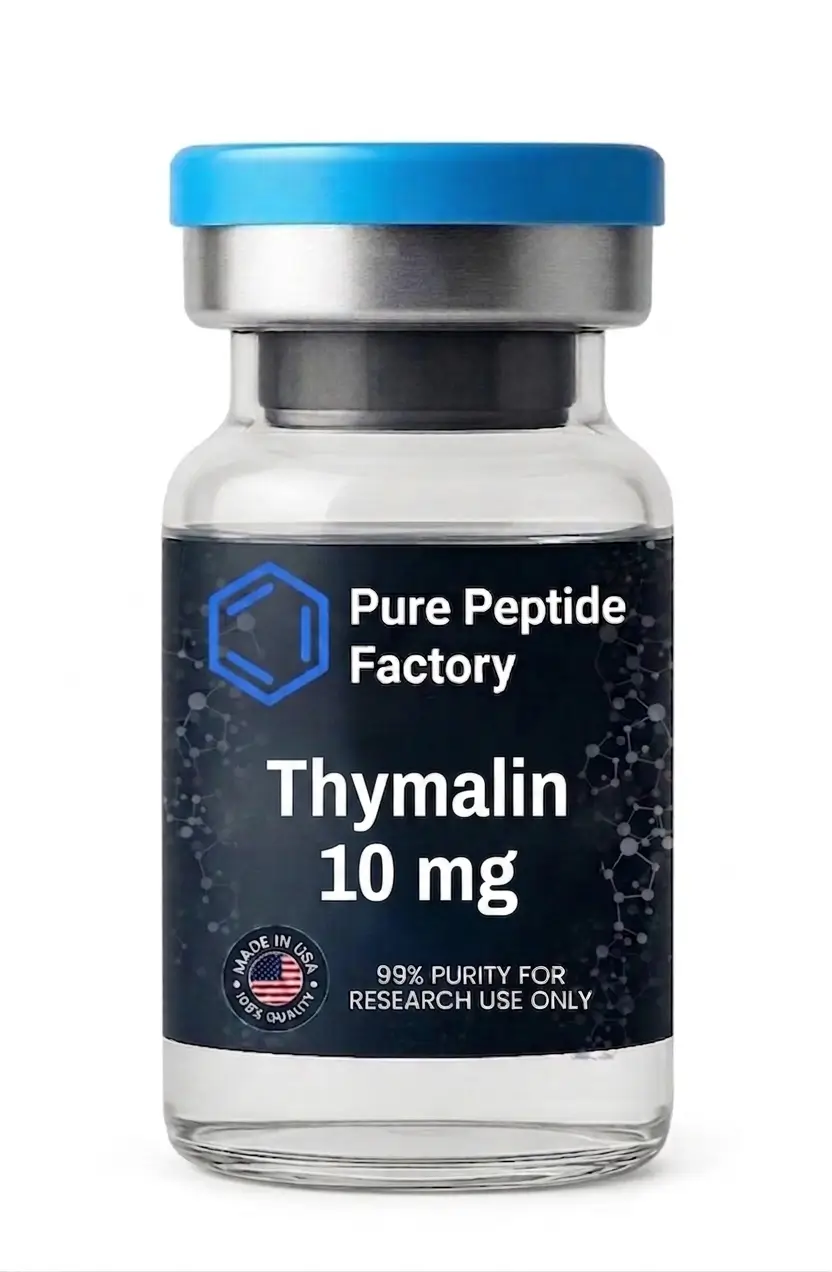
Thymalin 10 mg
$50.00
Thymalin for sale at Pure Peptide Factory. This thymic polypeptide bioregulator, developed by Vladimir Khavinson and Vyacheslav Morozov in 1981 at the St. Petersburg Institute of Bioregulation and Gerontology, has more than four decades of Russian clinical research behind it. The 6-year Khavinson-Morozov longevity trial documented 4.1x reduced mortality in elderly subjects receiving annual Thymalin plus Epithalamin courses. Research-grade Thymalin, HPLC verified, batch-specific COA. 10mg vials. Research use only.
Thymalin for Sale: Khavinson’s Thymic Polypeptide Bioregulator with 40+ Years of Clinical Research
Thymalin for sale at Pure Peptide Factory is research-grade stock backed by more than four decades of published clinical data. Developed in 1981 by Vladimir Khavinson and Vyacheslav Morozov at the St. Petersburg Institute of Bioregulation and Gerontology, Thymalin was registered as a pharmaceutical product in the Soviet Union in 1982. As a result, researchers working with this compound today have access to a depth of clinical outcome data that Western-origin peptides rarely match. The landmark Khavinson-Morozov 6-year longevity study documented a 4.1-fold reduction in mortality in subjects receiving annual Thymalin plus Epithalamin combination courses, making it one of the most extensively validated compounds in the Khavinson bioregulator program.
Western peptide research rarely matches that timescale or depth of clinical follow-up. For researchers studying immunosenescence, thymic involution, the peptide bioregulator hypothesis, or the Khavinson longevity protocols that have gained traction in Western gerontology, Thymalin anchors the entire research tradition.
Pure Peptide Factory stocks Thymalin peptide for sale with domestic cold-chain shipping and batch-specific HPLC documentation. If you are sourcing Thymalin from a supplier that understands what this compound actually is — a polypeptide complex, not a single peptide — this is it.
Why Researchers Buy Thymalin for sale: Correct Characterization
Correct Characterization of a Polypeptide Complex
Most peptide vendors mislabel Thymalin as a “9-amino-acid peptide” or a “32-amino-acid polypeptide hormone.” Neither is accurate. Thymalin is a heterogeneous polypeptide complex isolated from calf thymus, containing short peptides of 2 to 8 amino acids in the 1,000 to 10,000 Da molecular weight range. The primary active component has been identified as the dipeptide Glu-Trp, also sold separately as Thymogen, though additional dipeptides including Lys-Glu (Vilon) and EDP (Crystagen) contribute to the complex’s overall activity. Every batch we ship includes analytical documentation confirming polypeptide complex composition. We characterize our product correctly.
Cold-Chain Shipping on Every Thymalin for Sale Order
Polypeptide complexes are more sensitive to temperature excursions than single-sequence peptides because thermal stress can differentially affect individual components. We ship from domestic cold-storage using phase-change cooling rated for 96-hour protection. Most orders arrive within 1 to 3 business days. Researchers who buy Thymalin from us receive the compound in the same condition it left our cold storage.
10mg Vials Matching the Khavinson Protocol
Our 10mg vial configuration matches the standard Khavinson research protocol dosing reported in published Russian clinical literature — 10mg IM daily for 10 days, repeated every 6 months, often combined with 10mg Epitalon. Researchers following published Khavinson protocols work with a vial size that maps directly to the source material.
Thymalin for Sale: Synthesis Logs Archived 24 Months
Every batch is documented and archived. If your IRB or compliance office requires chain-of-custody records or synthesis documentation, they are available on request.
What Is Thymalin?
The First Peptide Bioregulator
Thymalin was the first compound developed through the Khavinson peptide bioregulation program, a Soviet and subsequently Russian research initiative examining whether short tissue-specific peptides could restore function to aging organs by modulating gene expression. The program was founded at the Military Medical Academy in Saint Petersburg and continues today at the St. Petersburg Institute of Bioregulation and Gerontology.
The peptide bioregulator hypothesis proposes that low-molecular-weight peptides (2 to 10 amino acids) extracted from young animal tissues contain the signaling information necessary to restore function in the corresponding aged organ. Thymalin is the thymus-targeted bioregulator. Epitalon (pineal), Cortagen (adrenal cortex), Pinealon (CNS), and several others complete the Khavinson family. Thymalin is the prototype that established the entire research program.
Molecular Profile:
- Type: Polypeptide complex extracted from calf thymus
- Primary active component: Glu-Trp dipeptide (also sold as Thymogen)
- Secondary components: Lys-Glu (Vilon), EDP (Crystagen), and other 2 to 8 amino acid peptides
- Molecular weight range: 1,000 to 10,000 Da (heterogeneous)
- Source: Low-molecular-weight peptides from calf thymus tissue
- Synonyms: Thymalin, thymic polypeptide bioregulator, Khavinson thymic peptide complex
- Developed by: Morozov and Khavinson, 1981
How Thymalin Works: The Bioregulator Mechanism
The Khavinson group proposed that short peptides modulate gene expression by binding directly to DNA sequences and histone proteins in target tissues. This direct peptide-DNA interaction hypothesis remains contested in Western molecular biology, where standard peptide signaling is understood to operate through cell-surface receptors rather than direct nuclear interactions. However, the clinical outcomes documented across 40+ years of Russian studies are consistent, even where the proposed mechanism is debated.
What the published research consistently shows:
Thymic function restoration. Thymalin promotes differentiation of hematopoietic stem cells into T-lymphocytes, particularly in aged animals where thymic output has declined. Research indicates normalization of CD4/CD8 ratios and restoration of T-cell subpopulation balance.
Cytokine modulation. Thymalin upregulates IL-2 and IFN-gamma production while moderating IL-6, IL-8, and other inflammatory mediators. This dual effect — enhancing adaptive immunity while tempering chronic inflammation — is central to its geroprotective research applications.
Gene expression effects. In vitro studies from the Khavinson group demonstrate that Thymalin and its component dipeptides alter gene expression patterns in cultured thymic cells and lymphocytes, specifically in pathways governing T-cell differentiation, apoptosis regulation, and cellular aging markers.
Pineal-thymic axis coordination. Research examining Thymalin combined with Epitalon shows synergistic effects exceeding either peptide alone. This supports the hypothesis that the pineal and thymus glands operate in coordinated neuroendocrine-immune signaling, and that age-related decline in both produces compound effects that benefit from combination intervention.
Thymalin Research Applications
Immunosenescence and Thymic Involution Research
The thymus begins involuting at puberty and progressively loses functional tissue through adulthood. By age 50 to 70, thymic tissue is largely replaced by adipose, and naive T-cell output drops substantially. This age-related thymic decline is considered a central driver of immunosenescence, which correlates with increased infection susceptibility, reduced vaccine response, and elevated cancer incidence in aging populations.
Consequently, Thymalin research protocols examine whether exogenous thymic peptide administration can restore aspects of thymic function in aged animal models and human subjects. Published Russian studies report improved T-cell counts, restored CD4/CD8 ratios, enhanced natural killer cell activity, and improved immune competence across functional assays including delayed-type hypersensitivity and vaccine response. Researchers sourcing Thymalin peptide for sale for immunosenescence work should confirm that supplier documentation covers the full polypeptide complex range, not a single isolated component.
The Khavinson-Morozov 6-Year Longevity Study
The landmark clinical trial in the Khavinson program followed elderly subjects receiving annual Thymalin and Epithalamin (pineal polypeptide) courses for 6 years, conducted at the St. Petersburg Institute of Bioregulation and Gerontology and published by Khavinson and Morozov in 2003.
| Treatment group | Mortality reduction vs controls |
|---|---|
| Thymalin alone (annual courses) | 1.5 to 1.7x lower |
| Epithalamin alone (annual courses) | 1.6 to 1.8x lower |
| Combined Thymalin plus Epithalamin (annual) | 2.5x lower |
| Combined annually for 6 years | 4.1x lower |
The 6-year combined group outcome remains one of the largest mortality reductions documented for any peptide intervention in published literature. For researchers studying geroprotection, integrated pineal-thymic axis biology, or the translational potential of the Khavinson bioregulator framework, this study is the primary reference point.
The 2021 Aging and Disease COVID-19 Study (PMC8365293)
During the COVID-19 pandemic, the Khavinson group published a clinical study in Aging and Disease (PMC8365293) examining Thymalin as adjunctive therapy in severe COVID-19. Combined with standard care, Thymalin accelerated clinical recovery, reduced lymphopenia, and normalized inflammatory markers including C-reactive protein and D-dimer. Hospital mortality in elderly subjects was reportedly halved in the Thymalin group. The findings extended the immunosenescence research rationale directly into acute viral infection in aged populations, where baseline thymic function correlates with outcomes.
HHV-1 and Viral Immunity Research
A 50-subject clinical study examined thymic peptide administration in subjects with HHV-1 reactivation. Over 2 months of treatment, CD4+ and CD8+ T-cell populations normalized, cytokine profiles shifted toward Th1-mediated antiviral response, and no HHV-1 reactivation occurred in the treatment group during the study period. This supports research applications examining Thymalin’s role in latent viral control where T-cell immunity is the primary defense mechanism.
Neuroendocrine-Immune Axis Research
Thymalin research extends beyond pure immunology into the neuroendocrine-immune axis. The compound modulates hypothalamic-pituitary-adrenal signaling through effects on corticotropin-releasing hormone (CRH), adrenocorticotropic hormone (ACTH), and cortisol regulation. Research applications include stress-induced immunosuppression models, cortisol response studies, and protocols examining how peripheral thymic signaling feeds back to central endocrine regulation.
Thymalin vs Thymosin Alpha-1: Understanding the Difference
Researchers regularly confuse these two thymic peptides. They are not the same compound and operate through different mechanisms.
| Feature | Thymalin | Thymosin Alpha-1 |
|---|---|---|
| Type | Polypeptide complex from calf thymus | Single defined 28-amino-acid peptide |
| Structure | Heterogeneous mixture, 2 to 8 aa peptides | Acetylated N-terminus, defined sequence |
| Molecular weight | 1,000 to 10,000 Da range | 3,108 Da (fixed) |
| Primary active component | Glu-Trp dipeptide (Thymogen) | Entire 28-aa peptide |
| Development origin | Khavinson and Morozov, USSR 1981 | Goldstein, US late 1970s |
| Mechanism hypothesis | Gene expression via peptide-DNA interaction | TLR9 activation, T-cell maturation |
| Regulatory status | Russian pharmaceutical registration | FDA IND for hepatitis B/C; approved in 35+ countries |
| Research advantage | 40+ years Russian clinical data, Khavinson protocols | Western clinical trial data, defined pharmacology |
Researchers working within the Khavinson bioregulator framework reach for Thymalin. Researchers focused on TLR9-mediated immunology, hepatitis, or Western clinical trial data reach for Thymosin Alpha-1. Both are legitimate thymic peptide research compounds. Nevertheless, they answer different research questions and should not be treated as substitutes.
Thymalin vs Thymulin
A third frequently confused compound is Thymulin — a single zinc-dependent nonapeptide of approximately 858 Da secreted by thymic epithelial cells in vivo. It requires zinc binding to achieve biological activity. Thymalin is a polypeptide complex with no documented zinc dependence. Thymulin and Thymalin are distinct compounds despite the similar names. Some Western peptide suppliers conflate them in product descriptions. We do not.
Epitalon and Thymalin Combination: The Pineal-Thymic Stack
The combination of Epitalon (pineal bioregulator) and Thymalin (thymic bioregulator) is the defining protocol of the Khavinson longevity program. The hypothesis is that coordinated restoration of pineal and thymic function produces synergistic effects on neuroendocrine-immune axis function and overall geroprotection — which the 6-year study data supports conclusively, with the combined group showing 4.1x mortality reduction versus either compound alone.
Published combination protocol (Khavinson standard):
- 10mg Thymalin IM daily for 10 days
- 10mg Epitalon IM daily for 10 days (concurrent or sequential)
- Repeat the combined course every 6 months
- Continue annually for multi-year protocols
This is the most common reason researchers buy Thymalin alongside Epitalon in matched quantities. For this reason, researchers running pineal-thymic axis protocols typically source both peptides from the same supplier to control for batch variability. We stock both under identical cold-storage protocols. Contact us for bulk combination pricing on the epithalon and thymalin bulk sale — if your protocol requires both peptides in matched quantities, we can accommodate that.
Thymalin Reddit and Protocol Community Discussions
Reddit and peptide protocol forums reference Thymalin in several common contexts. The Ben Greenfield longevity protocol popularized the Khavinson approach to English-speaking audiences, driving recent interest in Thymalin and Epitalon among researchers who would not otherwise have encountered the Russian literature. Community questions typically involve:
- Whether the polypeptide complex can be substituted by the pure Glu-Trp dipeptide (Thymogen) — research literature suggests the complex produces broader effects than the isolated dipeptide, though Thymogen alone retains significant activity.
- Combination timing with Epitalon — published protocols use sequential or concurrent administration. No systematic research has directly compared them head to head.
- The autoimmune contraindication question — because Thymalin enhances T-cell function, theoretical concerns exist about use in autoimmune research models where T-cell upregulation could worsen disease. Valid research design consideration.
- Long-term research protocol design — the Khavinson data supports annual courses rather than continuous administration. Continuous exposure research has not been systematically studied.
We do not provide human dosing recommendations. The published Khavinson protocol represents a research reference framework, not a human use recommendation.
Thymalin for Sale: Research Protocol Dosage Reference
Published Khavinson research provides the framework for protocol design. Researchers sourcing Thymalin for sale should note that the 10mg vial configuration maps directly to these published doses without requiring reconstitution calculations.
| Research context | Dose | Route | Frequency |
|---|---|---|---|
| Khavinson longevity protocol | 10mg | IM | Daily x 10 days, every 6 months |
| Combined with Epitalon (standard) | 10mg each | IM | Daily x 10 days, every 6 months |
| COVID-19 study (PMC8365293) | 10mg | IM | Daily x 5 days |
| HHV-1 viral immunity study | Variable thymic peptide | IM | 2-month course |
| Geriatric immune research | 10mg | IM | Daily x 10 days, annual course |
| Preclinical rodent studies | Scaled by body weight | SC or IM | Per protocol |
We do not provide human dosing recommendations. The references above are synthesized from peer-reviewed Khavinson group publications and are provided for research protocol design context only. Thymalin for sale at Pure Peptide Factory is strictly for laboratory use.
How to Reconstitute Thymalin
Step-by-Step Laboratory Protocol
- Sanitize the vial stopper with 70% isopropyl alcohol.
- Inject bacteriostatic water slowly against the vial wall. Do not aim directly at the lyophilized powder.
- Allow the complex to dissolve without agitation for 3 to 5 minutes. Polypeptide complexes dissolve more slowly than single-sequence peptides.
- Gently swirl until the solution is clear. Do not shake.
- Inspect for clarity and label with date and concentration before use.
Concentration reference:
- 10mg vial + 1mL water = 10mg/mL
- 10mg vial + 2mL water = 5mg/mL
- 10mg vial + 5mL water = 2mg/mL
Thymalin for sale: Storage Requirements
- Lyophilized powder: 24 months at -20°C, protected from light
- Reconstituted solution: 7 to 14 days at 2 to 8°C. Do not freeze reconstituted Thymalin.
- Polypeptide complexes are more sensitive to temperature cycling than single-sequence peptides. Minimize freeze-thaw cycles to maintain research reproducibility.
Regulatory Context
Thymalin is registered as a pharmaceutical product in Russia, where it has been used clinically under the Khavinson framework since 1982. It is not FDA approved in the United States. Research-grade Thymalin is legally available for laboratory procurement under research-use-only terms without a prescription. You must agree to research-use-only terms at checkout. This compound is not for human consumption, veterinary use, or diagnostic application.
Product Specifications
Thymalin is available in 10mg vials. Select your quantity from the product options above.
Thymalin for Sale: Quality Verification
- Purity: 98% minimum component purity (HPLC verified)
- Composition: Polypeptide complex characterized across the 1,000 to 10,000 Da range
- Primary component: Glu-Trp dipeptide presence confirmed
- Endotoxin: Less than 0.1 EU/mL
- Sterility: Verified per USP 71
- Form: Lyophilized polypeptide complex
- Storage: -20°C long-term, 2 to 8°C short-term after reconstitution
Current Batch: #PPF-THY-0426 | Purity: 98.6% | Download: HPLC Certificate | MS Report
Thymalin for Sale: Frequently Asked Questions
What is Thymalin used for in research?
Thymalin is used in immunosenescence and thymic involution research, geroprotection studies examining longevity outcomes, neuroendocrine-immune axis protocols, adjunctive infection research (HHV-1, COVID-19 models), T-cell differentiation studies, and combination bioregulator research with Epitalon and other Khavinson peptides.
Where can I buy Thymalin for sale for research?
Thymalin for sale at Pure Peptide Factory ships in 10mg research-grade vials with batch-specific HPLC documentation. Domestic cold-chain shipping delivers most orders within 1 to 3 business days. Institutional accounts with net-30 terms are available for universities and pharmaceutical companies.
What is thymalin for sale, exactly?
Thymalin is a polypeptide complex extracted from calf thymus, containing short peptides of 2 to 8 amino acids in the 1,000 to 10,000 Da molecular weight range. The primary active component is the dipeptide Glu-Trp. Thymalin is not a single defined peptide — which distinguishes it from Thymosin Alpha-1 and Thymulin. Most vendors mislabel it. We characterize it correctly.
What is the difference between Thymalin and Thymosin Alpha-1?
Thymalin is a polypeptide complex from calf thymus. Thymosin Alpha-1 is a single 28-amino-acid peptide with FDA IND status approved in 35+ countries for hepatitis research. They operate through different mechanisms and are not substitutes. Researchers working within the Khavinson framework buy Thymalin; researchers focused on TLR9-mediated immunology use Thymosin Alpha-1.
What is the difference between Thymalin and Thymulin?
Thymulin is a zinc-dependent nonapeptide of approximately 858 Da that requires zinc binding for activity. Thymalin is a polypeptide complex of 1,000 to 10,000 Da with no zinc dependence. The names are similar but the compounds are entirely distinct.
What is the Khavinson Thymalin and Epitalon protocol?
The published Khavinson research protocol uses 10mg Thymalin IM daily for 10 days combined with 10mg Epitalon IM daily for 10 days, repeated every 6 months. The 6-year longitudinal study showed 4.1x mortality reduction in the combined group versus age-matched controls. This is a research reference framework only.
What does the 2021 Thymalin COVID-19 study show?
The 2021 Aging and Disease publication (PMC8365293) examined Thymalin as adjunctive therapy in severe COVID-19. Combined with standard care, it accelerated clinical recovery, reduced lymphopenia, normalized C-reactive protein and D-dimer levels, and reportedly halved hospital mortality in elderly subjects.
How does Thymalin work?
The Khavinson bioregulator hypothesis proposes that Thymalin’s short peptide components bind directly to DNA sequences and histone proteins in target tissues, modulating gene expression. Documented effects include normalized T-cell subpopulations, cytokine modulation (enhanced IL-2 and IFN-gamma, reduced IL-6 and IL-8), and improved thymic output in aged animals. The proposed mechanism remains debated in Western molecular biology; the clinical outcomes are consistently documented.
Is thymalin for sale FDA approved?
No. Thymalin is registered as a pharmaceutical product in Russia but not FDA approved in the United States. Research-grade Thymalin for sale through Pure Peptide Factory is available for laboratory procurement under research-use-only provisions.
How should Thymalin be stored?
Lyophilized powder stores at -20°C for up to 24 months protected from light. Reconstituted solution stores at 2 to 8°C for 7 to 14 days. Do not freeze reconstituted solution. Minimize freeze-thaw cycles for best research reproducibility.
Buy Thymalin for Sale: Ordering and Shipping
Pure Peptide Factory has Thymalin for sale in stock with same-day dispatch on orders placed before 2 PM EST. Every order ships with cold-chain packaging and full tracking.
Secure Checkout
- Credit card, cryptocurrency, or wire transfer
- Same-day dispatch for orders placed before 2 PM EST
- Cold-chain packaging with phase-change cooling
- Discreet labeling with full tracking
Institutional Accounts
Net-30 terms and purchase order acceptance available for universities and pharmaceutical companies. Contact us for bulk pricing on 50 vials or more, including combination Thymalin plus Epitalon bulk orders for pineal-thymic axis research protocols. Researchers who regularly buy Thymalin in quantity can request a standing account with priority dispatch.
Add to cart and get research-grade Thymalin delivered with the HPLC documentation your immunosenescence or Khavinson protocol research requires. Browse our full Khavinson peptide range including Epitalon, Pinealon, and Cortagen if you are building a complete bioregulator research stack.
Related products
-
Pinealon 10mg
$130.00