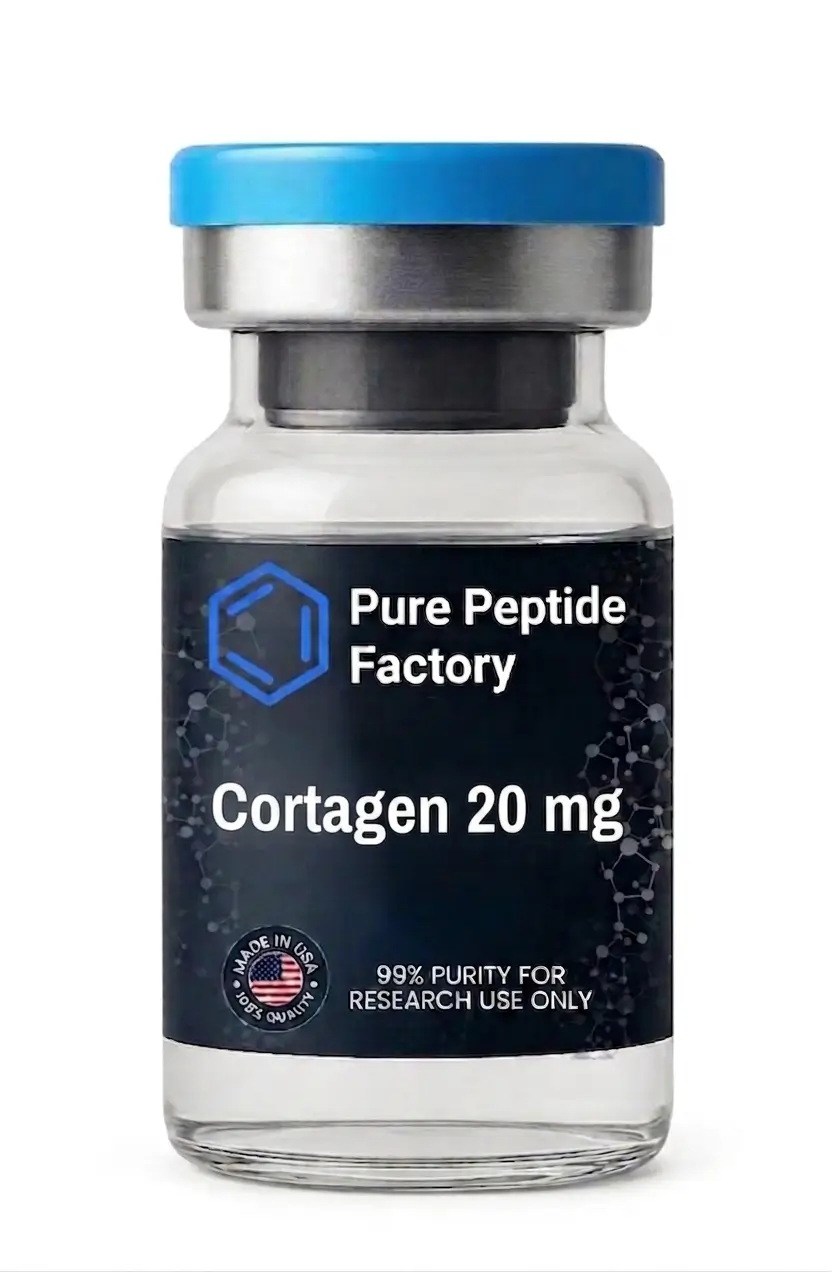
Cortagen 20 mg
$80.00
Cortagen peptide for sale at Pure Peptide Factory in research-grade 20mg vials. Specifically, cortagen peptide is a synthetic tetrapeptide with the sequence Ala-Glu-Asp-Pro (AEDP) developed by Vladimir Khavinson at the St. Petersburg Institute of Bioregulation and Gerontology. Khavinson’s team isolated the compound from Cortexin, the cerebral cortex polypeptide preparation that also produced Pinealon (EDR). Furthermore, the Anisimov 2004 microarray study identified 53 genes upregulated and 16 downregulated by cortagen in mouse heart tissue. HPLC verified at 98% minimum purity, batch-specific COA. 20mg vials. Research use only.
Cortagen Peptide for Sale: The Khavinson AEDP Tetrapeptide Cerebral Cortex Bioregulator
Cortagen peptide is the third major synthetic bioregulator developed by Vladimir Khavinson and colleagues at the St. Petersburg Institute of Bioregulation and Gerontology. Specifically, the compound is a 4-amino-acid synthetic peptide (Ala-Glu-Asp-Pro, AEDP) isolated through directed amino acid synthesis from Cortexin, the cerebral cortex polypeptide preparation that also produced Pinealon (Glu-Asp-Arg, EDR). Furthermore, the Anisimov, Khavinson, and Anisimov 2004 microarray study published in Neuro Endocrinology Letters documented that cortagen peptide modulates expression of 69 genes (53 upregulated, 16 downregulated) in mouse heart tissue, providing the most comprehensive gene-level mechanism profile for any short Khavinson peptide.
For researchers studying short peptide bioregulators, chromatin remodeling and aged heterochromatin decondensation, peripheral nerve regeneration, sciatic nerve repair models, IL-2 cytokine signaling, or the broader Khavinson bioregulator framework, cortagen peptide is the cerebral cortex-targeted compound that complements Pinealon (CNS broadly) and Thymalin (thymic) in your research catalog. Pure Peptide Factory stocks research-grade cortagen peptide in 20mg vials with domestic cold-chain shipping and batch-specific HPLC documentation. When researchers buy cortagen peptide for laboratory work, the AEDP sequence with C-terminal proline modification requires synthesis verification that matches the published Khavinson research framework.
Why Researchers Buy Cortagen Peptide from Pure Peptide Factory
Documentation for an Ultra-Short Khavinson Tetrapeptide
Cortagen peptide is a 4-amino-acid synthetic peptide with critical structural features. Specifically, the C-terminal proline residue confers modest resistance to carboxypeptidases compared to peptides ending in other amino acids, and the AEDP sequence determines selective DNA binding at AACC promoter motifs identified through Khavinson laboratory research. Therefore, every batch we ship includes a lot-specific HPLC chromatogram and mass spectrometry report verifying the 430.4 g/mol molecular weight target with sequence integrity confirmation. The Certificate of Analysis is downloadable before your compound ships.
Domestic Cold-Chain Shipping for Reproducible Research
Tetrapeptides like cortagen are small molecules with high surface-to-volume ratios, which makes them more susceptible to moisture absorption than larger peptides. Furthermore, our customers ordering cortagen peptide typically pair it with bacteriostatic water for reconstitution. We ship from domestic cold-storage using phase-change cooling rated for 96-hour protection. Consequently, most orders reach your lab within 1 to 3 business days.
20mg Configuration Matching Research Protocol Standards
Our 20mg vial configuration matches the standard research protocol dosing referenced in the Khavinson published literature and most community research protocols. Furthermore, researchers running combined Khavinson bioregulator studies with Pinealon and Thymalin work with matched vial configurations under identical handling conditions.
Synthesis Logs Archived for 24 Months
We document and archive every batch. Therefore, if your IRB or compliance office requests chain-of-custody records or synthesis documentation, we can provide them on demand.
What Is Cortagen Peptide?
The Cerebral Cortex-Derived AEDP Tetrapeptide
Cortagen peptide is a synthetic tetrapeptide combining L-alanine, L-glutamic acid, L-aspartic acid, and L-proline in that sequence (AEDP by single-letter code). Specifically, the compound emerged from research on Cortexin, a polypeptide complex extracted from cerebral cortex tissue. When Khavinson and colleagues fractionated Cortexin to identify its bioactive components through directed amino acid synthesis, AEDP was identified as one of the active tetrapeptides driving the complex’s neuroprotective effects.
By contrast, Pinealon (EDR, Glu-Asp-Arg) was identified through peptide fractionation of the same Cortexin preparation. Therefore, cortagen and Pinealon are sister compounds derived from the same source tissue using different isolation strategies. Furthermore, both target cerebral cortex biology but with distinct receptor and gene expression profiles.
Molecular Profile of Cortagen Peptide:
- Sequence: Ala-Glu-Asp-Pro (AEDP)
- Single-letter sequence: AEDP
- Molecular Formula: C17H26N4O9
- Molecular Weight: 430.4 g/mol
- CAS: 218938-58-2
- Origin: Isolated from Cortexin (cerebral cortex polypeptide complex) via directed synthesis
- Synonyms: AEDP tetrapeptide, Ala-Glu-Asp-Pro, SCHEMBL5491754
- Developer: Vladimir Khavinson, St. Petersburg Institute of Bioregulation and Gerontology
- Discovery framework: Khavinson bioregulator program (40+ years of research)
How Cortagen Peptide Works: Three Documented Mechanisms
The Khavinson laboratory has published extensively on cortagen peptide’s mechanism. Currently, the evidence supports three converging pathways:
First, gene expression modulation. The Anisimov, Khavinson, and Anisimov 2004 microarray study (Neuro Endocrinology Letters, 25(1-2):87-93) documented that cortagen peptide modulates expression of 69 genes in mouse heart tissue (53 upregulated, 16 downregulated). Specifically, the gene targets include those involved in inflammatory signaling, oxidative stress response, and tissue regeneration. Furthermore, the gene expression changes occurred at low peptide concentrations consistent with high-affinity nuclear binding rather than non-specific cellular effects.
Second, DNA binding at AACC sequence motifs. Khavinson research identified AACC as the preferred DNA-binding motif for cortagen peptide. Specifically, the tetrapeptide penetrates cell nuclei and binds directly to specific DNA hexanucleotide sequences in gene promoter regions, modulating chromatin structure and transcriptional accessibility. By contrast, this mechanism diverges from canonical receptor-mediated signaling, where larger peptides bind cell surface receptors and trigger secondary messenger cascades. As a result, cortagen peptide produces effects through epigenetic-like nuclear interactions rather than receptor pharmacology.
Third, chromatin remodeling and aged heterochromatin decondensation. The Lezhava et al. 2015 paper “Epigenetic Regulation of Aged Heterochromatin by Peptide Bioregulator Cortagen” (International Journal of Peptide Research and Therapeutics, 21(1):157-163) demonstrated that cortagen peptide can decondense heterochromatin in aged lymphocyte cells, restoring gene expression patterns more characteristic of younger cells. Therefore, the compound has emerged as a research tool for studying the reversibility of age-related chromatin compaction.
The proposed direct peptide-DNA mechanism remains debated in Western molecular biology. However, the cellular and behavioral findings reproduce consistently within the Khavinson research framework. Therefore, researchers using cortagen peptide should engage with this evidence base while acknowledging that the proposed mechanism would benefit from independent validation outside the St. Petersburg laboratory.
Cortagen Peptide Benefits in Research Applications
Cerebral Ischemia and Brain Metabolic Disorders
The Zarubina and Shabanov 2011 paper “Cortexin and cortagen as correcting agents in functional and metabolic disorders in the brain in chronic ischemia” (PubMed PMID 21476278) examined cortagen peptide effects in rat models of chronic cerebral ischemia. Specifically, the researchers documented that cortagen administration corrected functional and metabolic disorders in brain tissue under hypoxic stress. Furthermore, the effects paralleled those of the parent Cortexin preparation while providing the molecular precision of a defined synthetic peptide.
Research applications include:
- Chronic cerebral hypoperfusion rat models with cognitive endpoint testing
- Middle cerebral artery occlusion (MCAO) stroke models
- Hypoxia-ischemia neonatal brain injury research
- Oxidative stress markers in ischemic brain tissue (lipid peroxidation, antioxidant enzyme activity)
- Inflammatory cytokine profiling under cerebral ischemia exposure
Sciatic Nerve Regeneration Research
The Turchaninova et al. 2000 paper “Effect of tetrapeptide cortagen on regeneration of sciatic nerve” (Bulletin of Experimental Biology and Medicine, 130(12):1172-1174) established cortagen peptide as a research tool for peripheral nerve repair studies. Specifically, the researchers demonstrated that cortagen administration accelerated functional recovery and morphological regeneration in rat sciatic nerve injury models. As a result, cortagen has remained a research compound for peripheral nerve research alongside its central nervous system applications.
Research endpoints include:
- Sciatic nerve crush injury recovery rates
- Nerve conduction velocity measurements during regeneration
- Axon regrowth quantification by histological analysis
- Schwann cell proliferation and myelination markers
- Functional motor recovery assessment (sciatic functional index)
IL-2 mRNA Synthesis and Cytokine Research
Cortagen peptide activates interleukin-2 (IL-2) mRNA synthesis in vitro, which positions the compound as a research tool for cytokine signaling studies and immunomodulation research. Specifically, IL-2 plays central roles in T-cell proliferation, regulatory T-cell maintenance, and adaptive immune responses. Furthermore, the macrophage-derived cytokine signaling effects extend cortagen research into innate immunity contexts.
Aging and Heterochromatin Research
The Lezhava 2015 chromatin remodeling research positioned cortagen peptide as a tool for aging biology investigations. Specifically, aged cells show characteristic heterochromatin compaction patterns that silence gene expression in regions critical for cellular function. By contrast, cortagen exposure produces measurable heterochromatin decondensation, reversing aspects of this age-related gene silencing.
Research applications include:
- Lymphocyte chromatin structure analysis in aged donors
- Ribosomal gene activation studies
- Heterochromatin marker quantification (H3K9me3, HP1)
- Comparative aging studies with other Khavinson bioregulators
- Senescence-associated secretory phenotype (SASP) modulation
Cell Differentiation and Stem Cell Research
The Khavinson, Linkova, Diatlova, and Trofimova 2020 paper “Peptide Regulation of Cell Differentiation” (Stem Cell Reviews and Reports, 16(1):118-125) established the framework for cortagen peptide research in stem cell differentiation contexts. Specifically, the researchers examined cortagen effects on pluripotent embryonic ectodermal progenitor cells, documenting modulation of differentiation pathways.
Research applications include:
- Pluripotent embryonic ectodermal progenitor differentiation
- Neural stem cell fate decisions
- Mesenchymal stem cell differentiation toward neural lineages
- Comparative differentiation effects across the Khavinson peptide family
Cortagen Peptide vs Pinealon: Sister Compounds from Cortexin
The most-searched comparison question for cortagen peptide is the relationship to Pinealon. Both compounds derive from the same cerebral cortex polypeptide preparation but were isolated through different strategies and produce distinct effects:
| Feature | Cortagen (AEDP) | Pinealon (EDR) |
|---|---|---|
| Length | 4 amino acids | 3 amino acids |
| Sequence | Ala-Glu-Asp-Pro | Glu-Asp-Arg |
| Molecular Weight | 430.4 g/mol | 418.41 g/mol |
| Source compound | Cortexin (cerebral cortex) | Cortexin (cerebral cortex) |
| Isolation method | Directed amino acid synthesis | Peptide fractionation |
| DNA binding motif | AACC sequence | Hexanucleotide motifs |
| Primary research focus | Gene expression, chromatin remodeling | Antioxidant gene upregulation, dendritic spine preservation |
| Best for studying | Chromatin biology, IL-2 signaling, sciatic regeneration | Alzheimer’s, dendritic spines, oxidative stress |
The mechanistic distinction matters for research design. Cortagen peptide and Pinealon operate through related but distinct gene expression profiles. Therefore, researchers studying cerebral cortex biology often use both compounds in parallel protocols to dissect mechanism contributions. Furthermore, the Khavinson framework treats them as complementary research tools rather than substitutes.
For comparative research protocols, our facility stocks both compounds under identical handling conditions to eliminate batch variability across experiments.
Cortagen Peptide vs Epitalon: One Amino Acid, Different Tissue
Researchers studying the Khavinson tetrapeptide family compare cortagen to Epitalon because the two compounds differ by a single amino acid at the C-terminus yet produce dramatically different tissue specificity:
| Feature | Cortagen (AEDP) | Epitalon (AEDG) |
|---|---|---|
| Sequence | Ala-Glu-Asp-Pro | Ala-Glu-Asp-Gly |
| Length | 4 amino acids | 4 amino acids |
| C-terminal residue | Proline | Glycine |
| Source tissue | Cerebral cortex | Pineal gland (Epithalamin) |
| Primary target | CNS/brain cortex | Pineal gland, telomerase |
| Mechanism focus | Chromatin remodeling, IL-2 signaling | Telomerase activation (hTERT) |
| Secondary effects | Heart tissue, immune system | Retina, circadian rhythms |
| Clinical trials | None published | Limited Russian clinical data |
| Regulatory status | Research only | FDA Category 2 (banned from compounding) |
The single-residue difference produces fundamentally different research applications. Specifically, cortagen targets cerebral cortex with secondary effects on cardiac and immune tissue, while Epitalon targets pineal gland with secondary effects on retinal and circadian biology. Therefore, the compounds answer entirely different research questions despite their structural similarity.
Cortagen Peptide vs Cortexin: Defined Synthetic vs Multi-Component Extract
Researchers entering Khavinson bioregulator research often face a choice between cortagen peptide (defined synthetic) and Cortexin (the multi-component parent extract):
| Feature | Cortagen (AEDP) | Cortexin (parent extract) |
|---|---|---|
| Composition | Single defined tetrapeptide | Multi-component polypeptide preparation |
| Molecular precision | Defined molecular identity | Complex mixture |
| Receptor targets | DNA binding at AACC motifs | AMPA, kainate, mGluR1, GABAA1, mGluR5 receptors |
| Molecular partners | Chromatin proteins | Beta-5-tubulin, creatine kinase B, protein 14-3-3 |
| Russian clinical approval | Research only | Approved for stroke, TBI, epilepsy |
| Best for studying | Mechanism-specific research | Multi-pathway therapeutic effects |
| Clinical evidence | Limited human data | Decades of Russian clinical use |
The trade-off matters for research design. Specifically, cortagen peptide enables precise mechanism studies because the molecular identity is defined, while Cortexin provides broader therapeutic coverage through multiple receptor interactions. As a result, researchers often use cortagen for mechanism dissection and Cortexin (where available) for clinical correlation studies.
Cortagen Peptide Research Dosage Framework
Published research and community-derived protocols provide the dosage reference structure:
| Research Context | Dose | Route | Frequency | Reference |
|---|---|---|---|---|
| Khavinson published clinical (oral) | Per protocol | Oral | Daily | 10-day cycles, every 6 months |
| Cortical neuron cell culture | Nanomolar concentrations | In vitro | Per assay | Acute exposure |
| Rodent neuroprotection (IP) | 100 to 400 mcg/kg | Intraperitoneal | Daily | 14 to 60 days |
| Sciatic nerve regeneration model | Per Turchaninova protocol | Subcutaneous or IP | Daily | Recovery period |
| Chronic cerebral ischemia (rat) | Per Zarubina protocol | Subcutaneous or IP | Daily | 14 to 28 days |
| Aging chromatin research | Per Lezhava protocol | Per study design | Variable | Per protocol |
| Cell differentiation studies | Nanomolar to micromolar | Cell culture | Per assay | Per Khavinson 2020 |
We do not provide human dosing recommendations. The dosing references above synthesize peer-reviewed Khavinson group publications and serve only as laboratory research design context.
Cortagen Peptide Community Discussions
Reddit and peptide research forum discussions of cortagen peptide focus on several recurring research-community questions:
- The Cortagen vs Pinealon question appears constantly. Specifically, the relevant distinction is research focus: cortagen targets gene expression and chromatin remodeling, while Pinealon targets antioxidant enzymes and dendritic spine preservation. Both derive from Cortexin but produce distinct effects.
- The “single-lab dominance” research validation issue matters for protocol design. Specifically, most published cortagen peptide research originates from the Khavinson laboratory, and independent replication by Western research groups is limited. Therefore, researchers should engage with the evidence base critically while acknowledging the consistent reproducibility within the Khavinson framework.
- Combination protocols with Pinealon, Epitalon, and Thymalin appear in longevity-focused threads. For context, the Khavinson published 6-year longevity study combined Thymalin and Epithalamin (the polypeptide form of Epitalon) for the documented 4.1x mortality reduction outcomes. Adding cortagen to this combination is a community-derived protocol extension rather than a peer-reviewed framework.
- Cycling protocols in community discussions typically follow the Khavinson published framework: 10 to 20-day courses repeated every 6 months rather than continuous administration. Importantly, this matches the bioregulator model where peptide intervention is intermittent rather than chronic.
- The DNA-binding mechanism debate generates discussion because direct peptide-DNA interaction outside canonical receptor frameworks remains controversial in Western molecular biology. However, the AACC motif binding is supported by molecular modeling and gene expression data within the Khavinson literature.
We do not provide human protocols. Research protocol design should reference peer-reviewed Khavinson group publications rather than community forum extrapolations.
How to Reconstitute Cortagen Peptide
Step-by-Step Laboratory Protocol
- Sanitize the vial stopper with 70% isopropyl alcohol
- Inject bacteriostatic water or sterile saline slowly against the vial wall
- Allow the lyophilized powder to dissolve without agitation for 1 to 2 minutes (tetrapeptides dissolve quickly due to their small size)
- Gently swirl until the solution clears. Do not shake (vigorous agitation can cause aggregation in some peptides)
- Inspect for clarity and label with date and concentration before use
Concentration reference for 20mg vial:
- 20mg vial + 1mL water = 20mg/mL
- 20mg vial + 2mL water = 10mg/mL
- 20mg vial + 5mL water = 4mg/mL
- 20mg vial + 10mL water = 2mg/mL
For nanomolar cell culture work, prepare serial dilutions from a concentrated stock.
Storage Requirements
- Lyophilized powder: 24 months at -20°C, protected from light and moisture
- Reconstituted solution: 14 days at 2 to 8°C. Do not freeze reconstituted cortagen peptide
- The small tetrapeptide structure remains stable but absorbs moisture readily in lyophilized form. Therefore, keep vials sealed and desiccated during storage
- Avoid repeated freeze-thaw cycles on stock solutions
Cortagen Peptide for Sale: Regulatory and Research Context
Regulatory Status
Cortagen peptide is registered as a pharmaceutical product in Russia within the Khavinson bioregulator framework. By contrast, the FDA has not approved it in the United States, and no Western pharmaceutical registration exists. The Russian registration covers neuroprotective and cognitive support indications, with clinical outcome data published primarily in Russian biomedical journals and increasingly translated to English peer-reviewed publications including the Anisimov 2004 microarray paper and the Lezhava 2015 epigenetic regulation paper.
Research Use Only
Research-grade cortagen peptide is available for laboratory procurement under research-use-only terms without a prescription. This compound is not for human consumption, veterinary use, or diagnostic application. You must agree to research-use-only terms at checkout.
Independent Validation Status
Honest disclosure: most published cortagen peptide research originates from a single research group (the Khavinson laboratory at the St. Petersburg Institute of Bioregulation and Gerontology). Furthermore, independent replication of key findings by Western laboratories remains limited, and the proposed peptide-DNA direct interaction mechanism continues to be debated in mainstream molecular biology. Therefore, researchers using cortagen peptide should engage with this evidence base critically. While cellular and behavioral findings reproduce consistently within the Khavinson research framework, the proposed mechanism would benefit from independent validation. We provide this transparency because research-grade decisions require accurate assessment of the underlying literature.
Product Specifications
Available Configuration
Cortagen peptide is available in 20mg vials. Select your quantity from the product options above.
Quality Verification
- Purity: 98% minimum (HPLC verified)
- Identity: Mass spectrometry confirmed against the 430.4 g/mol target with AEDP sequence verification
- Endotoxin: Less than 0.1 EU/mL
- Sterility: Verified per USP 71
- Form: Lyophilized powder
- Storage: -20°C long-term, 2 to 8°C short-term after reconstitution
Current Batch: #PPF-CTG-0426
Purity: 98.5%
Download: HPLC Certificate | MS Report
FAQ
What is cortagen peptide used for in research?
Researchers use cortagen peptide in cerebral ischemia and brain metabolic disorder studies, sciatic nerve regeneration research, IL-2 mRNA synthesis and cytokine signaling investigations, aging chromatin remodeling and heterochromatin decondensation research, cell differentiation and stem cell studies, and combination protocols within the Khavinson bioregulator framework alongside Pinealon and Thymalin.
Where can I buy cortagen peptide for research?
Pure Peptide Factory stocks research-grade cortagen peptide in 20mg vials with batch-specific HPLC and mass spectrometry documentation. Furthermore, domestic cold-chain shipping delivers most orders within 1 to 3 business days.
What is cortagen peptide?
Cortagen peptide is a synthetic 4-amino-acid bioregulator peptide with the sequence Ala-Glu-Asp-Pro (AEDP). Specifically, Vladimir Khavinson and colleagues at the St. Petersburg Institute of Bioregulation and Gerontology developed the compound through directed amino acid synthesis from Cortexin, the cerebral cortex polypeptide preparation. Furthermore, cortagen targets cerebral cortex tissue with secondary effects on heart and immune system.
How does cortagen differ from Pinealon?
Cortagen (AEDP, 4 amino acids) and Pinealon (EDR, 3 amino acids) are sister compounds derived from the same Cortexin preparation. Specifically, cortagen was isolated through directed amino acid synthesis while Pinealon was isolated through peptide fractionation. Furthermore, cortagen targets gene expression and chromatin remodeling, while Pinealon focuses on antioxidant enzyme upregulation and dendritic spine preservation. See the comparison table above for full details.
How does cortagen differ from Epitalon?
Cortagen (AEDP) and Epitalon (AEDG) differ by a single amino acid at the C-terminus (proline vs glycine). Despite this minimal structural difference, they produce dramatically different tissue specificity. Specifically, cortagen targets cerebral cortex with secondary heart and immune effects, while Epitalon targets pineal gland with telomerase activation and circadian rhythm effects. Therefore, the compounds answer entirely different research questions.
What are cortagen peptide benefits in research models?
Published research documents gene expression modulation (53 genes upregulated, 16 downregulated per Anisimov 2004 microarray), chromatin remodeling and heterochromatin decondensation (Lezhava 2015), sciatic nerve regeneration (Turchaninova 2000), IL-2 mRNA synthesis activation, and beneficial effects in chronic cerebral ischemia models (Zarubina 2011).
What is the cortagen peptide dosage in research?
Published rodent neuroprotection research uses 100 to 400 mcg/kg intraperitoneally daily over 14 to 60 days. Cell culture work uses nanomolar concentrations. By contrast, Khavinson published clinical protocols use oral dosing with 10-day cycles repeated every 6 months. The Khavinson bioregulator framework emphasizes intermittent rather than continuous administration. We do not provide human dosing recommendations.
Is cortagen peptide FDA approved?
No. Although Russian regulators registered cortagen peptide as a pharmaceutical product within the Khavinson bioregulator framework, the FDA has not approved it in the United States. However, research-grade cortagen peptide remains legally available for laboratory procurement under research-use-only provisions.
How does cortagen peptide work mechanistically?
Cortagen peptide modulates gene expression through three documented pathways. First, the compound binds DNA directly at AACC sequence motifs in gene promoter regions. Second, cortagen exposure produces measurable chromatin remodeling and aged heterochromatin decondensation. Third, the gene expression changes (53 upregulated, 16 downregulated per Anisimov 2004) include genes involved in inflammatory signaling, oxidative stress response, and tissue regeneration. However, the proposed direct peptide-DNA mechanism remains debated outside the Khavinson research group.
What is the difference between cortagen and Cortexin?
Cortagen peptide is a single defined synthetic tetrapeptide (AEDP) with molecular precision, while Cortexin is the multi-component polypeptide preparation extracted from cerebral cortex tissue from which cortagen was originally identified. Specifically, cortagen enables precise mechanism studies because the molecular identity is defined, while Cortexin provides broader therapeutic coverage through multiple receptor interactions including AMPA, kainate, mGluR1, GABAA1, and mGluR5 receptors. See the comparison table above for full details.
Can cortagen peptide be combined with other Khavinson peptides?
Combination protocols with Pinealon, Epitalon, and Thymalin appear in community research discussions. Specifically, the Khavinson published 6-year longevity study combined Thymalin and Epithalamin (the polypeptide form of Epitalon). Adding cortagen to this combination is a community-derived protocol extension rather than a peer-reviewed framework. Researchers running combination protocols should design appropriate single-component control arms before drawing mechanistic conclusions.
How should cortagen peptide be stored?
Lyophilized powder stores at -20°C for up to 24 months protected from light and moisture. Furthermore, the small tetrapeptide structure absorbs moisture readily in lyophilized form, so vials should remain sealed and desiccated. Reconstituted solution stores at 2 to 8°C for up to 14 days. Do not freeze reconstituted solution.
Order Cortagen Peptide for Research
Secure Checkout
- Credit card, cryptocurrency, or wire transfer
- Same-day dispatch for orders placed before 2 PM EST
- Cold-chain packaging with phase-change cooling
- Discreet labeling with full tracking
Institutional Accounts
Net-30 terms and purchase order acceptance available for universities and pharmaceutical companies. Furthermore, contact us for bulk pricing on 50 vials or more, including matched bulk orders for cortagen peptide alongside Pinealon and Thymalin for combined Khavinson bioregulator research protocols.
Verify Cortagen Research Literature
For additional Khavinson research literature, see the PubMed Anisimov 2004 microarray paper and the Khavinson Stem Cell Reviews 2020 paper on peptide regulation of cell differentiation. Furthermore, the International Journal of Peptide Research and Therapeutics hosts the Lezhava 2015 epigenetic regulation paper.
Add to cart and get research-grade cortagen peptide delivered with the documentation your Khavinson bioregulator, gene expression, chromatin remodeling, or peripheral nerve regeneration research requires.
Related products
-
Pinealon 10mg
$130.00 -
Crystagen 20 mg
$100.00