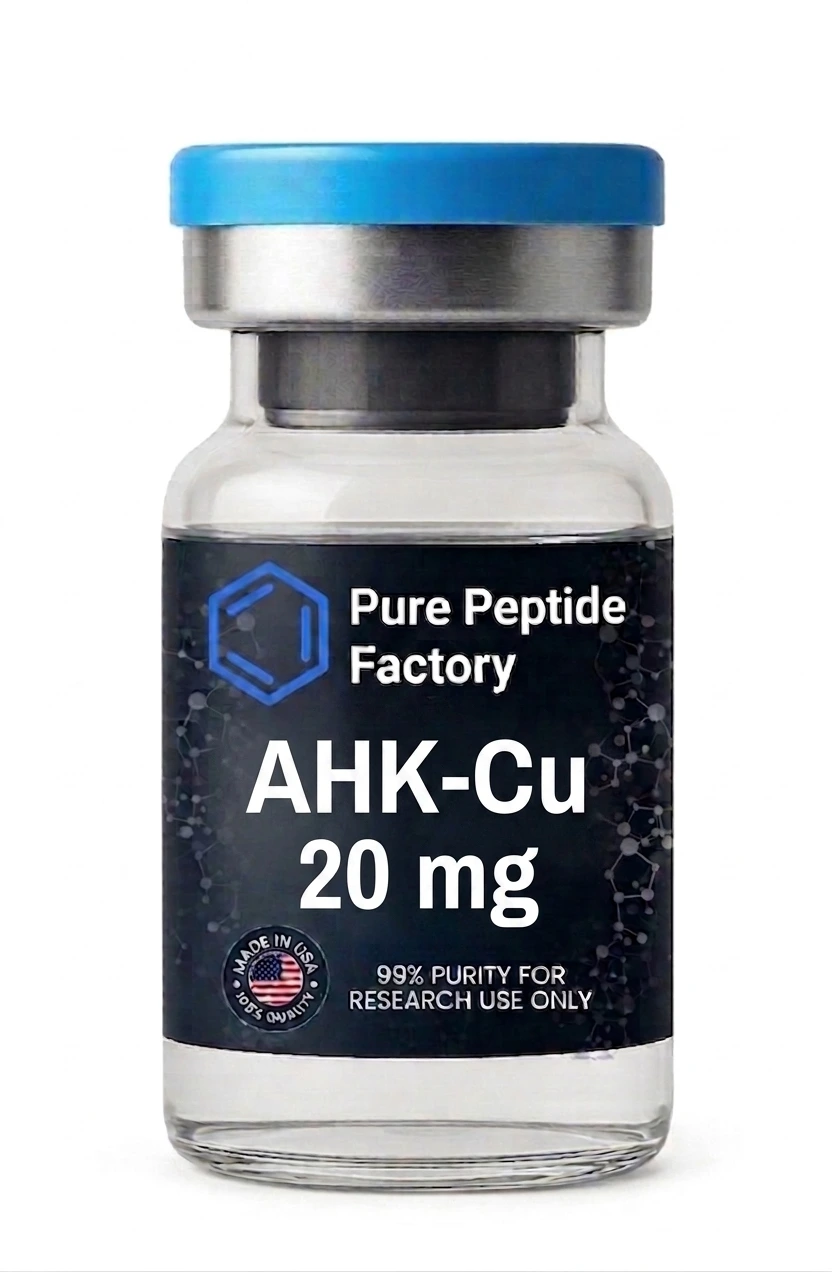
AHK-CU 20mg
$25.00 $40.00Price range: $25.00 through $40.00
AHK-Cu is a synthetic copper tripeptide engineered for hair follicle and dermal papilla cell research. It stimulates Wnt signaling, promotes dermal papilla cell proliferation, and supports hair follicle elongation. Supplied as 2mg lyophilized powder with batch-specific HPLC verification and mass spectrometry confirmation. Domestic cold-chain shipping. Research use only.
AHK Cu Powder for Sale: The Synthetic Copper Peptide for Hair Follicle Research
AHK-Cu is not GHK-Cu. That distinction matters because they do different jobs. GHK-Cu is a naturally occurring plasma peptide with broad regenerative effects. AHK-Cu is a synthetic variant engineered specifically for hair follicle biology. In a landmark study, AHK-Cu stimulated human hair follicle elongation ex vivo and dermal papilla cell proliferation at picomolar to nanomolar concentrations. It also elevated Bcl-2/Bax ratios and reduced caspase-3 cleavage, pointing to anti-apoptotic mechanisms in follicular cells.
Pure Peptide Factory stocks research-grade AHK-Cu powder in 20mg vials with batch-specific HPLC verification and domestic cold-chain shipping. If your dermatology or hair biology research program needs a compound with validated follicular activity and documented dermal papilla cell effects, this is it.
Why Researchers Buy AHK Cu Powder from Pure Peptide Factory
Purity Documentation You Can Verify Before You Order
AHK-Cu is a copper-coordinated tripeptide. The copper ion is not decorative. It is essential for the peptide’s three-dimensional structure and receptor interactions. Incorrect copper stoichiometry, oxidized peptide, or free copper contamination will produce a compound that fails in follicle assays or creates cytotoxic artifacts. Every batch we ship includes a lot-specific HPLC chromatogram and mass spectrometry report confirming the molecular weight at 416.94 g/mol and the Ala-His-Lys-Cu2+ complex integrity. Download the COA before you buy. Compare it against published data. No generic certificates.
Research-Grade Powder, Not Cosmetic Grade
Most AHK-Cu on the market is cosmetic grade sold for topical serums. That material is not validated for cell culture, lacks batch-specific analytical data, and may contain excipients that interfere with research assays. Our product is synthesized for laboratory use, lyophilized without fillers, and tested for endotoxin and sterility per USP 71. You get research-grade material with the documentation your protocol requires.
Domestic Cold-Chain That Protects Copper Peptide Stability
Copper peptides oxidize and degrade at room temperature. We ship from domestic cold-storage with phase-change cooling. Most orders arrive within 1 to 3 business days. International cosmetic suppliers cannot guarantee that timeline or temperature integrity.
Synthesis Logs Archived for 24 Months
Every batch is logged and archived. If your IRB or compliance office requests chain-of-custody documentation, it is ready before your compound arrives.
What Is AHK-Cu?
A Synthetic Copper Tripeptide Engineered for Hair Biology
AHK-Cu stands for L-alanyl-L-histidyl-L-lysine copper(II). It is a synthetic copper tripeptide developed specifically for hair and scalp research. The sequence replaces the glycine in GHK-Cu with alanine, producing a peptide with distinct receptor interactions and biological targets.
The copper ion is coordinated through the histidine imidazole nitrogen and lysine amino group, creating a square planar geometry that is essential for biological activity. This coordination is not incidental. It determines the peptide’s stability, receptor binding, and cellular uptake.
Molecular Profile:
-
Sequence: Ala-His-Lys-Cu2+
-
Molecular Formula: C15H25CuN6O4
-
Molecular Weight: 416.94 g/mol
-
CAS: 767286-83-9
-
Class: Synthetic copper tripeptide
-
Mechanism: Wnt signaling, dermal papilla cell proliferation, anti-apoptosis
How AHK-Cu Works at the Cellular Level
AHK-Cu operates through three distinct mechanisms that explain its hair follicle specificity.
First, it stimulates dermal papilla cell proliferation. Dermal papilla cells are specialized fibroblasts at the base of hair follicles that regulate follicle cycling and growth. AHK-Cu promotes their multiplication at concentrations as low as 10^-12 M, with peak effects around 10^-9 M.
Second, it activates Wnt/β-catenin signaling. This pathway is critical for hair follicle development and cycling. AHK-Cu promotes transition into the anagen (growth) phase through Wnt pathway activation, a mechanism that GHK-Cu does not engage as strongly.
Third, it may downregulate 5-alpha reductase. This enzyme converts testosterone to dihydrotestosterone (DHT), the primary hormone responsible for pattern hair loss. Research suggests AHK-Cu may reduce DHT formation, though this mechanism requires further validation.
AHK Cu vs GHK Cu: Which for Your Research?
Two Copper Tripeptides, Different Targets
Researchers frequently ask whether to use AHK-Cu or GHK-Cu. The answer depends entirely on your research endpoints:
| Feature | AHK-Cu | GHK-Cu |
|---|---|---|
| Origin | Synthetic | Naturally occurring in human plasma |
| Sequence | Ala-His-Lys-Cu2+ | Gly-His-Lys-Cu2+ |
| Primary target | Hair follicles, dermal papilla cells | Skin fibroblasts, general tissue repair |
| Wnt pathway activation | Strong | Limited |
| DHT inhibition | Potential | No direct effect |
| Collagen stimulation | Secondary | Primary |
| Research focus | Hair growth, follicle biology | Skin regeneration, wound healing, anti-aging |
| Plasma levels decline with age | N/A (synthetic) | Yes, 60% reduction from age 20 to 60 |
AHK-Cu is the precision tool for hair follicle and scalp research. GHK-Cu is the broader regenerative peptide for skin, wound healing, and general tissue repair. Neither substitutes for the other in protocol design.
Can They Be Combined?
Some research protocols use both peptides simultaneously. AHK-Cu targets follicle cycling and growth signaling. GHK-Cu supports scalp skin health and vascularization. Together they address both the follicle and its microenvironment. We stock both for researchers running combination studies.
AHK Cu Dosage: Published Research Protocols
Cell Culture and Ex Vivo Dosing
The landmark PubMed study
used the following concentrations:
-
Hair follicle elongation ex vivo: 10^-12 to 10^-9 M
-
Dermal papilla cell proliferation: 10^-12 to 10^-9 M
-
Anti-apoptotic effects (Bcl-2/Bax, caspase-3): 10^-9 M
These picomolar to nanomolar concentrations are remarkably low, indicating high potency. Researchers should prepare stock solutions carefully to achieve these working concentrations.
AHK Cu Dosage Reference Table
| Application | Concentration | Duration | Notes |
|---|---|---|---|
| Ex vivo hair follicle culture | 10^-12 to 10^-9 M | 7 to 14 days | Monitor follicle elongation vs controls |
| Dermal papilla cell culture | 10^-12 to 10^-9 M | 24 to 72 hours | Assess proliferation by MTT or BrdU |
| Anti-apoptosis assays | 10^-9 M | 24 to 48 hours | Measure Bcl-2, Bax, caspase-3, PARP |
| Wnt signaling studies | 10^-9 to 10^-7 M | 24 hours | Beta-catenin nuclear translocation |
We do not provide human dosing recommendations. AHK-Cu is not approved for human use and is sold strictly for research purposes.
How to Reconstitute AHK Cu Powder
Step-by-Step Laboratory Protocol
-
Sanitize the vial stopper with 70% isopropyl alcohol
-
Inject sterile water, bacteriostatic water, or DMSO slowly against the vial wall. Do not aim directly at the lyophilized cake
-
Allow the cake to dissolve without agitation for 2 to 3 minutes
-
Gently swirl until fully clear. Do not shake
-
Inspect for clarity and label with date, concentration, and solvent before storage
Concentration Reference
-
2mg vial + 0.5mL solvent = 4mg/mL
-
2mg vial + 1mL solvent = 2mg/mL
-
2mg vial + 2mL solvent = 1mg/mL
For cell culture work, prepare a 10^-3 M stock solution by dissolving 4.17mg in 10mL DMSO or water. Dilute further to achieve picomolar and nanomolar working concentrations.
Storage Requirements
-
Lyophilized powder: 24 months at -20°C, protected from light
-
Reconstituted solution: 14 days at 2 to 8°C under sterile conditions. Do not freeze
-
Stock solutions in DMSO: 3 months at -20°C
-
Avoid repeated freeze-thaw cycles
-
Protect from light at all stages
Regulatory Context and Research Use
Current Status
AHK-Cu is not FDA approved for any therapeutic indication. It is widely used in cosmetic formulations but is available for laboratory research under research-use-only terms without a prescription. You must agree to these terms at checkout. This compound is not for human consumption, veterinary use, or diagnostic application.
Why Purity Verification Matters for AHK-Cu
Copper peptide synthesis is prone to stoichiometric errors. Incorrect copper-to-peptide ratios, oxidized histidine residues, or free copper contamination will produce variable results in follicle assays and may introduce cytotoxicity. Our batch-specific HPLC and mass spectrometry documentation confirms the correct 1:1 copper:peptide complex and verifies against published molecular data. Every COA is lot-specific and downloadable before purchase.
Product Specifications
Available Configuration
AHK-Cu powder is available in 2mg vials. Select your quantity from the product options above.
Quality Verification
-
Purity: 98% minimum (HPLC verified)
-
Identity: Mass spectrometry confirmed against published Ala-His-Lys-Cu2+ structure
-
Molecular weight: 416.94 g/mol
-
Copper content: Verified by ICP-MS
-
Endotoxin: Less than 0.1 EU/mL
-
Sterility: Verified per USP 71
-
Form: Lyophilized powder
-
Storage: -20°C long-term, 2 to 8°C short-term
-
Current Batch: #PPF-AHK-0426 Purity: 98.9% Download: HPLC Certificate | MS Report
FAQ
What is AHK-Cu powder used for in research?
AHK-Cu powder is used to study hair follicle biology, dermal papilla cell proliferation, Wnt signaling in follicle development, anti-apoptotic mechanisms in hair follicle cells, and potential DHT modulation. It is the most hair-follicle-specific copper peptide available for research.
What is the difference between AHK-Cu and GHK-Cu?
AHK-Cu is a synthetic copper tripeptide (Ala-His-Lys-Cu2+) engineered for hair follicle research. GHK-Cu is a naturally occurring plasma peptide (Gly-His-Lys-Cu2+) with broad skin regenerative effects. AHK-Cu activates Wnt signaling and targets dermal papilla cells. GHK-Cu stimulates fibroblasts and collagen synthesis. They are complementary, not interchangeable.
What is AHK-Cu dosage in research models?
Published studies used 10^-12 to 10^-9 M for ex vivo hair follicle cultures and dermal papilla cell proliferation assays. Anti-apoptotic effects were observed at 10^-9 M. These are remarkably low concentrations indicating high potency.
Does AHK-Cu work for hair growth research?
In published ex vivo studies, AHK-Cu stimulated human hair follicle elongation and dermal papilla cell proliferation. It elevated Bcl-2/Bax ratios and reduced caspase-3 cleavage, suggesting anti-apoptotic protection for follicular cells.
Is AHK-Cu better than GHK-Cu for hair research?
For hair follicle-specific studies, yes. AHK-Cu was engineered for this purpose and shows stronger Wnt pathway activation and dermal papilla cell targeting. GHK-Cu is better for general skin regeneration, wound healing, and collagen studies.
Can AHK-Cu and GHK-Cu be used together?
Yes. Some research protocols combine both peptides to address the follicle (AHK-Cu) and the scalp microenvironment (GHK-Cu). We stock both for combination studies.
Is AHK-Cu powder soluble in water?
Yes, AHK-Cu is water soluble. For cell culture work, DMSO is often preferred for stock solution preparation due to improved stability. The final working concentration should be prepared in aqueous media appropriate for your cells.
Where to buy AHK-Cu powder for research?
Pure Peptide Factory stocks research-grade AHK-Cu powder with domestic cold-chain shipping and batch-specific HPLC and mass spectrometry documentation. Orders placed before 2 PM EST ship same-day and arrive within 1 to 3 business days. You must agree to research-use-only terms at checkout.
How should AHK-Cu powder be stored?
Lyophilized powder stores at -20°C for up to 24 months protected from light. Reconstituted solution stores at 2 to 8°C for up to 14 days under sterile conditions. DMSO stock solutions store at -20°C for up to 3 months. Protect from light at all stages.
What is the purity of your AHK-Cu?
Our current batch tests at 98.9% purity by HPLC with identity confirmation by mass spectrometry and copper content verification by ICP-MS. The Certificate of Analysis is available for download with your order.
Order AHK Cu Powder for Research
Secure Checkout
-
Credit card, cryptocurrency, or wire transfer
-
Same-day dispatch for orders placed before 2 PM EST
-
Cold-chain packaging with phase-change cooling
-
Discreet labeling and full tracking
Institutional Accounts
Net-30 terms and purchase order acceptance available for universities and pharmaceutical companies. Contact us for bulk pricing on 50 vials or more.
Add to cart and get batch-verified AHK-Cu powder delivered to your lab with the documentation your protocol requires.
Related products
-
Thymalin 10 mg
$50.00 -
Cardiogen 20 mg
$50.00 -
Cortagen 20 mg
$80.00