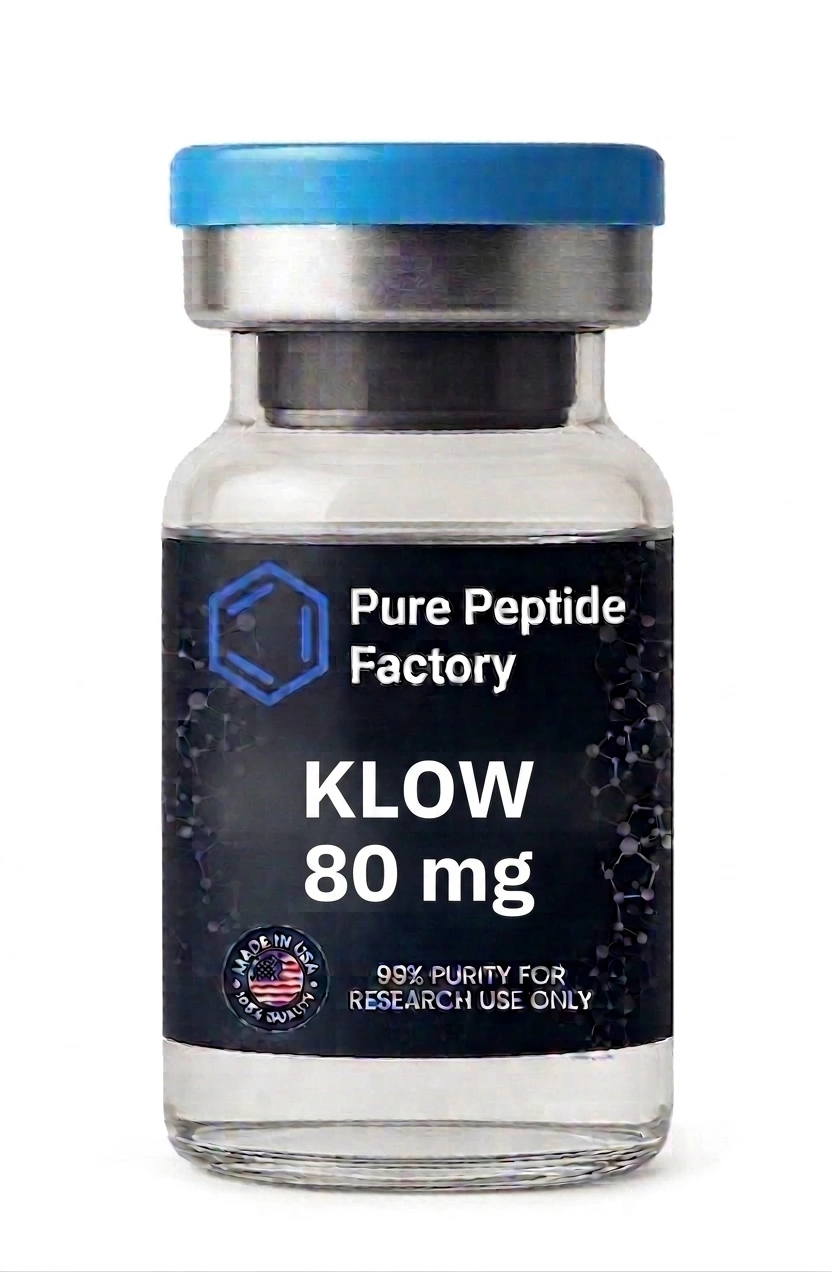
Klow 80 mg
$168.00
KLOW is an 80mg quad-peptide research blend combining GHK-Cu (50mg), BPC-157 (10mg), TB-500 (10mg), and KPV (10mg) in a single co-lyophilized vial. Researchers comparing klow vs glow peptide formulations choose KLOW when their protocol requires the melanocortin anti-inflammatory dimension that KPV adds to the foundational GHK-Cu, BPC-157, and TB-500 triple stack. HPLC verified, batch-documented, domestic cold-chain shipping. Research use only.
Klow vs Glow Peptide: The Complete Research Guide to the Quad-Blend Stack
The klow vs glow peptide question is the most searched comparison in multi-peptide blend research right now, growing from 110 monthly searches in May 2025 to over 1,900 in January 2026. Consequently, researchers evaluating both formulations need a clear, mechanistically grounded answer rather than marketing language. Specifically, KLOW adds one compound to the GLOW triple-blend: KPV, a tripeptide derived from the C-terminal of alpha-melanocyte-stimulating hormone that introduces melanocortin receptor-mediated anti-inflammatory signaling into the stack. As a result, the klow vs glow peptide decision reduces to a single question: does your research protocol require NF-kappaB suppression through melanocortin pathway activation alongside the angiogenic, matrix-remodeling, and cytoprotective mechanisms the triple-blend already covers?
Pure Peptide Factory stocks both formulations. Furthermore, every vial of KLOW ships with batch-specific HPLC documentation, domestic cold-chain cooling, and same-day dispatch for orders placed before 2 PM EST. Researchers who need to compare klow vs glow peptide in parallel arms of the same study can source both from one supplier under identical batch handling conditions, eliminating inter-vendor variability from their experimental design.
Klow vs Glow Peptide: The Core Difference Explained
What GLOW Contains and What It Does
GLOW is the foundational triple-blend combining GHK-Cu, BPC-157, and TB-500. Each component targets a distinct signaling pathway. Specifically, GHK-Cu activates TGF-beta/SMAD-mediated collagen synthesis and extracellular matrix remodeling through copper-dependent enzyme pathways. BPC-157 modulates nitric oxide production, promotes angiogenesis, and protects gastrointestinal and connective tissue through growth factor receptor activation. TB-500 sequesters actin monomers through its LKKTETQ motif, promoting cell migration, endothelial motility, and new blood vessel formation. Together, these three compounds cover angiogenesis, structural repair, and cytoprotection across multiple tissue types.
What KLOW Adds: The KPV Dimension
KLOW adds KPV (Lys-Pro-Val) at 10mg to the triple-blend foundation. KPV is the C-terminal tripeptide of alpha-MSH and activates melanocortin receptors, particularly MC1R and MC3R, to suppress NF-kappaB signaling and reduce pro-inflammatory cytokine production. Furthermore, KPV directly penetrates intestinal epithelial cells through a transporter-mediated mechanism, making it specifically relevant for gut mucosal inflammation research that the GHK-Cu, BPC-157, and TB-500 components do not specifically target. As a result, KLOW covers a fourth mechanistic dimension that GLOW cannot address: melanocortin-mediated inflammatory resolution.
Klow vs Glow Peptide: Side-by-Side Comparison
| Feature | KLOW (Quad-Blend) | GLOW (Triple-Blend) |
|---|---|---|
| Total mass per vial | 80mg | 60mg |
| GHK-Cu | 50mg | 50mg |
| BPC-157 | 10mg | 10mg |
| TB-500 | 10mg | 10mg |
| KPV | 10mg | Not included |
| Melanocortin pathway | Yes, through KPV MC1R/MC3R activation | No |
| NF-kappaB suppression | Yes, KPV-mediated | Indirect only through BPC-157 cytoprotection |
| Gut mucosal targeting | Yes, KPV transporter-mediated epithelial uptake | BPC-157 only |
| Best for studying | Multi-pathway repair plus inflammatory resolution | Angiogenesis, ECM remodeling, cytoprotection |
Consequently, the klow vs glow peptide choice is not about which is superior overall. Rather, it is about which mechanistic coverage your protocol requires. Researchers examining inflammatory disease models, gut epithelial biology, or mucosal immunity alongside tissue repair endpoints choose KLOW. Researchers isolating angiogenic and matrix-remodeling mechanisms without melanocortin confounders choose GLOW. We stock both for parallel arm study designs.
Why Researchers Buy KLOW Peptide for Sale from Pure Peptide Factory
Both Sides of the Klow vs Glow Peptide Comparison in One Supplier
Running a klow vs glow peptide comparison study requires both formulations from the same synthesis cycle to eliminate batch variability between groups. We manufacture and stock both KLOW and GLOW under identical quality controls in the same facility. Consequently, researchers designing head-to-head comparison protocols between the two formulations source both from one supplier with batch-matched documentation and avoid the inter-vendor variability that would otherwise confound their results.
HPLC Verification of All Four Components
Because KLOW contains four peptides in a single vial, verification requires confirming the presence and quantity of each component independently rather than simply measuring total peptide content. Every batch undergoes individual component analysis by HPLC and mass spectrometry. Furthermore, the Certificate of Analysis documents GHK-Cu, BPC-157, TB-500, and KPV ratios against nominal values, giving researchers confidence that the co-lyophilization process has not altered individual component stability or concentration.
Domestic Cold-Chain for a Multi-Component Blend
Multi-peptide blends introduce additional stability considerations because each component has different temperature sensitivity thresholds and degradation kinetics. Specifically, GHK-Cu’s copper coordination chemistry, BPC-157’s amide backbone, TB-500’s large 43-amino-acid sequence, and KPV’s small tripeptide structure all respond differently to temperature excursions during transit. Consequently, maintaining cold-chain integrity from our cold-storage facility to your lab is more critical for KLOW than for any single-compound product. We ship with phase-change cooling that maintains compound integrity for 96 hours, and most orders arrive within 1 to 3 business days.
Synthesis Logs Archived for Multi-Site Research
Researchers using KLOW across multiple sites or in publications that require batch documentation can access synthesis logs archived for 24 months. Furthermore, the downloadable COA includes individual component ratios, endotoxin results, and sterility verification, supporting the documentation requirements of institutional review boards and journal publication standards.
What Is the KLOW Stack Peptide?
Four Compounds, Four Distinct Mechanistic Pathways
The KLOW stack peptide brings together four compounds that each address a different dimension of tissue repair and inflammatory regulation. Because these pathways operate through distinct receptors and second messenger systems, combining them in a single research preparation allows researchers to study multi-pathway interactions that single-compound protocols cannot replicate. Furthermore, co-lyophilization preserves each compound’s individual stability characteristics while enabling simultaneous administration in research models.
GHK-Cu (50mg): Copper-Mediated Tissue Remodeling
GHK-Cu is the highest-mass component in KLOW at 50mg per vial. This copper-binding tripeptide activates TGF-beta/SMAD pathway signaling, stimulates collagen I and III synthesis, upregulates TIMP-1 and TIMP-2 to protect collagen from degradation, and modulates gene expression across approximately 4,000 human genes. Specifically, Pickart and Margolina published in Biomolecules summarizing over 150 published studies on GHK-Cu’s gene regulatory effects, establishing it as the most comprehensively studied copper peptide for extracellular matrix research.
BPC-157 (10mg): Cytoprotection and Angiogenesis
BPC-157 is a synthetic 15-amino-acid pentadecapeptide derived from a human gastric juice protein. It promotes angiogenesis through VEGF pathway activation, modulates nitric oxide production, and produces cytoprotective effects in connective tissue, vascular endothelium, and gastrointestinal epithelium. Furthermore, Sikiric et al. published in Current Pharmaceutical Design characterizing BPC-157’s systemic stability and multi-tissue protective effects across over 100 published preclinical studies. Consequently, BPC-157 contributes the vascular and cytoprotective dimensions of the KLOW stack that GHK-Cu’s matrix-focused mechanism does not cover.
TB-500 (10mg): Cellular Migration and Actin Dynamics
TB-500 is a synthetic analogue of the 43-amino-acid Thymosin Beta-4 protein, containing the critical LKKTETQ actin-binding motif. Specifically, this sequence sequesters G-actin monomers, reducing filamentous actin polymerization and promoting the cellular migration required for wound closure and tissue repair. Additionally, TB-500 promotes endothelial cell motility and angiogenesis through mechanisms complementary to but distinct from BPC-157’s VEGF pathway effects. Huff et al. published in the Annals of the New York Academy of Sciences reviewing Thymosin Beta-4’s actin dynamics and tissue repair mechanisms across cardiovascular and wound healing models.
KPV (10mg): Melanocortin Anti-Inflammatory Signaling
KPV is the C-terminal tripeptide of alpha-MSH (Lys-Pro-Val) and the compound that differentiates KLOW from GLOW in the klow vs glow peptide comparison. It activates melanocortin receptors MC1R and MC3R, suppressing NF-kappaB nuclear translocation and consequently reducing pro-inflammatory cytokine production including TNF-alpha, IL-6, and IL-1beta. Furthermore, KPV enters intestinal epithelial cells through the PepT1 oligopeptide transporter, achieving intracellular concentrations that receptor-restricted peptides cannot reach. As a result, KPV adds a gut-mucosal anti-inflammatory dimension to KLOW that the GLOW triple-blend does not possess.
Klow vs Glow Peptide: Research Applications
When to Choose KLOW for Inflammatory Disease Research
Researchers studying inflammatory bowel disease, colitis, Crohn’s disease models, and epithelial barrier dysfunction choose KLOW over GLOW because of KPV’s transporter-mediated gut epithelial uptake and NF-kappaB suppression. Specifically, the combination of BPC-157’s gastrointestinal cytoprotection, GHK-Cu’s extracellular matrix remodeling, TB-500’s cellular migration, and KPV’s anti-inflammatory resolution addresses all four phases of gut mucosal healing in a single preparation. Consequently, researchers can examine multi-pathway mucosal repair without the logistical complexity of administering four separate compounds at individually timed intervals.
KLOW Stack Peptide for Wound Healing Research
The KLOW stack peptide provides wound healing researchers with coverage across the four overlapping phases of wound repair. GHK-Cu accelerates re-epithelialization and collagen remodeling in the proliferative phase. TB-500 drives keratinocyte and endothelial migration necessary for wound closure. BPC-157 promotes new blood vessel formation and vascular integrity during the angiogenic phase. Additionally, KPV suppresses the excessive inflammatory signaling that delays chronic wound healing in diabetic and aged tissue models. Because all four mechanisms operate simultaneously in normal wound repair biology, KLOW provides a more physiologically complete research tool than single-compound or triple-blend preparations for wound biology endpoints.
KLOW vs GLOW for Multi-Pathway Tissue Repair Studies
When researchers need to isolate the contribution of the melanocortin anti-inflammatory pathway to overall tissue repair outcomes, klow vs glow peptide comparison designs provide the cleanest experimental approach. Specifically, using GLOW as the control arm and KLOW as the treatment arm isolates KPV’s contribution to inflammatory resolution, cell survival, and barrier function without confounding the angiogenic and matrix components present in both formulations. As a result, this comparison design is increasingly used in gut mucosal research, skin inflammation models, and systemic inflammatory disease protocols where KPV’s NF-kappaB suppression is the primary variable of interest.
KLOW Peptide for Sale: Skin and Dermatology Research
All four KLOW components are independently studied in dermatology research, making the blend relevant for skin biology protocols that require multi-pathway coverage. Specifically, GHK-Cu’s extensive skin research base, BPC-157’s wound closure data, TB-500’s keratinocyte migration effects, and KPV’s anti-inflammatory activity in psoriasis and rosacea models converge on complementary aspects of skin biology. Furthermore, because GHK-Cu alone has over 150 published studies in skin and extracellular matrix contexts, the KLOW blend builds on an exceptionally strong individual component evidence base rather than combining poorly characterized compounds.
KLOW Peptide for Sale: Dosage Reference Protocols
Individual Component Dosing from Published Literature
Because the specific KLOW quad-blend has not been systematically evaluated in published clinical studies, researchers should base dosing on the established protocols for individual components and adjust for the total vial mass. The following table summarizes reference dosing from peer-reviewed animal studies for each component:
| Component | KLOW Vial Content | Published Animal Dose | Route | Primary Endpoint |
|---|---|---|---|---|
| GHK-Cu | 50mg | 1 to 5 mg/kg | Subcutaneous or topical | Wound closure, collagen synthesis |
| BPC-157 | 10mg | 10 to 50 mcg/kg | IP or subcutaneous | Tissue repair, GI protection, angiogenesis |
| TB-500 | 10mg | 2 to 4 mg/kg | IP or subcutaneous | Wound healing, cellular migration, angiogenesis |
| KPV | 10mg | 100 to 200 mcg/kg | IP, oral, or topical | NF-kappaB suppression, gut inflammation, barrier function |
We do not provide human dosing recommendations. KLOW is sold strictly for laboratory research purposes and is not approved for human or veterinary use.
How to Reconstitute KLOW: Step-by-Step Protocol
Reconstituting a Co-Lyophilized Multi-Peptide Blend
Because KLOW contains four peptides co-lyophilized in a single vial, reconstitution requires care to achieve complete dissolution of all components without disturbing the individual peptide structures. Furthermore, GHK-Cu’s copper coordination chemistry and TB-500’s large 43-amino-acid sequence both require slightly more dissolution time than the smaller BPC-157 and KPV components. Consequently, patience during reconstitution protects the integrity of all four compounds simultaneously.
- Allow the KLOW vial to reach room temperature before reconstitution. Specifically, removing it from cold storage 15 minutes before use prevents thermal differentials at the solution interface that promote aggregation.
- Sanitize the vial stopper with 70% isopropyl alcohol and allow 30 seconds to dry.
- Draw the required volume of bacteriostatic water into a sterile syringe. Use bacteriostatic water rather than sterile water to maintain multi-draw sterility over the 28-day post-puncture window.
- Insert the needle at an angle and inject the water slowly against the vial wall. Do not direct the stream at the lyophilized cake, as this causes foaming and can denature the copper-peptide coordination of GHK-Cu.
- Remove the syringe and allow the lyophilized cake to dissolve without agitation for 3 to 5 minutes. Because TB-500 is the largest component at 43 amino acids, it requires the longest dissolution time in the blend.
- Gently swirl the vial until the solution runs fully clear. Do not shake vigorously, as this promotes GHK-Cu aggregation and TB-500 denaturation.
- Inspect for clarity before labeling. A slight blue-green tint from the copper component of GHK-Cu is normal and does not indicate degradation.
- Label with reconstitution date, concentration, and lot number before storage.
KLOW Concentration Reference Table
| Water Added to 80mg Vial | Total Concentration | GHK-Cu Concentration | BPC-157/TB-500/KPV Each |
|---|---|---|---|
| 2 mL | 40 mg/mL | 25 mg/mL | 5 mg/mL each |
| 4 mL | 20 mg/mL | 12.5 mg/mL | 2.5 mg/mL each |
| 8 mL | 10 mg/mL | 6.25 mg/mL | 1.25 mg/mL each |
| 10 mL | 8 mg/mL | 5 mg/mL | 1 mg/mL each |
Storage After KLOW Reconstitution
- Lyophilized powder: 24 months at -20°C, protected from light
- Reconstituted solution: 14 days at 2 to 8°C under sterile conditions. Do not freeze
- Because GHK-Cu is sensitive to light exposure through copper photo-oxidation, protect reconstituted KLOW from light at all stages
- Additionally, avoid repeated freeze-thaw cycles on reconstituted solution as TB-500’s large sequence is particularly susceptible to aggregation under these conditions
KLOW Stack Peptide vs Individual Component Research
When to Use KLOW vs Individual Compounds
Researchers new to the klow stack peptide frequently ask whether to use the blend or source each component individually. The answer depends on the study design. Specifically, KLOW suits multi-pathway exploratory research where the interaction between repair mechanisms is the endpoint. Individual components suit studies that need to isolate a specific mechanism or control for individual compound contributions to observed outcomes.
| Study Design | Use KLOW Blend | Use Individual Components |
|---|---|---|
| Multi-pathway tissue repair exploration | Yes, simpler logistics | Only if dose ratio control is needed |
| Isolating KPV anti-inflammatory mechanism | No, BPC-157 confounds | Yes, use KPV alone |
| Klow vs glow peptide comparison arm | Yes, KLOW as treatment arm | No, use GLOW as control arm |
| Dose-response for individual components | No, fixed ratios prevent titration | Yes, full dose range flexibility |
| Protocol efficiency across multiple endpoints | Yes, single reconstitution covers all | Only if custom ratios are required |
Furthermore, because we stock all four individual components separately alongside both KLOW and GLOW, researchers can transition between blend and individual compound protocols without changing suppliers or introducing quality variability between study phases.
Regulatory Context
Research Use Status
KLOW is not FDA approved for any therapeutic indication. None of its four components, GHK-Cu, BPC-157, TB-500, or KPV, have completed clinical trials for any approved indication. Consequently, KLOW is available for laboratory research under research-use-only terms without a prescription. You must agree to research-use-only terms at checkout. This compound is not for human consumption, veterinary use, or diagnostic application of any kind.
Important Note on the Specific Combination
While each individual component of KLOW has published preclinical research behind it, the specific quad-blend combination has not been systematically evaluated in published clinical studies. Consequently, researchers should treat observed effects from the blend as exploratory findings reflecting the combined action of four mechanistically distinct compounds rather than as validated outcomes of a characterized formulation. All in vivo protocols require institutional oversight and IRB approval.
Product Specifications
KLOW 80mg Vial Configuration
| SKU | Configuration | Components | Best For |
|---|---|---|---|
| KLW80 | 80mg co-lyophilized vial | GHK-Cu 50mg + BPC-157 10mg + TB-500 10mg + KPV 10mg | Multi-pathway tissue repair, inflammatory disease models, klow vs glow peptide comparison studies |
Quality Verification
- Overall purity: 99% minimum for each component (HPLC verified)
- Individual component ratios: Confirmed by HPLC and mass spectrometry
- GHK-Cu: Copper content verified by atomic absorption spectroscopy
- Endotoxin: Less than 0.1 EU/mL
- Sterility: Verified per USP 71
- Form: Co-lyophilized powder, single vial
- Storage: -20°C long-term, 2 to 8°C short-term
Current Batch: #PPF-KLW-0426
Component Purity: GHK-Cu 99.4% | BPC-157 99.2% | TB-500 98.8% | KPV 99.1%
Download: HPLC Certificate | MS Report
Frequently Asked Questions About Klow vs Glow Peptide
What is the difference between klow vs glow peptide?
KLOW contains four peptides: GHK-Cu (50mg), BPC-157 (10mg), TB-500 (10mg), and KPV (10mg). GLOW contains three: GHK-Cu (50mg), BPC-157 (10mg), and TB-500 (10mg). Consequently, KLOW adds KPV’s melanocortin receptor-mediated NF-kappaB suppression and gut epithelial anti-inflammatory signaling to the angiogenic, matrix-remodeling, and cytoprotective foundation that GLOW provides.
When should researchers choose KLOW over GLOW?
Researchers should choose KLOW when their protocol requires melanocortin anti-inflammatory signaling, NF-kappaB suppression, gut mucosal targeting through KPV’s PepT1 transporter uptake, or a comparison arm against GLOW to isolate KPV’s contribution to inflammatory resolution outcomes. Researchers studying pure angiogenesis, ECM remodeling, or cytoprotection without inflammatory confounders should choose GLOW.
What is the klow stack peptide made of?
The KLOW stack peptide combines GHK-Cu (glycyl-L-histidyl-L-lysine copper complex, 50mg), BPC-157 (body protection compound 15-mer, 10mg), TB-500 (synthetic Thymosin Beta-4 analogue, 10mg), and KPV (Lys-Pro-Val C-terminal alpha-MSH tripeptide, 10mg) in a single co-lyophilized 80mg vial.
How do you reconstitute the KLOW blend peptide for sale?
Add bacteriostatic water slowly against the vial wall, allow 3 to 5 minutes for dissolution without agitation, gently swirl until fully clear, and expect a slight blue-green tint from GHK-Cu’s copper component. Store reconstituted solution at 2 to 8°C for up to 14 days. See the complete step-by-step reconstitution protocol and concentration table above.
Can you run klow vs glow peptide comparison studies from one supplier?
Yes. Pure Peptide Factory stocks both KLOW and GLOW under identical quality controls in the same facility. Consequently, researchers designing klow vs glow peptide comparison protocols can source both formulations from one supplier with batch-matched documentation, eliminating inter-vendor variability from their experimental design.
Why does KLOW contain 50mg of GHK-Cu when the other components are 10mg each?
GHK-Cu has a lower effective concentration range than the other components, typically requiring higher mass to achieve equivalent receptor engagement in tissue models. Furthermore, GHK-Cu’s well-characterized 150-plus study evidence base in collagen and matrix biology makes it the foundational compound in the blend. Consequently, the 50mg allocation reflects GHK-Cu’s role as the primary tissue-remodeling anchor of the KLOW stack.
Does KLOW require cold-chain shipping?
Yes. Because GHK-Cu’s copper coordination chemistry and TB-500’s large 43-amino-acid sequence both degrade under temperature excursions during transit, KLOW requires cold-chain shipping with phase-change cooling rather than standard ice packs. We ship with 96-hour phase-change cooling and most orders arrive within 1 to 3 business days from our domestic cold-storage facility.
What internal controls should I use for klow vs glow peptide research?
For klow vs glow peptide comparison studies, use GLOW as the control arm and KLOW as the treatment arm to isolate KPV’s contribution. Additionally, include an NF-kappaB inhibitor control to confirm KPV-specific pathway involvement, a vehicle control for the reconstitution buffer, and individual compound controls for each component if the research goal is mechanistic attribution rather than integrated multi-pathway assessment.
How does KPV differ from other anti-inflammatory peptides in the KLOW stack?
Unlike BPC-157’s cytoprotective anti-inflammatory effects, which operate through growth factor receptor modulation and NO pathway interactions, KPV directly suppresses NF-kappaB nuclear translocation through melanocortin receptor activation. Furthermore, KPV’s PepT1 transporter-mediated epithelial uptake gives it intracellular access that receptor-restricted peptides cannot achieve, making it uniquely effective for gut mucosal inflammatory research within the KLOW blend.
Is the KLOW blend studied as a combination in published research?
Each individual KLOW component has published preclinical research, but the specific quad-blend combination has not been systematically evaluated in published clinical studies. Consequently, observed effects from KLOW as a blend represent exploratory multi-pathway findings rather than validated outcomes of a characterized formulation. This honest disclosure distinguishes Pure Peptide Factory from vendors who imply the blend itself has the evidence base of its individual components.
Where can I buy KLOW peptide for sale alongside its individual components?
Pure Peptide Factory stocks KLOW 80mg vials alongside individual GHK-Cu, BPC-157, TB-500, and KPV for researchers who need both blend and individual compound access in the same catalog. Orders placed before 2 PM EST ship same-day with domestic cold-chain packaging.
Order KLOW Peptide for Sale
Secure Checkout
- Credit card, cryptocurrency, or wire transfer
- Same-day dispatch for orders placed before 2 PM EST
- Cold-chain packaging with phase-change cooling, 96-hour protection
- Discreet labeling and full tracking
Institutional Accounts
Net-30 terms and purchase order acceptance are available for universities and pharmaceutical companies. Furthermore, researchers designing klow vs glow peptide comparison studies who need both formulations in bulk quantities receive coordinated batch matching to ensure study integrity. Contact our research team to discuss multi-vial orders and institutional supply agreements.