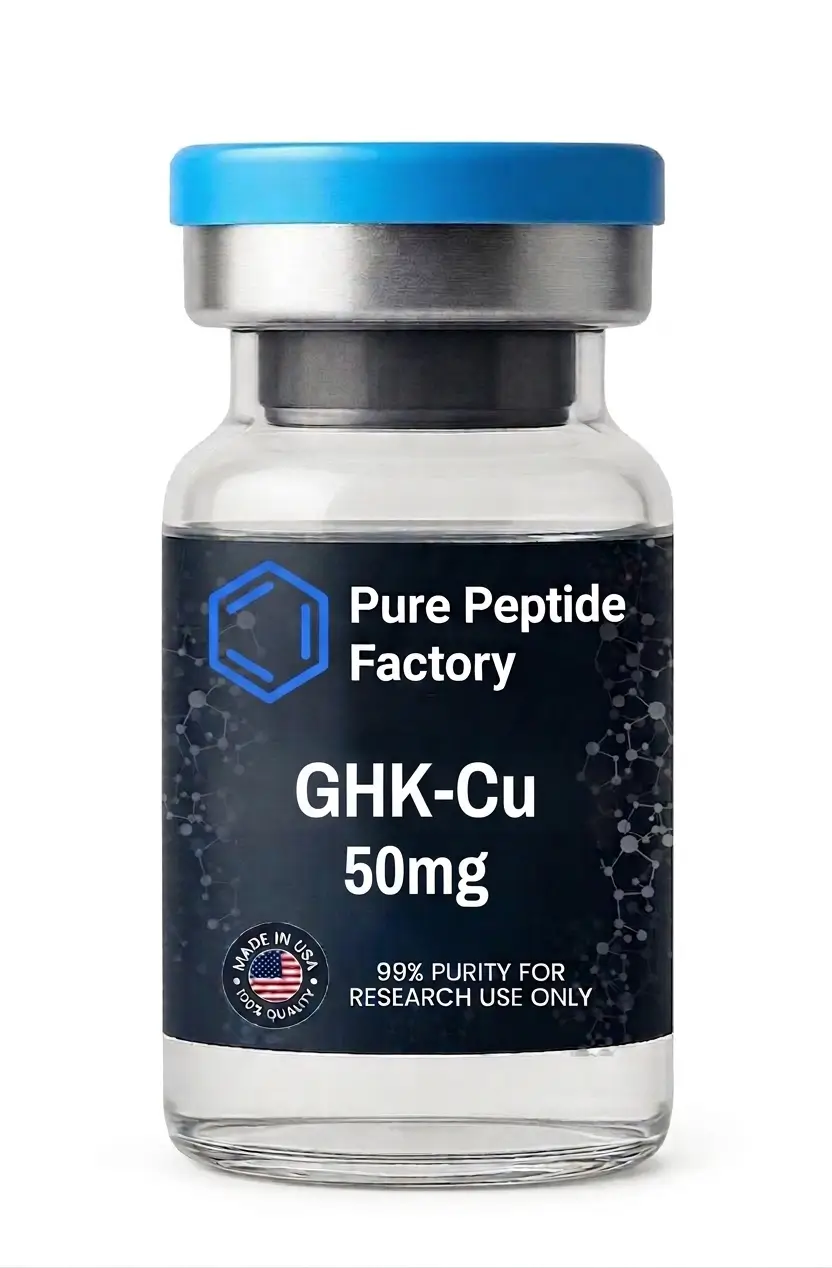
GHK-Cu (Copper) 50 Mg
$36.00 $58.00Price range: $36.00 through $58.00
GHK-CU — available in multiple dosages. For research use only.
Contents: GHK-Cu (50mg)
Form: Lyophilized powder
Purity: >99%
GHK Cu Peptide Benefits: What the Research Actually Shows
Researchers studying tissue regeneration, skin aging, and oxidative stress have spent decades mapping the GHK Cu peptide benefits documented in peer-reviewed literature. This naturally occurring copper complex does not act like a hormone or a stimulant. It functions as a signaling molecule that modulates gene expression, which is why laboratories across dermatology, wound care, and anti-aging research keep it in active rotation.
If you are looking for ghk cu peptide near me, you already know that shipping distance matters. Copper peptides degrade when exposed to heat and moisture during long transit times. Pure Peptide Factory stores GHK-Cu at negative 80 degrees Celsius and ships in phase-change cold packaging so your compound arrives with the same integrity it had when it left the lab.
Why Researchers Buy GHK-Cu from Pure Peptide Factory
Batch-Specific Testing, Not Generic Claims
Most vendors hand you a photocopied certificate from 2019 and call it verified. We test every batch for peptide sequence, copper content, and endotoxin levels. You get the actual HPLC chromatogram and mass spectrometry report for your specific vials. If your institutional review board wants documentation, you have it.
Domestic Cold-Chain Shipping
Searching ghk cu peptide near me is not just about convenience. It is about stability. We ship same-day from temperature-controlled facilities. Your order arrives in 1 to 3 business days inside insulated packaging with dry ice or phase-change materials, not melted gel packs.
Research Support That Understands Your Protocol
Our technical team includes scientists who have worked with copper peptides in cell culture and animal models. When you order, you get access to reconstitution protocols, concentration guidelines, and storage recommendations. We cannot give medical advice, but we can make sure you have the technical data your lab needs.
What Is GHK-Cu?
The Natural Copper Tripeptide
GHK-Cu is a tripeptide composed of glycyl-L-histidyl-L-lysine bound to a copper ion. It exists naturally in human plasma and is released at injury sites to signal tissue repair. At age 20, the average person has about 200 nanograms per milliliter of GHK in their plasma. By age 60, that level drops to roughly 80 nanograms per milliliter. This age-related decline is one reason researchers study its role in regeneration and cellular maintenance.
Molecular Data:
– Sequence: Gly-His-Lys-Cu2+
– Molecular Formula: C14H23CuN6O4
– Molecular Weight: 340.38 g/mol
– CAS: 49557-75-5 (GHK); 130120-57-9 (GHK-Cu)
How It Works in Laboratory Models
Unlike growth factors that degrade within hours, GHK-Cu remains stable and bioactive. It binds copper with high affinity and facilitates copper uptake into cells, where it supports collagen synthesis, tissue remodeling, and antioxidant defenses. Studies suggest it can reset elements of the genome associated with repair pathways, giving it broad activity across multiple tissue types.
GHK Cu Peptide Benefits: The Research Breakdown
Tissue Repair and Wound Healing
The earliest ghk cu peptide benefits were identified in the 1980s during studies on dermal wound healing in rats. Researchers found that GHK released at injury sites binds copper ions in blood and stimulates decorin protein synthesis. Decorin regulates collagen formation and wound closure.
In a controlled study using New Zealand white rabbits, open wounds were treated with GHK-Cu, zinc oxide, or placebo over 21 days. The GHK-Cu group showed significantly faster healing compared to both zinc oxide and control groups. A follow-up study compared GHK-Cu to helium-neon laser therapy over 28 days. The peptide group demonstrated reduced neutrophil counts and increased neovascularization, indicating a shift from inflammatory response to active tissue regeneration.
Collagen and Extracellular Matrix Support
Laboratories studying aging skin structure use GHK-Cu to examine extracellular matrix integrity. The peptide stimulates collagen III and elastin synthesis while upregulating tissue inhibitors of metalloproteinases (TIMP-1 and TIMP-2). These inhibitors help prevent collagen breakdown, which is why researchers investigate GHK-Cu for dermal thickening and skin barrier restoration.
Anti-Inflammatory and Antioxidant Activity
GHK-Cu exhibits potent antioxidant properties. It neutralizes hydroxyl radicals and peroxyl radicals more effectively than glutathione in certain assays. It reduces reactive oxygen species induced by tert-butyl hydroperoxide and lowers malondialdehyde levels while restoring glutathione stores.
In cigarette smoke-induced lung inflammation models, GHK-Cu reduced pro-inflammatory cytokines IL-1beta and TNF-alpha. It suppressed myeloperoxidase activity and inhibited NF-kappaB activation while activating the Nrf2 antioxidant pathway. These findings make it valuable for researchers studying chronic inflammation, COPD, and oxidative stress.
Hair Follicle and Growth Research
Laboratories investigating hair regeneration use GHK-Cu to study dermal papilla cell proliferation and hair follicle size increase. Some protocols compare GHK-Cu directly to minoxidil in ex vivo follicular unit models to measure VEGF expression and growth factor release.
Behavioral and Neurological Studies
Research outside dermatology has produced interesting findings. In pain response studies, mice on a heated surface showed reduced paw-licking latency after GHK-Cu administration, suggesting altered nociception. In anxiety models using elevated plus mazes, rats spent more time in open arms after peptide delivery. In aggression studies using foot-shock protocols, attack frequency dropped by approximately fivefold in treated subjects compared to controls.
Cancer Cell Research
The peptide has shown selective activity in oncology models. It suppressed growth in SH-SY5Y neuroblastoma cells and U937 histiocytic lymphoma cells while promoting apoptosis through caspase 3 and 7 activation. Notably, the same compound promoted growth in healthy NIH-3T3 fibroblasts, suggesting a potential preference for normal cells over certain malignant lines.
GHK Cu Before and After: What the Studies Measure
| Endpoint | Measurement | Typical Timeline |
|---|---|---|
| Wound closure rate | Percentage of initial wound area | 14 to 21 days |
| Collagen density | Histological staining | 21 to 28 days |
| Neovascularization | Microvessel count | 14 to 21 days |
| Inflammatory markers | TNF-alpha, IL-6 levels | 7 to 14 days |
| Oxidative stress | MDA, GSH levels | 7 to 14 days |
| Hair follicle diameter | Microscopic measurement | 28 to 56 days |
GHK Cu Powder for Sale
Quality Verification
Every order includes:
– HPLC chromatogram showing purity and retention time
– Mass spectrometry confirming molecular weight
– Copper content assay by atomic absorption
– Endotoxin report below 0.1 EU per milliliter
– Sterility verification
Current Batch: #PPF-GHK-0426
Purity: 99.4%
Copper Content: 98.7% of theoretical
**Download:** [Certificate of Analysis](#)
How to Reconstitute and Store GHK-Cu
Reconstitution
GHK-Cu dissolves readily in sterile water, PBS, or dilute acetic acid. For cell culture work, most researchers use 0.1 to 10 micrograms per milliliter. For topical studies, concentrations range from 1 to 5 percent weight per volume.
Storage Guidelines
– Lyophilized powder: 24 months at negative 20 degrees Celsius, protected from light
– Reconstituted solution: Use within 14 days at 4 degrees Celsius under sterile conditions
– Avoid: EDTA, strong acids, and oxidizing agents, which chelate copper or degrade the peptide
FAQ
What are the main GHK cu peptide benefits?
Published research identifies several key areas: tissue repair and wound healing, collagen synthesis, anti-inflammatory activity, antioxidant protection, hair follicle stimulation, and selective effects on cancer cell lines. The peptide works through gene expression modulation rather than hormone receptor activation.
Is GHK-Cu a peptide or a small molecule?
GHK-Cu is a peptide-copper complex. The GHK portion is a tripeptide, and the copper ion forms a coordination complex that gives the compound its biological activity. It is not active as the free peptide alone.
How does GHK-Cu compare to other copper peptides?
GHK-Cu is the most studied copper peptide in research literature. Its tripeptide structure gives it high copper binding affinity and cell permeability compared to larger copper-binding proteins.
Can I buy GHK-Cu without a research license?
We sell strictly for laboratory research. You do not need a specific license to purchase, but you must agree to our research-use-only terms at checkout. This compound is not for human consumption, veterinary use, or diagnostic applications.
How fast will my order arrive?
Most researchers receive their order within 1 to 3 business days. We ship same-day for orders placed before 2 PM EST in temperature-controlled packaging.
Order GHK-Cu for Your Research
Secure Checkout
Add to cart now and get:
– Credit card, cryptocurrency, or wire transfer options
– Same-day dispatch before 2 PM EST
– Encrypted transaction processing
– Discreet, cold-chain packaging
Institutional Accounts
We offer Net-30 terms and purchase order acceptance for universities and pharmaceutical companies. Contact our team for bulk pricing on orders of 50 vials or more.
Buy GHK-Cu today and get the batch-verified compound your research requires.
Related products
-
Humanin 10 mg
Original price was: $147.00.$100.00Current price is: $100.00. -
Cardiogen 20 mg
$50.00