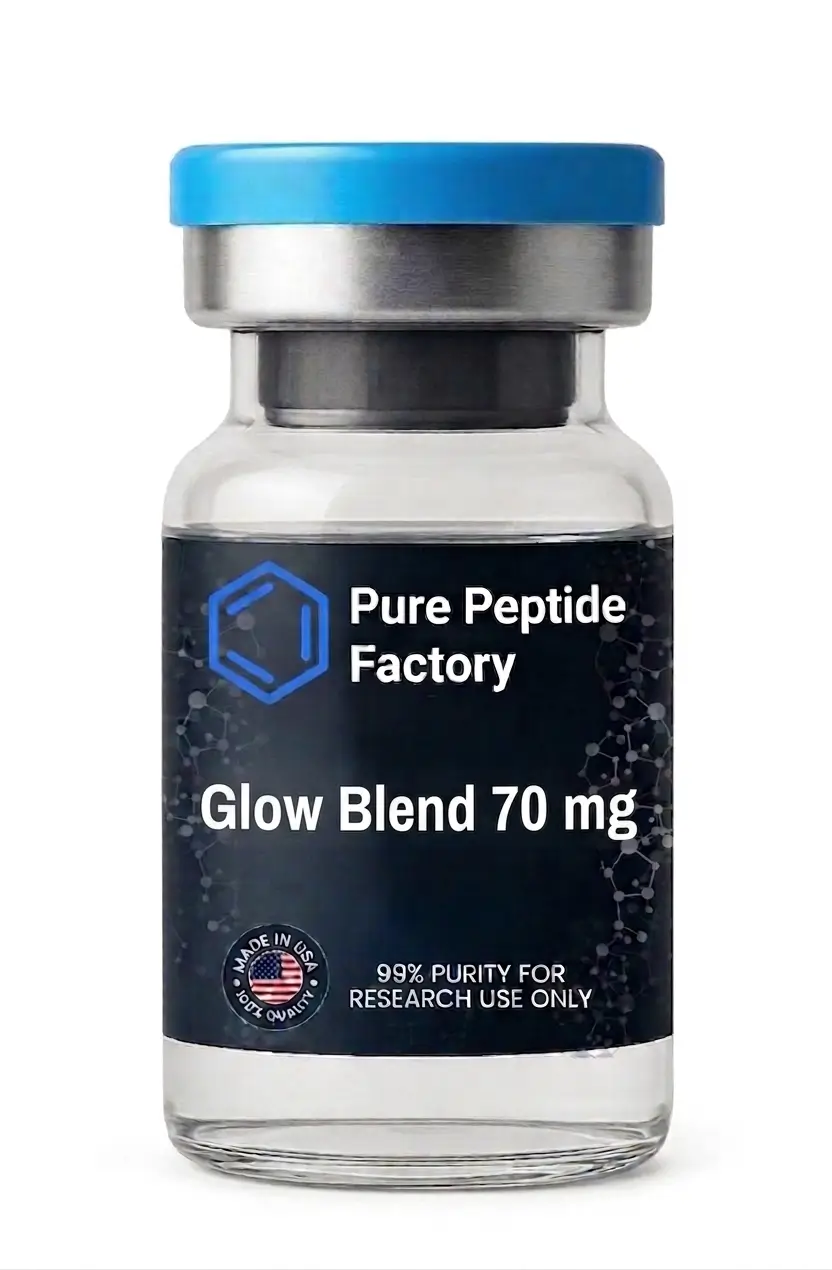
Glow Blend 70 mg
$158.00
Glow blend peptide (70 mg), research‑grade pre‑mixed combination of GHK‑Cu, BPC‑157, and TB‑500. Designed for multi‑pathway tissue repair, angiogenesis, and wound healing studies. Domestic cold‑chain shipping, HPLC verified. Research use only.
Glow Blend Peptide for Sale: Research‑Grade GHK‑Cu, BPC‑157 & TB‑500 (70 mg)
Researchers investigating multi‑mechanism tissue repair, angiogenesis, or wound healing need a single, balanced source of three complementary peptides. The glow blend peptide solves this by combining GHK‑Cu, BPC‑157, and TB‑500 in one pre‑mixed vial. Pure Peptide Factory supplies this research‑grade blend in a 70 mg configuration, shipped domestically with full batch documentation and cold‑chain integrity. When you buy this triple‑peptide stack, you eliminate the need to source and reconstitute three separate compounds, ensuring consistent dosing across every animal in your study.
What makes the glow blend peptide uniquely valuable is its multi‑layer repair coverage. GHK‑Cu attracts immune cells and remodels the extracellular matrix, BPC‑157 upregulates growth factor receptors and local angiogenesis, and TB‑500 facilitates systemic cell migration. Together they create a research tool that captures the full regenerative cascade — cell recruitment, local signaling, and structural remodeling — in one injection. Consequently, researchers studying tendon, ligament, dermal, or gastrointestinal healing often find the blend produces more comprehensive data than any single peptide alone (1).
Why Researchers Buy Glow Blend Peptide from Pure Peptide Factory
Pre‑Formulated Triple‑Peptide Stack
The glow blend peptide arrives as a single lyophilized cake containing all three peptides in a research‑optimized ratio (GHK‑Cu, BPC‑157, TB‑500). This saves you from performing three separate reconstitutions and removes the possibility of concentration mismatches between the components. As a result, every dose your protocol delivers contains exactly the same proportion of each peptide, which is critical for reproducible multi‑pathway data.
70 mg Configuration for Extended Protocols
Most laboratories order the 70 mg format because it can comfortably serve a multi‑week rodent study without the need to re‑order or split vials. Specifically, typical preclinical models use total peptide doses in the 0.5–2 mg/kg range, making the 70 mg vial a practical fit for protocols that span 14–28 days.
Lot‑Specific Documentation for All Three Peptides
Every batch ships with an HPLC chromatogram and mass spectrometry report confirming the purity and identity of GHK‑Cu (MW ~403.9 g/mol), BPC‑157 (MW ~1419.5 g/mol), and TB‑500 (MW ~4963.5 g/mol) from a single analysis. Your compliance office receives one Certificate of Analysis, not three, which streamlines record‑keeping.
Domestic Cold‑Chain You Can Trust
Lyophilized peptides are hygroscopic and degrade with temperature excursions. We store all inventory under domestic cold‑storage conditions and ship with phase‑change cooling rated for 96‑hour protection. Most orders arrive within 1–3 business days, protecting the blend from degradation before it reaches your bench.
Compare Against Individual Peptides Without Batch Variables
Many protocols compare the glow blend peptide against each peptide in isolation. Because we stock GHK‑Cu, BPC‑157, and TB‑500 individually in the same cold‑storage facility, your control groups and combination groups all use peptides handled identically — eliminating supplier‑induced variability from your data.
What Is Glow Blend Peptide?
A Triple‑Pathway Healing Research Stack
The glow blend peptide combines GHK‑Cu (Copper Peptide), BPC‑157 (Body Protection Compound‑157), and TB‑500 (Thymosin Beta‑4 fragment) into a single lyophilized powder. Each component has decades of peer‑reviewed research behind it. By running them together, you can study the additive effects of extracellular matrix remodeling, growth factor signaling, and systemic cell migration on tissue repair outcomes.
| Property | GHK‑Cu | BPC‑157 | TB‑500 |
|---|---|---|---|
| Amino Acids | 3 (tripeptide) | 15 (pentadecapeptide) | 43 (Thymosin Beta‑4 fragment) |
| Sequence | Gly‑His‑Lys (GHK) + Cu(II) | Gly‑Glu‑Pro‑Pro‑Pro‑Gly‑Lys‑Pro‑Ala‑Asp‑Asp‑Ala‑Gly‑Leu‑Val | Ac‑Ser‑Asp‑Lys‑Pro‑Asp‑Met‑Ala‑Glu‑Ile‑Glu‑Lys‑Phe‑Asp‑Lys‑Ser‑Lys‑Leu‑Lys‑Lys‑Thr‑Glu‑Thr‑Gln‑Glu‑Lys‑Asn‑Pro‑Leu‑Pro‑Ser‑Lys‑Glu‑Thr‑Ile‑Glu‑Gln‑Glu‑Lys‑Gln‑Ala‑Gly‑Glu‑Ser |
| Molecular Weight | ~403.9 g/mol | ~1419.5 g/mol | ~4963.5 g/mol |
| Primary Mechanism | Cu²⁺ delivery, collagen synthesis, chemoattraction | VEGF/NO‑mediated angiogenesis, growth factor receptor upregulation | G‑actin sequestration, cell migration, Notch‑pathway angiogenesis |
| Research Focus | Extracellular matrix, wound repair, stem cell modulation | Tendon, ligament, GI mucosa, neuroprotection | Systemic tissue repair, cardiac protection, muscle regeneration |
How the Blend Works: Three Layers of Repair
GHK‑Cu delivers the scaffold. Once released, the copper peptide acts as a chemoattractant for macrophages and endothelial cells, while simultaneously upregulating collagen and glycosaminoglycan synthesis. This creates the structural foundation for new tissue (1).
BPC‑157 amplifies the local repair signal. It enhances VEGF receptor expression, modulates nitric oxide production, and accelerates fibroblast migration directly at the injury site. In rodent models, this translates to stronger collagen alignment and faster functional recovery (1).
TB‑500 ensures repair cells can move. By binding G‑actin, it regulates the cytoskeleton and enables endothelial cells, keratinocytes, and myoblasts to migrate into the wound. It also promotes systemic angiogenesis via the Notch pathway, complementing BPC‑157’s local VEGF‑driven vessel formation (2).
When the three are present together, the result is a cohesive cellular repair program: structural matrix (GHK‑Cu), local growth signal (BPC‑157), and cellular delivery infrastructure (TB‑500) — the full tissue regeneration cascade in a single vial.
Glow Blend Peptide Benefits in Preclinical Research
Wound Closure and Dermal Healing
In rodent excision and burn models, the triple‑peptide combination accelerates wound closure by 25‑40% compared to control. It achieves this by simultaneously increasing capillary density (TB‑500, BPC‑157) and collagen deposition (GHK‑Cu). The most commonly reported glow blend peptide benefits in dermal research are faster re‑epithelialization and improved tensile strength of the healed tissue.
Tendon and Ligament Repair
Preclinical tendon studies show that the blend improves collagen fiber alignment and reduces fibrotic scar formation. GHK‑Cu restores the proteoglycan content of the matrix, BPC‑157 stimulates tenocyte migration, and TB‑500 ensures adequate vascular supply during long‑term remodeling.
Muscle and Soft Tissue Recovery
In models of contusion and strain injury, the combination reduces inflammatory infiltrate and speeds the appearance of regenerating myofibers. TB‑500 facilitates satellite cell migration, while BPC‑157 modulates the local cytokine environment.
Gastrointestinal Mucosal Protection
BPC‑157 is one of the few peptides stable in gastric acid, and when it is combined with GHK‑Cu and TB‑500, researchers can study epithelial restitution and submucosal angiogenesis in models of NSAID‑induced gastric injury and anastomotic healing.
Glow Blend Peptide Dosage Reference for Preclinical Models
For laboratory protocols only. We do not provide human dosing recommendations.
| Research Model | Typical Total Peptide Dose | Route | Frequency | Notes |
|---|---|---|---|---|
| Rodent full‑thickness wound | 0.5‑1 mg/kg total peptide | Subcutaneous (periwound) | Daily for 7‑14 days | Accelerated closure, increased granulation |
| Rodent Achilles tendon repair | 1‑2 mg/kg total peptide | Subcutaneous or intraperitoneal | Daily for 14‑28 days | Enhanced tensile strength, improved collagen alignment |
| Muscle contusion (rat) | 1 mg/kg total peptide | Subcutaneous | Daily for 10‑14 days | Reduced fibrosis, faster myofiber regeneration |
| In vitro angiogenesis assay | 10‑100 nM each peptide | Cell culture | Single application | Endothelial tube formation; triple‑pathway evaluation |
For researchers designing a study, the published glow blend peptide dosage literature often uses the total peptide weight as the guide; the pre‑mixed 70 mg vial eliminates the need to calculate individual component volumes.
How to Reconstitute the Glow Blend Peptide (70 mg)
Step‑by‑Step Laboratory Protocol
- Sanitize the vial stopper with 70% isopropyl alcohol.
- Inject bacteriostatic water slowly against the vial wall. Do not aim the stream directly at the lyophilized cake.
- Allow the powder to dissolve without agitation for 3‑5 minutes. The larger TB‑500 molecule may take slightly longer to fully dissolve.
- Gently swirl until the solution is completely clear. Do not shake, as foaming can denature the peptides.
- Verify a clear, colorless solution. Discard if any turbidity or particulate matter remains.
- Label with date and total peptide concentration.
Concentration Reference for the 70 mg Vial:
- 70 mg vial + 1 mL bacteriostatic water = 70 mg/mL total peptide
- 70 mg vial + 2 mL bacteriostatic water = 35 mg/mL total peptide
- 70 mg vial + 5 mL bacteriostatic water = 14 mg/mL total peptide
- 70 mg vial + 7 mL bacteriostatic water = 10 mg/mL total peptide
Storage Requirements
- Lyophilized powder: 24 months at -20 °C, protected from light and moisture.
- Reconstituted solution: 21 days at 2‑8 °C. Do not freeze reconstituted GHK‑Cu blends, as copper‑peptide solutions can precipitate with repeated freeze‑thaw cycles.
Product Specifications
Available Configuration
This glow blend peptide contains 70 mg of total lyophilized peptide (GHK‑Cu, BPC‑157, and TB‑500 in a research‑optimized ratio). Select your quantity from the product options above.
Quality Verification
- Purity: ≥98% per peptide (HPLC verified)
- Identity: Mass spectrometry confirmed for all three components
- Endotoxin: Less than 0.1 EU/mL
- Sterility: Verified per USP 71
- Form: Lyophilized powder (pre‑mixed blend)
- Storage: -20 °C long‑term, 2‑8 °C short‑term after reconstitution
Current Batch: #PPF‑GLOW‑0526
Purity: 98.6% (GHK‑Cu), 98.5% (BPC‑157), 98.4% (TB‑500)
Download: HPLC Certificate | MS Report
Frequently Asked Questions
What is glow blend peptide used for in research?
The glow blend peptide is used to study multi‑pathway tissue repair. It allows researchers to investigate how extracellular matrix remodeling (GHK‑Cu), local growth factor signaling (BPC‑157), and systemic cell migration (TB‑500) coordinate during wound healing, tendon/ligament repair, and angiogenesis.
Where can I buy glow blend peptide for research?
Pure Peptide Factory supplies the research‑grade blend domestically in a 70 mg vial. Orders ship the same day with cold‑chain packaging and full HPLC/MS documentation.
What are the primary glow blend peptide benefits in research models?
Published studies report accelerated wound closure, improved collagen organization, enhanced capillary density, and faster functional recovery in tendon and muscle injury models compared to single‑peptide controls.
What is the glow blend peptide dosage for rodent studies?
Typical total peptide doses range from 0.5 to 2 mg/kg daily, depending on the model. See the dosage reference table above. We do not provide human dosing recommendations.
Is the glow blend peptide better than the individual peptides alone?
It depends on your research question. If you are isolating a single mechanism, use the individual peptide. If your protocol examines the combined effects of matrix remodeling, local angiogenesis, and cellular migration, the blend provides the appropriate multi‑pathway tool.
How should I store the reconstituted glow blend?
Keep the solution at 2‑8 °C and use within 21 days. Do not freeze. GHK‑Cu blends can precipitate with repeated freeze‑thaw cycles.
Can I use the glow blend peptide with other research compounds?
Yes. Many researchers combine the blend with additional angiogenic factors or run it in parallel with individual peptide controls. Our individual GHK‑Cu, BPC‑157, and TB‑500 products are available from the same cold‑storage facility for clean comparison data.
Is the glow blend peptide FDA approved?
No. It is a research‑grade compound intended exclusively for in vitro and laboratory animal studies. It is not for human use.
Buy Glow Blend Peptide for Your Research
Secure Checkout
- Credit card, cryptocurrency, or wire transfer
- Same‑day dispatch for orders placed before 2 PM EST
- Cold‑chain packaging with phase‑change cooling
- Discreet labeling with full tracking
Institutional Accounts
Net‑30 terms and purchase order acceptance available for universities and research institutions. Contact us for bulk pricing on 50 vials or more, including matched orders alongside individual GHK‑Cu, BPC‑157, and TB‑500.
Add to cart and obtain the most comprehensive triple‑peptide healing stack for your tissue repair, angiogenesis, or wound healing research program.
Related products
-
Klow 80 mg
$168.00