BPC-157 TB-500 Combo
$50.00 $160.00Price range: $50.00 through $160.00
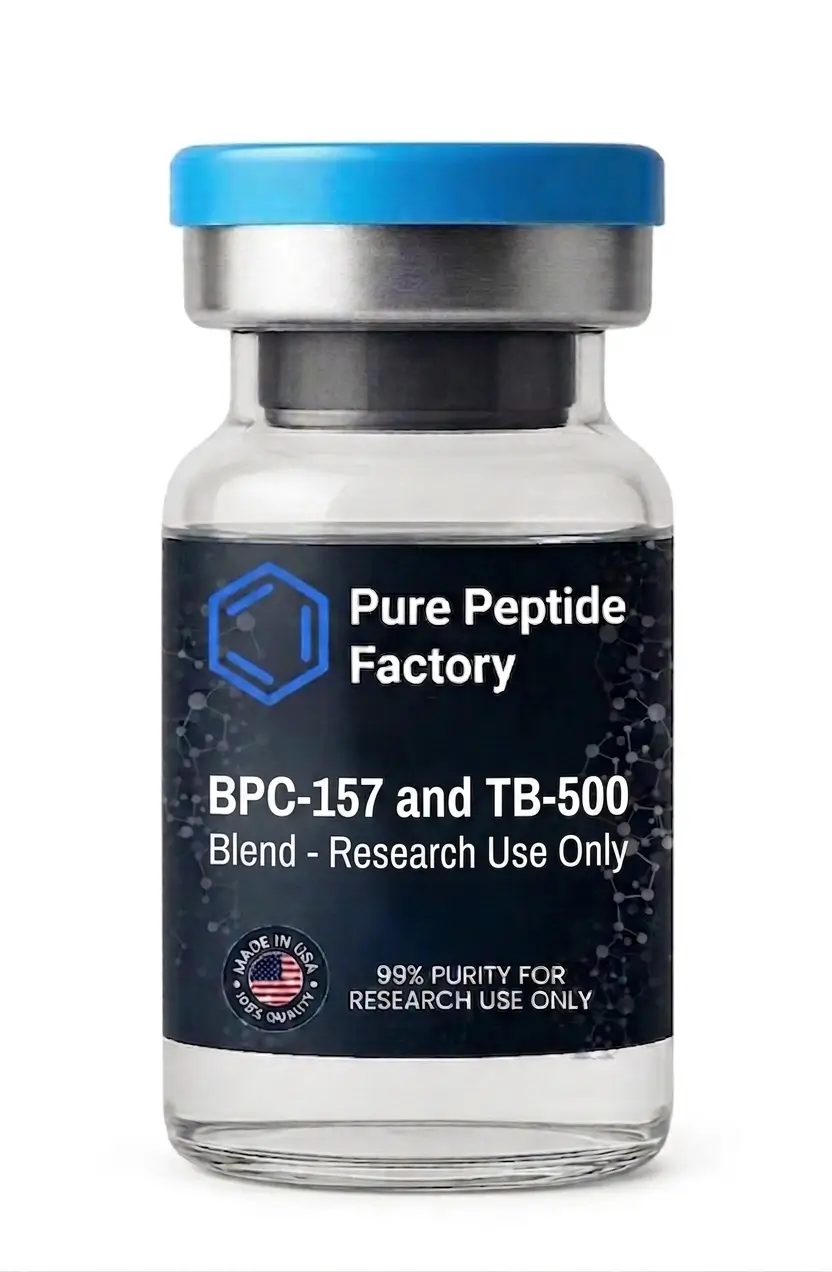
BPC-157 TB-500 combo — research-grade dual-peptide blend (Wolverine Stack) for local tissue repair and systemic recovery synergy studies. Domestic cold-chain shipping, HPLC verified, 5mg/5mg to 10mg/10mg vials. Research use only.
BPC-157 TB-500 Combo for Sale: Research-Grade Wolverine Stack Dual-Peptide Blend
Researchers investigating tissue repair pathways, angiogenesis models, or soft tissue recovery face a recurring question: why study BPC-157 and TB-500 separately when their mechanisms are complementary? The bpc-157 tb-500 combo, often called the Wolverine Stack by researchers, pairs two of the most studied regenerative peptides into a single pre-mixed lyophilized vial. Pure Peptide Factory now supplies this combination domestically with full batch documentation and cold-chain integrity.
When you buy the blend for your laboratory, you receive a precisely formulated combination that eliminates the need to source, reconstitute, and dose two separate peptides. Furthermore, this dual-peptide tool allows you to study how the local tissue repair signaling of BPC-157 interacts with the systemic cell migration drive of TB-500 within the same experimental model. As a result, your data captures the additive effects that are missing from single-peptide protocols. Our HPLC-verified blend ships from domestic cold-storage with phase-change cooling and arrives in 1 to 3 business days.
Why Researchers Choose Pure Peptide Factory for the BPC-157 TB-500 Combo
Pre-Mixed Ratio Eliminates Reconstitution Variables
Sourcing BPC-157 and TB-500 separately means two vials, two reconstitutions, and the potential for concentration discrepancies between the two compounds. Consequently, the pre-mixed bpc-157 tb-500 combo arrives in a single vial with the peptides already formulated at a balanced research ratio. You draw one solution, not two, and your dosing is automatically aligned for both peptides. Therefore, batch-to-batch variability between independently sourced peptides is eliminated from your data.
Lot-Specific Documentation Covering Both Peptides
Every combo vial ships with an HPLC chromatogram and mass spectrometry report that verifies the presence and purity of both BPC-157 (molecular weight 1419.5 g/mol) and TB-500 (molecular weight 4963.5 g/mol) from the same analysis. For this reason, your compliance office receives a single Certificate of Analysis covering the entire blend rather than two separate documents.
Compare Against Individual Peptides Using the Same Supplier
Many protocols compare the bpc-157 tb-500 combo against each peptide in isolation. Because we stock BPC-157 research peptide and TB-500 research peptide individually in the same cold-storage facility, your comparison data remains free of supplier variability. Additionally, all three products ship with matching lot documentation for protocol consistency.
Domestic Cold-Chain You Can Trust
Both peptides in this blend degrade with temperature excursion and moisture exposure. Specifically, the lyophilized powder format is hygroscopic, and improper storage leads to aggregation that reduces bioavailability in research models. We ship all combo vials from domestic cold-storage using phase-change cooling rated for 96-hour protection. Most orders arrive within 1 to 3 business days.
Synthesis Logs Archived for 24 Months
We document and archive every batch. If your IRB or compliance office requests chain-of-custody records, we provide them without delaying your research.
What Is the BPC-157 TB-500 Combo?
Two Peptides, One Synergistic Research Tool
The bpc-157 tb-500 combo combines two synthetic peptides with distinct but complementary mechanisms. BPC-157 (Body Protection Compound-157) is a pentadecapeptide originally derived from a protective protein fragment found in human gastric juice. TB-500 is a synthetic analog of the active region of Thymosin Beta-4, a 43-amino acid actin-sequestering protein. Together, they provide a dual-pathway research tool for studying how local repair signaling and systemic cell migration coordinate during tissue recovery (1).
Molecular Profile: Both Peptides
| Property | BPC-157 | TB-500 |
|---|---|---|
| Type | Synthetic pentadecapeptide (15 amino acids) | Thymosin Beta-4 fragment analog (43 amino acids) |
| Sequence | Gly-Glu-Pro-Pro-Pro-Gly-Lys-Pro-Ala-Asp-Asp-Ala-Gly-Leu-Val | Ac-Ser-Asp-Lys-Pro-Asp-Met-Ala-Glu-Ile-Glu-Lys-Phe-Asp-Lys-Ser-Lys-Leu-Lys-Lys-Thr-Glu-Thr-Gln-Glu-Lys-Asn-Pro-Leu-Pro-Ser-Lys-Glu-Thr-Ile-Glu-Gln-Glu-Lys-Gln-Ala-Gly-Glu-Ser |
| Molecular Formula | C62H98N16O22 | C212H350N56O78S |
| Molecular Weight | 1419.5 g/mol | 4963.5 g/mol |
| Origin | Synthetic fragment of gastric BPC protein | Synthetic analog of Thymosin Beta-4 active domain |
How the BPC-157 TB-500 Combo Works: Local + Systemic Repair Synergy
The combination benefits from two distinct yet additive mechanisms that make the blend more powerful than either peptide alone. Understanding this synergy is the reason researchers choose the combo over individual peptides.
BPC-157 drives local repair signaling. Research shows BPC-157 upregulates growth factor receptors, modulates the nitric oxide system to promote angiogenesis at the injury site, and accelerates fibroblast migration and collagen deposition (1). Specifically, it interacts with the FAK-paxillin pathway to promote cell spreading and migration, and enhances VEGF receptor expression to drive new blood vessel formation directly at the site of injury. Furthermore, BPC-157 has demonstrated protective effects on gastrointestinal mucosa, tendon explants, and neuronal tissue in published preclinical models.
TB-500 provides systemic cell migration infrastructure. TB-500 binds and sequesters G-actin monomers, regulating actin polymerization dynamics that enable cells to move, divide, and remodel tissue (2). Moreover, it promotes endothelial cell differentiation, keratinocyte migration, and the formation of new blood vessels through the Notch signaling pathway. By contrast with BPC-157’s site-specific action, TB-500 circulates systemically and facilitates the cellular infrastructure needed for repair to occur.
When combined, the synergy is clear. BPC-157 creates the local conditions for repair (growth factor expression, angiogenic signaling, anti-inflammatory modulation) while TB-500 ensures the repair cells actually arrive at the site (actin-mediated migration, systemic endothelial recruitment). As a result, the bpc-157 tb-500 combo provides a more comprehensive research tool than either peptide alone, and published preclinical models consistently show accelerated tissue recovery when both pathways are activated simultaneously (3).
BPC-157 TB-500 Combo Research Applications
Tendon, Ligament, and Soft Tissue Repair
One primary research application for the bpc-157 tb-500 combo is preclinical tendon and ligament healing. Specifically, published studies document enhanced tensile strength, improved collagen organization, and accelerated healing kinetics in Achilles tendon models. Furthermore, BPC-157 has demonstrated efficacy in ligament healing through improved fibroblast migration, while TB-500 supports the structural remodeling of the extracellular matrix. Consequently, researchers use the combo to study:
- Collagen fiber alignment and tensile strength in tendon repair models
- Fibroblast migration rates in ligament healing assays
- Extracellular matrix (ECM) deposition and remodeling
- Comparative healing timelines versus BPC-157 or TB-500 alone
Muscle Injury and Regeneration Research
Research shows BPC-157 promotes recovery of experimentally injured gastrocnemius muscle complexes, while TB-500 supports cardiac muscle cell survival and myocyte migration. Therefore, the combo is used in muscle regeneration protocols examining:
- Skeletal muscle contusion and strain recovery models
- Cardiac muscle survival under hypoxic conditions
- Myoblast migration and differentiation
- Satellite cell activation following muscle damage
Angiogenesis and Wound Healing
Both peptides promote angiogenesis, but through distinct pathways. Specifically, BPC-157 acts through VEGF receptor upregulation and nitric oxide modulation at the wound site. By contrast, TB-500 promotes endothelial cell migration and tube formation through the Notch pathway. As a result, the combo provides the researcher with a dual-pathway angiogenic tool for studying:
- Capillary density and blood vessel formation kinetics
- Endothelial cell migration in wound bed models
- Ischemic tissue revascularization
- Diabetic wound healing and impaired angiogenesis models
Gastrointestinal Mucosal Research
BPC-157 has extensively documented protective effects on gastrointestinal mucosa in animal models, including NSAID-induced lesion protection and anastomotic healing. In addition, the combo extends into GI research examining how systemic TB-500-mediated cell migration contributes to mucosal repair alongside BPC-157’s local protective signaling.
Neuroprotection and Nerve Regeneration
BPC-157 has shown effects in models of traumatic brain injury and peripheral nerve crush, while TB-500 reduces microglial activation and promotes oligodendrocyte precursor maturation. Consequently, the combo is a tool for researchers studying central and peripheral nervous system recovery and the interplay between neuronal repair signaling and glial cell migration.
BPC-157 vs TB-500 vs Combo: Which to Choose for Your Protocol
Researchers often ask whether to use the individual peptides or the bpc-157 tb-500 combo. The answer depends entirely on your research question. Furthermore, no competitor product page provides this comparison. Use the table below to match your protocol design to the right compound:
| Feature | BPC-157 (alone) | TB-500 (alone) | BPC-157 TB-500 Combo |
|---|---|---|---|
| Primary mechanism | Growth factor receptor upregulation, NO-system modulation, local VEGF angiogenic signaling | G-actin sequestration, systemic cell migration, Notch pathway angiogenesis | Local repair signaling + systemic cell migration infrastructure |
| Action pattern | Site-specific, concentrated at injury location | Systemic, circulating, multi-tissue | Local + systemic synergy |
| Tissue specificity | Tendon, ligament, GI mucosa, neuronal | Muscle, endothelial, cardiac, dermal | Comprehensive: covers both peptide target tissues |
| Best for studying | Tendon healing, GI protection, local angiogenesis | Cardiac repair, systemic wound closure, cell motility | Coordinated multi-pathway tissue recovery |
| Research setup | Single vial, one reconstitution | Single vial, one reconstitution | Single vial, one reconstitution — both peptides pre-mixed |
| Synergy factor | Not applicable (monotherapy) | Not applicable (monotherapy) | Additive: BPC-157 builds the repair signal; TB-500 delivers the repair cells |
Select BPC-157 alone when your hypothesis isolates growth factor signaling, nitric oxide modulation, or GI mucosal protection. Likewise, pick TB-500 alone when studying actin dynamics, systemic cell migration, or cardiac repair. For protocols examining how local repair signaling and systemic cell migration coordinate during tissue recovery, the bpc-157 tb-500 combo is the appropriate dual-pathway tool. Our facility stocks all three products for clean comparison protocols.
BPC-157 TB-500 Combo Dosage in Published Research
The following reference is compiled from published preclinical studies and serves strictly as a laboratory research design context. We do not provide human dosing recommendations.
| Research Model | Typical Dose (each peptide) | Frequency | Route | Notes |
|---|---|---|---|---|
| Rodent tendon repair (Achilles) | 10 mcg/kg | Daily | Subcutaneous or intraperitoneal | Published by Sikiric group; enhanced tensile strength |
| Muscle contusion model | 10-20 mcg/kg | Daily | Subcutaneous | 14-day protocol; gastrocnemius recovery |
| Wound healing (dermal) | 5-10 mcg per wound | Daily or every 2 days | Topical or subcutaneous | Accelerated closure and granulation |
| Angiogenesis assay | Nanomolar concentrations | Per assay | In vitro (endothelial tube formation) | Cell culture; dual-pathway evaluation |
| Cardiac ischemia model | TB-500: 150 mg/kg total (split dosing) | Every 3 days | Intraperitoneal | Published by Bock-Marquette group |
| GI lesion protection | 10 mcg/kg BPC-157 | Daily | Oral or subcutaneous | NSAID-induced lesion model |
For researchers designing protocols, the published literature provides model-specific ranges for the bpc-157 tb-500 combo. Importantly, the pre-mixed blend ensures the 1:1 ratio is maintained automatically. Researchers studying the combo in tendon or muscle models typically administer daily doses over 14 to 28 days, while angiogenesis and wound closure protocols may run 7 to 21 days depending on endpoints.
How to Reconstitute the BPC-157 TB-500 Combo
Step-by-Step Laboratory Protocol
- Sanitize the vial stopper with 70% isopropyl alcohol.
- Inject bacteriostatic water slowly against the vial wall. Do not aim the stream directly at the lyophilized cake. Both peptides are present in the cake and must dissolve evenly.
- Allow the powder to dissolve without agitation for 3 to 5 minutes. The inclusion of TB-500, a larger peptide (43 amino acids), may require slightly longer dissolution than BPC-157 alone.
- Gently swirl until the solution is clear. Do not shake vigorously. Foaming can denature both peptides.
- Verify a clear, colorless solution before use. Discard if particulate matter remains.
- Label with reconstitution date and concentration.
Concentration Reference for 5mg/5mg Vial (10mg total peptide):
- 5mg/5mg vial + 1mL bacteriostatic water = 5mg/mL BPC-157 + 5mg/mL TB-500
- 5mg/5mg vial + 2mL bacteriostatic water = 2.5mg/mL of each peptide
Concentration Reference for 10mg/10mg Vial (20mg total peptide):
- 10mg/10mg vial + 2mL bacteriostatic water = 5mg/mL of each peptide
- 10mg/10mg vial + 4mL bacteriostatic water = 2.5mg/mL of each peptide
Storage Requirements
- Lyophilized powder: 24 months at -20°C, protected from light and moisture.
- Reconstituted solution: 28 days at 2 to 8°C. Do not freeze.
- The pre-mixed format maintains stability under proper cold-chain conditions. Avoid repeated freeze-thaw cycles.
BPC-157 TB-500 Combo for Sale: Regulatory and Research Context
Research Use Only
Neither BPC-157 nor TB-500 is FDA approved for human therapeutic use. They are sold strictly as research compounds for in vitro and controlled laboratory experimentation. This product is not intended for human consumption, veterinary use, or diagnostic application. You must agree to research-use-only terms at checkout.
The “Wolverine Stack” Context
In research forums and preclinical discussions, the bpc-157 tb-500 combo is commonly referred to as the “Wolverine Stack,” named after the Marvel character known for rapid self-healing. This nickname reflects the dual-pathway healing observed in animal models, where BPC-157’s local repair signaling and TB-500’s systemic cell migration combine to produce faster tissue recovery than either peptide alone. However, this is a colloquial research community term. The product is strictly for laboratory use and has not undergone human clinical trials for any indication.
Important Note on Pre-Mixed Blends vs Separate Vials
Some vendors sell BPC-157 and TB-500 as two separate vials rather than a pre-mixed blend. Our product is shipped as a single pre-formulated vial containing both peptides in a fixed research ratio. This format eliminates reconstitution variability between two separate vials and ensures your protocol doses both peptides at the intended ratio every time. Researchers who need to titrate each peptide independently should purchase the BPC-157 and TB-500 individual products instead.
Product Specifications
Available Configurations
The bpc-157 tb-500 combo is available in 5mg BPC-157 + 5mg TB-500 (10mg total) or 10mg BPC-157 + 10mg TB-500 (20mg total) vials. Select your configuration from the product options above.
Quality Verification
- Purity: 98% minimum per peptide (HPLC verified)
- Identity: Mass spectrometry confirmed for both BPC-157 (1419.5 g/mol) and TB-500 (4963.5 g/mol)
- Endotoxin: Less than 0.1 EU/mL
- Sterility: Verified per USP 71
- Form: Lyophilized powder (pre-mixed blend)
- Storage: -20°C long-term, 2 to 8°C short-term after reconstitution
Current Batch: #PPF-BTCOMBO-0526
Purity: 98.6% (BPC-157), 98.3% (TB-500)
Download: HPLC Certificate | MS Report
Frequently Asked Questions
What is the BPC-157 TB-500 combo used for in research?
Researchers use the bpc-157 tb-500 combo to study coordinated tissue repair across tendon, ligament, muscle, dermal, gastrointestinal, and neuronal models. The combination allows investigation of how local growth factor signaling (BPC-157) and systemic cell migration (TB-500) interact during the recovery process.
What are the combo benefits in research?
Published preclinical studies document accelerated tendon and ligament healing, enhanced collagen organization, improved angiogenic response, reduced inflammatory signaling, and faster wound closure times compared to either peptide alone. The synergy comes from BPC-157 building the local repair signal while TB-500 ensures repair cells arrive at the site.
What is the combo dosage used in research?
Rodent tendon repair models typically use 10 mcg/kg of each peptide administered daily subcutaneously. Muscle contusion studies use 10-20 mcg/kg daily. Dermal wound models use 5-10 mcg per wound. Refer to the dosage chart above for model-specific ranges.
Is the combo better than BPC-157 or TB-500 alone?
The answer depends on your research question. When studying growth factor signaling isolation, use BPC-157 alone. Conversely, when studying actin-mediated cell migration, use TB-500 alone. However, if your protocol examines how local and systemic repair mechanisms coordinate, the combo provides the appropriate dual-pathway tool. See the comparison table above for full details.
Is this a pre-mixed blend or two separate vials?
This is a pre-mixed blend in a single lyophilized vial. Both peptides are formulated together at a fixed research ratio. This single-vial format eliminates variability between two separate reconstitutions.
Where can I buy the BPC-157 TB-500 combo?
Pure Peptide Factory stocks the research-grade bpc-157 tb-500 combo domestically with same-day dispatch and cold-chain shipping. Most orders arrive within 1 to 3 business days with full HPLC and mass spectrometry documentation.
How should I store the reconstituted combo?
Store reconstituted solution at 2 to 8°C and use within 28 days. Do not freeze. The lyophilized powder stores at -20°C for up to 24 months.
Is the combo safe for research models?
Published preclinical data supports a favorable safety profile in standard research models. Both peptides have been studied in numerous animal trials. As with all research compounds, institutional biosafety oversight and IRB approval are required for in vivo work.
Can I add GHK-Cu to this combo for my research?
Many researchers add GHK-Cu to the BPC-157/TB-500 combination to create a triple-peptide healing stack. Our Glow Blend contains all three peptides pre-formulated in a research ratio. Alternatively, GHK-Cu is available as a standalone product for protocols requiring independent dosing.
Why is it called the Wolverine Stack?
The nickname originated in research communities and refers to the rapid healing observed in preclinical models when both peptides are combined. It is a colloquial term and does not imply therapeutic claims.
Can I buy the combo without a prescription?
Yes, for laboratory research under research-use-only terms. This is a research procurement, not a prescription product.
Order the BPC-157 TB-500 Combo for Research
Secure Checkout
- Credit card, cryptocurrency, or wire transfer
- Same-day dispatch for orders placed before 2 PM EST
- Cold-chain packaging with phase-change cooling
- Discreet labeling with full tracking
Institutional Accounts
Net-30 terms and purchase order acceptance available for universities and research institutions. Contact us for bulk pricing on 50 vials or more, including matched bulk orders for the bpc-157 tb-500 combo alongside individual BPC-157, TB-500, and GHK-Cu for comparative research protocols.
Add to cart and get the most thoroughly documented dual-peptide tissue repair research blend available domestically.
Related products
-
Glow Blend 70 mg
$158.00