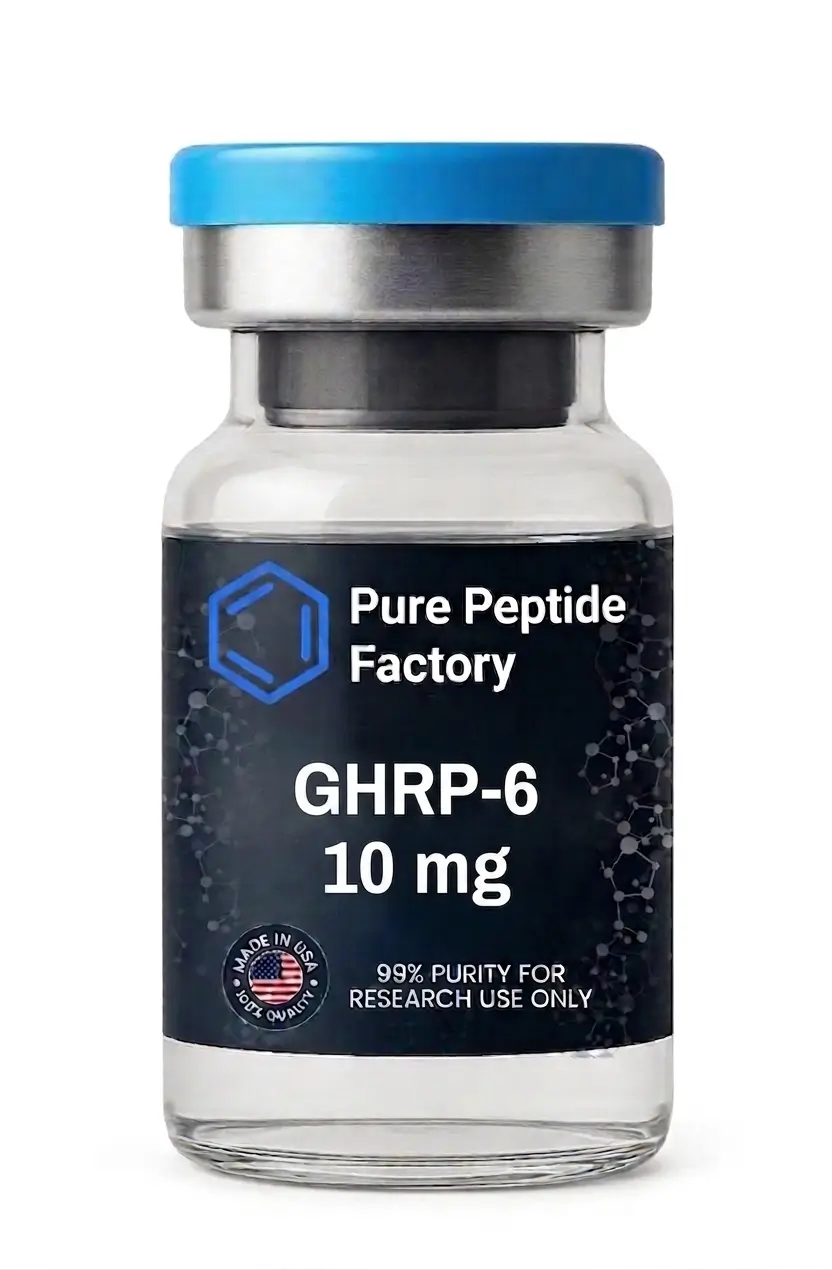
GHRP-6 10 mg
$20.00 $30.00Price range: $20.00 through $30.00
Buy GHRP-6 for research, the original synthetic hexapeptide ghrelin mimetic (His-D-Trp-Ala-Trp-D-Phe-Lys-NH₂) for GH secretion, appetite regulation, and cardioprotection studies. 5mg, 10mg vials. Domestic cold-chain shipping, HPLC verified. Research use only.
Buy GHRP-6: Research-Grade Ghrelin Receptor GH Secretagogue
Researchers studying growth hormone (GH) secretion dynamics, ghrelin receptor pharmacology, appetite regulation, or cardioprotection need a reliable domestic source for GHRP-6. Pure Peptide Factory supplies this research-grade synthetic hexapeptide in 5mg and 10mg lyophilized vials with full batch documentation and cold-chain shipping. As the original growth hormone-releasing peptide, the first synthetic ghrelin mimetic ever developed — GHRP-6 remains one of the most extensively characterized GH secretagogues in the research literature, with published studies spanning pituitary signaling, hypothalamic feeding circuits, cardiac ischemia models, and even self-assembling hydrogels for acute kidney injury (1). When you buy GHRP-6 from our domestic stock, you receive a precisely characterized hexapeptide backed by decades of peer-reviewed research.
What distinguishes GHRP-6 from newer ghrelin mimetics is its unique combination of robust GH-releasing activity and pronounced appetite stimulation, properties that mirror the dual orexigenic and somatotropic functions of endogenous ghrelin itself. Unlike Ipamorelin, which produces cleaner but weaker GH release, or GHRP-2, which generates higher GH output at the cost of elevated cortisol and prolactin, this original hexapeptide occupies a middle ground that makes it the preferred tool for researchers studying the full spectrum of ghrelin receptor biology (2). Researchers who buy GHRP-6 are therefore choosing the reference compound against which all later GHRPs were benchmarked.
Why Researchers Buy GHRP-6 from Pure Peptide Factory
Documentation for the Reference Ghrelin Mimetic
GHRP-6 is a precisely sequenced hexapeptide (His-D-Trp-Ala-Trp-D-Phe-Lys-NH₂) with a molecular formula of C₄₆H₅₆N₁₂O₆ and a molecular weight of 873.0 Da. Every batch we ship includes lot-specific HPLC and mass spectrometry documentation verifying purity (≥98%) and sequence integrity. Consequently, researchers who buy GHRP-6 from our facility can trust that the compound’s molecular identity matches the published literature, critical because even minor sequence variations shift the ghrelin receptor binding kinetics that define this peptide’s research utility.
Two SKU Configurations for Protocol Flexibility
We stock GHRP-6 in 5mg and 10mg lyophilized vials. The 5mg configuration accommodates pilot studies, acute GH pulse experiments, and dose-response protocols where doses of 20-200 µg/kg are examined in rodent models. The 10mg format supports extended protocols, multi-week feeding studies, and combination protocols pairing this ghrelin mimetic with GHRH analogs such as CJC-1295 or Sermorelin.
Domestic Cold-Chain Integrity
Synthetic hexapeptides like this compound are stable as lyophilized powder but degrade with moisture exposure and temperature excursion after reconstitution. Consequently, we store all inventory under domestic cold-storage conditions and ship using phase-change cooling. Most orders arrive in 1 to 3 business days.
Compare Against Other GH Secretagogues Without Batch Variables
Many research protocols compare GHRP-6 against other ghrelin receptor agonists such as GHRP-2, Ipamorelin, or Hexarelin. Additionally, combination protocols often pair it with GHRH analogs like Sermorelin or Mod GRF 1-29. Because we stock the full GH secretagogue panel under identical cold-storage conditions, researchers who buy GHRP-6 alongside these complementary compounds eliminate supplier variability from their cross-compound data.
Synthesis Logs Archived for 24 Months
Should your IRB or compliance office request chain-of-custody records, we provide them without delay.
What Is GHRP-6?
The Original Ghrelin Mimetic That Launched a Peptide Class
GHRP-6 (Growth Hormone Releasing Peptide-6), also known by its developmental code SKF-110679, is a synthetic hexapeptide that Dr. Cyril Bowers and colleagues at Tulane University developed in the 1980s as part of a systematic effort to create small, orally active GH secretagogues. The team synthesized this peptide by modifying met-enkephalin, replacing glycine residues with D-amino acids to eliminate opioid activity while preserving the GH-releasing signal. The result was a compound that activated a then-unknown receptor with surprising potency, stimulating GH release through a mechanism independent of the GHRH receptor. It was this receptor, cloned in 1996 by the Merck group, that became the growth hormone secretagogue receptor (GHS-R1a) and its subsequent identification as the target of the stomach-derived hormone ghrelin in 1999 by Kojima and colleagues remains one of the most significant discoveries in endocrinology of the past three decades (1).
Unlike GHRP-2, which eventually secured regulatory approval in Japan as a diagnostic agent for GH deficiency, GHRP-6 never proceeded to full clinical approval. However, it served as the template compound, the reference agonist against which all subsequent ghrelin mimetics were measured. When researchers buy GHRP-6, they work with the molecule that defined the GHS-R1a pharmacology field.
Molecular Profile:
- Sequence: His-D-Trp-Ala-Trp-D-Phe-Lys-NH₂
- Molecular Formula: C₄₆H₅₆N₁₂O₆
- Molecular Weight: 873.0 Da
- CAS Number: 87616-84-0
- Classification: Synthetic hexapeptide ghrelin receptor (GHS-R1a) agonist
- Synonyms: GHRP-6, SKF-110679, Growth Hormone Releasing Hexapeptide, GH-releasing hexapeptide
- Half-life: ~1.5-2.5 hours (plasma); GH pulse duration ~45-60 minutes
- Developer: Cyril Bowers, Tulane University School of Medicine
How GHRP-6 Works: GHS-R1a Activation and GH Pulse Amplification
The mechanism of GHRP-6 centers on the ghrelin receptor, officially the growth hormone secretagogue receptor type 1a (GHS-R1a), a seven-transmembrane G-protein-coupled receptor expressed at high density on pituitary somatotroph cells and hypothalamic feeding-regulatory neurons. When the hexapeptide binds GHS-R1a, it activates the Gq/11 protein pathway, stimulating phospholipase C (PLC) to cleave PIP₂ into IP₃ and diacylglycerol. IP₃ then triggers calcium release from intracellular stores, and the resulting Ca²⁺ influx drives GH-containing secretory vesicles to fuse with the plasma membrane, releasing GH into circulation. Importantly, this calcium-dependent mechanism is entirely distinct from the cAMP-dependent pathway used by GHRH, which is why co-administration of GHRP-6 with a GHRH analog produces synergistic, not merely additive — GH output (1).
Two additional mechanisms amplify the GH response. First, this ghrelin mimetic suppresses hypothalamic somatostatin tone, reducing the inhibitory brake on GH release and allowing each natural GHRH pulse to produce a larger GH spike. Second, research shows GHRP-6 also acts at the hypothalamic level: a landmark 2025 study by the Cornea group demonstrated that intranasal GHRP-6 (5 mg/kg) engages arcuate nucleus neurons,79% of c-fos-expressing cells coexpressed AgRP mRNA, and 63.5% coexpressed GHSR mRNA — confirming direct activation of the hypothalamic ghrelin signaling system (1).
Beyond GH release, activation of GHS-R1a on hypothalamic NPY/AgRP neurons stimulates appetite with notable intensity. Unlike GHRP-2, which produces moderate hunger, GHRP-6’s appetite-stimulating effect is substantial enough that metabolic researchers often use it as a measurable endpoint in its own right, the compound has been shown to increase meal frequency and meal size simultaneously, producing a pronounced orexigenic response within 20-30 minutes of administration in rodent models.
Buy GHRP-6: Research Applications and Benefits
GH Pulse Dynamics and Pituitary Function
The primary research application of GHRP-6 is the study of growth hormone secretory dynamics. Doses ranging from 3-30 µg/kg administered intravenously produce rapid, dose-dependent GH pulses peaking at 15-30 minutes in rodent and ovine models. Furthermore, the GH response to GHRP-6 changes with age and metabolic status, making it a valuable probe for assessing somatotroph responsiveness across different physiological states. The most extensively documented ghrp 6 benefits in this context include its ability to stimulate GH independently of the GHRH receptor, a feature that allows researchers to dissect the relative contributions of GHRH-dependent and ghrelin-dependent GH secretion pathways (2).
Appetite Regulation and Energy Balance
GHRP-6 produces appetite stimulation that is more pronounced than either GHRP-2 or Ipamorelin, making it the preferred ghrelin mimetic for feeding studies. A 2025 study demonstrated that intranasal GHRP-6 at 5 mg/kg increased food intake by increasing both meal frequency and meal size in mice, while detailed Fos mapping confirmed arcuate nucleus NPY/AgRP neuron activation, the canonical hypothalamic hunger circuit (1). Researchers who buy GHRP-6 for appetite studies can therefore use it as a reliable tool for probing ghrelin-mediated feeding behavior, with the hunger response measurable within 20-30 minutes of dosing.
Cardioprotection and Ischemia Research
A 2024 study published in Frontiers in Pharmacology demonstrated that GHRP-6 administered concurrently with doxorubicin prevented the onset of dilated cardiomyopathy in rats. Specifically, the peptide preserved left ventricular systolic function, attenuated extracardiac toxicity across multiple organs, sustained cellular antioxidant defenses, upregulated the prosurvival gene Bcl-2, and preserved cardiomyocyte mitochondrial integrity (2). These findings extend the peptide’s research utility significantly beyond the classical somatotropic axis into cardiovascular pharmacology.
Multiple Organ Failure and Cytoprotection
Pretreatment with GHRP-6 at 120 µg/kg intraperitoneally truncated multiple organ failure effects by 50-85% in rodent models, with additional benefit observed when combined with EGF. These cytoprotective properties position GHRP-6 as a research tool for studying tissue preservation mechanisms under severe physiological stress.
Acute Kidney Injury and Metabolic Reprogramming
A 2025 study designed a self-assembling GHRP-6 peptide hydrogel and demonstrated that it reprogrammed the metabolism of renal tubular epithelial cells, enhancing recovery from acute kidney injury through activation of the mTOR-P70 pathway. Specifically, the treatment enriched spermidine, L-glutamine, and acetyl-CoA in the ischemic microenvironment, providing metabolic fuel for cellular repair (3). This novel application demonstrates the peptide’s versatility as a research scaffold beyond traditional GH axis studies.
Combination Protocols with GHRH Analogs
The calcium-dependent (GHRP-6) and cAMP-dependent (GHRH) GH release pathways are mechanistically distinct, and simultaneous activation produces synergistic GH output far greater than either agent alone. Published research confirms that GHRP-6 combined with GHRH analogs (Sermorelin, CJC-1295 without DAC, or Mod GRF 1-29) amplifies GH output 2-3 times compared to the ghrelin mimetic alone. This dual-receptor strategy remains one of the most productive research applications of GHRP-6, and researchers who buy GHRP-6 for combination protocols can source the complementary GHRH analogs from our catalog under identical handling conditions.
GHRP-6 vs GHRP-2: Choosing the Right Ghrelin Mimetic for Your Protocol
The most-searched comparison question in the ghrelin mimetic research space is ghrp 2 vs 6. Both are synthetic hexapeptides targeting the same GHS-R1a receptor, and both were developed by the Bowers laboratory, but they differ significantly in potency, selectivity, and side-effect profile:
| Feature | GHRP-6 | GHRP-2 |
|---|---|---|
| Structure | His-D-Trp-Ala-Trp-D-Phe-Lys-NH₂ | H-D-Ala-D-β-Nal-Ala-Trp-D-Phe-Lys-NH₂ |
| Molecular Weight | 873.0 Da | 817.0 Da |
| GH-releasing potency | Reference compound (baseline potency) | 2-3× more potent than GHRP-6 |
| Appetite stimulation | Very strong (increases meal frequency + meal size) | Moderate (36% increase in food intake — Laferrère 2005) |
| Prolactin elevation | Minimal at doses ≤100 µg; measurable above 100 µg | Moderate across wider dose range |
| Cortisol elevation | Minimal at ≤1 µg/kg; distinct above 1 µg/kg | Moderate; more pronounced than GHRP-6 |
| Clinical development | Preclinical (reference compound only) | Phase 2 (Japan: approved diagnostic agent KP-102) |
| Oral/intranasal activity | Yes (active intranasally at 5 mg/kg in mice) | Yes (active via oral, intranasal routes) |
| Cardioprotection data | Strong: prevents DCM in doxorubicin model (2024) | Moderate: suppresses vascular oxidative stress (ApoE model, 2009) |
| Best for studying | Full-spectrum ghrelin biology, appetite research, cardioprotection, multi-organ cytoprotection | Maximal GH output, GH deficiency diagnostic modeling, vascular inflammation |
The key difference is research focus: choose GHRP-6 when studying ghrelin receptor biology holistically — appetite regulation, metabolic adaptation to feeding, and cardioprotection — where its pronounced hunger-stimulating effect and emerging tissue-protective properties are research advantages rather than confounds. Choose GHRP-2 when maximal GH output is the primary endpoint and appetite stimulation needs to remain moderate. For the cleanest possible ghrelin receptor activation with minimal off-target endocrine effects, Ipamorelin , a pentapeptide with superior selectivity, may be more appropriate than either hexapeptide.
GHRP-6 Dosage Reference for Preclinical Research
For laboratory protocols only. We do not provide human dosing recommendations.
| Research Model | Dose Range | Route | Key Finding | Reference |
|---|---|---|---|---|
| Mouse intranasal feeding study | 5 mg/kg | Intranasal | Increased food intake via arcuate nucleus NPY/AgRP neuron activation; elevated serum GH | Cornea 2025 |
| Rat doxorubicin cardiomyopathy | 200 µg/kg | Subcutaneous (concurrent with Dox) | Preserved LV systolic function; sustained Bcl-2; preserved mitochondrial integrity | Berlanga-Acosta 2024 |
| Mouse multiple organ failure | 120 µg/kg | Intraperitoneal | 50-85% reduction in organ failure effects; additive benefit with EGF | Berlanga 2003 |
| Rodent GH pulse study | 3-30 µg/kg | Intravenous | Dose-dependent GH release, peak at 15 min; synergistic with GHRH co-administration | Bowers 1990 |
| Mouse colonic motility | 20-200 µg/kg | Intraperitoneal | Dose-dependent effect on colonic propulsion | Chinese journal 2012 |
| Aquaculture immune modulation | 500 µg/kg (in feed) | Oral (dietary) | Modulated immune gene expression in tissue- and stimulus-specific manner | DOAJ 2025 |
For researchers seeking detailed dosing parameters, the published literature from the Bowers, Cornea, Berlanga-Acosta, and Berlanga groups provides validated dose ranges across multiple species and endpoints. The 2025 Cornea study establishing intranasal GHRP-6 activity at 5 mg/kg in mice represents a significant recent addition to the preclinical dosing literature (1).
How to Reconstitute GHRP-6
Step-by-Step Laboratory Protocol
- Sanitize the vial stopper with 70% isopropyl alcohol.
- Inject bacteriostatic water or sterile PBS slowly against the vial wall. This hexapeptide is highly soluble; avoid directing the stream at the lyophilized cake to minimize foaming.
- Allow the powder to dissolve without agitation for 1-2 minutes.
- Gently swirl until the solution is completely clear. Do not shake vigorously.
- Verify a clear, colorless solution. Discard if any turbidity or particulate matter remains.
- Label with date and concentration.
Concentration Reference:
- 5mg vial + 1 mL bacteriostatic water = 5 mg/mL; + 2 mL = 2.5 mg/mL
- 10mg vial + 1 mL bacteriostatic water = 10 mg/mL; + 2 mL = 5 mg/mL
Storage Requirements:
- Lyophilized powder: 24 months at -20°C, protected from light and moisture.
- Reconstituted solution: 2-7 days at 4°C. For long-term storage, aliquot and freeze at -20°C or below. It is recommended to add a carrier protein (0.1% HSA or BSA) for extended frozen storage.
- Please prevent freeze-thaw cycles. The hexapeptide is stable at neutral pH; avoid extreme acidic or basic conditions during handling.
Buy GHRP-6: Regulatory and Research Context
Research Use Only
GHRP-6 is not FDA approved for any human indication. It served as the reference compound for the ghrelin mimetic class and was never advanced to full clinical approval, unlike its successor GHRP-2 which gained diagnostic approval in Japan. Researchers who buy GHRP-6 from Pure Peptide Factory receive a research-grade synthetic hexapeptide sold strictly for in vitro and controlled laboratory animal studies. This product is not for human consumption, veterinary use, or diagnostic application. You must agree to research-use-only terms at checkout.
GHRP-6 in Bodybuilding Research Context
GHRP-6 occupies a distinctive position in the GH secretagogue family due to its pronounced appetite-stimulating effect, a property that made it the peptide of choice in research investigating how GH release and caloric surplus interact to promote lean mass accretion. The logic is straightforward: GH secretion promotes protein synthesis and lipolysis, but building tissue requires a caloric surplus. GHRP-6’s dual action, stimulating GH release while simultaneously driving food intake through NPY/AgRP neuron activation, provided researchers with a model to study the coordinated anabolic response. However, researchers should note that this same appetite effect makes GHRP-6 a confound in studies where food intake must remain controlled between groups. Furthermore, GHRP-6 (like GHRP-2) is classified as a prohibited substance by the World Anti-Doping Agency (WADA) under Section S2.2 (Peptide Hormone Releasing Factors). Athletes subject to doping control should be aware that GHRP-6 and its metabolites are detectable in urine. Researchers should source the peptide exclusively from verified suppliers with batch-specific documentation.
Product Specifications
Available Configurations
GHRP-6 is available in 5mg and 10mg lyophilized powder vials. Select your configuration from the product options above.
Quality Verification
- Purity: ≥98% (HPLC verified)
- Identity: Mass spectrometry confirmed against the 873.0 Da molecular weight target with sequence verification
- Endotoxin: Less than 0.1 EU/mL
- Sterility: Verified per USP 71
- Form: Lyophilized powder (lyophilized with no additives)
- Storage: -20°C long-term (lyophilized); 4°C short-term (2-7 days after reconstitution); -20°C or below for frozen aliquots
- CAS Number: 87616-84-0
Current Batch: #PPF-GHRP6-0526
Purity: 98.8%
Download: HPLC Certificate | MS Report
Frequently Asked Questions
Where can I buy GHRP-6 for research?
Pure Peptide Factory supplies research-grade GHRP-6 domestically in 5mg and 10mg vials with same-day dispatch and cold-chain shipping. Orders arrive within 1 to 3 business days with full HPLC and mass spectrometry documentation.
What are the primary ghrp 6 benefits in research?
Published research documents robust, dose-dependent GH release via GHS-R1a activation, pronounced appetite stimulation through hypothalamic NPY/AgRP neurons, cardioprotection in doxorubicin-induced cardiomyopathy models (preserved LV function, Bcl-2 upregulation, mitochondrial preservation), attenuation of multiple organ failure by 50-85% in rodent models, and synergistic GH output when combined with GHRH analogs such as Sermorelin or CJC-1295.
How does GHRP-6 compare to GHRP-2?
GHRP-2 is 2-3 times more potent at stimulating GH release but produces greater prolactin, ACTH, and cortisol elevation. GHRP-6 provides somewhat lower GH output but with a cleaner side-effect profile at low-to-moderate doses, and it stimulates appetite far more strongly, a property that is either an advantage or a confound depending on the study design. See the full comparison table above.
How does GHRP-6 compare to Ipamorelin?
Ipamorelin is the most selective ghrelin receptor agonist available, it stimulates GH without significantly elevating prolactin, ACTH, or cortisol, and produces minimal appetite stimulation. GHRP-6 is a less selective but more thoroughly characterized reference compound with decades of published research behind it. Choose GHRP-6 for studying the full spectrum of ghrelin receptor biology; choose Ipamorelin for protocols requiring clean GH release with minimal confounds.
What is the GHRP-6 dosage used in preclinical research?
Rodent GH pulse studies use 3-30 µg/kg IV. Cardioprotection studies use 200 µg/kg SC. Multiple organ failure studies use 120 µg/kg IP. Intranasal feeding studies use 5 mg/kg. Refer to the dosage reference table above for model-specific details. We do not provide human dosing recommendations.
Why does GHRP-6 stimulate appetite so strongly?
GHRP-6 was designed to mimic ghrelin’s GH-releasing effects, but it also inherited ghrelin’s appetite-stimulating properties because both effects are mediated through the same GHS-R1a receptor. Activation of this receptor on hypothalamic NPY/AgRP neurons in the arcuate nucleus triggers hunger signaling, a 2025 study confirmed that 79% of c-fos-expressing neurons activated by intranasal GHRP-6 coexpressed AgRP mRNA, directly linking the peptide to the canonical hunger circuit.
At what doses does cortisol elevation become significant in GHRP-6 research?
Cortisol elevation is dose-dependent. At lower doses (approximately 0.1-1 µg/kg), GH release occurs with minimal ACTH/cortisol response in most rodent models. As doses exceed 1 µg/kg, measurable cortisol elevation appears. Researchers isolating GH effects should track cortisol as a secondary variable and consider the 1 µg/kg threshold when designing dose-response studies.
Can GHRP-6 be combined with CJC-1295 or Sermorelin in research?
Yes. GHRP-6 combined with a GHRH analog (Sermorelin, Mod GRF 1-29, or CJC-1295 without DAC) produces synergistic GH release through simultaneous activation of the calcium-dependent (GHS-R1a) and cAMP-dependent (GHRH receptor) pathways. Published studies confirm GH output amplified 2-3 times compared to GHRP-6 alone.
Is GHRP-6 banned in sports?
Yes. WADA classifies GHRP-6 as a prohibited substance under Section S2.2 (Peptide Hormone Releasing Factors). The peptide and its metabolites are detectable in urine via LC-MS/MS. Researchers should source GHRP-6 exclusively from verified suppliers with batch-specific documentation.
How should I store GHRP-6 after reconstitution?
Store reconstituted solution at 4°C for 2-7 days. For long-term storage, aliquot and freeze at -20°C or below. It is recommended to add a carrier protein (0.1% HSA or BSA) for extended frozen storage. Avoid repeated freeze-thaw cycles.
Buy GHRP-6 for Your Research
Secure Checkout
- Credit card, cryptocurrency, or wire transfer
- Same-day dispatch for orders placed before 2 PM EST
- Cold-chain packaging with phase-change cooling
- Discreet labeling with full tracking
Institutional Accounts
Net-30 terms and purchase order acceptance available for universities and research institutions. Contact us for bulk pricing on 50 vials or more, including matched orders alongside Ipamorelin, Sermorelin, CJC-1295, GHRP-2, and Hexarelin for comparative GH axis research protocols.
Add to cart and secure the original reference ghrelin mimetic, the most extensively characterized GH secretagogue in the research literature, for your neuroendocrine, metabolic, cardioprotection, or appetite regulation research program.