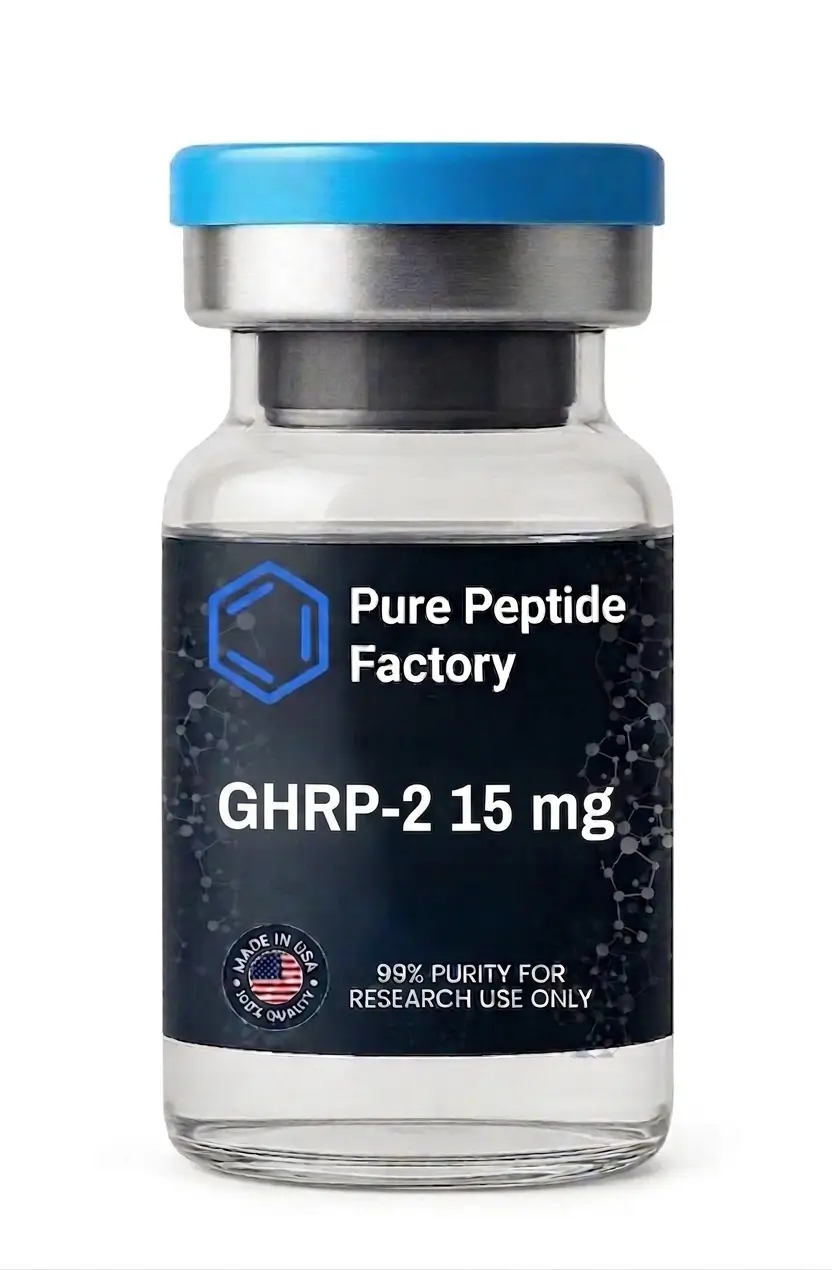
GHRP-2 15 mg
$20.00 $40.00Price range: $20.00 through $40.00
GHRP-2 peptide, research-grade synthetic hexapeptide ghrelin receptor (GHS-R1a) agonist for GH pulse dynamics, appetite regulation, and IGF-1 metabolic pathway studies. 5mg, 10mg, 15mg vials, domestic cold-chain shipping, HPLC verified. Research use only.
GHRP-2 Peptide for Sale: Research-Grade Ghrelin Receptor GH Secretagogue
Researchers investigating growth hormone (GH) pulse dynamics, ghrelin receptor signaling, appetite regulation, or the somatotropic axis need a reliable domestic source for ghrp 2 peptide. Pure Peptide Factory supplies this research-grade synthetic hexapeptide in 5mg, 10mg, and 15mg lyophilized vials with full batch documentation and cold-chain shipping. Unlike GHRH analogs such as Sermorelin or CJC-1295 that act through the GHRH receptor, this ghrelin mimetic targets the growth hormone secretagogue receptor (GHS-R1a), a parallel, non-GHRH-dependent pathway. Moreover, it remains one of the most potent GH secretagogues ever synthesized, delivering two to three times the GH-releasing activity of the original GHRP-6 (1).
What makes ghrp 2 peptide particularly significant in endocrinology research is its unusual clinical history. In Japan, Kaken Pharmaceutical successfully developed it as KP-102, an approved diagnostic agent for growth hormone deficiency that offers a GH stimulation test alternative to the insulin tolerance test. Multiple Phase 1 and Phase 2 trials in children with short stature demonstrated robust, dose-dependent GH release following intravenous, subcutaneous, and even intranasal administration. Additionally, the US rights were licensed to Wyeth for Phase 2 GH deficiency trials, although the company eventually discontinued development. Consequently, researchers working with ghrp 2 peptide benefit from published human pharmacokinetic and pharmacodynamic data, a reference base most research peptides lack entirely (1).
Why Researchers Buy GHRP-2 Peptide from Pure Peptide Factory
Documentation for a Defined Synthetic Hexapeptide
GHRP-2 peptide is a precisely sequenced hexapeptide (H-D-Ala-D-β-Nal-Ala-Trp-D-Phe-Lys-NH₂) with a molecular formula of C₄₅H₅₅N₉O₆ and a molecular weight of 817.0 Da. Every batch we ship includes lot-specific HPLC and mass spectrometry documentation verifying purity (≥98%) and sequence integrity. As a result, researchers can trust that the compound’s molecular identity matches the published literature before beginning any protocol.
Three SKU Configurations for Protocol Flexibility
We stock this peptide in 5mg, 10mg, and 15mg lyophilized vials. The 5mg configuration accommodates pilot studies and acute GH pulse experiments. The 10mg format supports standard rodent protocols where researchers use doses of 10-90 nmol for food intake and GH secretion studies. The 15mg size serves extended protocols and dose-response designs. Therefore, you can match vial size to protocol scale without splitting vials or compromising reconstituted solution freshness.
Domestic Cold-Chain Integrity
Synthetic hexapeptides like this compound are stable as lyophilized powder but degrade with moisture exposure and temperature excursion after reconstitution. Consequently, we store all inventory under domestic cold-storage conditions and ship using phase-change cooling. Most orders arrive in 1 to 3 business days.
Compare Against Other GH Secretagogues Without Batch Variables
Many research protocols compare this ghrelin receptor agonist against other GH secretagogues such as Ipamorelin, GHRP-6, Sermorelin, or CJC-1295/Ipamorelin combinations. Because we stock the full GH secretagogue panel under identical cold-storage conditions, your cross-compound comparison data remains free of supplier variability.
Synthesis Logs Archived for 24 Months
Should your IRB or compliance office request chain-of-custody records, we provide them without delay.
What Is GHRP-2 Peptide?
A Synthetic Hexapeptide That Mimics Ghrelin
GHRP-2 peptide (Growth Hormone Releasing Peptide-2), also known by its clinical name pralmorelin and the Japanese development codes KP-102 and GPA-748, is a synthetic hexapeptide designed to replicate the GH-releasing action of ghrelin. Dr. Cyril Bowers and colleagues at Tulane University synthesized the peptide as part of a systematic effort to develop small, highly active GH secretagogues suitable for multiple administration formats, including intravenous, subcutaneous, buccal, oral, and intranasal delivery. Unlike ghrelin, which requires an octanoyl modification for receptor activation, this synthetic hexapeptide binds the GHS-R1a receptor directly through its D-amino acid and D-β-naphthylalanine substitutions. As a result, it acts as a potent and stable agonist without requiring post-translational acylation. It belongs to a family of enkephalin-derived peptides (alongside GHRP-6, Hexarelin, and Ipamorelin) that researchers engineered to favor GH release over opioid activity by targeting ghrelin receptors rather than classical opioid receptors (1).
Molecular Profile:
- Sequence: H-D-Ala-D-β-Nal-Ala-Trp-D-Phe-Lys-NH₂
- Single-letter code: aXAWfK-NH₂ (where ‘a’ = D-alanine, ‘X’ = D-β-naphthylalanine, ‘f’ = D-phenylalanine, ‘K’ = lysine amide)
- Molecular Formula: C₄₅H₅₅N₉O₆
- Molecular Weight: 817.0 Da (free base); 877.0 Da (hydrochloride salt)
- CAS Number: 158861-67-7
- Classification: Synthetic hexapeptide ghrelin receptor (GHS-R1a) agonist
- Synonyms: Pralmorelin, KP-102, GPA-748, GHRP-2, Growth Hormone Releasing Peptide-2
- Half-life: ~15 minutes peak concentrations; effects persist ~60 minutes
- Clinical status: Approved diagnostic agent in Japan (KP-102 for GH deficiency testing); US Phase 2 development discontinued
How GHRP-2 Peptide Works: GHS-R1a Activation and GH Pulse Amplification
The mechanism of ghrp 2 peptide centers on the ghrelin receptor, officially the growth hormone secretagogue receptor type 1a (GHS-R1a). This seven-transmembrane G-protein-coupled receptor expresses at high density on pituitary somatotroph cells and hypothalamic appetite-regulating neurons. When the hexapeptide binds GHS-R1a, it activates the Gq/11 protein pathway, stimulating phospholipase C (PLC) to cleave PIP₂ into IP₃ and diacylglycerol. IP₃ then triggers calcium release from intracellular stores, and the resulting Ca²⁺ influx drives GH-containing secretory vesicles to fuse with the plasma membrane, releasing GH into circulation. Importantly, this calcium-dependent mechanism is distinct from the cAMP-dependent pathway that GHRH uses (2).
Two additional mechanisms amplify the GH response. First, this ghrelin mimetic suppresses hypothalamic somatostatin tone, reducing the inhibitory brake on GH release and allowing each natural GHRH pulse to produce a larger GH spike. Second, GHRP-2 and GHRH act on different receptors and different intracellular pathways. Consequently, co-administration with a GHRH analog like Sermorelin produces synergistic, not merely additive, GH output. Researchers widely use this dual-receptor strategy as the basis for combination protocols in preclinical GH axis research.
Beyond the pituitary, activation of GHS-R1a on hypothalamic NPY/AgRP neurons in the arcuate nucleus stimulates appetite and food intake. Specifically, Laferrère et al. (2005) confirmed this effect in healthy human subjects. Their study showed that subcutaneous infusion of GHRP-2 increased ad libitum food intake by approximately 36% compared to saline (2).
GHRP-2 Peptide: The Patient Diagnostic Story
One of the most distinctive aspects of ghrp 2 peptide research is its documented clinical history. Investigators did not confine this peptide to rodent cages and cell culture dishes. They actually tested it in human patient populations for specific clinical indications.
KP-102: A Diagnostic Tool for GH Deficiency
In Japan, Kaken Pharmaceutical secured regulatory approval for GHRP-2 (as KP-102) as a diagnostic agent for evaluating hypothalamic-pituitary GH secretory function. The rationale was straightforward. The traditional insulin tolerance test (ITT) for diagnosing GH deficiency is unpleasant, carries a risk of hypoglycemia, and requires close medical supervision. By contrast, a simple intravenous or even intranasal dose of GHRP-2 offers a safer, more tolerable alternative. Analysis of receiver-operating characteristics established a cutoff threshold of 15.0 µg/L for the GH peak to distinguish GH-deficient patients from healthy controls. Additionally, researchers tested the agent extensively in children with short stature. Phase 1 studies characterized its pharmacokinetics in 10 prepubertal children at a dose of 1 µg/kg intravenous bolus. Subsequent trials examined chronic subcutaneous dosing (0.3-3.0 µg/kg/day) in GH-deficient children, demonstrating that the GH response remained sustained over 8 months of treatment, even though the GH pulses stayed relatively brief (1).
Why Development Was Discontinued in the United States
Wyeth licensed the US rights and conducted Phase 2 trials for GH deficiency. However, the company eventually discontinued development, not due to safety concerns, but because recombinant human growth hormone (somatropin) had already established market dominance. A diagnostic agent and potential therapeutic that stimulated endogenous GH production faced an uphill commercial battle against an entrenched, highly profitable exogenous hormone replacement market. Nevertheless, this history provides researchers with published human pharmacokinetic data, including dose-response curves, safety monitoring records, and GH profile measurements across multiple routes of administration. Such data simply do not exist for most research-only peptides.
GHRP-2 vs GHRP-6: Choosing the Right Ghrelin Mimetic for Your Protocol
The most common comparison search in the ghrelin mimetic research space is ghrp-2 vs ghrp-6. Both are synthetic hexapeptides targeting the same GHS-R1a receptor, but they differ significantly in potency, selectivity, and side-effect profile:
| Feature | GHRP-2 | GHRP-6 |
|---|---|---|
| Structure | H-D-Ala-D-β-Nal-Ala-Trp-D-Phe-Lys-NH₂ | His-D-Trp-Ala-Trp-D-Phe-Lys-NH₂ |
| Molecular Weight | 817.0 Da | 873.0 Da |
| GH-releasing potency | 2-3× more potent than GHRP-6 | Reference compound |
| Receptor | GHS-R1a (ghrelin receptor) | GHS-R1a (same receptor) |
| Appetite stimulation | Strong (36% increase in food intake at 1 µg/kg/h — Laferrère 2005) | Very strong |
| Prolactin elevation | Moderate | Minimal |
| Cortisol elevation | Moderate | Minimal |
| ACTH stimulation | Present | Minimal |
| Clinical development | Phase 2 (Japan: approved diagnostic; US: discontinued) | Preclinical |
| Best for studying | Maximal GH stimulation, GH deficiency diagnostics, appetite studies | Cleaner GH release with fewer off-target endocrine effects |
| Oral/intranasal activity | Yes (active via oral and intranasal routes) | Yes (oral activity demonstrated) |
Both compounds activate the same GHS-R1a receptor via the same calcium-dependent mechanism. The key difference is potency: this hexapeptide releases two to three times more GH at equivalent doses. However, it also stimulates prolactin, ACTH, and cortisol to a greater degree than GHRP-6. Therefore, choose ghrp 2 peptide when your protocol requires maximal GH output or when studying the clinical diagnostic model of GH deficiency testing. Choose GHRP-6 when your protocol requires cleaner GH release with fewer confounding endocrine variables.
For researchers seeking the cleanest possible ghrelin receptor activation with minimal off-target hormone stimulation, Ipamorelin may be more appropriate than either GHRP-2 or GHRP-6.
GHRP-2 Peptide Research Applications
GH Pulse Dynamics and Pituitary Function
The primary research application of ghrp 2 peptide is the study of growth hormone secretory dynamics. In rodent and ovine models, doses ranging from 10-90 nmol administered intravenously or subcutaneously produce rapid, robust GH pulses lasting 45-60 minutes. Unlike GHRH analogs that require co-administration for maximal effect, this ghrelin mimetic is fully active as a standalone agent. Specifically, it both stimulates somatotrophs directly and suppresses somatostatin, amplifying each GH pulse from both sides of the regulatory axis.
Appetite Regulation and Energy Balance
A landmark 2005 study by Laferrère and colleagues demonstrated that GHRP-2 infusion (1 µg/kg/h subcutaneously for 270 minutes) increased ad libitum food intake by 35.9% in healthy human subjects. Every subject consumed more during GHRP-2 infusion than during saline control (2). This finding confirmed that GHRP-2, like ghrelin itself, has dual effects — GH secretion and appetite stimulation — making it a valuable tool for neuroendocrine research on hunger signaling. Furthermore, preclinical studies in rats demonstrate that doses of 10, 30, and 90 nmol administered intraperitoneally stimulate feeding in both satiated and fasted states.
IGF-1 Production and Protein Metabolism
GH secreted in response to GHS-R1a activation stimulates hepatic IGF-1 production. Consequently, researchers use this peptide to study the GH/IGF-1 axis, protein synthesis, and lean tissue anabolism. In wether sheep models, intravenous GHRP-2 at 12.5 µg/kg/day significantly elevated plasma IGF-1 concentrations. These results confirm that episodic GH pulses, not sustained elevation, are sufficient to drive IGF-1 output.
Anti-Inflammatory and Vascular Research
Research demonstrates that this peptide suppresses vascular oxidative stress in ApoE knockout mice. Specifically, it reduces aortic gene expression of 12/15-lipoxygenase by 92% and suppresses macrophage migration inhibitory factor (3). Furthermore, co-administration with GH significantly attenuated LPS-induced TNF-α, IL-6, and iNOS gene expression in mouse liver. These findings extend the peptide’s research utility beyond the classical somatotropic axis into inflammation and cardiovascular biology.
Combination with GHRH Analogs (Sermorelin, CJC-1295, Mod GRF)
The calcium-dependent (GHRP-2) and cAMP-dependent (GHRH) GH release pathways are mechanistically distinct. Simultaneous activation of both pathways produces synergistic GH output far greater than either agent alone. This is the rationale behind the widely studied GHRH + GHRP combination protocols. The GHRP suppresses somatostatin and drives Ca²⁺-dependent GH release, while the GHRH analog activates cAMP-dependent secretion. Multiple published studies confirm that co-administration of GHRP-2 with GHRH produces GH peaks significantly larger than either compound alone. Therefore, this remains one of the most productive research applications of this hexapeptide (1).
GHRP-2 Peptide Dosage Reference for Preclinical Research
For laboratory protocols only. We do not provide human dosing recommendations.
| Research Model | Dose Range | Route | Key Finding | Reference |
|---|---|---|---|---|
| Rat GH pulse study | 10-90 nmol (~8.2-73.5 µg) | Intraperitoneal | Dose-dependent GH release, peak at 15 min | Bowers 1998 |
| Mouse LPS cytokine model | 30 µg/mouse | Intravenous | Significant reduction of TNF-α, IL-6, iNOS mRNA | Granado 2009 |
| Sheep IGF-1 study | 12.5 µg/kg/day | Intravenous (chronic) | Elevated plasma IGF-1 concentrations | Sugino 2025 |
| Rat feeding study | 10, 30, 90 nmol | Intraperitoneal | Stimulated food intake in satiated and fasted rats | Fekete 2003 |
| Mouse ApoE atherosclerosis | 100 µg/kg | Subcutaneous | 92% reduction in aortic 12/15-lipoxygenase expression | Shimizu 2009 |
| Human appetite study | 1 µg/kg/h infusion | Subcutaneous (270 min) | 35.9% increase in ad libitum food intake | Laferrère 2005 |
For researchers seeking detailed ghrp 2 dosage reference parameters, the published literature from the Bowers, Laferrère, Granado, and Sugino groups provides validated dose ranges across multiple species and endpoints.
How to Reconstitute GHRP-2 Peptide
Step-by-Step Laboratory Protocol
- Sanitize the vial stopper with 70% isopropyl alcohol.
- Inject bacteriostatic water or sterile PBS slowly against the vial wall. This hexapeptide is highly soluble; avoid directing the stream at the lyophilized cake to minimize foaming.
- Allow the powder to dissolve without agitation for 1-2 minutes.
- Gently swirl until the solution is completely clear. Do not shake vigorously.
- Verify a clear, colorless solution. Discard if any turbidity or particulate matter remains.
- Label with date and concentration.
Concentration Reference:
- 5mg vial + 1 mL water = 5 mg/mL; + 2 mL = 2.5 mg/mL; + 5 mL = 1 mg/mL
- 10mg vial + 1 mL water = 10 mg/mL; + 2 mL = 5 mg/mL
- 15mg vial + 1 mL water = 15 mg/mL; + 3 mL = 5 mg/mL
Storage Requirements:
- Lyophilized powder: 24 months at -20°C, protected from light and moisture.
- Reconstituted solution: 14 days at 2 to 8°C. Do not freeze reconstituted GHRP-2.
- The peptide remains stable across a range of pH conditions typical of bacteriostatic water. Avoid exposure to extreme acidic or basic environments during handling.
GHRP-2 Peptide: Regulatory and Doping Control Context
Research Use Only
GHRP-2 peptide is not FDA approved for any indication in the United States. In Japan, regulators approved the peptide as a diagnostic agent (KP-102) for GH deficiency testing. Our product is a research-grade synthetic hexapeptide sold strictly for in vitro and controlled laboratory animal studies. It is not for human consumption, veterinary use, or diagnostic application. You must agree to research-use-only terms at checkout.
WADA Prohibited Substance Status
GHRP-2 is classified as a prohibited substance by the World Anti-Doping Agency (WADA) under Section S2.2 (Peptide Hormone Releasing Factors). A 2015 case report by Thomas et al. documented the identification and quantification of GHRP-2 in over-the-counter nutritional supplements. As a result, researchers now know that illicit manufacturers have attempted to exploit the peptide’s GH-releasing properties (4). Researchers should source the peptide exclusively from verified suppliers with batch-specific documentation, not from unregulated supplement channels, to ensure the compound’s identity and purity. Athletes subject to doping control should also be aware that GHRP-2 and its metabolites are detectable in urine via LC-MS/MS.
Product Specifications
Available Configurations
GHRP-2 peptide is available in 5mg, 10mg, and 15mg lyophilized powder vials. Select your configuration from the product options above.
Quality Verification
- Purity: ≥98% (HPLC verified)
- Identity: Mass spectrometry confirmed against the 817.0 Da molecular weight target with sequence verification
- Endotoxin: Less than 0.1 EU/mL
- Sterility: Verified per USP 71
- Form: Lyophilized powder (acetate salt)
- Storage: -20°C long-term, 2 to 8°C short-term after reconstitution
- CAS Number: 158861-67-7
Current Batch: #PPF-GHRP2-0526
Purity: 98.7%
Download: HPLC Certificate | MS Report
Frequently Asked Questions
What is ghrp 2 peptide used for in research?
Researchers use ghrp 2 peptide to study GH pulse dynamics, ghrelin receptor (GHS-R1a) signaling, appetite regulation and food intake mechanisms, IGF-1 production and protein metabolism, anti-inflammatory effects in vascular and hepatic models, and synergistic GH axis protocols in combination with GHRH analogs like Sermorelin or Mod GRF 1-29.
What is the difference between GHRP-2 and GHRP-6?
This hexapeptide is two to three times more potent than GHRP-6 at stimulating GH release. However, it also produces greater prolactin, ACTH, and cortisol elevation, and stimulates appetite more strongly. By contrast, GHRP-6 provides cleaner GH release with fewer off-target endocrine effects. See the full comparison table above.
Was GHRP-2 ever used in human patients?
Yes. In Japan, Kaken Pharmaceutical secured regulatory approval for GHRP-2 (as KP-102) as a diagnostic agent for GH deficiency testing. Researchers also tested it in Phase 1 and Phase 2 clinical trials in children with short stature, using intravenous, subcutaneous, and intranasal administration. Wyeth licensed the US rights, though the company eventually discontinued development for commercial reasons.
What is the ghrp 2 dosage used in preclinical research?
Rodent studies use doses of 10-90 nmol (~8.2-73.5 µg) administered intraperitoneally. Sheep IGF-1 studies use 12.5 µg/kg/day intravenously. Mouse cytokine models use 30 µg/mouse IV. Refer to the dosage reference table above for model-specific details. We do not provide human dosing recommendations.
Where can I buy ghrp 2 peptide for research?
Pure Peptide Factory supplies research-grade ghrp 2 peptide domestically in 5mg, 10mg, and 15mg vials with same-day dispatch and cold-chain shipping. Orders arrive within 1 to 3 business days with full HPLC and mass spectrometry documentation.
Is GHRP-2 FDA approved?
Not in the United States. Japanese regulators approved it as a diagnostic agent (KP-102) there. In the US, it is available exclusively as a research compound for laboratory use.
How does GHRP-2 compare to Ipamorelin?
Ipamorelin is a pentapeptide ghrelin receptor agonist with superior selectivity. It stimulates GH release without significantly elevating prolactin, ACTH, or cortisol. This peptide, by contrast, is more potent at GH release but has broader off-target endocrine effects. Choose Ipamorelin for clean GH pulse studies; choose this hexapeptide for maximal GH output or appetite research.
Is GHRP-2 banned in sports?
Yes. WADA classifies GHRP-2 as a prohibited substance under Section S2.2. It has been detected in contaminated nutritional supplements. Therefore, researchers should source the peptide exclusively from verified suppliers with batch-specific documentation.
How should I store ghrp 2 peptide?
Store lyophilized powder at -20°C for up to 24 months. After reconstitution, keep at 2 to 8°C and use within 14 days. Do not freeze reconstituted solution.
Can GHRP-2 be combined with other peptides in research?
Yes. The most extensively studied combination pairs it with a GHRH analog (Sermorelin, Mod GRF 1-29, or CJC-1295 without DAC). This combination simultaneously activates the calcium-dependent (ghrelin) and cAMP-dependent (GHRH) GH release pathways for synergistic GH output. Pure Peptide Factory stocks all these compounds for protocol-matched sourcing.
Buy GHRP-2 Peptide for Your Research
Secure Checkout
- Credit card, cryptocurrency, or wire transfer
- Same-day dispatch for orders placed before 2 PM EST
- Cold-chain packaging with phase-change cooling
- Discreet labeling with full tracking
Institutional Accounts
Net-30 terms and purchase order acceptance available for universities and research institutions. Contact us for bulk pricing on 50 vials or more, including matched orders alongside Ipamorelin, Sermorelin, CJC-1295, and GHRP-6 for comparative GH axis research protocols.
Add to cart and secure the most clinically characterized ghrelin receptor agonist for your neuroendocrine, metabolic, or appetite regulation research program.