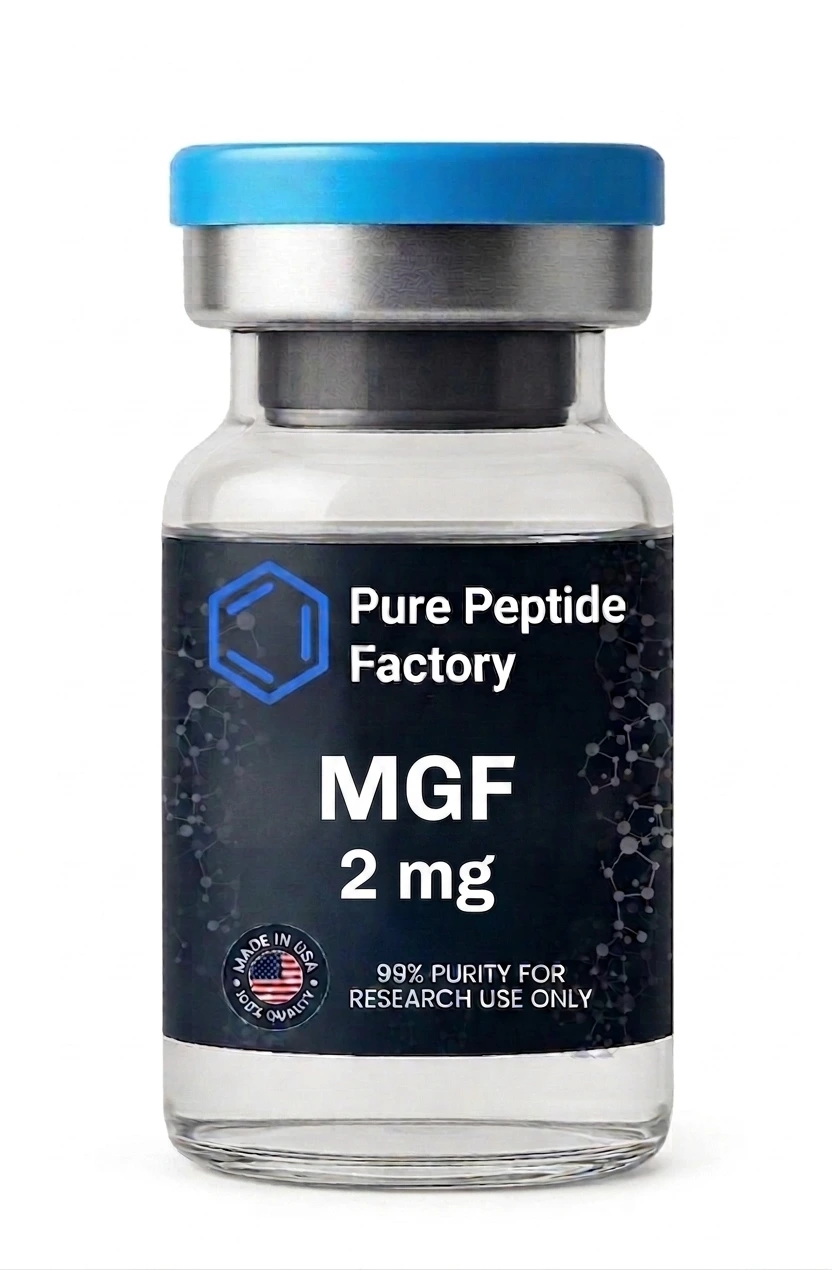
MGF 2 mg
$35.00
MGF peptide — research-grade Mechano Growth Factor (IGF-1Ec C-terminal 24-amino acid E-domain) and PEG-MGF for satellite cell activation, myoblast proliferation, muscle repair, and bone healing studies. 2mg vials, domestic cold-chain shipping, HPLC verified. Research use only.
MGF Peptide for Sale: Research-Grade Mechano Growth Factor & PEG-MGF
Researchers investigating skeletal muscle repair, satellite cell biology, or tissue regeneration need a reliable domestic source for Mechano Growth Factor. Pure Peptide Factory supplies research-grade mgf peptide in 2mg lyophilized vials, with both native MGF (IGF-1Ec C-terminal 24-amino acid E-domain) and PEG-MGF (pegylated long-acting form) available. When you buy mgf peptide from our domestic stock, you receive a precisely characterized compound with full batch documentation and cold-chain integrity.
What distinguishes MGF from standard IGF-1 is its origin as a splice variant. When skeletal muscle undergoes mechanical stress, the IGF-1 gene produces an alternative transcript — IGF-1Ec in humans, also called MGF — that includes a reading frame shift in exon 5. This generates a unique 24-amino acid C-terminal E-domain sequence distinct from the systemic liver-type IGF-1Ea. The synthetic MGF-24aa-E peptide replicates this unique domain and, unlike mature IGF-1, drives satellite cell proliferation through receptors distinct from the classical IGF-1 receptor, without triggering the differentiation arrest that mature IGF-1 induces in myoblasts (1). For researchers who buy mgf peptide, this receptor-level distinction is what makes MGF a unique tool — it expands the muscle stem cell pool, while mature IGF-1 drives the later differentiation and fusion of those cells into mature myofibers.
Why Researchers Buy MGF Peptide from Pure Peptide Factory
Two Forms for Different Research Questions
When you mgf peptide source from Pure Peptide Factory, you can choose between native MGF (IGF-1Ec C-terminal 24-aa E-domain) and PEG-MGF (pegylated form with extended half-life). Native MGF has a short plasma half-life of less than 20 minutes, which makes it ideal for studying localized, injection-site-specific satellite cell activation. PEG-MGF, by contrast, has polyethylene glycol chains covalently attached, extending its half-life to several hours or more in circulation and enabling systemic distribution. Consequently, researchers studying localized muscle repair typically use native MGF, while those investigating broader tissue recovery protocols often select PEG-MGF. Both are stocked domestically with identical quality documentation.
Documentation for a Splice-Variant-Derived Research Peptide
MGF corresponds to the C-terminal 24 amino acids of the IGF-1Ec propeptide (Tyr-Gln-Pro-Pro-Ser-Thr-Asn-Lys-Asn-Thr-Lys-Ser-Gln-Arg-Arg-Lys-Gly-Ser-Thr-Phe-Glu-Glu-His-Lys-NH₂). It has a molecular formula of C₁₂₁H₂₀₀N₄₂O₃₉ and a molecular weight of approximately 2,888 Da. Every batch we ship includes lot-specific HPLC and mass spectrometry documentation verifying purity (≥98%) and molecular identity. Therefore, researchers who buy mgf peptide from our facility can trust that the compound matches the published sequence before beginning any satellite cell or muscle repair protocol.
Domestic Cold-Chain Integrity
This 24-amino acid peptide is stable as lyophilized powder but degrades with moisture exposure and temperature excursion after reconstitution. We store all inventory under domestic cold-storage conditions at -20°C and ship using phase-change cooling. Most orders arrive within 1 to 3 business days, protecting peptide integrity from warehouse to laboratory bench.
Compare Against Complementary Muscle Research Peptides
Many research protocols compare MGF against other myogenic compounds such as IGF-1 LR3, BPC-157, TB-500, or KLOW blend. Because we stock the full muscle biology peptide panel under identical cold-storage conditions, researchers who buy mgf peptide alongside these complementary compounds eliminate supplier variability from their comparison data.
Synthesis Logs Archived for 24 Months
Should your IRB or compliance office request chain-of-custody records, we provide them without delay.
What Is MGF Peptide?
A Splice Variant of IGF-1, Not a Modified Growth Factor
Mechano Growth Factor (MGF), also designated IGF-1Ec in humans, is not a separate gene product. It is one of three splice variants produced from the IGF-1 gene through alternative mRNA processing. The predominant circulating form, IGF-1Ea, is produced in the liver and accounts for systemic IGF-1. However, when skeletal muscle undergoes mechanical overload or damage, the IGF-1 gene splices differently — exon 5 is included, introducing a 49-base-pair insert in humans that causes a reading frame shift. This generates IGF-1Ec mRNA, which translates into a prohormone with a unique C-terminal E-domain of 24 amino acids. This E-domain, represented by the synthetic MGF-24aa-E peptide that researchers buy mgf peptide to obtain, is the biologically active fragment responsible for MGF’s distinct effects on satellite cells (2).
The specificity of MGF’s mechanism is critical: it activates satellite cell proliferation through receptors that are distinct from the classical IGF-1 receptor (IGF-1R). Mature IGF-1 drives myoblast differentiation into myotubes, whereas MGF drives the earlier step — expanding the population of muscle stem cells that will later differentiate. This temporal and functional separation (MGF first expands the stem cell pool; IGF-1 later fuses those cells into fibers) is why MGF and IGF-1 produce different, complementary research outcomes despite originating from the same gene (3).
Molecular Profile of MGF Peptide:
- Sequence: H-Tyr-Gln-Pro-Pro-Ser-Thr-Asn-Lys-Asn-Thr-Lys-Ser-Gln-Arg-Arg-Lys-Gly-Ser-Thr-Phe-Glu-Glu-His-Lys-NH₂
- Single-letter code: YQPPSTNKNTKSQRRKGSTFEEHK-NH₂
- Molecular Formula: C₁₂₁H₂₀₀N₄₂O₃₉
- Molecular Weight: ~2,888 Da (native MGF)
- Source: Synthetic peptide corresponding to the C-terminal 24 amino acids of the IGF-1Ec (human) / IGF-1Eb (rodent) prohormone
- Classification: Synthetic splice-variant-derived E-domain peptide
- Synonyms: MGF, IGF-1Ec, Mechano Growth Factor, MGF-24aa-E peptide, MGF-Ct24E
- Half-life: Less than 20 minutes in plasma (native MGF); extended to several hours by pegylation (PEG-MGF)
How MGF Peptide Works: Satellite Cell Activation Without Differentiation
When muscle fibers experience mechanical overload or injury, the IGF-1 gene is differentially spliced to produce MGF mRNA locally within the damaged tissue. The translated MGF prohormone, or the synthetic E-domain peptide that researchers buy mgf peptide to obtain, then binds to receptors on quiescent satellite cells — the resident muscle stem cells located between the basal lamina and sarcolemma of muscle fibers. This binding activates the satellite cells, causing them to re-enter the cell cycle, proliferate, and expand the pool of myogenic precursor cells available for repair (3).
Critically, MGF promotes proliferation but opposes differentiation. The expanded satellite cell pool remains undifferentiated until later signals — notably mature IGF-1 — drive their fusion into existing myofibers for hypertrophy or into new myofibers for regeneration. This temporal separation is what makes MGF mechanistically unique: it provides the raw cellular material, while other factors handle the construction. Research by Kandalla and colleagues (2011) demonstrated that the MGF-24aa-E peptide alone significantly increases the proliferative lifespan and delays senescence of human satellite cells isolated from neonatal and young adult muscle. In all age groups, MGF-E peptide induced hypertrophy with a significant decrease in the percentage of reserve cells — cells that would otherwise escape the differentiation process and remain quiescent (4).
Furthermore, MGF appears to act through receptors distinct from the classical IGF-1 receptor, which explains how two peptides derived from the same gene can produce different cellular outcomes. Unlike mature IGF-1, MGF does not activate the IGF-1R signaling cascade that drives differentiation. Instead, it appears to signal through alternative pathways that consistently yield proliferative rather than differentiative responses.
MGF vs PEG-MGF: Choosing the Right Form for Your Protocol
Researchers who buy mgf peptide face a choice between native MGF and PEG-MGF. The distinction is not cosmetic — it fundamentally determines whether the peptide acts locally at the injection site or distributes systemically:
| Feature | MGF (Native, IGF-1Ec E-domain) | PEG-MGF (Pegylated) |
|---|---|---|
| Structure | 24-amino acid C-terminal E-domain peptide | 24-amino acid MGF peptide with polyethylene glycol chains covalently attached |
| Molecular Weight | ~2,888 Da | ~2,888 Da (core peptide) + variable PEG chain mass |
| Half-life in plasma | Less than 20 minutes | Several hours to days (pegylation protects against proteolysis and renal clearance) |
| Site of action | Localized to injection site (rapid clearance limits systemic exposure) | Systemic distribution possible (longer circulation time) |
| Satellite cell activation | Localized proliferation at injection site | Broader, sustained satellite cell pool expansion across multiple muscle groups |
| Receptor binding | Distinct from IGF-1R; putative MGF-specific receptors | Same as native MGF; pegylation extends receptor exposure |
| Solubility | May require DMSO or acetonitrile pre-dissolution | Improved aqueous solubility due to PEG chains |
| Best for studying | Localized muscle repair, acute satellite cell activation kinetics | Sustained muscle regeneration, multi-muscle-group protocols, systemic recovery models |
Choose native MGF when your protocol requires studying localized satellite cell activation at a specific injection site, when acute signaling kinetics are the experimental endpoint, or when avoiding systemic exposure is important for your model. Choose peg mgf peptide when extended half-life is required for sustained satellite cell pool expansion, when studying multi-muscle-group recovery, or when the convenience of less frequent administration matters for long-term protocols. Both forms are available from our inventory under identical quality standards.
MGF Peptide Benefits: What the Research Shows
Satellite Cell Activation and Muscle Stem Pool Expansion
The most extensively documented mgf peptide benefits center on satellite cell biology. Published research demonstrates that the MGF-24aa-E peptide activates quiescent satellite cells, drives them into the cell cycle, and expands the pool of myogenic precursor cells available for muscle repair. In human muscle cell cultures, MGF-E peptide increased the proliferative lifespan of satellite cells and delayed senescence — effects observed in cells from neonatal and young adult donors (4). This stem-cell-pool-expanding effect is fundamentally different from mature IGF-1, which drives differentiation of already-proliferating myoblasts but does not increase the upstream precursor population.
Muscle Repair and Regeneration
In animal models of muscle injury, MGF upregulation correlates temporally with satellite cell activation markers. Local injection of MGF peptide following muscle damage accelerates the appearance of regenerating myofibers and increases the total number of myonuclei per fiber — a structural readout of successful repair. Because MGF does not drive differentiation itself, researchers often pair it with IGF-1 or mechanical loading protocols that provide the differentiation signal once the satellite cell pool has been expanded.
Bone Healing and Osteoblast Proliferation
A significant and often overlooked research application for MGF is bone biology. The first demonstration that MGF-Ct24E possesses positive effects on osteoblast proliferation and bone-defect healing was published in 2010. Rabbit bone defect models showed that MGF-E peptide promoted osteoblast proliferation and accelerated fracture healing (5). A subsequent 2020 study demonstrated that MGF-19E and MGF-25E peptides promoted proliferation, differentiation, and mineralization of MC3T3-E1 osteoblast precursor cells, and significantly promoted bone injury healing in rabbit models — notably, these effects occurred independently of IGF-1R, confirming MGF’s distinct receptor mechanism. Researchers who buy mgf peptide for bone studies can investigate this IGF-1R-independent osteogenic pathway.
Neuroprotection and Motoneuron Survival
MGF has demonstrated neuroprotective effects in the SOD1-G93A mouse model of amyotrophic lateral sclerosis (ALS). Research shows that MGF, as an IGF-1 splice variant, rescues motoneurons and improves muscle function in these mice — effects attributed to the peptide’s ability to promote neuronal survival in addition to its muscle-specific actions (2). This dual neuroprotective and myogenic profile positions MGF as a research tool for studying the neuromuscular axis in degenerative disease models.
Anti-Sarcopenia and Aging Research
MGF expression declines with age, and this decline correlates with the loss of satellite cell responsiveness that underlies sarcopenia. MGF-E peptide administration in aged muscle models has been investigated as a strategy to restore satellite cell function, combat age-related muscle loss, and promote muscle maintenance without the oncogenic side effects associated with mature IGF-1 signaling (4).
MGF Peptide Dosage Reference for Preclinical Research
For laboratory protocols only. We do not provide human dosing recommendations.
| Research Model | Form | Typical Dose | Route | Key Finding |
|---|---|---|---|---|
| Rabbit bone defect healing | MGF-Ct24E | Local injection into defect site (dose per protocol) | Local (bone defect) | Promoted osteoblast proliferation and bone-defect healing |
| MC3T3-E1 osteoblast culture | MGF-19E / MGF-25E | Nanomolar to micromolar range | In vitro | Promoted proliferation, differentiation, and mineralization independent of IGF-1R |
| Human primary muscle cell culture | MGF-24aa-E | Nanomolar concentrations | In vitro | Increased proliferative lifespan; delayed senescence |
| Mouse muscle injury (regeneration) | PEG-MGF | 200-400 µg per injection site | Intramuscular | Accelerated myofiber regeneration; increased myonuclei per fiber |
| Systemic muscle recovery (rodent) | PEG-MGF | 200-400 µg per administration | Subcutaneous | Sustained satellite cell activation across multiple muscle groups |
| Rat tenotomy / overload model | MGF (endogenous) | Mechanical overload stimulus | N/A (endogenous expression) | MGF mRNA upregulated within 24h post-overload |
For researchers designing protocols, the published preclinical literature provides validated reference frameworks. The 200-400 µg range for PEG-MGF is the most commonly cited in rodent muscle regeneration studies. Researchers who buy mgf peptide should note that native MGF’s short half-life (under 20 minutes) means localized injection immediately post-injury or post-exercise is the typical experimental design for capturing acute satellite cell activation events. The term peg mgf dose frequently appears in research literature searches; the values above reflect the published range.
How to Reconstitute MGF and PEG-MGF
MGF (Native) — Step-by-Step Protocol
- Sanitize the vial stopper with 70% isopropyl alcohol.
- Native MGF has limited aqueous solubility. Pre-dissolve the lyophilized powder in 50-100 µL of DMSO or 60% acetonitrile in sterile water.
- Once fully dissolved, dilute with sterile bacteriostatic water or PBS to the desired final concentration.
- Gently swirl to mix. Do not shake vigorously.
- Verify a clear solution. Discard if turbidity persists.
- Label with date and concentration. Use immediately due to short peptide stability in solution.
PEG-MGF — Step-by-Step Protocol
- Sanitize the vial stopper with 70% isopropyl alcohol.
- PEG-MGF has improved aqueous solubility due to pegylation. Inject sterile bacteriostatic water or PBS slowly against the vial wall.
- Allow the powder to dissolve without agitation for 1 to 2 minutes.
- Gently swirl until the solution is completely clear. Do not shake.
- Verify a clear, colorless solution. Discard if any turbidity remains.
- Label with date and concentration.
Concentration Reference for 2mg Vial:
- Native MGF: 2mg vial pre-dissolved in 100 µL DMSO/acetonitrile + 900 µL diluent = 2 mg/mL. Adjust dilution volume to protocol requirements.
- PEG-MGF: 2mg vial + 1 mL bacteriostatic water = 2 mg/mL; + 2 mL = 1 mg/mL
Storage Requirements:
- Lyophilized powder: 24 months at -20°C, protected from light and moisture.
- Reconstituted solution: Use immediately. If storage is necessary, keep at 2 to 8°C and use within 24 hours. Do not freeze reconstituted solution.
- Native MGF is unstable in aqueous solution; PEG-MGF has extended solution stability due to pegylation. Both should be protected from light at all stages.
MGF Peptide: Regulatory Context and Research Validation
Research Use Only
MGF peptide is not FDA approved for any human indication. It is a synthetic peptide corresponding to a splice-variant-derived domain of the IGF-1 gene, sold strictly as a research compound for in vitro and controlled laboratory animal studies. Researchers who buy mgf peptide from Pure Peptide Factory must agree to research-use-only terms at checkout. This product is not for human consumption, veterinary use, or diagnostic application.
Single-Lab Dominance and Research Validation Status
Honest disclosure: most published MGF research originates from a single research group — the laboratory of Geoffrey Goldspink at the Royal Free Hospital and University College London. While the Goldspink group has produced a coherent and internally consistent body of work over two decades, independent replication of key findings by laboratories outside this group remains limited. The proposed mechanism of MGF acting through receptors distinct from IGF-1R is supported by cellular data but has not been fully characterized at the structural level. Furthermore, no completed Phase 1 human clinical trials exist for MGF or PEG-MGF. Researchers using mgf peptide should engage with the evidence base critically, acknowledging both the consistent reproducibility within the Goldspink framework and the need for independent validation. We provide this transparency because research-grade decisions require accurate assessment of the underlying literature.
WADA Prohibited Substance Status
MGF and PEG-MGF are classified as prohibited substances by the World Anti-Doping Agency (WADA) under Section S2 (Peptide Hormones, Growth Factors, and Related Substances). Researchers should source the peptide exclusively from verified suppliers with batch-specific documentation. Athletes subject to doping control should be aware that MGF, PEG-MGF, and their metabolites may be detectable.
Product Specifications
Available Configurations
MGF peptide is available in 2mg lyophilized powder vials in two forms: native MGF (IGF-1Ec C-terminal 24-aa E-domain) and PEG-MGF (pegylated form). Select your configuration from the product options above.
Quality Verification
- Purity: ≥98% (HPLC verified)
- Identity: Mass spectrometry confirmed against the ~2,888 Da molecular weight target (native MGF); variable PEG chain mass for PEG-MGF
- Endotoxin: Less than 0.1 EU/mL
- Sterility: Verified per USP 71
- Form: Lyophilized powder
- Storage: -20°C long-term; use reconstituted solution immediately
Current Batch: #PPF-MGF-0426
Purity: 98.6%
Download: HPLC Certificate | MS Report
Frequently Asked Questions
Where can I buy MGF peptide for research?
Pure Peptide Factory supplies research-grade mgf peptide domestically in 2mg vials, available as both native MGF and PEG-MGF. Orders ship same-day with cold-chain packaging and full HPLC/MS documentation. Most arrive within 1 to 3 business days.
What is MGF peptide used for in research?
Researchers use mgf peptide to study satellite cell activation and muscle stem cell pool expansion, skeletal muscle repair and regeneration, bone healing and osteoblast proliferation, neuroprotection in motoneuron disease models, and age-related sarcopenia. Its distinct receptor mechanism, separate from the classical IGF-1 receptor, allows researchers to study proliferative signaling independent of differentiation.
What is the difference between MGF and PEG-MGF?
Native MGF has a plasma half-life of less than 20 minutes and acts locally at the injection site. Peg mgf peptide has polyethylene glycol chains attached that extend its half-life to several hours or days, enabling systemic distribution and sustained satellite cell activation. See the full comparison table above.
Is MGF the same as IGF-1?
No. MGF is a splice variant of the IGF-1 gene with a unique C-terminal E-domain sequence generated by a reading frame shift in exon 5. The synthetic MGF-24aa-E peptide replicates this unique domain. MGF activates satellite cell proliferation through receptors distinct from the classical IGF-1 receptor, producing different cellular outcomes.
What are the primary mgf peptide benefits in preclinical research?
Published research documents satellite cell activation and stem pool expansion, accelerated muscle repair and regeneration, enhanced osteoblast proliferation and bone-defect healing (IGF-1R-independent), neuroprotection with motoneuron rescue in ALS mouse models, and delayed senescence of human muscle progenitor cells.
What is the MGF peptide dosage for rodent research?
PEG-MGF is typically administered at 200-400 µg per injection site for localized muscle studies, or 200-400 µg subcutaneously for systemic protocols. In vitro satellite cell and osteoblast studies use nanomolar to micromolar concentrations. Refer to the dosage reference table above. We do not provide human dosing recommendations.
How should I store MGF peptide?
Store lyophilized powder at -20°C for up to 24 months. After reconstitution, use immediately. If short-term storage is unavoidable, keep at 2 to 8°C and use within 24 hours. Native MGF is unstable in aqueous solution; PEG-MGF has better solution stability due to pegylation. Do not freeze reconstituted solution.
Is MGF peptide FDA approved?
No. MGF peptide is a research-grade synthetic peptide not approved by the FDA for any human indication. It is available for laboratory procurement under research-use-only provisions.
What does MGF stand for?
MGF stands for Mechano Growth Factor. It is an IGF-1 splice variant (IGF-1Ec in humans) expressed locally in skeletal muscle in response to mechanical overload. The name reflects its mechanosensitive expression — it is produced when muscles undergo mechanical stress.
Can MGF be combined with other peptides in research?
Yes. Many researchers combine MGF with BPC-157, TB-500, or the KLOW blend for comprehensive tissue repair protocols. Combination protocols studying the GH-IGF axis may pair MGF with Ipamorelin, Sermorelin, or Tesamorelin. All these compounds are available from our catalog under identical storage conditions.
Buy MGF Peptide for Your Research
Secure Checkout
- Credit card, cryptocurrency, or wire transfer
- Same-day dispatch for orders placed before 2 PM EST
- Cold-chain packaging with phase-change cooling
- Discreet labeling with full tracking
Institutional Accounts
Net-30 terms and purchase order acceptance available for universities and research institutions. Contact us for bulk pricing on 50 vials or more, including matched orders alongside IGF-1 LR3, BPC-157, TB-500, and other muscle biology research peptides.
Add to cart and secure the reference Mechano Growth Factor peptide — the unique IGF-1 splice variant for satellite cell, muscle repair, and bone healing research.