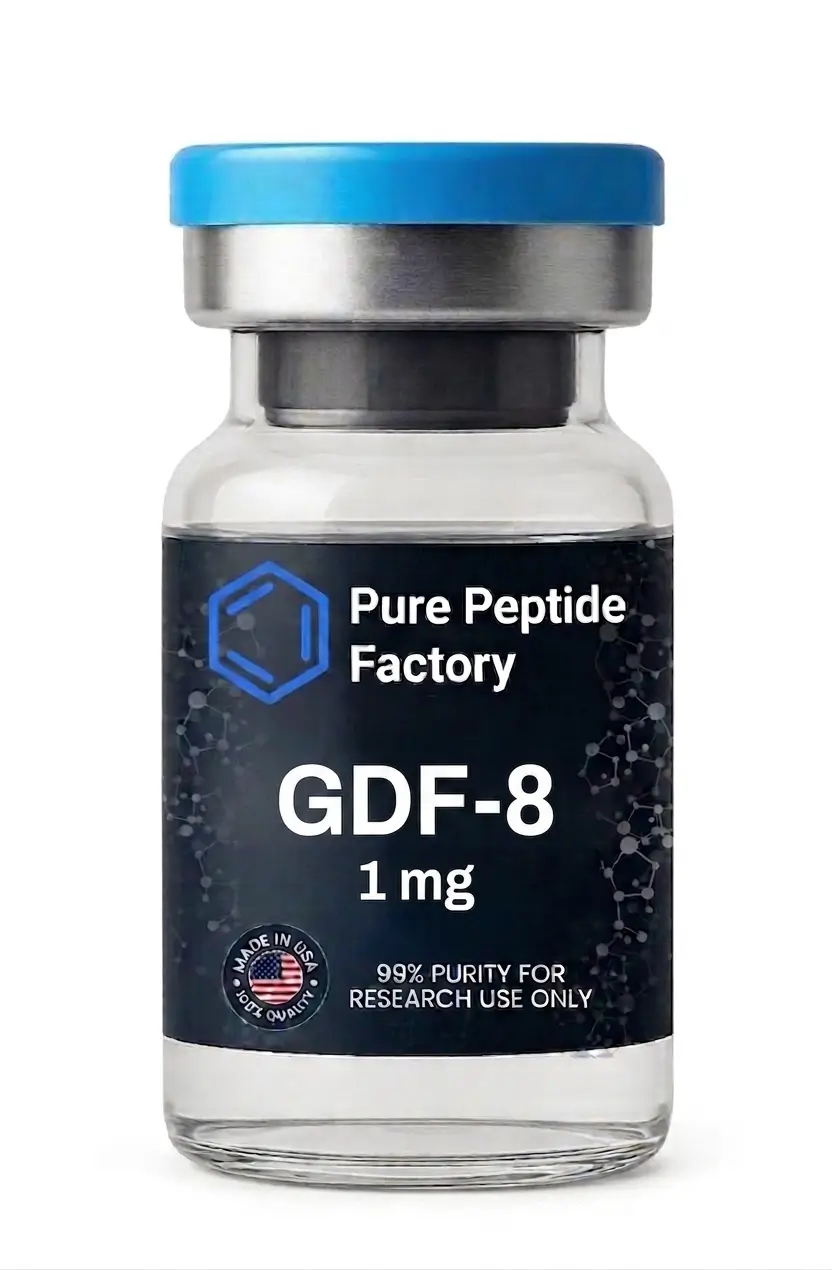
GDF-8 1 mg
$20.00
GDF-8 peptide, research-grade myostatin prodomain fragment (23-mer) for skeletal muscle growth regulation, ActRIIB/SMAD pathway, and muscle atrophy research. 1mg vials, domestic cold-chain shipping, HPLC verified. Research use only.
GDF-8 Peptide for Sale: Research-Grade Myostatin Prodomain Fragment
Researchers studying skeletal muscle growth regulation, myostatin pathway inhibition, or muscle atrophy models need a reliable domestic source for gdf 8 peptide. Pure Peptide Factory supplies this research-grade 23-amino-acid synthetic fragment derived from the myostatin prodomain with full batch documentation and cold-chain shipping. Unlike the full-length recombinant myostatin protein — which is a 25 kDa disulfide-linked homodimer that suppresses muscle growth when active — this prodomain fragment binds mature myostatin and neutralizes it, functioning as a research tool to study the derepression of muscle protein synthesis (1).
The scientific rationale for targeting myostatin is among the most validated in muscle biology. In 1997, McPherron and Lee generated myostatin-knockout mice that displayed a dramatic “super-muscled” phenotype with individual muscles weighing 2 to 3 times more than wild-type controls. Shortly thereafter, natural myostatin mutations were identified in double-muscled Belgian Blue and Piedmontese cattle, confirming the pathway’s conservation across species. These discoveries — alongside the identification of a loss-of-function myostatin mutation in a human child with extraordinary muscularity in 2004 — established gdf 8 peptide research as a cornerstone of muscle hypertrophy investigation. When you source this prodomain fragment from Pure Peptide Factory, you work with the same inhibitory domain that has been demonstrated to suppress myostatin signaling in controlled laboratory studies (2).
Why Researchers Buy GDF-8 Peptide from Pure Peptide Factory
Documentation for a Defined Prodomain Fragment
GDF-8 peptide is a synthetic 23-amino-acid sequence (Trp-Arg-Gln-Asn-Thr-Arg-Tyr-Ser-Arg-Ile-Glu-Ala-Ile-Lys-Ile-Gln-Ile-Leu-Ser-Lys-Leu-Arg-Leu-NH₂) modeled on the inhibitory core of the myostatin prodomain. It has a molecular formula of C₁₃₀H₂₂₂N₄₂O₃₂ and a molecular weight of 2885.42 g/mol. Every batch we ship includes lot-specific HPLC and mass spectrometry documentation verifying purity (≥98%) and sequence integrity. Consequently, researchers who purchase gdf 8 peptide can trust the compound’s molecular identity before beginning any protocol.
Domestic Cold-Chain Shipping
Synthetic peptides of this length are stable as lyophilized powder but degrade with moisture exposure and temperature excursion after reconstitution. We store all inventory under domestic cold-storage conditions and ship using phase-change cooling. Most orders arrive in 1 to 3 business days. For this reason, researchers searching for where to buy gdf 8 peptide with guaranteed cold-chain integrity rely on Pure Peptide Factory.
Compare Against Other Myostatin Pathway Modulators
Many research protocols compare this prodomain fragment against other myostatin inhibitors such as FST-344 (follistatin), ACE-031 (ActRIIB-Fc decoy), or Bimagrumab (anti-ActRII antibody). Because we stock the full myostatin pathway panel under identical cold-storage conditions, your cross-compound data remains free of supplier variability.
Synthesis Logs Archived for 24 Months
Should your IRB or compliance office request chain-of-custody records, we provide them without delay.
What Is GDF-8 Peptide?
Myostatin: The Muscle Brake
GDF-8 (growth/differentiation factor 8), more commonly known as myostatin, is a member of the TGF-β superfamily of signaling proteins and functions as the single most potent negative regulator of skeletal muscle mass in mammals. It is synthesized as a large precursor protein (375 amino acids) that undergoes proteolytic cleavage to generate an N-terminal prodomain and a disulfide-linked C-terminal dimer — the biologically active mature myostatin. The mature protein circulates in a latent complex with its own prodomain and/or follistatin-related gene products, remaining inactive until the prodomain is cleaved by BMP-1/tolloid metalloproteinases (1).
The gdf 8 peptide product sold for research is not the full-length protein. It is a synthetic 23-amino-acid fragment corresponding to the inhibitory core of the myostatin prodomain — the exact region that binds mature myostatin and prevents it from engaging the ActRIIB receptor. This fragment was identified through systematic truncation analysis by Takayama et al. (2015), who demonstrated that peptides corresponding to this region suppress myostatin-induced transcriptional activity in cell-based assays (2).
Molecular Profile of GDF-8 Peptide:
- Sequence: Trp-Arg-Gln-Asn-Thr-Arg-Tyr-Ser-Arg-Ile-Glu-Ala-Ile-Lys-Ile-Gln-Ile-Leu-Ser-Lys-Leu-Arg-Leu-NH₂
- Single-letter code: WRQNTRYSRIEAIKIQILSKLRL-NH₂
- Molecular Formula: C₁₃₀H₂₂₂N₄₂O₃₂
- Molecular Weight: 2885.42 g/mol
- Classification: Synthetic 23-amino-acid prodomain fragment
- Synonyms: GDF-8 prodomain peptide, myostatin propeptide fragment, myostatin inhibitory core peptide
- Target: Mature myostatin (GDF-8 dimer)
- Origin: Inhibitory core of the myostatin N-terminal prodomain
How GDF-8 Peptide Works: ActRIIB/SMAD Pathway Disruption
Mature myostatin signals by binding to the activin type IIB receptor (ActRIIB) on the skeletal muscle cell surface. This binding recruits and phosphorylates the type I co-receptors ALK4 and ALK5, which then phosphorylate the intracellular SMAD2 and SMAD3 proteins. Phosphorylated SMAD2/3 forms a complex with SMAD4 that translocates to the nucleus, where it represses the transcription of myogenic regulatory factors — specifically MyoD, myogenin, and Myf5 — thereby blocking myoblast proliferation and differentiation.
The gdf 8 peptide prodomain fragment disrupts this pathway upstream, at the ligand level. It binds directly to mature myostatin in the extracellular space, preventing receptor engagement. As a result, ActRIIB remains unoccupied, the SMAD2/3 cascade is not activated, and myogenic transcription proceeds without suppression. This mechanism mirrors the body’s own endogenous regulation, where the full-length prodomain holds myostatin in a latent, inactive state. The difference is that the synthetic 23-mer fragment provides a defined molecular tool for studying this inhibition in a controlled laboratory setting (3).
GDF-8 Peptide Research Applications
Muscle Hypertrophy and Atrophy Research
The primary application for gdf 8 peptide is the study of skeletal muscle mass regulation. Preclinical models — including the mdx mouse model of Duchenne muscular dystrophy, hindlimb suspension models of disuse atrophy, and glucocorticoid-induced muscle wasting — employ myostatin prodomain fragments to examine the effects of myostatin blockade on muscle fiber cross-sectional area, protein synthesis rates, and satellite cell activation.
The Bodybuilding Connection: Why GDF-8 Became a Research Focus
The discovery of naturally occurring myostatin mutations with dramatic muscle hypertrophy phenotypes — Belgian Blue cattle displaying 20-25% more muscle mass, whippets with a “bully” phenotype and extraordinary racing speed, and a German child born with functional myostatin deficiency and visible quadriceps and biceps at birth — naturally captured attention in athletic and bodybuilding communities. Research has since identified associations between myostatin polymorphisms and athletic performance. Specifically, the K153R variant in the MSTN gene has been studied for its relationship to muscle hypertrophy and strength in elite athletes. Furthermore, studies demonstrate that resistance training downregulates myostatin expression, providing a mechanistic link between exercise and muscle growth. However, it is important to clarify that gdf 8 peptide is strictly a research compound. Anecdotal reports of its use for athletic performance enhancement should not be interpreted as evidence of safety or efficacy. All research must be conducted under IACUC-approved protocols.
Muscular Dystrophy and Neuromuscular Disease
In the mdx mouse model of Duchenne muscular dystrophy, prodomain-mediated myostatin inhibition improved dystrophic pathology, increased muscle mass, and reduced fibrosis. This research application parallels the gene therapy approaches being investigated for follistatin and other myostatin antagonists in clinical trials for DMD and Becker muscular dystrophy.
Metabolic and Adipose Tissue Research
Myostatin inhibition does not only affect muscle. Research shows that myostatin knockout mice are resistant to diet-induced obesity, exhibit improved insulin sensitivity, and show browning of white adipose tissue through UCP1 upregulation. GDF-8 peptide therefore serves as a tool for dissecting the muscle-adipose cross-talk that governs systemic metabolism.
Bone-Muscle Crosstalk and Orthopedic Research
Myostatin is expressed in the fracture callus during bone healing, and prodomain administration has been studied for its effects on both muscle and bone repair in models of deep tissue injury. This application extends the peptide’s utility into orthopedic regenerative medicine research.
GDF-8 Peptide vs FST-344 vs ACE-031 vs Bimagrumab
| Feature | GDF-8 Prodomain Fragment | FST-344 (Follistatin) | ACE-031 (ActRIIB-Fc) | Bimagrumab |
|---|---|---|---|---|
| Type | Synthetic 23-mer peptide (prodomain fragment) | Recombinant glycoprotein (315 aa) | Soluble receptor decoy (Fc fusion) | Monoclonal antibody (anti-ActRII) |
| Mechanism | Direct myostatin binding; prevents receptor engagement | Ligand sequestration; binds myostatin + activin A + GDF-11 | Decoy receptor; traps multiple TGF-β ligands | Receptor blockade; blocks ActRIIA and ActRIIB |
| Selectivity | Moderate (myostatin + GDF-11) | Moderate (10-fold lower activin binding for FS315 isoform) | Low (broad ligand trap) | High (receptor-level blockade) |
| Molecular Weight | ~2.9 kDa | ~38.7 kDa | ~90 kDa (Fc-fusion dimer) | ~146 kDa (IgG1) |
| Clinical Status | Preclinical | Phase 1/2a BMD gene therapy | Phase 2 DMD (discontinued: epistaxis) | Phase 2/3 sIBM (FDA breakthrough) |
| Best for Studying | Prodomain mechanism, small-molecule myostatin antagonism | Multi-ligand TGF-β blockade, FSH-sparing muscle hypertrophy | Broad TGF-β ligand trapping, off-target vascular effects | Receptor-level pathway blockade, clinical translation |
GDF-8 Peptide Dosage in Published Research
For laboratory protocols only. We do not provide human dosing recommendations.
| Research Model | Typical Dose/Approach | Route | Key Finding |
|---|---|---|---|
| mdx mouse (DMD model) | Prodomain fragment: 10-100 µg intramuscular injection | Intramuscular | Reduced fibrosis, increased myofiber size |
| Rodent muscle atrophy model | 1-10 mg/kg prodomain via osmotic pump | Subcutaneous (continuous) | Preserved muscle mass during hindlimb unloading |
| Cell culture (C2C12 myoblasts) | Inhibitory core peptide: 0.1-10 µM | In vitro | Suppressed myostatin-induced SMAD2/3 phosphorylation |
| Takayama 2015 cell assay | p29 peptide (29-aa): 10 µM | In vitro (HEK293) | 79% inhibition of myostatin transcriptional activity |
For researchers designing myostatin inhibition protocols, the published gdf 8 peptide bodybuilding dosage discussions found in research forums should not be used to inform preclinical dosing. Peer-reviewed literature from the Rodino-Klapac, Takayama, and McPherron groups provides the validated reference framework for laboratory study design.
How to Reconstitute GDF-8 Peptide
Step-by-Step Laboratory Protocol
- Sanitize the vial stopper with 70% isopropyl alcohol.
- Inject bacteriostatic water or sterile PBS slowly against the vial wall. This 23-mer peptide is highly soluble; avoid directing the stream at the lyophilized cake to minimize foaming.
- Allow the powder to dissolve without agitation for 1 to 2 minutes.
- Gently swirl until the solution is completely clear. Do not shake vigorously.
- Verify a clear, colorless solution. Discard if any turbidity or particulate matter remains.
- Label with date and concentration.
Concentration Reference for 1mg Vial:
- 1mg vial + 1mL bacteriostatic water = 1 mg/mL
- 1mg vial + 2mL bacteriostatic water = 0.5 mg/mL
- 1mg vial + 5mL bacteriostatic water = 0.2 mg/mL
Storage Requirements:
- Lyophilized powder: 24 months at -20°C, protected from light and moisture.
- Reconstituted solution: 14 days at 2 to 8°C. Do not freeze.
- The synthetic 23-mer peptide is stable at neutral pH; avoid exposure to extreme acidic or basic conditions during handling.
GDF-8 Peptide: Regulatory and Safety Context
Research Use Only
GDF-8 peptide is not FDA approved for any human indication. It is a synthetic fragment of the myostatin prodomain sold strictly as a research compound for in vitro and controlled laboratory animal studies. This product is not for human consumption, veterinary use, or diagnostic application. You must agree to research-use-only terms at checkout.
The Prodomain Safety Advantage
Unlike direct ActRIIB receptor blockers (ACE-031) or broad-spectrum ligand traps, the prodomain fragment targets myostatin at the ligand level with moderate selectivity. This mirrors the body’s endogenous regulatory mechanism and avoids the off-target vascular effects — notably epistaxis and telangiectasia — that led to the discontinuation of ACE-031 clinical trials. Full myostatin knockout mice are viable but display increased tendon stiffness and reduced specific force in some muscle groups. The prodomain approach, which attenuates rather than eliminates myostatin signaling, may represent a safer pharmacological profile, though this remains an active area of investigation.
Product Specifications
Available Configuration
GDF-8 peptide is available in 1mg lyophilized powder vials. This is the standard research configuration for this prodomain fragment. Select your quantity from the product options above.
Quality Verification
- Purity: ≥98% (HPLC verified)
- Identity: Mass spectrometry confirmed against the 2885.42 g/mol molecular weight target with sequence verification
- Endotoxin: Less than 0.1 EU/mL
- Sterility: Verified per USP 71
- Form: Lyophilized powder
- Storage: -20°C long-term, 2 to 8°C short-term after reconstitution
Current Batch: #PPF-GDF8-0526
Purity: 98.8%
Download: HPLC Certificate | MS Report
Frequently Asked Questions
What is gdf 8 peptide used for in research?
Researchers use gdf 8 peptide to study skeletal muscle growth regulation, myostatin pathway inhibition, muscle atrophy models (disuse, cachexia, glucocorticoid-induced), muscular dystrophy (mdx mouse), metabolic interactions between muscle and adipose tissue, and bone-muscle crosstalk in orthopedic healing.
Is gdf 8 the same as myostatin?
Yes. GDF-8 (growth/differentiation factor 8) is the gene name for myostatin. The two terms are used interchangeably in the research literature. Our product is a synthetic fragment of the myostatin prodomain, not the full mature myostatin protein.
What is the difference between the prodomain fragment and full myostatin?
Full myostatin is a 25 kDa disulfide-linked dimer that suppresses muscle growth by binding ActRIIB. The prodomain fragment is a 23-amino-acid synthetic peptide that binds to mature myostatin and prevents it from engaging ActRIIB, functioning as a myostatin inhibitor for research purposes.
What is the gdf 8 peptide dosage in preclinical research?
In rodent models, prodomain fragment doses of 10-100 µg (intramuscular) and 1-10 mg/kg (subcutaneous via osmotic pump) have been employed in published studies. Cell culture work uses 0.1-10 µM concentrations. Refer to the dosage table above for model-specific details.
Where can I buy gdf 8 peptide for research?
Pure Peptide Factory supplies research-grade gdf 8 peptide domestically with same-day dispatch and cold-chain shipping. Orders arrive within 1 to 3 business days with full HPLC and mass spectrometry documentation.
Is gdf 8 peptide FDA approved?
No. Myostatin inhibitors remain investigational. Research-grade myostatin prodomain fragments are available for laboratory procurement under research-use-only provisions.
How does gdf 8 peptide compare to follistatin for research?
Follistatin (FST-344) is a ~38.7 kDa glycoprotein that binds myostatin, activin A, and GDF-11. The GDF-8 prodomain fragment is a small (~2.9 kDa) synthetic peptide that targets myostatin and GDF-11 with greater ligand specificity. Follistatin has more clinical data through AAV gene therapy trials; the prodomain approach offers a defined small-molecule tool for mechanism studies.
How should I store gdf 8 peptide?
Store lyophilized powder at -20°C for up to 24 months. After reconstitution, keep at 2 to 8°C and use within 14 days. Do not freeze reconstituted solution.
Buy GDF-8 Peptide for Your Research
Secure Checkout
- Credit card, cryptocurrency, or wire transfer
- Same-day dispatch for orders placed before 2 PM EST
- Cold-chain packaging with phase-change cooling
- Discreet labeling with full tracking
Institutional Accounts
Net-30 terms and purchase order acceptance available for universities and research institutions. Contact us for bulk pricing on 50 vials or more, including matched orders alongside FST-344, ACE-031, and other myostatin pathway research compounds.
Add to cart and secure the most thoroughly characterized myostatin prodomain fragment for your muscle biology, hypertrophy, or dystrophy research program.
Related products
-
MGF 2 mg
$35.00