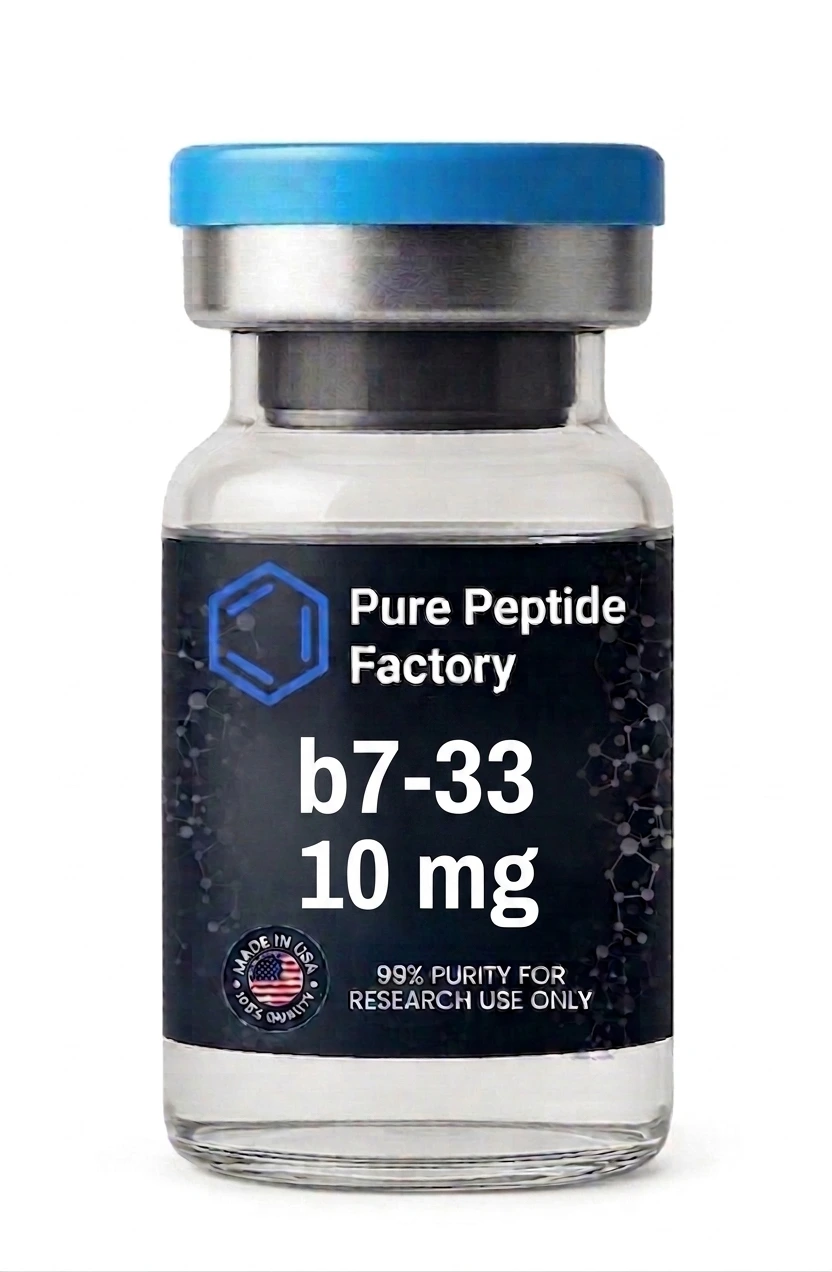
B7-33 10mg
$40.00 $90.00Price range: $40.00 through $90.00
B7-33 for sale at Pure Peptide Factory delivers the single-chain relaxin analog Mohammed Akhter Hossain and colleagues developed at the Florey Institute (University of Melbourne) in 2016. Specifically, B7-33 selectively activates the RXFP1 receptor and biases signaling toward the pERK1/2 pathway rather than the cAMP/PKA pathway that drives the tumor-promoting effects associated with native H2 relaxin. As a result, researchers use B7-33 to study cardiac, renal, and pulmonary fibrosis without the cAMP-mediated complications. HPLC verified at 98% minimum purity, batch-specific COA. 2mg and 10mg vials. Research use only.
B7-33 For Sale: The Single-Chain Relaxin Analog That Solved Serelaxin’s Problem
In 2014, Novartis ran the RELAX-AHF-2 Phase 3 trial of serelaxin (recombinant H2 relaxin) for acute heart failure. Specifically, the trial enrolled over 6,500 patients across 34 countries. The compound failed to meet its primary endpoints despite promising Phase 2 data, and Novartis discontinued the program. Furthermore, serelaxin’s complex two-chain structure with three disulfide bridges proved difficult to manufacture cost-effectively, and its strong cAMP/PKA pathway activation raised concerns about long-term tumor-promoting effects.
Two years later, Mohammed Akhter Hossain and colleagues at the Florey Institute of Neuroscience and Mental Health (University of Melbourne) published the seminal solution in Chemical Science. They engineered B7-33, a single-chain peptide derived from the B-chain of human H2 relaxin that retained the anti-fibrotic properties of native relaxin while eliminating the cAMP signaling that produces the tumor-promoting effects. Therefore, B7-33 became the first functionally selective agonist of the RXFP1 receptor.
For researchers studying cardiac, renal, or pulmonary fibrosis, biased GPCR agonism, MMP-2-mediated collagen degradation, or the next generation of relaxin-based therapeutics, B7-33 is the foundational research tool. Pure Peptide Factory stocks research-grade B7-33 in 2mg and 10mg configurations with domestic cold-chain shipping and batch-specific HPLC documentation.
Why Researchers Choose Pure Peptide Factory for B7-33
Documentation for a Functionally Selective Agonist
B7-33 is a 33-amino-acid synthetic peptide with critical structural features that enable its biased agonism at RXFP1. Specifically, the truncated N-terminus and elongated C-terminus relative to the native H2 relaxin B-chain confer water solubility and the selective ERK1/2 pathway activation. Therefore, every batch we ship includes a lot-specific HPLC chromatogram and mass spectrometry report verifying the molecular weight target and sequence integrity. The Certificate of Analysis is downloadable before your compound ships.
Domestic Cold-Chain Shipping for a Short-Half-Life Peptide
Native B7-33 has a notoriously short serum half-life (approximately 6 minutes in vitro), which the Hossain group later addressed through lipidation studies. As a result, lyophilized stability and proper cold-chain handling matter significantly for research protocol design. We ship from domestic cold-storage using phase-change cooling rated for 96-hour protection. Most orders reach your lab within 1 to 3 business days.
Two Configurations for Research Protocol Flexibility
We stock B7-33 in 2mg and 10mg vials. Specifically, the 2mg configuration accommodates pilot studies and small-scale receptor pharmacology work, while the 10mg vial supports extended protocols including the 0.25 mg/kg/day s.c. dosing used in the 2023 Alam cardiomyopathy research. Therefore, researchers can match vial size to protocol scale without splitting vials or compromising reconstituted solution freshness.
Synthesis Logs Archived for 24 Months
We document and archive every batch. Therefore, if your IRB or compliance office requests chain-of-custody records or synthesis documentation, we can provide them on demand.
What Is B7-33?
A Single-Chain Derivative of H2 Relaxin’s B-Chain
B7-33 is a 33-amino-acid synthetic peptide derived from the B-chain of human gene-2 relaxin (H2 relaxin). Specifically, the Hossain group engineered B7-33 by truncating the N-terminus and elongating the C-terminus of the native H2 relaxin B-chain. This structural modification produced the first water-soluble, biologically active single-chain analog of relaxin. By contrast, earlier attempts to create single-chain relaxin analogs produced compounds that were either insoluble or pharmacologically inactive.
The compound’s name reflects its structure: “B7” denotes the seventh amino acid position in the H2 relaxin B-chain where the truncation begins, and “33” indicates the total amino acid count of the resulting peptide. Therefore, the B7-33 designation directly references its derivation from native relaxin.
Molecular Profile:
- Type: Single-chain 33-amino-acid synthetic peptide
- Origin: B-chain of human gene-2 relaxin (H2 relaxin)
- CAS: 1818415-56-3
- Receptor target: RXFP1 (Relaxin Family Peptide Receptor 1)
- Signaling bias: ERK1/2 (selective) over cAMP/PKA (minimal activation)
- Discovery reference: Hossain MA et al., Chemical Science, 2016; 7(6):3805-3813
- Developer: Florey Institute of Neuroscience and Mental Health, University of Melbourne
- Synonyms: Single-chain relaxin mimetic, single-chain RXFP1 agonist, B-chain relaxin derivative
How B7-33 Works: Functionally Selective RXFP1 Agonism
The mechanistic innovation of B7-33 is biased agonism at the RXFP1 receptor. RXFP1 is a G-protein coupled receptor that, when activated by native H2 relaxin, signals through two parallel pathways: the cAMP/PKA pathway (linked to vasodilation, hemodynamic effects, and tumor-promoting actions) and the ERK1/2 pathway (linked to anti-fibrotic effects via MMP-2 collagen-degrading enzyme upregulation).
By contrast, B7-33 activates RXFP1 with strong bias toward the ERK1/2 pathway and minimal cAMP/PKA activation. Specifically, in fibroblasts natively expressing RXFP1, B7-33 displays equivalent potency to H2 relaxin in pERK1/2 phosphorylation and MMP-2 induction. However, B7-33 barely activates cAMP signaling. As a result, the peptide retains the anti-fibrotic actions of native relaxin while avoiding the cAMP-mediated effects that have raised long-term safety concerns.
The mechanistic basis for B7-33’s biased agonism appears to involve activation of RXFP1-AT2R (angiotensin II type 2 receptor) heterodimers. Furthermore, the Hossain 2016 paper demonstrated that B7-33-mediated ERK1/2 activation depends on this heterodimer formation, which native H2 relaxin engages but with different downstream signaling kinetics due to its concurrent cAMP activation.
This signaling bias has practical research implications. Specifically, B7-33 did not promote prostate tumor growth in vivo, while native H2 relaxin produced documented tumor-promoting effects in the same models. Therefore, researchers studying long-term anti-fibrotic interventions can use B7-33 as a research tool that isolates the therapeutic mechanism from the safety concerns associated with parent H2 relaxin.
B7-33 Research Applications
Cardiac Fibrosis and Heart Failure Research
The 2023 Alam et al. paper “The single-chain relaxin mimetic, B7-33, maintains the cardioprotective effects of relaxin and more rapidly reduces left ventricular fibrosis compared to perindopril” (Biomedicine & Pharmacotherapy, 160:114370) provided the most comprehensive cardiomyopathy comparison data to date. Specifically, the researchers used isoprenaline-induced cardiomyopathy in 129sv mice and compared B7-33 (0.25 mg/kg/day s.c.) to native H2 relaxin (0.5 mg/kg/day s.c.) and the ACE inhibitor perindopril (1 mg/kg/day) over days 7-14 post-injury.
Quantified outcomes:
- B7-33 and H2 relaxin equivalently reduced LV fibrosis by approximately 40% from injured baseline
- Both compounds normalized cardiomyocyte hypertrophy by 70-75%
- Both compounds reduced macrophage infiltration by 65-75%
- Both compounds restored vascular density toward control levels
- By contrast, perindopril lowered systolic blood pressure and inflammation but did not reduce fibrosis or hypertrophy
Furthermore, the 2020 Devarakonda et al. paper in Journal of the American Heart Association (9:8, e015748) demonstrated that B7-33 attenuates myocardial infarction-related adverse cardiac remodeling in mice. Therefore, the cardiac research framework for B7-33 spans both ischemic and non-ischemic cardiomyopathy models.
Research applications include:
- Isoproterenol-induced cardiomyopathy models with LV collagen quantification
- Post-MI cardiac remodeling protocols
- Hypertensive cardiac hypertrophy research
- Heart failure with preserved ejection fraction (HFpEF) models
- TGF-β1 and pro-fibrotic transcription factor profiling under B7-33 exposure
Pulmonary Fibrosis and Respiratory Research
B7-33 demonstrates anti-fibrotic activity in mouse models of bleomycin-induced pulmonary fibrosis and in asthma research models. Specifically, the original Hossain 2016 paper reported that B7-33 prevented or reversed organ fibrosis in three pre-clinical rodent models of heart or lung disease with similar potency to H2 relaxin. As a result, researchers studying idiopathic pulmonary fibrosis (IPF), chronic obstructive pulmonary disease (COPD), and inflammatory airway disease use B7-33 as a research tool for examining MMP-2-mediated collagen degradation in lung tissue.
Renal Fibrosis Research
The lipidated B7-33 study (Alagesan et al., 2023, PMC10454739) tested B7-33 in rat renal myofibroblasts isolated from injured kidneys. The peptide demonstrated MMP-2 production capacity equivalent to H2 relaxin in these primary RXFP1-expressing cells. Furthermore, the same study reversed or resolved fibrosis in multiple animal models including kidney fibrosis. Therefore, diabetic nephropathy research, chronic kidney disease progression studies, and acute kidney injury protocols increasingly use B7-33 to model anti-fibrotic interventions.
Hypertrophic Scar Research (2025-2026 Frontier)
The November 2025 ScienceDirect paper “B7-33 modulates fibrotic signalling in hypertrophic scar fibroblasts: An in vitro study supporting a novel therapeutic strategy” represents the newest research frontier for B7-33. Specifically, the researchers demonstrated B7-33’s biocompatibility and anti-fibrotic efficacy on human hypertrophic scar fibroblasts (HSF) and proposed an electrospun peptide-based dressing as a topical strategy for hypertrophic scar management. As a result, B7-33 research is expanding from internal organ fibrosis into dermal applications including:
- Hypertrophic scar fibroblast TGF-β1 signaling research
- Keloid formation models
- Topical electrospun B7-33 delivery system development
- Wound healing protocols where excessive scarring is a primary endpoint
Vascular Biology and Endothelial Research
B7-33 activates RXFP1 receptors in vascular tissue including aorta, small renal arteries, and mesenteric arteries. Specifically, research has demonstrated that B7-33 selectively enhances bradykinin-mediated endothelium-dependent relaxation in murine vascular models. Furthermore, B7-33 stimulates VEGF expression in cytotrophoblasts (CTBs), which has implications for preeclampsia research where impaired placental vascularization drives pathology. Therefore, vascular and reproductive immunology research increasingly examines B7-33 as a tool for studying RXFP1-mediated vasoprotection.
Anti-Fibrotic Coatings for Medical Device Research
An emerging research application uses B7-33 as a bioactive coating for implantable medical devices. Specifically, fibrotic encapsulation of cardiovascular stents, pacemaker leads, and other implants drives device dysfunction over time. Research demonstrated that B7-33 release from coated devices reduced fibrotic capsule thickness by approximately 50% over 6 weeks in research models. Therefore, B7-33 represents a research tool for next-generation device coating development that may avoid systemic anti-fibrotic therapy requirements.
B7-33 vs Native H2 Relaxin (Serelaxin): Why the Single-Chain Analog Matters
Researchers entering relaxin biology need to understand why B7-33 was developed and how it differs from the native hormone:
| Feature | B7-33 | Native H2 Relaxin (Serelaxin) |
|---|---|---|
| Structure | Single-chain 33-amino-acid peptide | Two-chain (A and B) with three disulfide bridges |
| Synthesis complexity | Standard SPPS, cost-effective | Complex recombinant production required |
| Serum stability | ~6 min half-life (improved with lipidation) | ~30-60 min half-life |
| Receptor selectivity | RXFP1-selective with ERK1/2 bias | RXFP1 with cAMP and ERK1/2 dual activation |
| cAMP/PKA activation | Minimal | Strong |
| ERK1/2 activation | Equipotent to native relaxin | Reference |
| Anti-fibrotic effect (MMP-2) | Equipotent to native relaxin | Reference |
| Tumor-promoting effects | Not observed in prostate models | Documented in long-term studies |
| Vasodilation | Limited | Strong |
| Clinical history | Preclinical research (Phase 1 ready) | Failed Phase 3 (RELAX-AHF-2, 2017) |
| Best for studying | Selective anti-fibrotic mechanism research | Comparative dual-pathway pharmacology |
The key research insight: B7-33 isolates the anti-fibrotic ERK1/2 mechanism from the cAMP-mediated effects that complicated serelaxin’s clinical development. Therefore, researchers studying long-term fibrosis interventions can use B7-33 as a cleaner pharmacological tool than native relaxin.
Lipidated B7-33: The Next-Generation Derivative Research
The Alagesan 2023 paper “A Lipidated Single-B-Chain Derivative of Relaxin Exhibits Improved In Vitro Serum Stability without Altering Activity” (International Journal of Molecular Sciences, 24(7):6616) addressed B7-33’s primary pharmacokinetic limitation. Specifically, the researchers conjugated different fatty acids at various positions and demonstrated that AcK(PalmGlu)-PEG12-B7-33 extended in vitro serum half-life from 6 minutes to 60 minutes — a 10-fold improvement.
Importantly, the lipidation did not alter B7-33’s binding affinity for RXFP1 or its ERK1/2 pathway activation profile. Therefore, the lipidated derivative retained the functional selectivity that defines B7-33’s research advantage while addressing the practical limitation that constrained earlier in vivo work.
For researchers, this means two research compounds in the B7-33 family: the original B7-33 (suitable for in vitro and short-duration in vivo work) and the lipidated derivative (suitable for extended-duration protocols requiring sustained systemic exposure). Pure Peptide Factory currently stocks the original B7-33 for the broader research applications. Researchers requiring lipidated derivatives for extended-duration in vivo protocols should contact us for sourcing options.
B7-33 Research Dosing Framework
Published preclinical research dosing in established models:
| Research Context | Dose | Route | Frequency | Reference |
|---|---|---|---|---|
| Mouse cardiomyopathy (ISO model) | 0.25 mg/kg/day | Subcutaneous | Daily x 7 days | Alam 2023 |
| Mouse post-MI cardiac remodeling | Per protocol | Subcutaneous | Daily | Devarakonda 2020 |
| Rat lung fibrosis (bleomycin) | Per Hossain protocol | Subcutaneous | Daily | Hossain 2016 |
| In vitro fibroblast assays | Nanomolar concentrations | Cell culture | Per assay | Multiple |
| Hypertrophic scar fibroblast (HSF) | In vitro concentrations | Cell culture | Per assay | 2025 ScienceDirect |
| Renal myofibroblast assays | Nanomolar concentrations | Cell culture | Per assay | Alagesan 2023 |
| Lipidated B7-33 (extended dosing) | Per protocol | Subcutaneous | Variable | Alagesan 2023 |
We do not provide human dosing recommendations. The dosing references above synthesize peer-reviewed research and serve only as laboratory research design context. B7-33 has not progressed to human clinical trials, and no validated human dosing exists.
How to Reconstitute B7-33
Step-by-Step Laboratory Protocol
- Sanitize the vial stopper with 70% isopropyl alcohol
- Inject bacteriostatic water or sterile saline slowly against the vial wall
- Allow the lyophilized powder to dissolve without agitation for 2 to 3 minutes
- Gently swirl until the solution clears. Do not shake (vigorous agitation can affect peptide conformational stability)
- Inspect for clarity and label with date and concentration before use
Concentration reference for 2mg vial:
- 2mg vial + 1mL water = 2mg/mL
- 2mg vial + 2mL water = 1mg/mL
- 2mg vial + 4mL water = 0.5mg/mL
- For nanomolar fibroblast assays, prepare serial dilutions from concentrated stock
Concentration reference for 10mg vial:
- 10mg vial + 1mL water = 10mg/mL
- 10mg vial + 2mL water = 5mg/mL
- 10mg vial + 5mL water = 2mg/mL
- 10mg vial + 10mL water = 1mg/mL
Storage Requirements
- Lyophilized powder: 24 months at -20°C, protected from light
- Reconstituted solution: 14 days at 2 to 8°C. Do not freeze reconstituted B7-33
- Because B7-33 is largely unstructured in solution and adopts its functional conformation upon RXFP1 binding, freeze-thaw cycles may reduce activity through aggregation
- Working dilutions should be prepared fresh for behavioral or biochemical studies where reproducibility matters
B7-33 For Sale: Regulatory Context
Research Status
B7-33 is not FDA approved for any indication. The compound remains in preclinical research with active academic investigation by the Hossain group at the Florey Institute and collaborating laboratories. Specifically, the lipidated derivatives represent the next stage of preclinical optimization toward potential clinical translation. However, no clinical trials have begun for B7-33 itself, and no validated human dosing exists.
Research Use Only
Research-grade B7-33 is available for laboratory procurement under research-use-only terms without a prescription. This compound is not for human consumption, veterinary use, or diagnostic application. You must agree to research-use-only terms at checkout.
Why B7-33 Research Continues to Expand
The serelaxin failure in RELAX-AHF-2 did not eliminate interest in relaxin-based therapeutics. By contrast, it redirected research toward functionally selective agonists that could capture the anti-fibrotic benefits without the cAMP-mediated complications. Therefore, B7-33 represents the leading research tool in this redirected effort. The 2025 hypertrophic scar publication, the ongoing lipidation optimization work, and the device coating applications all extend the research frontier in ways that justify B7-33’s continued laboratory presence.
Product Specifications
Available Configurations
B7-33 is available in 2mg and 10mg vials. Select your configuration from the product options above based on protocol scale.
Quality Verification
- Purity: 98% minimum (HPLC verified)
- Identity: Mass spectrometry confirmed against the B7-33 sequence with N-terminus truncation and C-terminus elongation verification
- Endotoxin: Less than 0.1 EU/mL
- Sterility: Verified per USP 71
- Form: Lyophilized powder
- Storage: -20°C long-term, 2 to 8°C short-term after reconstitution
Current Batch: #PPF-B733-0426 Purity: 98.5% Download: HPLC Certificate | MS Report
FAQ
What is B7-33 used for in research?
Researchers use B7-33 in cardiac fibrosis and heart failure studies, pulmonary fibrosis research (IPF, asthma, COPD models), renal fibrosis and diabetic nephropathy research, hypertrophic scar and dermal fibrosis investigations, vascular biology and endothelial function studies, biased GPCR agonism pharmacology, MMP-2 collagen-degrading enzyme research, and anti-fibrotic coating development for medical devices.
Where can I buy B7-33 for research?
Pure Peptide Factory stocks research-grade B7-33 in 2mg and 10mg vials with batch-specific HPLC and mass spectrometry documentation. Furthermore, domestic cold-chain shipping delivers most orders within 1 to 3 business days.
What are B7-33 peptide benefits in research models?
Published research documents anti-fibrotic effects in cardiac, renal, pulmonary, and dermal fibroblast models. Specifically, the 2023 Alam paper showed equivalent LV fibrosis reduction (~40%), cardiomyocyte hypertrophy normalization (70-75%), and macrophage infiltration reduction (65-75%) compared to native H2 relaxin in cardiomyopathy models. By contrast, B7-33 did not produce the cAMP-mediated tumor-promoting effects associated with native relaxin in long-term studies.
How does B7-33 differ from native H2 relaxin?
B7-33 is a single-chain 33-amino-acid synthetic peptide derived from H2 relaxin’s B-chain. Native H2 relaxin is a two-chain peptide with three disulfide bridges. Specifically, B7-33 selectively activates the ERK1/2 pathway through RXFP1 with minimal cAMP/PKA activation, while native H2 relaxin activates both pathways equally. Therefore, B7-33 retains the anti-fibrotic effects of native relaxin while avoiding the cAMP-mediated tumor-promoting concerns. See the comparison table above for the full breakdown.
What is RXFP1 and why does it matter for B7-33?
RXFP1 (Relaxin Family Peptide Receptor 1) is the G-protein coupled receptor through which B7-33 produces its effects. Specifically, RXFP1 is expressed in cardiac fibroblasts, renal myofibroblasts, vascular endothelium, and various other tissues. When B7-33 binds RXFP1 in fibroblasts, it activates RXFP1-AT2R heterodimers and biases signaling toward ERK1/2 phosphorylation and MMP-2 induction. As a result, the receptor selectivity drives B7-33’s research utility for fibrosis applications.
What is the recommended B7-33 dosage in research?
Published preclinical research uses 0.25 mg/kg/day subcutaneously in mouse cardiomyopathy models (Alam 2023). In vitro fibroblast assays use nanomolar concentrations. We do not provide human dosing recommendations because B7-33 has not progressed to human clinical trials.
Who developed B7-33?
Mohammed Akhter Hossain and colleagues at the Florey Institute of Neuroscience and Mental Health (University of Melbourne) developed B7-33. The seminal publication appeared in Chemical Science in 2016 (Hossain et al., 7(6):3805-3813). Subsequent research from the same group and collaborators has extended the compound’s applications into cardiac, renal, pulmonary, vascular, and dermal fibrosis research.
Why was B7-33 developed instead of using native relaxin?
Native H2 relaxin (serelaxin) failed Phase 3 clinical trials (RELAX-AHF-2) for acute heart failure despite promising Phase 2 data. Furthermore, serelaxin’s complex two-chain structure made cost-effective manufacturing difficult, and its cAMP/PKA pathway activation raised concerns about long-term tumor-promoting effects. Therefore, the Hossain group engineered B7-33 to retain relaxin’s anti-fibrotic effects while eliminating the cAMP signaling complications.
Does B7-33 have a short half-life?
Yes. Native B7-33 has a serum half-life of approximately 6 minutes in vitro, which limits its in vivo applications. However, the 2023 Alagesan lipidated derivative work extended this to 60 minutes through fatty-acid conjugation without altering RXFP1 binding or ERK1/2 activation. Therefore, lipidated B7-33 derivatives are the active research focus for extended-duration protocols.
Is B7-33 the same as serelaxin?
No. Serelaxin is recombinant human H2 relaxin — the native two-chain hormone with all original signaling pathways intact. By contrast, B7-33 is a synthetic single-chain B-chain derivative with biased agonism toward ERK1/2 and minimal cAMP activation. They are distinct compounds with different pharmacological profiles, manufacturing complexity, and research applications.
Does B7-33 promote tumor growth?
Published research indicates B7-33 does not promote prostate tumor growth in vivo, while native H2 relaxin did produce tumor-promoting effects in the same models (Hossain 2016). Specifically, this difference is attributed to B7-33’s minimal cAMP/PKA activation, since the cAMP pathway is associated with the tumor-promoting actions of native relaxin. Therefore, B7-33 represents a research tool for studying long-term anti-fibrotic interventions without the cAMP-mediated concerns.
How should B7-33 be stored?
Lyophilized powder stores at -20°C for up to 24 months protected from light. Reconstituted solution stores at 2 to 8°C for up to 14 days. Do not freeze reconstituted B7-33 because the peptide is largely unstructured in solution and freeze-thaw cycles may reduce activity through aggregation. Working dilutions should be prepared fresh for studies where reproducibility matters.
Order B7-33 for Research
Secure Checkout
- Credit card, cryptocurrency, or wire transfer
- Same-day dispatch for orders placed before 2 PM EST
- Cold-chain packaging with phase-change cooling
- Discreet labeling with full tracking
Institutional Accounts
Net-30 terms and purchase order acceptance available for universities and pharmaceutical companies. Furthermore, contact us for bulk pricing on 50 vials or more, including matched bulk orders for B7-33 alongside related anti-fibrotic research compounds for comparative pharmacology protocols.
Add to cart and get research-grade B7-33 delivered with the documentation your fibrosis biology, biased agonism, or RXFP1 receptor pharmacology research requires.
Related products
-
FST 344 1 mg
$120.00