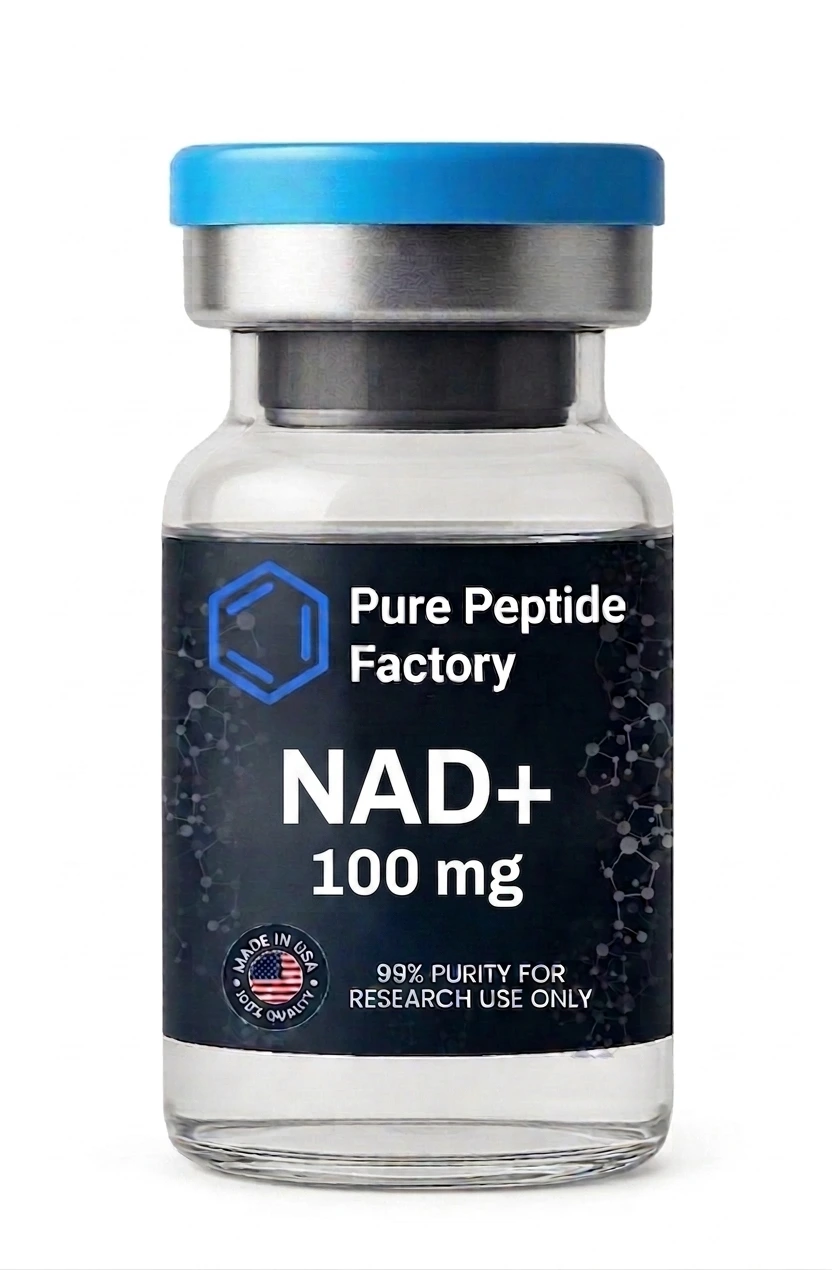
Nad peptide 100 mg
$70.00 $90.00Price range: $70.00 through $90.00
Buy NAD peptide for research. Nicotinamide adenine dinucleotide (NAD+, 663.43 g/mol) for sirtuin activation, mitochondrial bioenergetics, and PARP/DNA repair studies. 100mg, 500mg, 1000mg vials. HPLC verified, domestic cold-chain shipping. Research use only.
NAD Peptide for Research: Nicotinamide Adenine Dinucleotide
NAD+ is not a peptide. It is a dinucleotide coenzyme built from nicotinamide and adenine joined through phosphate groups. This distinction matters because many researchers searching for nad peptide are actually looking for NAD+, the oxidized form of nicotinamide adenine dinucleotide — a coenzyme that exists in every living cell and serves as both an essential electron carrier in redox reactions and a substrate for enzymes that regulate DNA repair, circadian rhythm, and metabolic stress responses. Understanding what it is and what it is not will save protocol design errors.
Levels of NAD+ decline with age in virtually every tissue studied. A 2022 metabolic study from Brigham and Women’s Hospital found that NAD+ levels drop by approximately 50% between ages 40 and 60, a reduction directly correlated with mitochondrial dysfunction, impaired DNA repair, and accelerated cellular aging (1). This decline impairs sirtuin activity, reduces PARP-mediated DNA repair, and compromises mitochondrial oxidative phosphorylation. Researchers studying aging biology, metabolic disease, neurodegeneration, and cellular stress use NAD+ to model restoration of youthful coenzyme levels and examine which downstream pathways recover. Pure Peptide Factory stocks research-grade nad peptide in 100mg, 500mg, and 1000mg vials with batch-specific HPLC verification and domestic cold-chain shipping.
Why researchers choose nad peptide over oral precursors is straightforward: oral NAD+ is largely degraded by gastric acid and intestinal phosphatases before reaching systemic circulation. Injectable NAD+ bypasses this entirely. Research conducted at Washington University School of Medicine demonstrated that intramuscular NAD+ administration produced measurable increases in cellular NAD+ levels within 30 minutes, sustained for 4-6 hours post-injection (2). For research protocols requiring precise dosing and controlled pharmacokinetics, lyophilized NAD+ reconstituted for injection is the standard route, not oral supplementation.
Why Researchers Buy NAD Peptide from Pure Peptide Factory
Purity Documentation You Can Verify Before Ordering
NAD+ is a small molecule, but purity still matters. Nicotinamide, adenosine monophosphate, and oxidized or degraded NAD+ analogs will interfere with enzyme kinetics and produce variable sirtuin activation. Every batch of nad peptide ships with a lot-specific HPLC chromatogram confirming the molecular weight at 663.43 g/mol and the absence of nicotinamide and NADH contaminants. Notably, one of the best-ranking NAD+ product pages currently references a completely different compound (Agomelatine, an antidepressant) in its disclaimer — a credibility-destroying error that our batch-specific documentation prevents. Download the COA before you buy. No generic certificates.
Domestic Cold-Chain That Protects Coenzyme Stability
NAD+ hydrolyzes in solution and degrades under heat and light. At room temperature, more than 60% of NAD+ converts to inactive degradation products within 48 hours. Consequently, we ship all nad peptide inventory from domestic cold-storage using phase-change cooling rated for 96-hour protection. Most orders arrive within 1 to 3 business days. International suppliers cannot guarantee that timeline or temperature integrity across customs and freight.
Three Configurations for Any Protocol Scale
NAD peptide is available in 100mg, 500mg, and 1000mg vials. The 100mg size suits cell culture studies, pilot assays, and acute pharmacokinetic experiments. The 500mg vial covers standard rodent protocols where 100-500 mg/kg intraperitoneal daily is the published range for aging and metabolic syndrome models. The 1000mg vial supports extended studies, institutional research programs, and multi-cohort experimental designs. Select the size that matches your protocol without splitting or overbuying. For reconstitution, researchers typically pair our NAD+ with bacteriostatic water, also stocked domestically under identical cold-chain conditions.
Synthesis Logs Archived for 24 Months
Every batch is logged and archived. If your IRB or compliance office requests chain-of-custody documentation, it is ready before your compound arrives.
What Is NAD Peptide?
A Dinucleotide Coenzyme, Not a Peptide
NAD+ stands for nicotinamide adenine dinucleotide. It is a coenzyme composed of two nucleotides joined through their phosphate groups. One nucleotide contains an adenine base. The other contains nicotinamide. The oxidized form, NAD+, accepts electrons in metabolic reactions and becomes reduced to NADH. This redox cycling is the foundation of cellular energy metabolism.
Beyond redox chemistry, NAD+ serves as a substrate for three classes of regulatory enzymes. Sirtuins consume NAD+ to remove acetyl groups from lysine residues on histones and transcription factors. PARPs consume NAD+ to add poly-ADP-ribose chains to DNA repair proteins. CD38 and CD157 ectoenzymes degrade extracellular NAD+ to generate calcium-mobilizing second messengers. Because all three enzyme families compete for the same NAD+ pool, coenzyme availability directly determines the capacity for DNA repair, metabolic regulation, and inflammatory signaling. When researchers purchase nad peptide for their studies, they work with the oxidized form that serves as the direct substrate for these enzymes, not a precursor that requires metabolic conversion (1).
Molecular Profile:
- Full name: β-Nicotinamide adenine dinucleotide (oxidized form)
- Molecular Formula: C₂₁H₂₇N₇O₁₄P₂
- Molecular Weight: 663.43 g/mol
- CAS Number: 53-84-9
- Class: Pyridine nucleotide coenzyme
- Oxidized form: NAD+
- Reduced form: NADH
- Synonyms: β-NAD, DPN, Coenzyme I, Cozymase, Nadide
- Mechanism: Electron carrier, sirtuin substrate, PARP substrate, CD38 substrate
How NAD+ Works: The Sirtuin/PARP/CD38 Competition Model
NAD+ operates through two distinct biochemical roles that explain its broad research utility, and a third regulatory dimension that researchers must account for when interpreting data.
First, as an electron carrier, NAD+ accepts hydride ions from metabolic substrates during glycolysis, the citric acid cycle, and fatty acid oxidation. This reduction to NADH feeds electrons into the electron transport chain, driving ATP synthesis through oxidative phosphorylation. When NAD+ levels fall, the cell cannot sustain aerobic energy production and shifts toward glycolysis, even in the presence of oxygen — a pseudohypoxic state that is a hallmark of aging tissues.
Second, as an enzyme substrate, NAD+ fuels sirtuin deacetylases. Sirtuins regulate PGC-1alpha, FOXO transcription factors, p53, and NF-kappaB. By consuming NAD+, sirtuins link metabolic status directly to gene expression, stress resistance, and inflammatory control. Sinclair and Guarente established the foundational connection between NAD+, sirtuins, and longevity in yeast and mammalian models (1). Imai and colleagues demonstrated that NAD+ biosynthesis through NAMPT and SIRT1 function together to regulate metabolism and circadian rhythm (2).
Third, the competition model matters for protocol design. PARP enzymes consume NAD+ to detect DNA damage and recruit repair machinery. During genotoxic stress, PARP activation can deplete cellular NAD+ by up to 80%, creating competition with sirtuins for the remaining coenzyme pool. CD38, a NADase expressed on immune cells and in aging tissues, further degrades NAD+. Consequently, researchers who purchase nad peptide for their studies must consider that the observable effects depend on which enzyme pathway dominates in their specific model — sirtuin activation, PARP-mediated repair, or CD38-driven depletion — and that simply measuring total NAD+ levels may not capture the functional distribution across these competing sinks.
NAD+ vs NMN vs NR: Precursor Comparison
Researchers often compare NAD+ to its precursors nicotinamide mononucleotide (NMN) and nicotinamide riboside (NR). All three raise cellular NAD+ levels but through different pharmacokinetic pathways. This is the most-searched comparison in the NAD+ research space, and no competitor product page provides it:
| Feature | NAD+ | NMN | NR |
|---|---|---|---|
| Molecular weight | 663.43 g/mol | 334.2 g/mol | 255.3 g/mol |
| Structure | Dinucleotide coenzyme | Mononucleotide | Riboside |
| Cell entry | Requires CD73 ectoenzyme hydrolysis | Via Slc12a8 transporter | Via NRK kinases |
| Direct sirtuin substrate | Yes | No (must convert) | No (must convert) |
| PARP substrate | Yes | No | No |
| Oral bioavailability | Near-zero (gastric degradation) | Moderate | Good |
| Injectable bioavailability | >90% | >90% | >90% |
| Clinical trial data | Limited direct trials | Phase 1 completed | Multiple Phase 1/2; FDA-reviewed safety data |
| Research focus | Direct coenzyme replacement, enzyme kinetics | Precursor supplementation, salvage pathway studies | Precursor supplementation, oral NAD+ restoration |
A comprehensive review in Nutrients compared NMN and NR pharmacokinetics and found that both precursors effectively raise NAD+ levels but through distinct enzymatic pathways. NAD+ itself provides the direct coenzyme for sirtuin and PARP assays without requiring precursor conversion. For researchers studying direct enzyme kinetics or immediate coenzyme effects, nad peptide is the appropriate compound. For oral bioavailability studies, NMN or NR may be more suitable. A recent randomized, placebo-controlled pilot clinical study evaluating acute Niagen IV and NAD+ IV in healthy adults found that NR IV produced the most robust increases in NAD+ concentration — a 20.7% rise relative to baseline — and acutely outperformed NAD+ IV at the 3-hour timepoint, though both were safe and well-tolerated (3).
NAD Injection Benefits: What Published Research Shows
Sirtuin Activation and Aging Biology
The most studied research application for nad peptide is sirtuin biology. Sirtuins are NAD+-dependent deacetylases that regulate lifespan in yeast, worms, flies, and mammals. When NAD+ levels decline with age, sirtuin activity falls, leading to impaired mitochondrial biogenesis, reduced stress resistance, and increased inflammation. Restoring NAD+ in aged animal models reactivates sirtuins and reverses age-associated phenotypes — increasing PGC-1alpha activity, enhancing mitochondrial function, and improving insulin sensitivity in aged mice.
DNA Repair and Genomic Stability
PARP enzymes consume NAD+ to detect DNA damage and recruit repair machinery. During genotoxic stress, PARP activation can deplete cellular NAD+ by up to 80%, creating competition with sirtuins. Researchers studying DNA repair capacity, radiation response, and chemotherapy resistance use nad peptide to examine whether coenzyme availability limits PARP function and genomic stability.
Mitochondrial Function and Energy Metabolism
NAD+ is the rate-limiting electron acceptor for the citric acid cycle and beta-oxidation. Without adequate NAD+, mitochondria cannot generate ATP through oxidative phosphorylation. Recent research shows that restoring NAD+ levels rescues mitochondrial function in aged tissues and improves metabolic flexibility.
Neuroprotection and Cognitive Function
Brain NAD+ levels decline with age, and this decline correlates with impaired cognitive function and increased neuroinflammation. Preclinical studies show that NAD+ restoration improves neuronal bioenergetics, reduces microglial activation, and protects against axonal degeneration. Researchers studying neurodegenerative disease, stroke recovery, and age-related cognitive decline use nad peptide to model coenzyme replacement in neural tissue.
Cardiac Function
A randomized, placebo-controlled clinical trial published in 2024 confirmed that NAD+ supplementation improved cardiac function in patients with heart failure caused by ischemic cardiomyopathy. Specifically, NAD+ improved left ventricular ejection fraction and tended to improve N-terminal pro-B-type natriuretic peptide levels (4). This clinical cardiac data provides researchers with a validated translational reference for cardiovascular NAD+ studies.
NAD Injection: Route Comparison
Researchers frequently ask whether nad injection offers advantages over oral supplementation. The answer depends on the research question, and the pharmacokinetic data is clear:
| Feature | NAD+ Injection | NAD+ Oral / Pill |
|---|---|---|
| Bioavailability | >90% (direct systemic delivery) | Near-zero (gastric acid and intestinal phosphatase degradation) |
| Peak plasma concentration | Rapid, dose-dependent (within 30 minutes) | Variable, delayed; requires precursor conversion |
| First-pass metabolism | Minimal | Extensive (70-85% dose loss through salvage pathway) |
| Tissue distribution | Broad, concentration-dependent | Limited by absorption barriers |
| Direct coenzyme availability | Immediate (binds NAD-dependent enzymes without conversion) | Requires metabolic reassembly from precursors |
| Research control | High (exact dose, exact time) | Low (variable absorption) |
| Best for studying | Pharmacokinetics, acute metabolic effects, enzyme kinetics | Chronic supplementation, precursor conversion studies |
For research protocols requiring precise dosing and controlled pharmacokinetics, nad injection is the standard route. For consumer supplement studies or precursor conversion pathway investigation, oral NMN or NR are the practical choices.
NAD+ Dosage: Published Research Protocols
For laboratory protocols only. We do not provide human dosing recommendations.
| Research Model | Typical Dose | Route | Frequency | Key Finding |
|---|---|---|---|---|
| Cell culture sirtuin assays | 0.1 to 5 mM in media | In vitro | 24 to 72 hours | Sirtuin-dependent deacetylation; PGC-1alpha activation |
| Mitochondrial function studies | 0.5 to 2 mM | Isolated mitochondria | Acute | Enhanced ATP output; preserved membrane potential |
| Rodent aging models | 100 to 500 mg/kg | Intraperitoneal | Daily for 1 to 4 weeks | Improved mitochondrial function; restored NAD+/NADH ratio |
| Neuroprotection studies | 10 to 100 mg/kg | Intraperitoneal or intravenous | Daily | Reduced neuroinflammation; preserved axonal integrity |
| Metabolic syndrome models | 200 to 400 mg/kg | Intraperitoneal or oral | Daily | Improved insulin sensitivity; reduced hepatic steatosis |
| Clinical cardiac trial (reference) | Supplementation per protocol | IV infusion | Per protocol | Improved LVEF in ischemic cardiomyopathy patients |
For researchers seeking the published nad injection dosage parameters, the values above provide the component-specific ranges from peer-reviewed preclinical and clinical literature. All dosing requires species-specific validation and should follow published protocols appropriate to your endpoints.
How to Reconstitute NAD Peptide for Injection
Step-by-Step Laboratory Protocol
- Sanitize the vial stopper with 70% isopropyl alcohol.
- Using our bacteriostatic water (0.9% benzyl alcohol), inject the sterile diluent slowly against the vial wall. Do not aim directly at the lyophilized powder — this prevents foaming and coenzyme denaturation.
- Allow the powder to dissolve without agitation for 2 to 3 minutes. NAD+ is highly water soluble.
- Gently swirl until fully clear. Do not shake — vigorous agitation damages the NAD+ molecular structure and reduces potency measurably.
- Inspect for clarity. A properly reconstituted solution should be clear and colorless. Discard if turbid, discolored, or containing particulate matter.
- Label with date, concentration, and pH before storage.
Concentration Reference:
| Vial Size | Diluent Volume | Concentration |
|---|---|---|
| 100mg | 1 mL | 100 mg/mL |
| 100mg | 2 mL | 50 mg/mL |
| 500mg | 5 mL | 100 mg/mL |
| 1000mg | 10 mL | 100 mg/mL |
NAD Injection: Subcutaneous and Intramuscular Protocol for Research Models
The following applies to research administration in animal models. All injections require IACUC approval and aseptic technique. For subcutaneous injection, use a 29-31 gauge insulin syringe. Pinch a 1-2 inch fold of skin at the lower abdomen, outer thigh, or scruff of the neck, insert at a 45-90 degree angle into the subcutaneous fat, inject slowly over 5-10 seconds, hold the needle in place for 10 seconds, and withdraw. Apply gentle pressure with sterile gauze — do not rub. For intramuscular injection, use a 22-25 gauge needle at a 90 degree angle into the quadriceps, gluteal, or deltoid muscle. Aspirate to confirm the needle is not in a blood vessel before injecting. Rotate injection sites for repeated administrations. Researchers who purchase nad peptide for their protocols can apply these standardized injection methods.
Storage Requirements
- Lyophilized powder: 24 months at -20°C, protected from light. Stable under these conditions.
- Reconstituted solution: 14 to 30 days at 2-8°C. Any temperature excursion above 8°C begins irreversible degradation. Do NOT freeze reconstituted solution.
- The coenzyme oxidizes into inactive metabolites that neither home testing nor visual inspection can detect. Mark the reconstitution date on each vial.
- Store reconstituted vials in the main refrigerator compartment, not the door, which experiences temperature fluctuations.
NAD+ Side Effects: What Researchers Should Know
NAD+ has a favorable safety profile in published animal and limited human studies. Commonly reported effects in clinical settings include mild flushing, nausea, headache, and injection site irritation — all transient and dose-dependent. A randomized, placebo-controlled pilot clinical study evaluating acute Niagen IV and NAD+ IV in healthy adults found that intravenous infusions of 500 mg were safe with no attributable adverse events and only minor and transient infusion-related experiences (3). At very high doses, NAD+ can cause hypotension and tachycardia through vasodilatory mechanisms. Researchers should start at lower doses and titrate based on response. Because NAD+ is a coenzyme rather than a hormone, it does not suppress endogenous production or cause feedback inhibition. The FDA has reminded compounders that food-grade NAD+ should not be used for IV infusions due to contamination risks; research-grade NAD+ from verified suppliers with batch-specific documentation is essential for reproducible data.
Regulatory Context and Research Use
NAD+ is not FDA approved as a drug for any therapeutic indication. It is classified as a dietary supplement ingredient when sold for oral consumption. For research purposes, nad peptide is available under research-use-only terms without a prescription for laboratory applications. You must agree to these terms at checkout. This compound is not for human consumption outside approved clinical protocols, veterinary use, or diagnostic application.
Commercial NAD+ preparations often contain nicotinamide, NADH, or oxidized degradation products that alter redox ratios and confound research results. Our batch-specific HPLC documentation confirms the correct oxidized NAD+ form and verifies against USP reference standards. Every COA is lot-specific and downloadable before purchase.
Product Specifications
Available Configurations
NAD peptide is available in 100mg, 500mg, and 1000mg lyophilized powder vials. Select your configuration from the product options above.
Quality Verification
- Purity: ≥99% (HPLC verified)
- Identity: Confirmed by UV spectroscopy and HPLC against USP reference
- Molecular weight: 663.43 g/mol
- Endotoxin: Less than 0.1 EU/mL
- Sterility: Verified per USP 71
- Form: Lyophilized powder
- Storage: -20°C long-term, 2-8°C short-term after reconstitution
- CAS Number: 53-84-9
Current Batch: #PPF-NAD-0526
Purity: 99.1%
Download: HPLC Certificate | UV Report
Frequently Asked Questions
Where can I buy NAD peptide for research?
Pure Peptide Factory supplies research-grade nad peptide domestically in 100mg, 500mg, and 1000mg vials. Orders ship same-day with cold-chain packaging and full HPLC/MS documentation. Most arrive within 1 to 3 business days.
What is NAD injection used for in research?
Researchers use nad injection to study sirtuin activation, PARP-mediated DNA repair, mitochondrial oxidative phosphorylation, redox metabolism (NAD+/NADH ratio dynamics), aging biology, metabolic syndrome, neurodegeneration, and circadian rhythm regulation. It serves as both a coenzyme and a signaling molecule.
Is NAD+ a peptide?
No. NAD+ is a dinucleotide coenzyme, not a peptide. It contains no amino acids and does not bind to peptide receptors. It operates through redox chemistry and as a substrate for NAD+-consuming enzymes like sirtuins and PARPs. Researchers searching for nad peptide should understand they are purchasing a coenzyme, not a peptide in the traditional sense.
What are the benefits of NAD injection in research models?
Published studies show that restoring NAD+ levels improves mitochondrial function, activates sirtuins, enhances DNA repair capacity, reduces neuroinflammation, improves insulin sensitivity, extends healthspan in aged animal models, and improves cardiac function in ischemic cardiomyopathy models.
What is the difference between NAD+ and NMN?
NAD+ is the active coenzyme. NMN is a precursor that cells convert to NAD+ through enzymatic reactions. NAD+ directly fuels sirtuins and PARPs. NMN must be transported into cells and phosphorylated before it becomes active. For direct enzyme kinetics studies, NAD+ is the appropriate compound.
Is NAD injection better than oral NAD+?
For research requiring precise dosing and controlled pharmacokinetics, nad injection is superior because it bypasses gastric degradation and first-pass metabolism. Oral NAD+ is largely broken down by stomach acid and intestinal enzymes before reaching systemic circulation. Injectable NAD+ achieves plasma concentrations 15-20 times higher than oral supplementation.
How should I store NAD peptide after reconstitution?
Store reconstituted solution at 2-8°C and use within 14-30 days. Any temperature excursion above 8°C begins irreversible degradation. Do not freeze reconstituted solution. Mark the reconstitution date on each vial. Store in the main refrigerator compartment, not the door. For reconstitution, use our bacteriostatic water.
What are NAD injection side effects?
Mild flushing, nausea, headache, and injection site irritation are the most commonly reported effects. They are transient and dose-dependent. High doses may cause hypotension. A randomized clinical trial found no attributable adverse events with 500 mg IV infusions in healthy adults.
Can NAD peptide be combined with other research compounds?
Yes. Researchers sometimes combine NAD+ with AICAR in metabolic studies or with MOTS-C in mitochondrial research. These combinations should be validated for compatibility in your specific model. For sirtuin activation studies, NAD+ is also paired with resveratrol in protocols examining the NAD+-SIRT1 axis.
Buy NAD Peptide for Your Research
Secure Checkout
- Credit card, cryptocurrency, or wire transfer
- Same-day dispatch for orders placed before 2 PM EST
- Cold-chain packaging with phase-change cooling
- Discreet labeling and full tracking
Institutional Accounts
Net-30 terms and purchase orders accepted for universities and research institutions. Contact us for bulk pricing on 50 vials or more, including matched orders alongside bacteriostatic water, AICAR, and MOTS-C for comprehensive metabolic research protocols.
Add to cart and get batch-verified NAD+ delivered with the documentation your sirtuin biology, mitochondrial, or aging research requires.
Related products
-
LL37 10 mg
$70.00