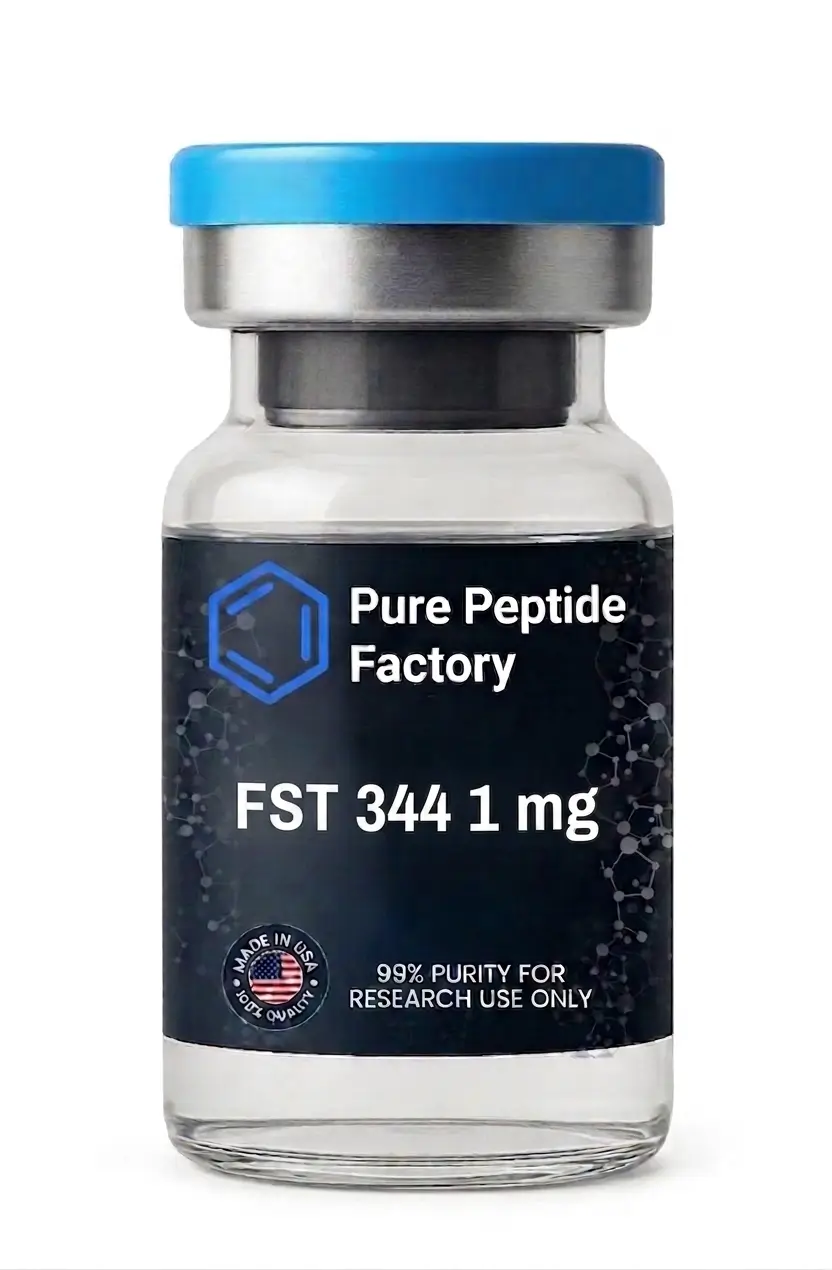
FST 344 1 mg
$120.00
FST-344 peptide, research-grade recombinant follistatin glycoprotein for myostatin inhibition, activin binding, and muscle hypertrophy studies. 1mg vials, domestic cold-chain shipping, HPLC verified. Research use only.
FST-344 Peptide for Sale: Research-Grade Follistatin Myostatin Inhibitor
Researchers studying myostatin pathway inhibition, muscle hypertrophy mechanisms, or TGF-β superfamily signaling need a reliable domestic source for follistatin-344. Pure Peptide Factory supplies research-grade fst 344 peptide in 1mg vials with full batch documentation and cold-chain shipping. Unlike small synthetic peptides, this is a recombinant glycoprotein — a 315-amino acid mature protein derived from the 344-amino acid FS344 precursor — that binds and neutralizes myostatin (GDF-8) with high affinity, relieving the brake on skeletal muscle growth (1).
What makes the fst 344 peptide isoform particularly valuable for research is its deliberately reduced affinity for activin A. The alternatively spliced FS344 variant produces a serum-circulating FS315 protein that binds activin approximately 10-fold less potently than the membrane-associated FS288 isoform. This means researchers can study myostatin blockade without the confounding variable of follicle-stimulating hormone (FSH) suppression that would otherwise occur through activin inhibition (2). This is the exact same isoform used in the AAV1-FS344 gene therapy trials that produced durable muscle hypertrophy in nonhuman primates and improved ambulation in Becker muscular dystrophy patients.
Why Researchers Choose Pure Peptide Factory for FST-344 Peptide
Documentation for a Complex Recombinant Glycoprotein
Fst 344 peptide is not a simple short-chain peptide. It is a recombinant glycoprotein of approximately 315 amino acids with a molecular weight of ~38.7 kDa and multiple disulfide bonds (36 cysteine residues across three follistatin-like domains). Every batch we ship includes lot-specific HPLC and mass spectrometry documentation verifying purity and molecular weight. Consequently, researchers can trust that the glycoprotein is intact and properly folded for binding studies.
Domestic Cold-Chain for Large Glycoproteins
Recombinant proteins are more structurally fragile than short synthetic peptides. Therefore, we store and ship all fst 344 peptide inventory from domestic cold-storage using phase-change cooling rated for 96-hour protection. Most orders arrive in 1 to 3 business days, preserving the tertiary structure essential for ligand-binding activity.
Compare Against Other Myostatin Inhibitors Without Batch Variability
Many research protocols compare follistatin-344 against other myostatin pathway inhibitors such as ACE-031 (ActRIIB-Fc), Bimagrumab (anti-ActRII monoclonal antibody), or myostatin propeptide. Because we stock the full myostatin inhibitor panel under identical cold-storage conditions, your comparison data remains free of supplier variability.
Synthesis Logs Archived for 24 Months
Should your IRB or compliance office request chain-of-custody records, we provide them without delay.
What Is FST-344 Peptide?
FS344: The Precursor to a Safe, Circulating Myostatin Antagonist
The follistatin gene (FST) produces two primary isoforms through alternative mRNA splicing: FST-317 and FST-344. These encode precursor proteins of 317 and 344 amino acids, which undergo post-translational cleavage and glycosylation to yield the mature forms: FS288 and FS315, respectively. The fst 344 peptide available for research corresponds to the FS315 mature protein — the serum-circulating form that preferentially targets myostatin over activin (3).
Critically, the FS288 isoform (from FST-317) is a potent suppressor of FSH secretion because it binds activin with high affinity at the cell surface. By contrast, FS315 (from FS344) has approximately 10-fold lower affinity for activin and lacks cell-surface binding affinity, providing a substantial safety margin that avoids pituitary-gonadal axis disruption. This is why the FS344 variant — not the shorter isoform — was selected for all gene therapy clinical trials in Becker muscular dystrophy, sporadic inclusion body myositis, and Duchenne muscular dystrophy.
Molecular Profile:
- Precursor: 344 amino acids (FS344)
- Mature protein: 315 amino acids (FS315) after signal peptide cleavage
- Molecular Weight: ~38.7 kDa (glycoprotein)
- Structural Domains: Three follistatin-like domains (FSD1, FSD2, FSD3), each with 10 conserved cysteines
- Primary Ligands: Myostatin (GDF-8), Activin A, GDF-11, select BMPs
- Key Isoform Difference: FS315 has 10-fold lower activin binding vs. FS288; no cell-surface affinity
- Synonyms: Follistatin-344, FST-344, FS344, Follistatin 315, Activin-binding protein
How FST-344 Peptide Works: Myostatin Sequestration and SMAD Pathway Inhibition
Myostatin (GDF-8) is a muscle-specific negative regulator of growth. It binds to the activin type IIB receptor (ActRIIB) on skeletal muscle cells, triggering phosphorylation of SMAD2/3, which then translocates to the nucleus to repress transcription factors regulating muscle differentiation — specifically Pax-3, Myf-5, and MyoD. Fst 344 peptide disrupts this pathway by binding directly to myostatin in the extracellular space, preventing receptor engagement. The result is derepression of myogenic transcription factors, allowing myoblast proliferation, differentiation, and ultimately muscle fiber hypertrophy to proceed unchecked (1).
In rodent models, follistatin overexpression produces 1.5- to 2-fold increases in muscle mass relative to controls, with proportional increases in strength. Importantly, these effects occur without exercise or dietary intervention, and persist for the duration of transgene expression — months in the case of AAV-mediated delivery. The mechanism may also extend beyond myostatin: follistatin binds GDF-11 and several BMPs, suggesting additional myostatin-independent contributions to muscle growth.
FST-344 Peptide vs Other Myostatin Inhibitors
| Feature | FST-344 (Follistatin) | ACE-031 (ActRIIB-Fc) | Bimagrumab | Myostatin Propeptide |
|---|---|---|---|---|
| Type | Recombinant glycoprotein (315 aa) | Soluble receptor decoy (Fc fusion) | Monoclonal antibody (anti-ActRII) | Recombinant propeptide fragment |
| Mechanism | Direct ligand binding and sequestration | Decoy receptor: binds multiple TGF-β ligands | Receptor blockade | Non-covalent inhibition of myostatin activation |
| Targets | Myostatin, activin A, GDF-11, BMPs | Myostatin, activin A, GDF-11, BMP-9, BMP-10 | ActRIIA and ActRIIB receptors | Myostatin only (highly specific) |
| Selectivity | Moderate (FS344 avoids activin over-suppression) | Low (broad ligand trap) | High (receptor-level blockade) | Very high (myostatin-specific) |
| Clinical Status | Phase 1/2a BMD gene therapy (AAV1-FS344) | Phase 2 DMD (discontinued due to epistaxis) | Phase 2/3 for sIBM (FDA breakthrough) | Preclinical / research only |
| Best for Studying | Multiligand TGF-β antagonism, muscle hypertrophy with FSH-sparing safety | Broad TGF-β ligand trapping, off-target effects | Receptor-level myostatin pathway blockade | Isolated myostatin-specific inhibition |
FST-344 Peptide Research Applications
Muscle Hypertrophy and Atrophy Research
The primary application of fst 344 peptide is the study of skeletal muscle hypertrophy. Preclinical models — from mice to nonhuman primates — demonstrate robust and durable increases in muscle fiber size and whole-muscle mass following follistatin administration or gene delivery. Researchers use this peptide to dissect the relative contributions of myostatin blockade versus activin inhibition, to map the SMAD2/3 signaling cascade in muscle, and to test whether myostatin antagonism can counter muscle wasting in models of cachexia, sarcopenia, denervation, or glucocorticoid-induced atrophy.
Muscular Dystrophy and Neuromuscular Disease
The AAV1-FS344 gene therapy program provides the translational framework for this research application. In the mdx mouse model of Duchenne muscular dystrophy, FS344 delivery improved dystrophic pathology more than myostatin blockade alone, suggesting additive benefits from blocking other TGF-β ligands. A Phase 1/2a clinical trial in Becker muscular dystrophy patients demonstrated improved 6-minute walk distance (gains of 58-125 meters in responders), reduced endomysial fibrosis, and more normal fiber size distribution with no adverse effects (2).
Metabolic and Adipose Tissue Research
Beyond muscle, follistatin induces browning of white adipose tissue through UCP1 upregulation and enhances mitochondrial biogenesis. Studies also show reduced hepatic glucose production and improved peripheral glucose uptake, linking myostatin pathway modulation to metabolic health. Fst 344 peptide therefore serves as a tool for investigating the muscle-adipose-liver metabolic axis.
Tissue Repair and Regeneration
In wound healing models, follistatin regulates keratinocyte proliferation and migration. In muscle injury models, it reduces fibrosis and promotes neovascularization. These applications extend the peptide’s research utility beyond pure hypertrophy studies.
FST-344 Peptide Dosage in Published Research
For laboratory protocols only. We do not provide human dosing recommendations.
| Research Model | Typical Dose/Approach | Route | Key Finding |
|---|---|---|---|
| Mdx mouse (DMD model) | AAV1-FS344: 3 × 10¹¹ vg/kg | Intramuscular | Reduced fibrosis, increased fiber size, improved dystrophic pathology |
| Cynomolgus macaque | AAV1-FS344: 3 × 10¹¹ vg/kg | Intramuscular (quadriceps) | Pronounced and durable increases in muscle size and strength; no organ pathology |
| Rodent muscle hypertrophy | 100 mcg/kg recombinant FS315 | Subcutaneous or intraperitoneal | 1.5- to 2-fold increase in muscle mass over 8-12 weeks |
| Cell culture (C2C12 myoblasts) | 0.13-0.19 µg/mL (ED₅₀ for activin neutralization) | In vitro | SMAD2/3 phosphorylation inhibition assay |
For researchers seeking detailed dosing guidance, the published fst 344 dosage literature from Rodino-Klapac et al. (2009) and Kota et al. (2009) provides model-specific parameters. Note that most published work uses AAV-mediated gene delivery rather than recombinant protein injection, which is important context for experimental design.
How to Reconstitute FST-344 Peptide
Step-by-Step Laboratory Protocol
- Sanitize the vial stopper with 70% isopropyl alcohol.
- Inject sterile bacteriostatic water or PBS slowly against the vial wall. Because this is a large glycoprotein rather than a short peptide, avoid directing the stream at the lyophilized cake to minimize foaming and protein aggregation.
- Allow the powder to dissolve without agitation for 5-10 minutes. Large glycoproteins dissolve more slowly than short synthetic peptides.
- Gently swirl until the solution is completely clear. Do not shake — mechanical stress can denature disulfide-rich proteins.
- Verify a clear, colorless to faintly yellow solution. Discard if turbidity or particulate matter remains.
- Label with date and concentration. Aliquot and freeze for long-term storage.
Concentration Reference for 1mg Vial:
- 1mg vial + 1mL bacteriostatic water = 1 mg/mL
- 1mg vial + 2mL bacteriostatic water = 0.5 mg/mL
Storage Requirements:
- Lyophilized powder: 24 months at -20°C, protected from light and moisture.
- Reconstituted solution: 7 days at 2 to 8°C. For longer storage, aliquot and freeze at -20°C for up to 6 months.
- Avoid repeated freeze-thaw cycles. The multiple disulfide bonds (36 cysteine residues) make this protein susceptible to aggregation upon repeated handling.
FST-344 Peptide: Regulatory and Safety Context
Research Use Only
Fst 344 peptide is not FDA approved for any human indication. The AAV1-FS344 gene therapy is an investigational product currently in clinical trials. Our recombinant follistatin-344 is sold strictly as a research-grade glycoprotein for in vitro and controlled laboratory animal studies. It is not for human consumption, veterinary use, or diagnostic application. You must agree to research-use-only terms at checkout.
Safety: Why FS344 Was Chosen Over FS288
Follistatin was first isolated from the ovary and is known to suppress follicle-stimulating hormone (FSH) secretion through activin inhibition. This raised legitimate concerns about potential adverse effects on the hypothalamic-pituitary-gonadal axis and reproductive function. The FS344 → FS315 isoform was specifically selected for clinical development because its 10-fold lower activin affinity and lack of cell-surface binding provide a safety margin. Published preclinical and clinical data show no organ system pathology or changes in reproductive capabilities with AAV1-FS344 delivery. However, researchers using the recombinant fst 344 peptide should be aware that at high concentrations, activin cross-reactivity may still occur and should be monitored as an experimental variable.
Product Specifications
Available Configuration
FST-344 peptide is available in 1mg lyophilized powder vials. This is the standard research configuration for this recombinant glycoprotein. Select your quantity from the product options above.
Quality Verification
- Purity: ≥98% (HPLC verified)
- Identity: Mass spectrometry confirmed (~38.7 kDa) with SDS-PAGE verification
- Endotoxin: Less than 0.1 EU/mL
- Sterility: Verified per USP 71
- Form: Lyophilized powder (recombinant glycoprotein)
- Storage: -20°C long-term, 2 to 8°C short-term after reconstitution
Current Batch: #PPF-FST-0526
Purity: 98.5%
Download: HPLC Certificate | MS Report
Frequently Asked Questions
What is fst 344 peptide used for in research?
Researchers use fst 344 peptide to study myostatin pathway inhibition, skeletal muscle hypertrophy, muscular dystrophy models, TGF-β superfamily signaling, metabolic interactions between muscle and adipose tissue, and tissue repair mechanisms.
What is the difference between FS344 and FS288?
FS344 (precursor) produces the serum-circulating FS315 protein with 10-fold lower activin binding affinity. FS288 (from FST-317) is membrane-associated and potently suppresses FSH through activin inhibition. The FS344 isoform was chosen for clinical development specifically to avoid reproductive axis side effects.
Is this the same follistatin used in the gene therapy trials?
The gene therapy trials use AAV1-FS344, which delivers the FS344 cDNA to muscle cells. The transgene product is the same FS315 protein. Our recombinant fst 344 peptide is the mature protein, not the gene therapy vector, but studies the same molecular pathway.
What is the fst 344 dosage used in research?
Rodent hypertrophy studies typically use 100 mcg/kg of recombinant FS315 administered subcutaneously or intraperitoneally. Cell culture ED₅₀ for activin neutralization is 0.13-0.19 µg/mL. Refer to the dosage table above for model-specific details.
Where can I buy fst 344 peptide for research?
Pure Peptide Factory supplies research-grade fst 344 peptide domestically with same-day dispatch and cold-chain shipping. Orders arrive within 1 to 3 business days with full HPLC and mass spectrometry documentation.
Is fst 344 peptide FDA approved?
No. AAV1-FS344 is an investigational gene therapy in clinical trials. Our recombinant follistatin-344 is a research-grade glycoprotein for laboratory use only.
How should I store fst 344 peptide?
Store lyophilized powder at -20°C for up to 24 months. After reconstitution, keep at 2 to 8°C and use within 7 days. For longer storage, aliquot and freeze at -20°C. Avoid repeated freeze-thaw cycles due to the protein’s disulfide-rich structure.
How does fst 344 compare to ACE-031 or Bimagrumab?
ACE-031 is a soluble ActRIIB receptor decoy that traps multiple TGF-β ligands broadly. Bimagrumab is a monoclonal antibody that blocks the ActRII receptor directly. FST-344 is a natural ligand-binding protein with moderate selectivity. See the comparison table above for full details.
Buy FST-344 Peptide for Your Research
Secure Checkout
- Credit card, cryptocurrency, or wire transfer
- Same-day dispatch for orders placed before 2 PM EST
- Cold-chain packaging with phase-change cooling
- Discreet labeling with full tracking
Institutional Accounts
Net-30 terms and purchase order acceptance available for universities and research institutions. Contact us for bulk pricing on 50 vials or more, including matched orders alongside ACE-031, Bimagrumab, and other myostatin pathway research compounds.
Add to cart and secure the most extensively clinically characterized myostatin inhibitor for your muscle biology, dystrophy, or TGF-β superfamily research program.
Related products
-
LL37 10 mg
$70.00