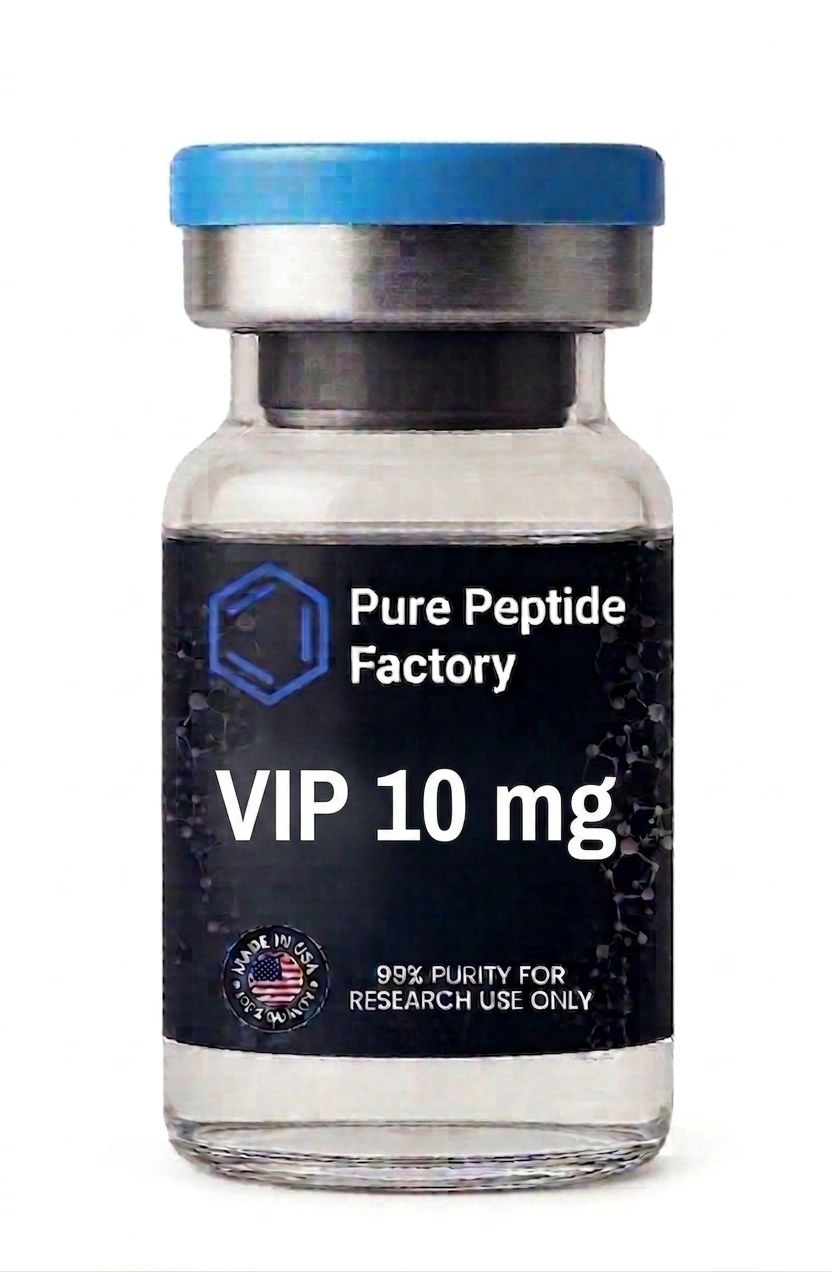
VIP 10 mg
$90.00
Vasoactive intestinal peptide buy options at Pure Peptide Factory deliver research-grade VIP, the 28-amino-acid neuropeptide that Said and Mutt first isolated in 1970. VIP is the parent molecule of Aviptadil (RLF-100), which holds FDA orphan drug designations for pulmonary sarcoidosis, pulmonary hypertension, ARDS, and idiopathic pulmonary fibrosis. Researchers study VIP through VPAC1, VPAC2, and PAC1 receptor pharmacology for neuroinflammation, respiratory biology, circadian rhythm, and immunomodulation applications. HPLC verified at 98% minimum purity, batch-specific COA. 10mg vials. Research use only.
Vasoactive Intestinal Peptide Buy: Research-Grade VIP from a Domestic Supplier
In 1970, Sami Said and Viktor Mutt isolated a 28-amino-acid peptide from porcine duodenum that produced potent vasodilation, gut motility effects, and bronchodilation. Specifically, they named it Vasoactive Intestinal Peptide (VIP), and the compound has since become one of the most extensively studied neuropeptides in human biology. Furthermore, VIP serves as the parent molecule for Aviptadil (RLF-100), a synthetic VIP analog developed by Relief Therapeutics that currently holds FDA orphan drug designations for pulmonary sarcoidosis, pulmonary arterial hypertension, ARDS, and idiopathic pulmonary fibrosis.
For researchers studying neuroinflammation, respiratory biology, circadian rhythm regulation, immunomodulation, or the rapidly developing aviptadil clinical pipeline, VIP is the foundational research compound. Pure Peptide Factory stocks research-grade VIP with domestic cold-chain shipping, batch-specific HPLC documentation, and the complete VPAC1/VPAC2/PAC1 receptor pharmacology framework integrated into our research approach. When you need to buy vasoactive intestinal peptide for laboratory research, the 3326.8 g/mol molecular weight and amphipathic α-helical structure require sophisticated synthesis verification that not all vendors provide.
Why Researchers Choose Pure Peptide Factory for VIP
Documentation for a Receptor-Specific Research Compound
VIP binds three distinct G-protein coupled receptors (VPAC1, VPAC2, PAC1) with different affinities, and research protocols depend on receptor selectivity for proper experimental design. Therefore, every batch we ship includes a lot-specific HPLC chromatogram and mass spectrometry report verifying the 3326.8 g/mol molecular weight target with C-terminal amidation confirmation. The Certificate of Analysis is downloadable before your compound ships.
Domestic Cold-Chain Shipping for a Sensitive Neuropeptide
VIP has a notably short half-life in plasma (1-2 minutes), which reflects its sensitivity to proteolytic degradation. Lyophilized stability is excellent, but reconstituted solution stability matters significantly for research protocol design. Consequently, we ship from domestic cold-storage using phase-change cooling rated for 96-hour protection. Most orders reach your lab within 1 to 3 business days.
10mg Configuration for Comprehensive Research Protocols
Our 10mg vial configuration matches research-scale dosing for VIP protocols. Specifically, intranasal administration research uses microgram-range doses (typical aviptadil-style protocols are 50-100 mcg per spray), cell culture work uses nanomolar to micromolar concentrations, and rodent injection protocols vary by route and endpoint. Therefore, a single 10mg vial accommodates extensive dose-response work across multiple research applications.
Synthesis Logs Archived for 24 Months
We document and archive every batch. Therefore, if your IRB or compliance office requests chain-of-custody records or synthesis documentation, we can provide them on demand.
What Is Vasoactive Intestinal Peptide?
A Pleiotropic 28-Amino-Acid Neuropeptide
VIP is a 28-amino-acid peptide belonging to the secretin/glucagon peptide superfamily. The compound functions simultaneously as a neurotransmitter, neuromodulator, hormone, and immune signaling molecule. Furthermore, VIP is widely distributed throughout the central and peripheral nervous systems, gastrointestinal tract, respiratory system, cardiovascular tissue, and immune cells. This pleiotropic distribution explains why VIP research spans neuroscience, gastroenterology, pulmonology, immunology, reproductive biology, and oncology.
By contrast with most peptides that target a single receptor type, VIP binds three distinct G-protein coupled receptors with differing affinities and tissue distributions. As a result, the same peptide produces fundamentally different effects depending on which receptors are expressed locally in the target tissue.
Molecular Profile:
- Sequence: His-Ser-Asp-Ala-Val-Phe-Thr-Asp-Asn-Tyr-Thr-Arg-Leu-Arg-Lys-Gln-Met-Ala-Val-Lys-Lys-Tyr-Leu-Asn-Ser-Ile-Leu-Asn-NH2
- Single-letter sequence: HSDAVFTDNYTRLRKQMAVKKYLNSILN-NH2
- Molecular Formula: C147H237N43O43S
- Molecular Weight: 3326.8 g/mol
- CAS: 37221-79-7 (free acid); 40077-57-4 (amide)
- Length: 28 amino acids with C-terminal amidation
- Structure: Amphipathic α-helix in physiological conditions
- Discovery: Said & Mutt, 1970 (porcine duodenum isolation)
- Synonyms: VIP, vasoactive intestinal polypeptide, PHM27 family member
How VIP Works: Three Receptors, Three Tissue Distributions
VIP signaling depends on which of its three receptors dominates in the target tissue. Specifically, the VPAC1, VPAC2, and PAC1 receptors have distinct expression patterns and downstream signaling cascades:
| Receptor | Primary Distribution | Signaling Pathway | Research Focus |
|---|---|---|---|
| VPAC1 | Brain, liver, lungs, intestine, immune cells | Gαs → cAMP/PKA | Immunomodulation, GI motility, respiratory biology |
| VPAC2 | CNS, pancreas, heart, kidney, skeletal muscle, GI, reproductive tract | Gαs → cAMP/PKA | Circadian rhythm (SCN), bronchodilation, smooth muscle |
| PAC1 | Brain (predominant), adrenal medulla | Gαs and Gαq → cAMP and PLC pathways | Neuroprotection, stress response, neurodevelopment |
Importantly, VIP binds VPAC1 and VPAC2 with high affinity but PAC1 with much lower affinity. By contrast, the related neuropeptide PACAP (pituitary adenylate cyclase-activating peptide) preferentially binds PAC1. Therefore, researchers studying PAC1-specific effects often use PACAP rather than VIP, while researchers targeting VPAC1/VPAC2 effects use VIP as the more selective tool.
Once bound, VIP receptors activate adenylate cyclase through Gαs proteins, increasing intracellular cAMP and activating protein kinase A (PKA). As a result, downstream effects include smooth muscle relaxation (bronchodilation, vasodilation), anti-inflammatory cytokine modulation (decreased IL-6, IL-12, TNF-α; increased IL-10), and tissue-specific transcriptional changes mediated by CREB phosphorylation.
VIP Research Applications
Respiratory Biology and Pulmonary Research
VIP concentrations are highest in the lungs, where the peptide functions as a potent endogenous bronchodilator. Specifically, VIP relaxes bronchial smooth muscle through VPAC2 receptor activation, increases pulmonary blood flow through vasodilation, and modulates inflammatory cytokine production in alveolar macrophages. Furthermore, the 2023 EMJ Reviews paper “Aviptadil: Class Effect of a Synthetic Vasoactive Intestinal Peptide as a Treatment Option in Patients with COVID-19 with Severe Respiratory Failure” documented VIP’s role in inhibiting SARS-CoV-2 gene replication in human monocytes and viral replication in Calu-3 cells.
Research applications include:
- Bronchial smooth muscle relaxation studies in tracheal preparation models
- Histamine and prostaglandin F2α-induced bronchoconstriction protection
- Pulmonary vasodilation research in PAH models
- Alveolar macrophage cytokine profiling under VIP exposure
- ARDS research with VIP analog administration
Aviptadil Clinical Development Context
Aviptadil (RLF-100) is the synthetic VIP analog developed by Relief Therapeutics for clinical applications. Importantly, the FDA has granted Aviptadil orphan drug designations for multiple respiratory conditions:
- Pulmonary sarcoidosis (granted 2021)
- Pulmonary arterial hypertension (granted 2005)
- Acute respiratory distress syndrome (ARDS) (granted 2001)
- Idiopathic pulmonary fibrosis (granted)
- SARS-CoV-2 acute respiratory disease (Fast Track Designation, June 2020)
The 2024 PMC10949283 retrospective observational study examined aviptadil in viral-related severe ARDS, building on the COVID-19 trial framework that produced mixed but informative results. By contrast, sarcoidosis research using inhaled aviptadil has shown favorable immunoregulatory effects with good tolerability in open-label exploratory clinical experience. Therefore, VIP research-grade peptide allows preclinical investigation of mechanisms that aviptadil is testing clinically.
Neuroinflammation and Alzheimer’s Research
VIP is neuroprotective through VPAC1/VPAC2 receptor activation in CNS tissue. Specifically, VIP suppresses microglial activation, reduces pro-inflammatory cytokine production in neurons, and modulates the Th17/Treg balance in neuroinflammatory contexts. Furthermore, intranasal VIP administration in Alzheimer’s research models has shown reductions in beta-amyloid pathology and improvements in cognitive function endpoints.
Research endpoints include:
- Microglial activation marker quantification (Iba1, CD68, MHC-II)
- Pro-inflammatory cytokine profiles (IL-1β, IL-6, TNF-α) under VIP exposure
- Beta-amyloid plaque deposition in 5xFAD or APP/PS1 mouse models
- Behavioral cognitive testing (Morris water maze, novel object recognition)
- BDNF and neurotrophic factor expression
Circadian Rhythm and Suprachiasmatic Nucleus Biology
VIP is the primary intercellular signaling peptide in the suprachiasmatic nucleus (SCN), the master circadian pacemaker of the brain. Specifically, VIP-positive neurons synchronize the SCN’s neural network through VPAC2 receptor signaling, and disruption of VIP signaling produces circadian arrhythmicity in research models. Therefore, researchers studying circadian biology, sleep-wake cycles, and chronobiology use VIP as a fundamental research tool.
Notably, VPAC2-deficient mice show fragmented circadian rhythms and cannot maintain stable entrainment to light-dark cycles. By contrast, exogenous VIP administration can restore some aspects of circadian function in disrupted models.
Immunomodulation and Autoimmune Disease Research
The Delgado and Ganea 2013 review “Vasoactive intestinal peptide: a neuropeptide with pleiotropic immune functions” established the immunomodulatory research framework that current studies build on. Specifically, VIP modulates the Th17/Treg balance toward immunosuppressive phenotypes, increases IL-10 and TGF-β production, and induces Foxp3+ regulatory T cells. As a result, VIP shows beneficial effects in research models of:
- Multiple sclerosis (EAE rodent models)
- Rheumatoid arthritis (collagen-induced arthritis models)
- Inflammatory bowel disease (DSS and TNBS colitis)
- Type 1 diabetes (NOD mouse models)
- Sepsis and endotoxemia
Gastrointestinal and Pancreatic Research
VIP was first isolated from gastrointestinal tissue and remains a foundational tool for GI research. Specifically, VIP relaxes GI smooth muscle, stimulates bicarbonate secretion in the pancreas, modulates intestinal water and electrolyte balance, and regulates blood flow in the splanchnic circulation. Furthermore, VIPoma (a rare pancreatic neuroendocrine tumor that secretes excess VIP) provides a clinical research framework for studying pathological VIP elevation, characterized by Verner-Morrison syndrome (watery diarrhea, hypokalemia, achlorhydria).
Reproductive and Maternal-Fetal Research
The Hauk et al. (2014) work in American Journal of Reproductive Immunology demonstrated VIP’s role in maternal-fetal immune homeostasis. Specifically, VIP induces an immunosuppressant microenvironment at the maternal-fetal interface in non-obese diabetic mice and improves early pregnancy outcomes. Therefore, reproductive immunology research uses VIP to model trophoblast-leukocyte interactions and pregnancy maintenance mechanisms.
VIP Nasal Spray: Intranasal Administration Research
The “vasoactive intestinal peptide nasal spray” keyword cluster (180 combined monthly volume across “vasoactive intestinal peptide nasal spray,” “vasoactive intestinal peptide vip nasal spray,” and “vasoactive intestinal peptide spray”) reflects substantial researcher and consumer interest in this administration route. Below is honest framing of the research context.
Why Intranasal Administration Matters for VIP
VIP has a short plasma half-life (1-2 minutes) due to rapid proteolytic degradation. Therefore, systemic administration produces fleeting exposure that limits research applications. Intranasal administration bypasses first-pass metabolism while delivering compound directly to CNS targets through olfactory and trigeminal nerve pathways. As a result, intranasal VIP achieves measurable CSF concentrations within 30-60 minutes, supporting research protocols that target central nervous system VPAC1/VPAC2/PAC1 receptors.
Furthermore, intranasal administration is the route used in inhaled aviptadil clinical trials for sarcoidosis and pulmonary indications, where the goal is direct delivery to lung tissue rather than systemic exposure.
Published Research and Compounded VIP Protocols
Compounding pharmacy formulations of intranasal VIP (50 mcg per spray, administered four times daily alternating nostrils, with monthly titration toward 100 mcg per spray in some protocols) have been described in clinical literature primarily within the Shoemaker chronic inflammatory response syndrome (CIRS) framework. Specifically, the Shoemaker protocol uses intranasal VIP for patients with mold-related CIRS following completion of other protocol elements. By contrast, mainstream medical literature considers CIRS a contested diagnostic framework, and the FDA has not approved VIP for any human indication.
For laboratory research applications, intranasal VIP administration in rodent models typically uses lower concentrations and volumes adjusted for species and protocol design. Therefore, researchers translating clinical compounding pharmacy protocols to laboratory work should account for species, dose, and pharmacokinetic differences.
We do not provide human dosing recommendations. The clinical compounding pharmacy protocol references above appear in published literature for context only. Research-grade VIP is sold strictly for laboratory use.
VIP vs Aviptadil: Research Peptide vs Synthetic Clinical Analog
Researchers comparing VIP research peptide to aviptadil should understand the relationship clearly:
| Feature | Research-Grade VIP | Aviptadil (RLF-100) |
|---|---|---|
| Sequence | Native human VIP (28 aa) | Synthetic VIP analog (28 aa) |
| Molecular weight | 3326.8 g/mol | 3326.8 g/mol (identical) |
| Regulatory status | Research use only | FDA orphan drug designations (4+ indications) |
| Manufacturer | Multiple research peptide vendors | Relief Therapeutics |
| Formulation | Lyophilized powder for research reconstitution | Commercial sterile pharmaceutical formulation |
| Intended use | Laboratory research | Clinical investigation under FDA oversight |
| Cost | Research peptide pricing | Commercial pharmaceutical pricing |
| Purity standards | Research-grade (98% HPLC) | Clinical-grade (cGMP) |
| Best for studying | Mechanism, receptor pharmacology, preclinical models | Not available for non-clinical research |
The practical takeaway: research-grade VIP is the appropriate tool for laboratory research and preclinical studies. Aviptadil is the clinical formulation under active development for FDA-approved indications. Researchers running mechanism studies, in vitro receptor pharmacology, animal models, or cell culture work use research-grade VIP because aviptadil is not available outside clinical trial contexts.
VIP vs PACAP: Two Related Neuropeptides
Researchers entering VIP biology need to understand the relationship to pituitary adenylate cyclase-activating peptide (PACAP) because the two compounds share receptors and are often discussed together:
| Feature | VIP | PACAP |
|---|---|---|
| Length | 28 aa | 27 aa (PACAP-27) or 38 aa (PACAP-38) |
| Sequence homology with VIP | Reference | ~68% homologous |
| Receptor preference | VPAC1 ≈ VPAC2 >> PAC1 | PAC1 ≈ VPAC1 ≈ VPAC2 |
| Primary research focus | Smooth muscle, immune, circadian | Neuroprotection, stress response, neurodevelopment |
| Tissue distribution | Lungs (highest), GI, immune | Brain (predominant), endocrine glands |
| Best for studying | VPAC1/VPAC2 selective effects | PAC1-mediated effects |
Therefore, researchers studying VPAC1 and VPAC2-specific signaling reach for VIP. By contrast, researchers studying PAC1-mediated effects (neuroprotection, adrenal medulla function, stress response) reach for PACAP. Both compounds answer different research questions despite sharing receptor families.
How to Reconstitute VIP
Step-by-Step Laboratory Protocol
- Sanitize the vial stopper with 70% isopropyl alcohol
- Inject bacteriostatic water or sterile saline slowly against the vial wall
- Allow the lyophilized powder to dissolve without agitation for 2 to 3 minutes
- Gently swirl until the solution clears. Do not shake (vigorous agitation can cause aggregation in amphipathic peptides)
- Inspect for clarity and label with date and concentration before use
Concentration reference:
- 10mg vial + 1mL water = 10mg/mL (~3 mM stock)
- 10mg vial + 2mL water = 5mg/mL (~1.5 mM stock)
- 10mg vial + 5mL water = 2mg/mL (~600 µM)
- 10mg vial + 10mL water = 1mg/mL (~300 µM)
- For receptor pharmacology assays, prepare serial dilutions to nanomolar working concentrations
Storage Requirements
- Lyophilized powder: Stable at room temperature for approximately 3 weeks; for longer-term storage, keep desiccated below -18°C
- Reconstituted solution: 2 to 7 days at 4°C; below -18°C for future use
- For long-term storage of reconstituted solution, add a carrier protein (0.1% HSA or BSA) to prevent peptide loss through container surface adsorption
- Avoid freeze-thaw cycles. Specifically, the amphipathic α-helical structure can aggregate after multiple freeze-thaw events, reducing receptor binding activity
Vasoactive Intestinal Peptide Buy: Regulatory Context
Research Status
Research-grade VIP is not FDA approved for any human indication. The synthetic analog Aviptadil (RLF-100) developed by Relief Therapeutics holds FDA orphan drug designations and Fast Track Designation for multiple respiratory conditions, but Aviptadil itself is in active clinical development rather than commercial market availability. Therefore, research-grade VIP serves as the appropriate research tool for preclinical investigation of VIP signaling biology.
Research Use Only
Research-grade VIP is available for laboratory procurement under research-use-only terms without a prescription. This compound is not for human consumption, veterinary use, or diagnostic application. You must agree to research-use-only terms at checkout.
Distinction from Diagnostic VIP Testing
Searches for “vasoactive intestinal peptide test” reflect interest in clinical VIP measurement for VIPoma diagnosis. Specifically, plasma VIP testing is a clinical laboratory procedure used to evaluate patients with suspected VIPoma (a rare pancreatic neuroendocrine tumor causing Verner-Morrison syndrome). This is distinct from research-grade VIP peptide procurement. Patients seeking diagnostic VIP testing should consult their physician, who can order appropriate testing through clinical laboratories. Pure Peptide Factory does not provide diagnostic services or clinical testing.
Product Specifications
Available Configuration
VIP is available in 10mg vials. Select your quantity from the product options above.
Quality Verification
- Purity: 98% minimum (HPLC verified)
- Identity: Mass spectrometry confirmed against the 3326.8 g/mol target with C-terminal amidation verification
- Sequence: HSDAVFTDNYTRLRKQMAVKKYLNSILN-NH2 verified
- Endotoxin: Less than 0.1 EU/mL
- Sterility: Verified per USP 71
- Form: Lyophilized powder
- Storage: Below -18°C long-term, 4°C short-term after reconstitution
Current Batch: #PPF-VIP-0426 Purity: 98.4% Download: HPLC Certificate | MS Report
FAQ
What is vasoactive intestinal peptide used for in research?
Researchers use VIP in respiratory biology and bronchodilation studies, neuroinflammation and Alzheimer’s research, circadian rhythm and SCN biology, immunomodulation and autoimmune disease models (multiple sclerosis, rheumatoid arthritis, IBD, type 1 diabetes), gastrointestinal and pancreatic research, reproductive immunology, and aviptadil-related preclinical mechanism studies for sarcoidosis, pulmonary hypertension, and ARDS pipelines.
Where can I buy vasoactive intestinal peptide for research?
Pure Peptide Factory stocks research-grade VIP in 10mg vials with batch-specific HPLC and mass spectrometry documentation. Furthermore, domestic cold-chain shipping delivers most orders within 1 to 3 business days.
What is VIP function in the body?
VIP functions simultaneously as a neurotransmitter, neuromodulator, hormone, and immune signaling molecule. Specifically, the peptide produces vasodilation, bronchodilation, smooth muscle relaxation, anti-inflammatory cytokine modulation, neuroprotection, and circadian rhythm coordination. Furthermore, VIP is widely distributed across the central and peripheral nervous systems, gastrointestinal tract, respiratory system, cardiovascular tissue, and immune cells.
What is VIP nasal spray used for in research?
Intranasal VIP administration bypasses first-pass metabolism and delivers compound directly to CNS targets through olfactory and trigeminal nerve pathways. Specifically, research applications include neuroinflammation models, Alzheimer’s disease research, and pulmonary investigations. Compounded clinical formulations have been used in the Shoemaker CIRS framework, though mainstream medicine considers CIRS a contested diagnostic category. Research-grade VIP is sold strictly for laboratory use.
What is the difference between VIP and Aviptadil?
VIP and Aviptadil have identical 28-amino-acid sequences and identical molecular weights (3326.8 g/mol). However, Aviptadil (RLF-100) is the synthetic clinical formulation developed by Relief Therapeutics, manufactured to cGMP standards for clinical investigation under FDA orphan drug designations. By contrast, research-grade VIP is manufactured to research standards (98% HPLC purity) for laboratory use. Therefore, the molecules are equivalent but the regulatory categories and intended uses differ significantly.
How does VIP differ from PACAP?
VIP and PACAP are related neuropeptides that share VPAC1 and VPAC2 receptors. Specifically, VIP is 28 amino acids and binds VPAC1/VPAC2 with high affinity but PAC1 with much lower affinity. By contrast, PACAP exists as 27 or 38-amino-acid forms and binds PAC1 preferentially while also activating VPAC1 and VPAC2. Therefore, researchers studying PAC1-mediated effects use PACAP, while researchers studying VPAC1/VPAC2 selective effects use VIP.
What is a VIP test in medicine?
A VIP test is a clinical laboratory blood test that measures circulating VIP levels in patients with suspected VIPoma, a rare pancreatic neuroendocrine tumor causing Verner-Morrison syndrome (watery diarrhea, hypokalemia, achlorhydria). This is a diagnostic procedure ordered by physicians through clinical laboratories. By contrast, research-grade VIP peptide is a separate category sold for laboratory research only. Patients seeking diagnostic testing should consult their physician.
Has VIP been studied in COVID-19?
Yes. Aviptadil, the synthetic VIP analog, received FDA Fast Track Designation in June 2020 for critical COVID-19 with respiratory failure. Specifically, the 2024 PMC10949283 retrospective observational study examined aviptadil in viral-related severe ARDS. Furthermore, the 2023 EMJ Reviews paper documented VIP’s inhibition of SARS-CoV-2 gene replication in human monocytes and viral replication in Calu-3 cells. Mixed clinical trial results in COVID-19 patients have informed ongoing research design.
What FDA orphan drug designations does VIP-derived therapy hold?
Aviptadil (RLF-100), the synthetic VIP analog from Relief Therapeutics, holds FDA orphan drug designations for pulmonary sarcoidosis (2021), pulmonary arterial hypertension (2005), acute respiratory distress syndrome (2001), and idiopathic pulmonary fibrosis. Furthermore, Aviptadil received FDA Fast Track Designation for COVID-19 respiratory failure in June 2020.
How does VIP affect the immune system?
VIP modulates immune function through VPAC1 receptor expression on immune cells. Specifically, the peptide shifts the Th17/Treg balance toward immunosuppressive phenotypes, increases IL-10 and TGF-β production, induces Foxp3+ regulatory T cells, and decreases pro-inflammatory cytokines (IL-6, IL-12, TNF-α). As a result, VIP shows beneficial effects in research models of multiple sclerosis, rheumatoid arthritis, inflammatory bowel disease, type 1 diabetes, and sepsis.
What is the half-life of VIP?
Plasma half-life of native VIP is approximately 1 to 2 minutes due to rapid proteolytic degradation. Therefore, systemic administration produces fleeting exposure that limits research applications, which is why intranasal and inhaled administration routes have become preferred for research protocols targeting CNS or pulmonary effects.
How should VIP be stored?
Lyophilized powder is stable at room temperature for approximately 3 weeks but should be kept desiccated below -18°C for long-term storage. Reconstituted solution stores at 4°C for 2 to 7 days, or below -18°C for longer-term storage with addition of carrier protein (0.1% HSA or BSA) to prevent peptide loss through surface adsorption. Avoid repeated freeze-thaw cycles.
Order VIP for Research
Secure Checkout
- Credit card, cryptocurrency, or wire transfer
- Same-day dispatch for orders placed before 2 PM EST
- Cold-chain packaging with phase-change cooling
- Discreet labeling with full tracking
Institutional Accounts
Net-30 terms and purchase order acceptance available for universities and pharmaceutical companies. Furthermore, contact us for bulk pricing on 50 vials or more, including matched bulk orders for VIP alongside related neuropeptides for comparative receptor pharmacology research.
Add to cart and get research-grade VIP delivered with the documentation your respiratory, neuroinflammatory, circadian, or immunomodulatory research requires.
Related products
-
FST 344 1 mg
$120.00 -
LL37 10 mg
$70.00