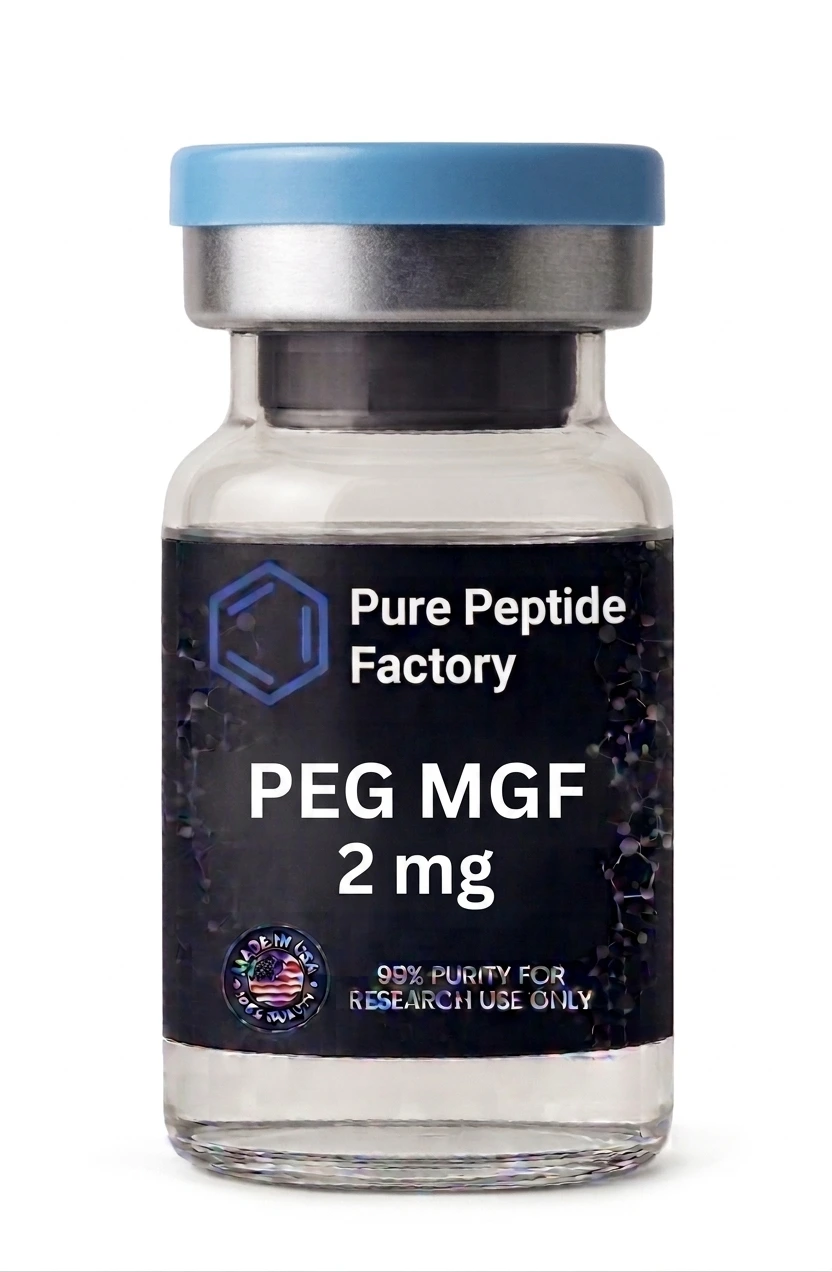
PEG MGF 2 mg
$50.00
PEG MGF is a pegylated variant of mechano growth factor, an IGF-1 splice variant that activates satellite cells and drives tissue repair. The polyethylene glycol modification extends half-life from minutes to days, making it suitable for sustained signaling studies in muscle regeneration, bone healing, cardiac repair, and neuroprotection. Supplied as 2mg lyophilized powder with batch-specific HPLC verification and mass spectrometry confirmation. Domestic cold-chain shipping. Research use only.
PEG MGF Peptide: The IGF-1 Splice Variant That Extends Muscle Repair Signaling
Most growth factors signal for minutes. PEG MGF signals for days. The difference is pegylation, a polyethylene glycol modification that takes mechano growth factor from a 5-minute half-life to a 48-to-72-hour circulation window. That extended timeline changes what researchers can study. Satellite cell activation, bone defect healing, cardiac repair after infarction, and neuroprotection after ischemia all benefit from sustained MGF exposure that unmodified MGF cannot provide.
Pure Peptide Factory stocks research-grade PEG MGF in 2mg vials with batch-specific HPLC verification and domestic cold-chain shipping. If your tissue regeneration or muscle repair research program needs a compound with extended bioavailability and documented efficacy across multiple tissue types, this is it.
Why Researchers Buy PEG MGF from Pure Peptide Factory
Purity Documentation You Can Verify Before You Order
PEG MGF is a complex peptide. The pegylation adds a polyethylene glycol polymer to the MGF sequence, which increases molecular weight and complicates synthesis. Incorrect pegylation, incomplete coupling, or degraded PEG groups will produce a compound that circulates but does not activate satellite cells with the expected potency. Every batch we ship includes a lot-specific HPLC chromatogram and mass spectrometry report confirming the molecular weight at approximately 2900 g/mol and sequence integrity of the pegylated construct. Download the COA before you buy. Compare it against published data. No generic certificates.
Domestic Cold-Chain That Protects Pegylated Peptide Stability
PEG groups improve stability but the underlying peptide remains temperature sensitive. We ship from domestic cold-storage with phase-change cooling. Most orders arrive within 1 to 3 business days. International suppliers cannot guarantee that timeline or temperature integrity across customs and freight.
One Vial Size for Precision Dosing
PEG MGF is available in 2mg vials. This concentration suits most published research protocols including satellite cell activation studies, bone regeneration models, and cardiac repair experiments. You get the standard research quantity without overbuying or splitting vials.
Synthesis Logs Archived for 24 Months
Every batch is logged and archived. If your IRB or compliance office requests chain-of-custody documentation, it is ready before your compound arrives.
What Is PEG MGF?
A Pegylated Splice Variant of IGF-1
PEG MGF stands for Pegylated Mechano Growth Factor. It is a synthetic derivative of MGF, which itself is a splice variant of insulin-like growth factor 1 (IGF-1). When muscle tissue undergoes mechanical stress or damage, the IGF-1 gene produces MGF through alternative splicing. MGF activates satellite cells, increases stem cell proliferation, and initiates repair. The problem is that native MGF has a half-life of approximately 5 to 7 minutes in circulation. It breaks down before it can reach distant tissues or sustain signaling long enough for certain research applications .
PEGylation solves this. Researchers attach a polyethylene glycol (PEG) polymer to the MGF peptide. This PEG group increases molecular size, reduces renal clearance, protects against enzymatic degradation, and extends half-life to 48 to 72 hours. The PEG group itself is biologically inert, does not bind to receptors or tissues, and is excreted unchanged through urine .
Molecular Profile:
-
Sequence: PEG-Tyr-Gln-Pro-Pro-Ser-Thr-Asn-Lys-Asn-Thr-Lys-Ser-Gln-Arg-Arg-Lys-Gly-Ser-Thr-Phe-Glu-Glu-Arg-Lys
-
Molecular Formula: C121H200N42O39
-
Molecular Weight: approximately 2900 g/mol
-
CAS: 108174-48-7
-
Structure: Pegylated 24-amino acid C-terminal peptide of IGF-1 Ec
-
Half-life: 48 to 72 hours (vs. 5 to 7 minutes for unmodified MGF)
How PEG MGF Works at the Cellular Level
PEG MGF operates through several converging mechanisms that explain its broad research utility across tissue types.
First, it activates satellite cells in skeletal muscle. Satellite cells are quiescent muscle stem cells that reside between the basal lamina and sarcolemma of muscle fibers. When activated by PEG MGF, they proliferate, differentiate into myoblasts, and fuse with existing muscle fibers to drive repair and hypertrophy. Research shows PEG MGF enhances satellite cell activation, proliferation, and fusion across all age groups, with particular efficacy in maintaining muscle function in aging models .
Second, PEG MGF promotes nitrogen retention and increases protein synthesis. This anabolic signaling supports the growth and repair of muscle tissue, connective tissue, and bone.
Third, PEG MGF activates the MAPK-Erk1/2 pathway, which regulates cell proliferation, migration, and differentiation across multiple cell types including osteoblasts, chondrocytes, and neural cells.
Fourth, PEG MGF may activate Nrf2 signaling and increase heme oxygenase 1 expression, providing neuroprotective effects against oxidative stress-induced apoptosis in brain tissue .
PEG MGF Benefits: What Published Research Shows
Muscle Regeneration and Satellite Cell Activation
The foundational research application for PEG MGF is skeletal muscle repair. In muscle cell cultures ranging from neonatal to aged stages, MGF exposure enhanced satellite cell activation, proliferation, and fusion. Younger cells showed delayed senescence and increased proliferation. Older cells showed increased hypertrophy with enhanced myotube formation and expression of muscle-specific contractile proteins. The researchers concluded that “MGF-24aa-E peptide alone has a marked ability to enhance satellite cell activation, proliferation and fusion for muscle repair and maintenance” .
In murine muscle injury models, MGF injection protected tissue by mitigating inflammatory hormone expression and oxidative stress. Macrophage depletion impaired regeneration, but MGF administration partially restored repair capacity .
Bone Repair and Osteoblast Proliferation
A landmark study in rabbits with 5mm segmental radius bone defects demonstrated that MGF-Ct24E promoted osteoblast proliferation, differentiation, and mineralization. The high-dose treatment group (57 mcg/kg) showed statistically significant improvement in radiographic healing and histological scores compared to controls. This was the first demonstration that MGF-Ct24E possesses positive effects on osteoblast proliferation and bone-defect healing, suggesting a new strategy in fracture repair .
Cartilage Regeneration and Chondrocyte Function
In rabbit articular cartilage defect models, MGF combined with TGF-beta3 in silk fibroin scaffolds increased stem cell recruitment and chondrogenic differentiation. The result was improved cartilage regeneration and integration compared to scaffold alone. MGF also attenuated mechanical overload-induced nucleus pulposus cell apoptosis through inhibition of the p38 MAPK pathway, suggesting protective effects for intervertebral disc tissue .
Cardiac Repair After Myocardial Infarction
Research from the University of Illinois showed that localized delivery of MGF E-domain peptide via polymeric microstructures after myocardial infarction improved cardiac function, reduced mortality, and prevented adverse remodeling. MGF inhibited programmed cell death in cardiac muscle subjected to hypoxia and facilitated recruitment of cardiac stem cells to the injury site. The researchers concluded that “cardiac restricted administration of the MGF E-domain peptide using polymeric microstructures may prevent adverse remodeling of the heart and improve function following myocardial infarction” .
Neuroprotection and Brain Ischemia
The C-terminal peptide of MGF demonstrates strong neuroprotective effects in brain ischemia models, functioning independently of the IGF-1 receptor and providing prolonged neuronal protection compared to full-length IGF-1. Transgenic mice overexpressing MGF in the hippocampus showed elevated markers of proliferative activity and resistance to age-related brain damage with improved cognitive function. Research from the Mayo Clinic suggests that increasing MGF levels may promote growth of new brain cells in regions associated with brain renewal .
Dental and Periodontal Repair
In vitro studies on human periodontal ligament cells showed that PEG MGF enhanced expression of MMP-1 and MMP-2, essential factors for ligament repair and tooth stability within bone. The peptide improved osteogenic differentiation, suggesting potential applications for preserving natural teeth after injury and supporting periodontal regeneration.
MGF vs PEG MGF: Why Researchers Choose the Pegylated Form
The Half-Life Problem That PEGylation Solves
Unmodified MGF is a powerful signaling molecule with a critical limitation. Its half-life in circulation is approximately 5 to 7 minutes. That is enough time for local paracrine signaling in muscle tissue but insufficient for sustained systemic exposure, distant tissue targeting, or protocols requiring less frequent administration.
PEGylation extends that window to 48 to 72 hours. The PEG polymer increases molecular size above the renal filtration threshold, reducing kidney clearance. It also creates a steric shield that protects the peptide backbone from enzymatic degradation. The result is a compound that maintains therapeutic concentrations long enough to activate satellite cells, recruit stem cells, and drive tissue repair across multiple organ systems.
| Feature | Unmodified MGF | PEG MGF |
|---|---|---|
| Half-life | 5 to 7 minutes | 48 to 72 hours |
| Administration frequency | Multiple times daily | 2 to 3 times weekly |
| Systemic distribution | Limited | Extended |
| Research applications | Local muscle signaling | Multi-tissue regeneration |
| Satellite cell activation | Rapid, short pulse | Sustained, prolonged |
| Bone repair efficacy | Reduced | Enhanced |
Researchers studying local muscle signaling with frequent dosing may use unmodified MGF. Researchers studying sustained tissue repair, bone healing, cardiac regeneration, or neuroprotection need the extended bioavailability that only PEG MGF provides. We stock both for comparative and combination protocols.
PEG MGF Dosage: Published Research Protocols
Animal Model Dosing
Researchers searching for mgf peg dosage data will find the literature well-developed across multiple tissue types. Published protocols include:
-
Muscle regeneration studies: 200 to 400 mcg per injection, subcutaneous or intramuscular, 2 to 3 times per week for 4 to 8 weeks
-
Bone repair studies: 28.5 to 57 mcg/kg body weight, administered for 5 consecutive days postoperatively in rabbit segmental defect models
-
Cardiac repair studies: Localized delivery via polymeric microstructures after myocardial infarction in murine models
-
Neuroprotection studies: Variable dosing depending on model, with sustained exposure protocols favored over bolus administration
-
Cell culture: 10 to 100 nanomolar concentration for osteoblast, chondrocyte, and satellite cell studies
These figures come from peer-reviewed publications and provide validated frameworks for protocol design. Translation between species requires allometric scaling appropriate to your research model.
PEG MGF Dosage Reference Table
| Body Weight | Low Dose (200 mcg) | High Dose (400 mcg) |
|---|---|---|
| 250g rat | 200 mcg | 400 mcg |
| 500g rat | 200 mcg | 400 mcg |
| 1kg animal | 200 mcg | 400 mcg |
Note: PEG MGF dosing is typically administered per injection rather than weight-scaled in published muscle regeneration protocols. Bone repair studies use weight-based scaling at 28.5 to 57 mcg/kg.
We do not provide human dosing recommendations. PEG MGF is not approved for human use and is sold strictly for research purposes.
How to Reconstitute PEG MGF
Step-by-Step Laboratory Protocol
-
Sanitize the vial stopper with 70% isopropyl alcohol
-
Inject bacteriostatic water slowly against the vial wall. Do not aim directly at the lyophilized cake
-
Allow the cake to dissolve without agitation for 2 to 3 minutes
-
Gently swirl until fully clear. Do not shake
-
Inspect for clarity and label with date and concentration before storage
Concentration Reference
-
2mg vial + 0.5mL bacteriostatic water = 4mg/mL
-
2mg vial + 1mL bacteriostatic water = 2mg/mL
-
2mg vial + 2mL bacteriostatic water = 1mg/mL
Adjust to your protocol’s required working concentration.
Storage Requirements
-
Lyophilized powder: 24 months at -20°C, protected from light
-
Reconstituted solution: 14 days at 2 to 8°C under sterile conditions. Do not freeze
-
Avoid repeated freeze-thaw cycles
-
Protect from light at all stages
Regulatory Context and Research Use
Current Status
PEG MGF is not FDA approved for any indication. It is not scheduled under the Controlled Substances Act. It is available for laboratory research under research-use-only terms without a prescription. You must agree to these terms at checkout. This compound is not for human consumption, veterinary use, or diagnostic application.
Why Purity Verification Matters for PEG MGF
The pegylation step adds complexity to synthesis. Incorrect PEG molecular weight, incomplete coupling, or free PEG contamination will alter pharmacokinetics and reduce efficacy. Our batch-specific HPLC and mass spectrometry documentation confirms the correct pegylated construct and verifies against published molecular data. Every COA is lot-specific and downloadable before purchase.
Product Specifications
Available Configuration
PEG MGF is available in 2mg vials. Select your quantity from the product options above.
Quality Verification
-
Purity: 98% minimum (HPLC verified)
-
Sequence identity: Mass spectrometry confirmed against published pegylated MGF sequence
-
Molecular weight: approximately 2900 g/mol
-
Endotoxin: Less than 0.1 EU/mL
-
Sterility: Verified per USP 71
-
Form: Lyophilized powder
-
Storage: -20°C long-term, 2 to 8°C short-term
-
Current Batch: #PPF-PMG-0426 Purity: 98.6% Download: HPLC Certificate | MS Report
FAQ
What is PEG MGF peptide used for in research?
PEG MGF is used to study satellite cell activation and muscle regeneration, bone defect healing and osteoblast proliferation, cartilage repair and chondrocyte function, cardiac repair after myocardial infarction, neuroprotection after brain ischemia, and dental periodontal ligament repair. Its extended half-life makes it suitable for sustained signaling studies across multiple tissue types.
What are PEG MGF benefits in research models?
Published studies show enhanced satellite cell activation, proliferation, and fusion in muscle cells; improved bone defect healing in rabbit radius models; increased chondrocyte migration and cartilage regeneration; reduced cardiac cell death and improved function post-infarction; neuroprotection in brain ischemia models; and enhanced periodontal ligament repair factors.
What is mgf peg dosage in animal studies?
Muscle regeneration protocols typically use 200 to 400 mcg per injection, subcutaneous or intramuscular, 2 to 3 times weekly for 4 to 8 weeks. Bone repair studies use 28.5 to 57 mcg/kg for 5 consecutive days postoperatively. Cell culture work uses 10 to 100 nanomolar. All dosing requires species-specific validation.
How does PEG MGF work?
PEG MGF activates satellite cells in muscle tissue, promotes nitrogen retention and protein synthesis, stimulates the MAPK-Erk1/2 pathway in bone and cartilage cells, and may activate Nrf2 signaling for neuroprotection. The PEG modification extends half-life from 5 to 7 minutes to 48 to 72 hours, enabling sustained systemic exposure.
Is PEG a polymer?
Yes. PEG stands for polyethylene glycol, a biocompatible polymer widely used in pharmaceuticals to extend drug half-life, improve solubility, and reduce immunogenicity. In PEG MGF, the PEG group is attached to the MGF peptide to protect it from degradation and reduce renal clearance. The PEG group itself is pharmacologically inert and is excreted unchanged.
What is the difference between MGF and PEG MGF?
Unmodified MGF has a half-life of 5 to 7 minutes and is suitable for local paracrine signaling studies. PEG MGF has a half-life of 48 to 72 hours due to polyethylene glycol modification, making it suitable for sustained systemic signaling, multi-tissue regeneration studies, and protocols requiring less frequent administration. Both activate the same cellular pathways but differ in pharmacokinetics and research applications.
Does PEG MGF build muscle?
In research models, PEG MGF activates satellite cells, increases myoblast proliferation, enhances myotube fusion, and promotes muscle-specific protein expression. These mechanisms support muscle repair and hypertrophy in controlled studies. It does not build muscle in humans and is not approved for human use.
Is PEG MGF a steroid?
No. PEG MGF is a synthetic peptide, not a steroid. It operates through growth factor signaling pathways (IGF-1 splice variant mechanisms) rather than androgen receptor activation. It does not share the hormonal profile, side effect spectrum, or regulatory classification of anabolic steroids.
Is PEG MGF safe in research?
Published animal studies show a favorable safety profile at therapeutic doses. Potential concerns include hypoglycemia due to IGF-1 related pathways, localized swelling at injection sites, and the theoretical risk of abnormal tissue growth with excessive dosing. Long-term safety data is limited. Researchers should design protocols within published dosing windows and monitor appropriate endpoints.
How to reconstitute PEG MGF?
Sanitize the vial stopper with 70% isopropyl alcohol. Inject bacteriostatic water slowly against the vial wall. Allow the lyophilized cake to dissolve without agitation for 2 to 3 minutes. Gently swirl until fully clear. Do not shake. Label with date and concentration. Store reconstituted solution at 2 to 8°C for up to 14 days.
How to inject PEG MGF in research models?
Published protocols use subcutaneous or intramuscular injection in rodent models. Some researchers administer near the target muscle for localized studies. Administration route should match your published protocol. Cell culture applications use direct media addition.
When to take PEG MGF in research protocols?
Muscle regeneration protocols typically administer 2 to 3 times weekly. Bone repair protocols use daily administration for 5 days post-injury. Cardiac and neuroprotection studies use sustained delivery systems. Timing depends on your research endpoints and published protocol.
Is PEG MGF systemic or local?
The pegylation modification makes PEG MGF systemic. It circulates in the bloodstream for 48 to 72 hours and reaches multiple tissue types. Unmodified MGF acts primarily as a local paracrine signal. Researchers choose between them based on whether their protocol requires systemic or localized signaling.
Where to buy PEG MGF for research?
Pure Peptide Factory stocks research-grade PEG MGF with domestic cold-chain shipping and batch-specific HPLC and mass spectrometry documentation. Orders placed before 2 PM EST ship same-day and arrive within 1 to 3 business days. You must agree to research-use-only terms at checkout.
How should PEG MGF be stored?
Lyophilized powder stores at -20°C for up to 24 months protected from light. Reconstituted solution stores at 2 to 8°C for up to 14 days under sterile conditions. Do not freeze reconstituted solution. Protect from light at all stages.
What is the purity of your PEG MGF?
Our current batch tests at 98.6% purity by HPLC with sequence confirmation by mass spectrometry. The Certificate of Analysis is available for download with your order.
Order PEG MGF for Research
Secure Checkout
-
Credit card, cryptocurrency, or wire transfer
-
Same-day dispatch for orders placed before 2 PM EST
-
Cold-chain packaging with phase-change cooling
-
Discreet labeling and full tracking
Institutional Accounts
Net-30 terms and purchase order acceptance available for universities and pharmaceutical companies. Contact us for bulk pricing on 50 vials or more.
Add to cart and get batch-verified PEG MGF delivered to your lab with the documentation your protocol requires.