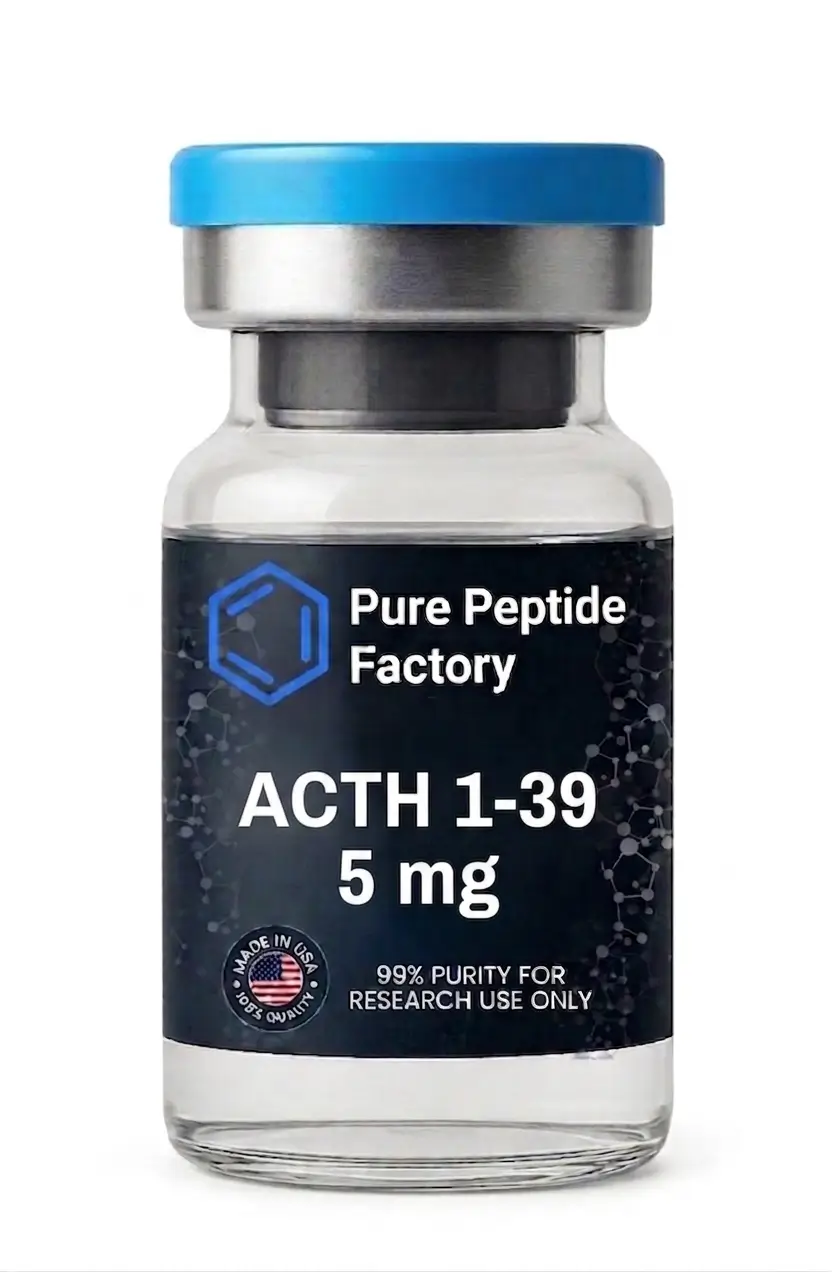
ACTH 1-39 5 mg
$40.00
ACTH 1-39 is the full-length adrenocorticotropic hormone, a 39-amino-acid peptide cleaved from pro-opiomelanocortin (POMC) in the anterior pituitary. It is the parent compound from which multiple research peptides are derived, including alpha-MSH (ACTH 1-13) and the ACTH(4-7) fragment that forms the basis of Semax. Research applications span HPA axis regulation, adrenal function, stress response, cognitive effects, and melanogenesis. HPLC verified, batch-documented, domestic cold-chain shipping. Research use only.
ACTH 1-39 Peptide: The Parent Compound Behind Some of the Most Studied Research Peptides
ACTH 1-39 is not a niche compound. It is the origin point for an entire research lineage. Adrenocorticotropic hormone is one of the most studied peptide hormones in endocrinology, sitting at the center of the hypothalamic-pituitary-adrenal axis and connecting stress physiology, immune regulation, cognitive function, and melanogenesis through a single 39-amino-acid sequence. The fragments derived from it, including alpha-MSH and the ACTH(4-7) core used to develop Semax, have generated decades of independent research that traces directly back to the full-length parent compound.
Pure Peptide Factory supplies research-grade ACTH 1-39 in 5mg vials with batch-specific HPLC verification and domestic cold-chain shipping. Researchers studying the HPA axis, POMC-derived peptide biology, or the full-length compound as a reference standard will find this the cleanest source available domestically.
Why Researchers Buy ACTH 1-39 from Pure Peptide Factory
Purity Verification on a Reference Compound
ACTH 1-39 is frequently used as a reference standard in assay development and as a positive control in HPA axis research. For these applications, purity matters more than for most research peptides because any impurity can confound the assay results you are trying to validate. Every vial ships with a lot-specific HPLC chromatogram and mass spectrometry confirmation at the published molecular weight. Download the COA before ordering and verify against published values.
Domestic Shipping That Protects a Sensitive Compound
ACTH 1-39 is a 39-amino-acid peptide and one of the larger research compounds in the catalog. Larger peptides are more susceptible to temperature-related aggregation and degradation than smaller sequences. We store at -80°C and ship with phase-change cooling. Most orders arrive within 1 to 3 business days. International sourcing cannot guarantee that cold chain for a compound this size.
Synthesis Logs Archived for Compliance
Every batch is documented and archived for 24 months. If your IRB requires chain-of-custody documentation for a reference compound used in assay validation, it is ready before your order arrives.
What Is ACTH 1-39?
The Full-Length Adrenocorticotropic Hormone
ACTH 1-39 is a 39-amino-acid peptide hormone produced in the anterior pituitary gland from the precursor protein pro-opiomelanocortin (POMC). POMC is cleaved by prohormone convertases into multiple biologically active fragments depending on tissue type and physiological context. In the anterior pituitary, the primary ACTH-producing cleavage yields the full 39-amino-acid sequence.
The full-length peptide contains several functionally distinct regions that have been studied independently as research compounds. Understanding this structural map is essential for designing ACTH-related research protocols:
- ACTH 1-13: alpha-melanocyte-stimulating hormone (alpha-MSH), responsible for melanogenesis and pigmentation signaling
- ACTH 1-17: contains the full steroidogenic signaling domain for adrenal cortex activation
- ACTH 4-7: the core behavioral and cognitive sequence, basis of the Semax peptide
- ACTH 4-10: the minimal sequence retaining cognitive and behavioral effects
- ACTH 18-39: corticotropin-like intermediate lobe peptide (CLIP), involved in insulin secretion and adrenal signaling
- ACTH 1-39: the complete sequence retaining all of the above activities in a single molecule
Molecular Profile:
- Molecular Formula: C207H308N56O58S
- Molecular Weight: 4541.13 g/mol
- CAS: 9002-60-2
- Also known as: Adrenocorticotropin, Adrenocorticotropic hormone, corticotropin
How ACTH 1-39 Works
ACTH 1-39 acts primarily through melanocortin receptors, particularly MC2R (the ACTH receptor) expressed on adrenal cortex cells. Binding to MC2R activates adenylate cyclase through Gs protein coupling, raising intracellular cAMP and triggering the steroidogenesis cascade that produces cortisol, corticosterone, and other glucocorticoids.
Beyond adrenal stimulation, ACTH also binds MC1R on melanocytes to stimulate melanin production, and acts through MC4R in the central nervous system to influence cognitive function, appetite, and energy balance. This multi-receptor profile is why ACTH 1-39 research spans disciplines from endocrinology and stress physiology to neuroscience and metabolic biology.
ACTH 1-39 Research Applications
HPA Axis and Stress Response Studies
The hypothalamic-pituitary-adrenal axis is the primary neuroendocrine stress response system. CRH from the hypothalamus triggers ACTH release from the pituitary, which drives cortisol synthesis from the adrenal cortex. ACTH 1-39 is the central signal in this cascade, making it indispensable for researchers studying HPA axis activation, feedback regulation, and dysfunction.
Research applications include:
- Cortisol stimulation testing using ACTH challenge protocols in adrenal function studies
- HPA axis sensitization and desensitization in chronic stress models
- Cortisol diurnal rhythm disruption in psychiatric disease models
- Adrenal cortex cell biology and steroidogenesis enzyme expression studies
- Negative feedback regulation through glucocorticoid receptor signaling
POMC Biology and Peptide Fragment Research
ACTH 1-39 as a full-length reference compound is essential for researchers studying POMC processing and the biology of POMC-derived peptides. The same POMC precursor generates ACTH, alpha-MSH, beta-endorphin, and CLIP in a tissue-specific manner. Researchers mapping POMC cleavage patterns, studying convertase activity, or examining how different fragments compete for the same receptors need the full-length compound as both a reference and an experimental tool.
The internal structure of ACTH 1-39 also makes it valuable for structure-activity relationship studies examining which fragments retain specific biological activities and which modifications enhance or diminish receptor selectivity.
Cognitive and Behavioral Research
The ACTH 4-10 sequence within the full-length molecule has documented effects on learning, memory, and attention in animal models independent of adrenal activation. Researchers studying cognitive effects of ACTH-derived peptides use the full-length compound to characterize how the adrenal-independent cognitive activity compares to the full hormonal signal, which includes both central nervous system effects and peripheral cortisol elevation.
This research connection directly links ACTH 1-39 to Semax, which is the ACTH(4-7)PGP analog developed specifically to isolate and amplify the cognitive fragment while removing the adrenal stimulation that complicates the parent compound’s use in cognition research.
Melanogenesis and Skin Pigmentation Research
ACTH 1-13, the alpha-MSH fragment contained within the full-length sequence, binds MC1R on melanocytes and stimulates melanin synthesis. Researchers studying skin pigmentation, UV protection mechanisms, photoprotection biology, and melanoma cell biology use ACTH 1-39 alongside isolated alpha-MSH to compare the full hormonal signal with the isolated melanotropic fragment.
The melanogenic potency of ACTH 1-39 versus isolated alpha-MSH is an active area of research, with the full-length compound providing the adrenal and metabolic context that the isolated fragment studies lack.
Immunomodulation and Inflammatory Research
ACTH receptors are expressed on immune cells including macrophages, lymphocytes, and dendritic cells. ACTH modulates immune function through direct receptor signaling on immune cells and indirectly through cortisol production, which has broad immunosuppressive effects. Researchers studying neuroimmune crosstalk, stress-induced immune suppression, and the relationship between HPA axis activity and inflammatory disease incorporate ACTH 1-39 to examine the full hormonal signal in immune biology.
ACTH 1-39 and Its Research Peptide Derivatives
Understanding the ACTH Peptide Family
Pure Peptide Factory stocks ACTH 1-39 alongside Semax, which is the ACTH(4-7)PGP synthetic analog derived from the cognitive fragment of the parent compound. Understanding how these compounds relate allows researchers to design protocols that use the parent and derivative compounds in a complementary way:
| Compound | Sequence | Primary Research Use | Key Difference from ACTH 1-39 |
|---|---|---|---|
| ACTH 1-39 | Full 39-amino-acid sequence | HPA axis, adrenal function, reference standard | Full hormonal activity including adrenal stimulation |
| Semax | ACTH(4-7)PGP | Cognitive function, neuroprotection, anxiety | Adrenal activity removed, cognitive fragment amplified, BBB penetration enhanced |
| Alpha-MSH | ACTH 1-13 | Melanogenesis, pigmentation, appetite | Selective MC1R and MC4R activity, no adrenal effect |
| ACTH 4-10 | Fragment | Cognitive and behavioral effects | Minimal sequence retaining behavioral activity |
Researchers designing studies that require both the full hormonal signal and isolated fragment effects can source ACTH 1-39 and Semax from Pure Peptide Factory under identical batch handling conditions.
ACTH 1-39 and the POMC Connection
Where ACTH Comes From
Pro-opiomelanocortin is one of the most complex precursor proteins in mammalian biology. A single POMC gene produces multiple peptide hormones through tissue-specific processing. In the anterior pituitary, prohormone convertase 1 cleaves POMC to produce ACTH 1-39 and beta-lipotropin. In the intermediate lobe and brain, prohormone convertase 2 further processes ACTH into alpha-MSH and CLIP, and beta-lipotropin into beta-endorphin and gamma-MSH.
Researchers studying POMC processing, convertase activity, and the regulation of POMC-derived peptide production use ACTH 1-39 as the primary pituitary output in assay systems. The relationship between POMC gene expression, ACTH production, and downstream cortisol regulation is a fundamental axis in stress physiology research, psychiatric disease modeling, and endocrine disorder characterization.
How to Reconstitute ACTH 1-39
Step-by-Step Laboratory Protocol
- Sanitize the vial stopper with 70% isopropyl alcohol
- Inject bacteriostatic water slowly against the vial wall. Do not aim at the lyophilized cake directly
- Allow the cake to dissolve without agitation for 3 to 5 minutes. ACTH 1-39 is a large peptide and may dissolve more slowly than smaller compounds
- Gently swirl until fully clear. Do not shake
- Inspect for clarity and label with date, concentration, and lot number before storage
Concentration reference for 5mg vial:
| Bacteriostatic Water Added | Final Concentration |
|---|---|
| 0.5 mL | 10 mg/mL |
| 1 mL | 5 mg/mL |
| 2.5 mL | 2 mg/mL |
| 5 mL | 1 mg/mL |
Adjust to your protocol’s required working concentration. For receptor binding assays, researchers typically prepare stock solutions at higher concentrations and dilute in assay buffer.
Storage Requirements
- Lyophilized powder: 24 months at -20°C, protected from light
- Reconstituted solution: 7 to 14 days at 2 to 8°C under sterile conditions. Do not freeze reconstituted solution
- Large peptides like ACTH 1-39 are prone to aggregation on freeze-thaw cycling in solution
- Aliquot into single-use volumes after reconstitution if multi-draw is not required
- Protect from light at all stages
ACTH 1-39 Dosage in Published Research
Reference Protocols from Peer-Reviewed Literature
| Application | Dose | Route | Model |
|---|---|---|---|
| Adrenal stimulation testing | 250 mcg total dose | IV or IM bolus | Human clinical (cosyntropin test reference) |
| HPA axis activation studies | 1 to 10 mcg/kg | Intraperitoneal | Rodent stress models |
| Cognitive and behavioral studies | 0.1 to 1 mcg intracerebroventricularly | ICV injection | Murine memory and learning models |
| Melanogenesis research | 10 to 100 nM | In vitro cell culture | Melanocyte and melanoma cell lines |
| Immunomodulation research | 1 to 100 nM | In vitro | Macrophage and lymphocyte cultures |
These figures are derived from published peer-reviewed literature. Translation between species and models requires allometric scaling and protocol-specific adjustment. We do not provide human dosing recommendations.
Regulatory Context
Research Use Status
ACTH 1-39 is not available as an approved pharmaceutical product for general use in the same form as research-grade lyophilized peptide. Synthetic cosyntropin (ACTH 1-24) is FDA approved as Cortrosyn for adrenal function testing. Full-length ACTH 1-39 as a research compound is available for laboratory procurement under research-use-only terms without prescription.
This compound is sold exclusively for in vitro and controlled in vivo research. Not for human consumption, veterinary use, or diagnostic purposes without appropriate institutional and regulatory oversight. You must agree to research-use-only terms at checkout.
Product Specifications
Available Configuration
ACTH 1-39 is supplied in 5mg vials. Select your quantity from the product options above.
Quality Verification
- Purity: 98% minimum (HPLC verified)
- Identity: Mass spectrometry confirmed at 4541.13 g/mol
- Endotoxin: Less than 0.1 EU/mL
- Sterility: Verified per USP 71
- Form: Lyophilized powder
- Storage: -20°C long-term, 2 to 8°C short-term
Current Batch: #PPF-ACT-0426 Purity: 98.6% Download: HPLC Certificate | MS Report
FAQ
What is ACTH 1-39 used for in research?
ACTH 1-39 is used to study HPA axis regulation, adrenal cortex function and steroidogenesis, POMC processing biology, cognitive and behavioral effects of ACTH fragments, melanogenesis through the alpha-MSH sequence, immunomodulation, and as a reference standard in assay development.
How does ACTH 1-39 relate to Semax?
Semax is derived from the ACTH(4-7) fragment contained within ACTH 1-39, with a Pro-Gly-Pro sequence added at the C-terminal end to increase stability and BBB penetration. ACTH 1-39 is the parent compound. Semax is an engineered analog of one of its fragments, designed to isolate and amplify the cognitive effects while removing the adrenal stimulation that complicates research using the full-length hormone.
What is the difference between ACTH 1-39 and ACTH 1-24?
ACTH 1-24 (cosyntropin) contains the first 24 amino acids of the full sequence, which includes the complete steroidogenic signaling domain for adrenal activation. ACTH 1-39 is the full-length hormone including the additional 15 amino acids at the C-terminal end, which contribute to receptor binding affinity and extend the biological half-life. For adrenal stimulation testing, both are functionally equivalent. For research requiring the full POMC-derived sequence, ACTH 1-39 is the appropriate compound.
What is the relationship between ACTH and MSH?
Alpha-MSH is identical to the first 13 amino acids of ACTH 1-39 (ACTH 1-13), with an acetyl group at the N-terminus and an amide at the C-terminus. Both peptides derive from the same POMC precursor. ACTH activates MC2R for adrenal stimulation and MC1R for melanogenesis. Alpha-MSH is more selective for MC1R and MC4R, making it more potent for pigmentation and appetite research with less adrenal confounding.
How should ACTH 1-39 be stored after reconstitution?
Reconstituted ACTH 1-39 should be stored at 2 to 8°C under sterile conditions and used within 7 to 14 days. Do not freeze reconstituted solution as large peptides aggregate on freeze-thaw cycling. Aliquot into single-use volumes where possible to minimize repeated temperature changes.
Is ACTH 1-39 the same as corticotropin?
Yes. Corticotropin is another name for adrenocorticotropic hormone. ACTH, ACTH 1-39, adrenocorticotropin, and corticotropin all refer to the same full-length 39-amino-acid peptide hormone.
Where can I buy ACTH 1-39 peptide for research?
Pure Peptide Factory stocks research-grade ACTH 1-39 in 5mg vials with domestic cold-chain shipping. Orders placed before 2 PM EST ship same-day and arrive within 1 to 3 business days.
Related Research Compounds
ACTH-Derived Peptides in Our Catalog
Researchers working with ACTH 1-39 often incorporate these related compounds from the same POMC lineage:
- Semax: ACTH(4-7)PGP analog for cognitive enhancement and neuroprotection research without adrenal stimulation
- Selank: Tuftsin analog with overlapping enkephalinase inhibition mechanism studied alongside ACTH-derived cognitive peptides
Internal links to Semax and Selank product pages are recommended from this section in your WordPress editor.
Order ACTH 1-39 Peptide for Research
Secure Checkout
- Credit card, cryptocurrency, or wire transfer
- Same-day dispatch for orders placed before 2 PM EST
- Cold-chain packaging with phase-change cooling
- Discreet labeling and full tracking
Institutional Accounts
Net-30 terms and purchase order acceptance available for universities and pharmaceutical companies. Contact us for bulk pricing on 50 vials or more.
Add to cart and get the full-length ACTH reference compound with batch-verified documentation your research requires.
Related products
-
VIP 10 mg
$90.00