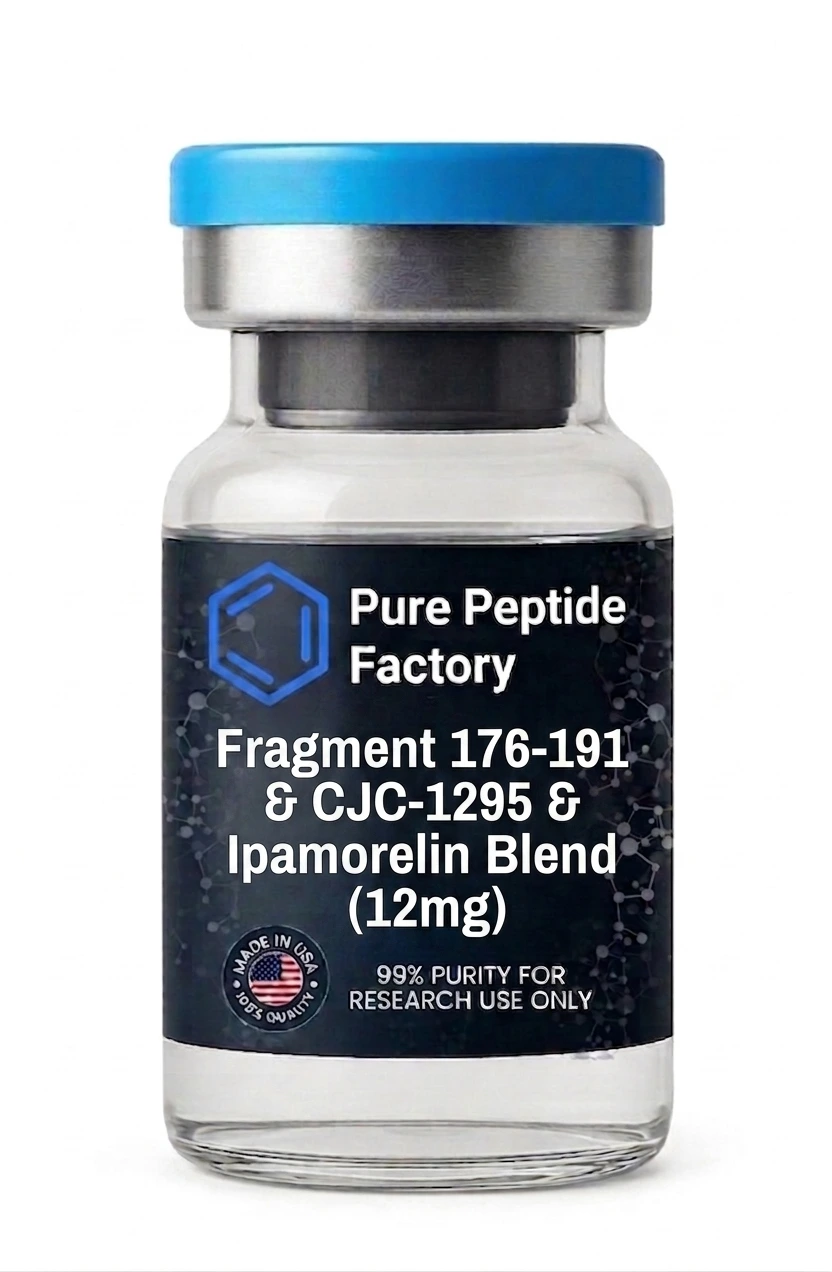
Fragment 176-191 & CJC-1295 & Ipamorelin Blend (12mg)
$65.00
This blend combines three research compounds: HGH Fragment 176-191 for lipolytic signaling, CJC-1295 NO DAC for sustained GHRH stimulation, and Ipamorelin for selective ghrelin receptor activation. Together they target fat metabolism, growth hormone pulsatility, and body composition. Supplied as 12mg lyophilized blend with batch-specific HPLC verification. Domestic cold-chain shipping. Research use only.
Where to Buy CJC 1295 Ipamorelin: The Three-Compound Blend for Body Composition Research
This is not a single peptide. It is a three-part system. HGH Fragment 176-191 handles the fat metabolism side. CJC-1295 NO DAC provides sustained GHRH signaling to the pituitary. Ipamorelin delivers selective ghrelin receptor activation without the cortisol and prolactin spikes that other GHRPs trigger. Each compound has a distinct job. Together they create a research tool for studying growth hormone pulsatility, lipolysis, and body composition without the systemic side effects of exogenous growth hormone.
Pure Peptide Factory stocks this blend as a 12mg lyophilized vial: 6mg Fragment 176-191, 3mg CJC-1295 NO DAC, 3mg Ipamorelin. Batch-specific HPLC verification. Domestic cold-chain shipping. If your endocrinology or metabolic research program needs a pre-formulated combination with documented synergy, this is it.
Why Researchers Buy This Blend from Pure Peptide Factory
Purity Documentation You Can Verify Before You Order
Three compounds in one vial means three opportunities for error. Incorrect ratios, degraded fragments, or mislabeled DAC status will invalidate your data. Every batch we ship includes a lot-specific HPLC chromatogram and mass spectrometry report confirming the identity and ratio of all three components. Download the COA before you buy. Verify the Fragment 176-191 sequence, the CJC-1295 NO DAC structure, and the Ipamorelin mass. No generic certificates.
Pre-Formulated Blend Eliminates Mixing Errors
Researchers running combination protocols often buy separate vials and mix them manually. That introduces concentration errors, sterility risks, and batch-to-batch variability. This blend is formulated in a single vial at a validated 2:1:1 ratio. You reconstitute once and administer a consistent combination every time.
Domestic Cold-Chain That Protects Peptide Stability
All three compounds are temperature sensitive. Fragment 176-191 oxidizes. CJC-1295 degrades. Ipamorelin hydrolyzes. We ship from domestic cold-storage with phase-change cooling. Most orders arrive within 1 to 3 business days. International suppliers cannot guarantee that timeline or temperature integrity.
Synthesis Logs Archived for 24 Months
Every batch is logged and archived. If your IRB or compliance office requests chain-of-custody documentation, it is ready before your compound arrives.
What Is in This Blend?
HGH Fragment 176-191: The Lipolytic Fragment
Fragment 176-191 is not growth hormone. It is a 16-amino-acid synthetic peptide corresponding to the C-terminal region of human growth hormone (amino acids 176-191). This fragment was engineered to isolate the lipolytic effects of hGH from its other systemic actions .
The mechanism operates through beta-3 adrenergic receptor (ADRB3) activation in adipose tissue. In animal models, Fragment 176-191 binds to ADRB3 and triggers lipolysis while inhibiting lipogenesis. Mice lacking ADRB3 do not respond to the compound, confirming receptor specificity .
Molecular Profile:
-
Sequence: Tyr-Leu-Arg-Ile-Val-Gln-Cys-Arg-Ser-Val-Glu-Gly-Ser-Cys-Gly-Phe
-
Molecular Weight: 1817.12 g/mol
-
Mechanism: ADRB3-mediated lipolysis, thermogenesis in skeletal muscle
-
Key distinction: Does not raise IGF-1, does not cause insulin resistance
CJC-1295 NO DAC: Sustained GHRH Signaling
CJC-1295 NO DAC, also called Mod GRF 1-29, is a modified growth hormone-releasing hormone analog. The “NO DAC” designation is critical. This variant lacks the Drug Affinity Complex that extends half-life to 6-8 days. Instead, it provides a shorter, more physiologic pulse of GHRH activity that mimics natural hypothalamic signaling .
The modification replaces four amino acids in GHRH(1-29) to enhance stability and receptor binding. The result is sustained but not supraphysiologic GH stimulation that preserves natural pulsatility patterns.
Molecular Profile:
-
Sequence: Modified GRF(1-29)
-
Molecular Weight: 3367.9 g/mol
-
Mechanism: GHRH receptor agonist, sustained GH secretion
-
Key distinction: NO DAC = shorter half-life, more natural pulsatility
Ipamorelin: Selective Ghrelin Receptor Agonist
Ipamorelin is a pentapeptide ghrelin analog that activates the growth hormone secretagogue receptor (GHS-R) on pituitary somatotrophs. Unlike other GHRPs such as GHRP-2 or GHRP-6, Ipamorelin is highly selective. It stimulates growth hormone release without significantly affecting cortisol, prolactin, aldosterone, or thyroid hormones .
This selectivity matters for research. Cortisol spikes confound metabolic studies. Prolactin elevation interferes with reproductive endpoints. Ipamorelin avoids both, providing cleaner data on GH-mediated effects.
Molecular Profile:
-
Sequence: Aib-His-D-2-Nal-D-Phe-Lys-NH2
-
Molecular Weight: 711.8 g/mol
-
Mechanism: GHS-R agonist, selective GH release
-
Key distinction: No cortisol or prolactin elevation
Does CJC 1295 Ipamorelin Work? The Synergy Explained
Three Mechanisms, One Goal
Researchers ask whether CJC-1295 and Ipamorelin work together. The answer is yes, through complementary pharmacokinetics and distinct receptor pathways.
CJC-1295 NO DAC acts as the sustained signal. It binds GHRH receptors on pituitary somatotrophs and provides a prolonged, low-amplitude stimulus for GH synthesis and release. This is the tortoise: steady, extended, foundational .
Ipamorelin acts as the acute trigger. It binds ghrelin receptors on the same pituitary cells and induces a rapid, high-amplitude GH pulse. This is the hare: fast, intense, immediate .
Together they produce a GH profile that resembles natural physiology more closely than either compound alone: elevated baseline with preserved pulsatility. For researchers studying GH-mediated metabolism, this synergy provides a more physiologic tool than exogenous GH administration .
Why Add Fragment 176-191?
Fragment 176-191 does not stimulate GH release. It acts peripherally on adipose tissue through ADRB3 receptors. Adding it to the blend creates a dual-action research tool: central GH stimulation plus direct peripheral lipolysis.
In animal models, Fragment 176-191 reduces fat accumulation without affecting blood glucose or IGF-1 levels . This separates its effects from GH-mediated mechanisms, allowing researchers to study lipolysis independent of systemic GH exposure.
The combination is particularly relevant for researchers studying:
-
Body composition regulation
-
GH-lipolysis interactions
-
Metabolic syndrome models
-
Adipose tissue biology
Benefits of Ipamorelin and CJC 1295: Research Applications
Growth Hormone Secretion and Pulsatility
The primary research application for the CJC-1295/Ipamorelin combination is growth hormone dynamics. Human studies show that CJC-1295 increases both minimum and mean GH secretion with enhanced pulsatility . Ipamorelin produces biologically effective GH peaks within one hour of administration .
Together they create a pharmacokinetic profile that sustains elevated GH for days while preserving natural pulse patterns. This is superior to exogenous GH, which flattens pulsatility and suppresses endogenous production.
Body Composition and Metabolism
Increased GH and IGF-1 correlate with improved body composition in research models: increased lean mass, reduced adiposity, and enhanced metabolic rate . The Fragment 176-191 component adds direct lipolytic signaling that operates independently of the GH axis.
Researchers studying obesity, metabolic syndrome, or age-related body composition changes use this combination to probe GH-mediated and GH-independent mechanisms simultaneously.
Sleep and Recovery
GHRH activity promotes slow-wave sleep . CJC-1295 extends this effect through sustained receptor activation. Ipamorelin’s rapid onset may help initiate sleep onset. The combination has been studied for sleep architecture improvements in research contexts.
Injury Healing and Cellular Repair
GH stimulates cellular replication and collagen synthesis . While direct evidence for the blend in injury models is limited, the mechanistic rationale is sound. Researchers studying tendon, ligament, and muscle repair use GH secretagogues as tools to examine growth factor-mediated healing.
Can I Take CJC 1295 Ipamorelin in the Morning? Timing in Research
Administration Timing for Research Protocols
Researchers frequently ask about timing. Published protocols vary by endpoint and species.
For GH pulsatility studies, morning administration aligns with natural circadian rhythms. The pituitary is most responsive to GHRH stimulation in the early morning hours when somatostatin tone is lowest .
For sleep studies, evening administration may enhance slow-wave sleep through GHRH-mediated mechanisms .
For metabolic studies, fasting administration may improve GH response by reducing somatostatin inhibition from glucose exposure.
There is no universal correct time. The optimal timing depends on your research endpoints, species, and protocol design.
Frequency Considerations
CJC-1295 NO DAC has a shorter half-life than the DAC variant. Published protocols typically use once-daily or twice-daily administration to maintain sustained receptor occupancy .
Ipamorelin clears more rapidly. Multiple daily injections or continuous infusion may be required for sustained GH elevation, depending on study design.
Fragment 176-191 is typically administered once or twice daily in animal models, often in conjunction with feeding schedules for metabolic studies.
HGH Fragment 176 191 vs Ipamorelin: Different Jobs
Why These Compounds Are Not Interchangeable
Researchers sometimes confuse Fragment 176-191 with Ipamorelin because both appear in body composition protocols. They are completely different:
| Feature | Fragment 176-191 | Ipamorelin |
|---|---|---|
| Class | hGH lipolytic fragment | Ghrelin analog |
| Receptor | Beta-3 adrenergic (ADRB3) | GHS-R (ghrelin receptor) |
| Primary effect | Direct fat metabolism | GH release from pituitary |
| IGF-1 elevation | No | Yes (indirect) |
| Insulin resistance | No | Minimal |
| Cortisol/prolactin | No effect | No effect (selective) |
| Mechanism | Peripheral lipolysis | Central GH stimulation |
Fragment 176-191 acts directly on fat cells. Ipamorelin acts on the pituitary to release GH, which then affects multiple tissues. They are complementary, not competitive. The blend uses both precisely because they operate through different pathways.
How to Reconstitute This Blend
Step-by-Step Laboratory Protocol
-
Sanitize the vial stopper with 70% isopropyl alcohol
-
Inject bacteriostatic water slowly against the vial wall. Do not aim directly at the lyophilized cake
-
Allow the cake to dissolve without agitation for 2 to 3 minutes
-
Gently swirl until fully clear. Do not shake
-
Inspect for clarity and label with date and concentration before storage
Concentration Reference
Total blend: 12mg (6mg Fragment 176-191 + 3mg CJC-1295 NO DAC + 3mg Ipamorelin)
-
12mg vial + 1mL bacteriostatic water = 12mg/mL total
-
Fragment 176-191: 6mg/mL
-
CJC-1295 NO DAC: 3mg/mL
-
Ipamorelin: 3mg/mL
-
-
12mg vial + 2mL bacteriostatic water = 6mg/mL total
-
Fragment 176-191: 3mg/mL
-
CJC-1295 NO DAC: 1.5mg/mL
-
Ipamorelin: 1.5mg/mL
-
Adjust to your protocol’s required working concentration.
Storage Requirements
-
Lyophilized powder: 24 months at -20°C, protected from light
-
Reconstituted solution: 14 days at 2 to 8°C under sterile conditions. Do not freeze
-
Avoid repeated freeze-thaw cycles
-
Protect from light at all stages
Dosage: Published Research Protocols
Animal Model Dosing
Published protocols for the individual components include:
-
Fragment 176-191: 250 to 500 mcg per kg daily in murine metabolic studies
-
CJC-1295 NO DAC: 30 to 100 mcg per kg, once or twice daily
-
Ipamorelin: 100 to 300 mcg per kg, once to three times daily
For the blend, researchers typically scale proportionally based on the 2:1:1 ratio. A common research approach is to administer the blend at a total peptide dose of 300 to 600 mcg per kg, which delivers:
-
150 to 300 mcg/kg Fragment 176-191
-
75 to 150 mcg/kg CJC-1295 NO DAC
-
75 to 150 mcg/kg Ipamorelin
These figures come from peer-reviewed publications and provide validated frameworks for protocol design. Translation between species requires allometric scaling appropriate to your research model.
Blend Dosage Reference Table
| Body Weight | Low Dose (300 mcg/kg total) | High Dose (600 mcg/kg total) |
|---|---|---|
| 250g rat | 75 mcg | 150 mcg |
| 500g rat | 150 mcg | 300 mcg |
| 1kg animal | 300 mcg | 600 mcg |
We do not provide human dosing recommendations. This blend is not approved for human use and is sold strictly for research purposes.
Regulatory Context and Research Use
Current Status
None of these compounds are FDA approved for any indication. CJC-1295 and Ipamorelin are growth hormone secretagogues and are prohibited by WADA under Section S2. Fragment 176-191 is not specifically listed but may fall under metabolic modulator categories. None are scheduled under the Controlled Substances Act. They are available for laboratory research under research-use-only terms without a prescription. You must agree to these terms at checkout. This blend is not for human consumption, veterinary use, or diagnostic application.
Why Purity Verification Matters for Blends
Three compounds in one vial triple the risk of contamination, mislabeling, or incorrect ratios. A blend with degraded Fragment 176-191 will not produce expected lipolytic effects. A blend mislabeled as NO DAC when it contains DAC will produce prolonged GH suppression rather than physiologic pulsatility. Our batch-specific HPLC and mass spectrometry documentation confirms all three identities, the correct ratio, and structural integrity. Every COA is lot-specific and downloadable before purchase.
Product Specifications
Available Configuration
Fragment 176-191 & CJC-1295 & Ipamorelin Blend is available in 12mg vials (6mg Fragment 176-191 + 3mg CJC-1295 NO DAC + 3mg Ipamorelin). Select your quantity from the product options above.
Quality Verification
-
Purity: 98% minimum per component (HPLC verified)
-
Identity: Mass spectrometry confirmed for all three compounds
-
Ratio: 2:1:1 (Fragment:CJC-1295:Ipamorelin) verified by quantitative HPLC
-
Endotoxin: Less than 0.1 EU/mL
-
Sterility: Verified per USP 71
-
Form: Lyophilized powder blend
-
Storage: -20°C long-term, 2 to 8°C short-term
-
Current Batch: #PPF-FCI-0426 Purity: 98.7% Download: HPLC Certificate | MS Report
FAQ
Does CJC 1295 Ipamorelin work in research models?
Yes. Published studies show that CJC-1295 increases GH secretion and pulsatility, while Ipamorelin produces rapid GH peaks. Together they create sustained, physiologic GH profiles. Fragment 176-191 adds direct lipolytic signaling through ADRB3 receptors. The combination is well-documented in animal and cell culture research.
Can I take CJC 1295 Ipamorelin in the morning for research?
Morning administration aligns with natural circadian GH rhythms and may enhance pituitary responsiveness. Evening administration may better support sleep architecture studies. Timing depends on your specific research endpoints and protocol design.
What are the benefits of Ipamorelin and CJC 1295 together?
CJC-1295 provides sustained GHRH signaling for baseline GH elevation. Ipamorelin provides acute ghrelin receptor activation for rapid GH pulses. Together they produce natural-appearing GH profiles with both elevated baseline and preserved pulsatility. This synergy is superior to exogenous GH for studying physiologic GH effects.
What is Fragment 176 191 used for in this blend?
Fragment 176-191 is a lipolytic hGH fragment that acts directly on adipose tissue through beta-3 adrenergic receptors. It does not stimulate GH release or raise IGF-1. In the blend, it provides peripheral fat metabolism research independent of the central GH axis.
Is CJC 1295 the same as Ipamorelin?
No. CJC-1295 is a GHRH analog that stimulates the pituitary through GHRH receptors. Ipamorelin is a ghrelin analog that stimulates the pituitary through GHS-R receptors. They operate through completely different pathways and are complementary, not interchangeable.
What is the difference between CJC-1295 and CJC-1295 DAC?
CJC-1295 DAC contains a Drug Affinity Complex that extends half-life to 6-8 days. CJC-1295 NO DAC (Mod GRF 1-29) has a shorter half-life and produces more physiologic GH pulsatility. This blend contains NO DAC for research applications requiring natural GH patterns.
Does Ipamorelin raise cortisol or prolactin?
No. Ipamorelin is highly selective for GH release and does not significantly elevate cortisol, prolactin, aldosterone, or thyroid hormones. This distinguishes it from non-selective GHRPs like GHRP-2 and GHRP-6.
How much HGH Frag 176 191 should I use in animal studies?
Published murine protocols use 250 to 500 mcg/kg daily. When using this blend, the Fragment 176-191 component is delivered at half the total blend dose (2:1:1 ratio). A 300 mcg/kg blend dose provides 150 mcg/kg Fragment 176-191.
When to take Fragment 176 191 in research protocols?
Fragment 176-191 is typically administered once or twice daily in animal models, often aligned with feeding schedules for metabolic studies. Fasting administration may enhance lipolytic response.
How to mix this blend for research?
Reconstitute with bacteriostatic water. A 12mg vial in 1mL water yields 12mg/mL total (6mg/mL Fragment, 3mg/mL CJC-1295, 3mg/mL Ipamorelin). Gently swirl to dissolve. Do not shake. Store reconstituted solution at 2 to 8°C for up to 14 days.
Is this blend WADA prohibited?
CJC-1295 and Ipamorelin are prohibited by WADA as growth hormone secretagogues under Section S2. Fragment 176-191 is not specifically listed but may fall under metabolic modulator categories. This does not affect laboratory research procurement or use.
Where to buy CJC 1295 Ipamorelin blend?
Pure Peptide Factory stocks this pre-formulated blend with domestic cold-chain shipping and batch-specific HPLC and mass spectrometry documentation. Orders placed before 2 PM EST ship same-day and arrive within 1 to 3 business days. You must agree to research-use-only terms at checkout.
How should this blend be stored?
Lyophilized powder stores at -20°C for up to 24 months protected from light. Reconstituted solution stores at 2 to 8°C for up to 14 days under sterile conditions. Do not freeze reconstituted solution. Protect from light at all stages.
What is the purity of your blend?
Our current batch tests at 98.7% purity per component by HPLC with identity confirmation by mass spectrometry. The ratio is verified by quantitative HPLC. The Certificate of Analysis is available for download with your order.
Order This Blend for Research
Secure Checkout
-
Credit card, cryptocurrency, or wire transfer
-
Same-day dispatch for orders placed before 2 PM EST
-
Cold-chain packaging with phase-change cooling
-
Discreet labeling and full tracking
Institutional Accounts
Net-30 terms and purchase order acceptance available for universities and pharmaceutical companies. Contact us for bulk pricing on 50 vials or more.
Add to cart and get batch-verified blend delivered to your lab with the documentation your protocol requires.