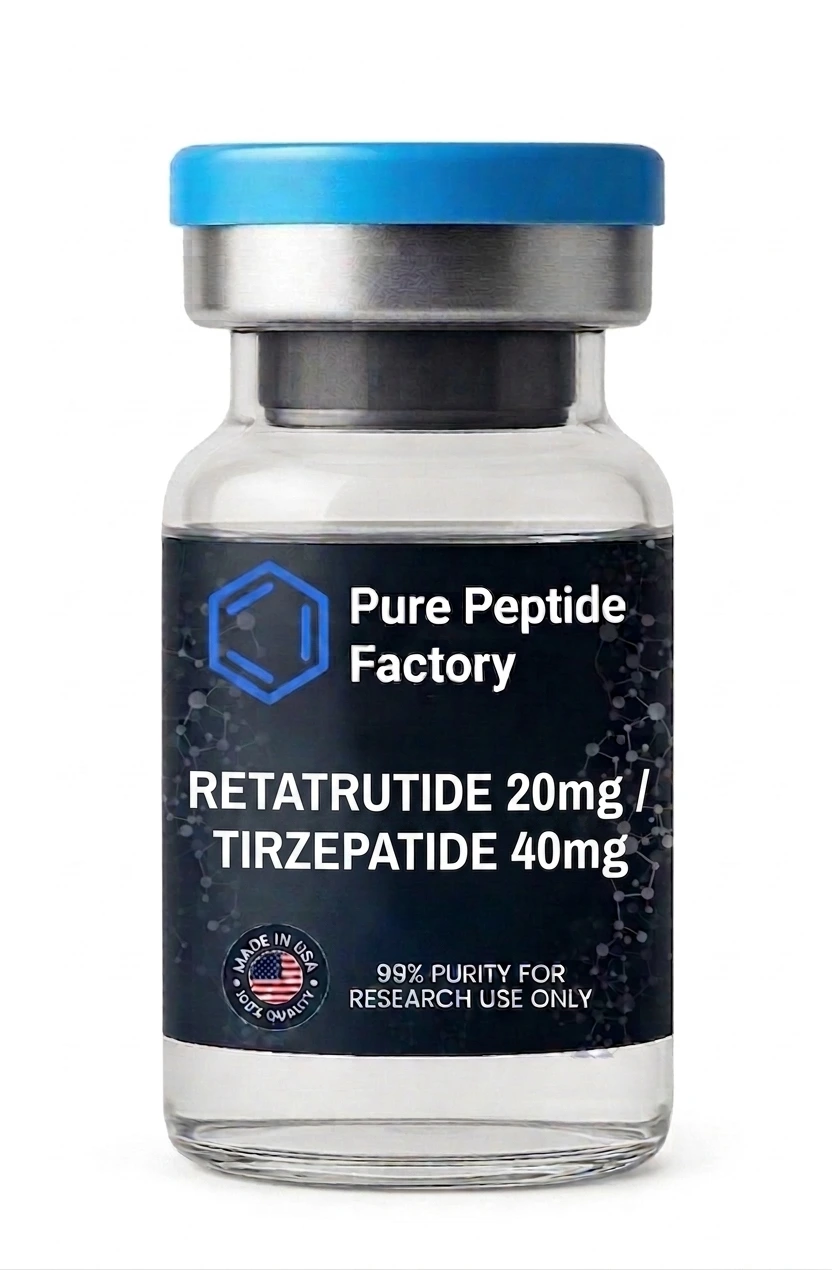
Retatrutide+Tirzepatide Combo – Retatrutide 20mg + Tirzepatide 40mg
$100.00
Retatrutide vs tirzepatide research combo kit — 20mg Retatrutide (triple GLP-1/GIP/glucagon agonist) + 40mg Tirzepatide (dual GLP-1/GIP agonist) for head-to-head incretin receptor pharmacology and metabolic comparison studies. Both peptides HPLC verified at 99%+ purity. Domestic cold-chain shipping. Research use only.
Retatrutide vs Tirzepatide: Research Combo Kit
The retatrutide vs tirzepatide research combo kit provides both compounds in a single procurement for laboratories investigating incretin receptor pharmacology. Tirzepatide (LY3298176) is a 39-amino acid linear peptide-based dual agonist of the glucose-dependent insulinotropic polypeptide (GIP) and glucagon-like peptide-1 (GLP-1) receptors, FDA-approved as Mounjaro and Zepbound. Retatrutide (LY3437943) is a 39-amino acid triple agonist activating GIP, GLP-1, and glucagon receptors, currently in Phase 3 clinical development. Furthermore, this combination enables direct head-to-head comparison of dual versus triple incretin agonism within the same experimental framework, eliminating batch-to-batch variability and supplier sourcing inconsistencies that confound cross-compound data (1).
What makes the retatrutide vs tirzepatide comparison particularly significant for metabolic research is the glucagon dimension. Tirzepatide’s dual agonism drives appetite suppression and glycemic control through GLP-1 and GIP pathways. Retatrutide adds glucagon receptor activation, which directly increases energy expenditure, enhances lipolysis, and promotes thermogenesis. Consequently, the Phase 2 trial published in the New England Journal of Medicine demonstrated 24.2% mean weight reduction at 48 weeks for Retatrutide’s highest dose, while Tirzepatide’s SURMOUNT-1 trial reported 20.9% at 72 weeks (2). Moreover, the Phase 3 TRIUMPH-4 topline results announced December 2025 showed Retatrutide achieving 28.7% weight loss at 68 weeks — a magnitude that exceeds every FDA-approved obesity medication to date. For researchers investigating the incremental metabolic impact of adding glucagon receptor agonism to dual GLP-1/GIP activation, this combo kit provides both compounds from a single verified source.
Why Researchers Choose Pure Peptide Factory for the Retatrutide vs Tirzepatide Combo
Single-Source Procurement Eliminates Inter-Supplier Variability
When running a retatrutide vs tirzepatide comparison protocol, the single largest confounding variable is supplier-to-supplier variability in peptide purity, residual solvents, or counter-ion content. By sourcing both compounds from Pure Peptide Factory, researchers eliminate this variable entirely. Both peptides ship from the same cold-storage facility, undergo the same HPLC verification protocol, and are documented with lot-specific Certificates of Analysis that are downloadable before your kit arrives. Consequently, any difference observed between experimental arms can be attributed to pharmacology, not procurement.
Batch-Specific Documentation for Both Peptides
Every combo kit ships with individual HPLC chromatograms and mass spectrometry reports for both Retatrutide (MW 1,113.1 g/mol, CAS 2381089-83-2) and Tirzepatide (MW 4,813.5 g/mol, CAS 2023788-19-2). Current batch #PPF-RTZ-0513 tested at 99.1% purity for Retatrutide and 99.3% for Tirzepatide by RP-HPLC. Identity confirmed by MALDI-TOF mass spectrometry. Endotoxin levels below 0.05 EU/µg by LAL assay. Therefore, your compliance office receives complete documentation for both compounds before the package arrives.
Domestic Cold-Chain Integrity for Both Vials
Both peptides in the retatrutide vs tirzepatide kit contain C20 fatty diacid side chains that confer albumin binding and extended half-life but make the lyophilized powder hygroscopic. Moisture exposure and temperature excursion degrade peptide integrity and alter receptor binding kinetics. We store all inventory under domestic cold-storage at -20°C and ship using phase-change cooling rated for 96-hour protection. Most orders arrive within 1 to 3 business days. For reconstitution, researchers typically pair both peptides with our bacteriostatic water, also stocked domestically under identical cold-chain conditions.
Cross-Compare Against the Full Incretin Catalog
Many protocols extend the retatrutide vs tirzepatide comparison to include additional incretin peptides. Because we stock Semaglutide (GLP-1 mono-agonist baseline), Cagrilintide (amylin analog), Survodutide (GLP-1/glucagon dual agonist), and Mazdutide (GLP-1/glucagon dual agonist) under identical handling conditions, researchers can build comprehensive multi-arm incretin studies without introducing supplier variability across any compound in the panel.
Synthesis Logs Archived for 24 Months
Should your IRB or compliance office request chain-of-custody records, we provide them without delay.
What Is the Retatrutide Tirzepatide Combo?
This research kit contains two distinct incretin receptor agonists for comparative metabolic and pharmacological investigation. Tirzepatide is a dual GLP-1/GIP receptor agonist; Retatrutide is a triple GLP-1/GIP/glucagon receptor agonist. The kit is designed for research teams conducting parallel receptor pharmacology studies, comparative efficacy assays, or mechanism-of-action investigations requiring both compounds from a single verified source. By sourcing the retatrutide tirzepatide combo together, investigators eliminate inter-supplier variability that confounds cross-compound comparisons.
Retatrutide vs Tirzepatide: Mechanism Comparison
The core difference between these compounds lies in receptor targeting. Understanding this distinction is fundamental to experimental design in metabolic research:
| Parameter | Retatrutide | Tirzepatide |
|---|---|---|
| Receptor Profile | Triple agonist: GLP-1R + GIPR + GCGR | Dual agonist: GLP-1R + GIPR |
| Peptide Structure | 39-amino acid linear peptide; C20 fatty diacid moiety | 39-amino acid linear peptide; C20 fatty diacid moiety |
| Glucagon Activity | Yes — GCGR agonism increases energy expenditure and lipolysis | No — no glucagon receptor activity |
| Primary Metabolic Effect | Appetite suppression + enhanced lipolysis + increased thermogenesis | Appetite suppression + improved glycemic control |
| Clinical Weight Loss (Highest Dose) | 24.2% at 48 weeks (Phase 2); 28.7% at 68 weeks (TRIUMPH-4) | 20.9% at 72 weeks (SURMOUNT-1) |
| Heart Rate Effect | Dose-dependent increase, peaks ~24 weeks then declines | Modest increase, stable over time |
| GI Side Effect Profile | Dose-related, mostly mild-moderate; higher incidence than dual agonists | 56% GI AEs vs 30% placebo (Zepbound label) |
| FDA Status | Investigational (Phase 3) | Approved (2023) |
Salhab et al. (2025) conducted a network meta-analysis of 12 clinical trials and found Retatrutide produced significantly greater absolute weight reduction (MD -16.34 kg) and percentage weight loss (MD -23.77%) compared to Tirzepatide (MD -11.82 kg; MD -16.79%). However, adverse events were more frequent with Retatrutide (RR 4.10) versus Tirzepatide (RR 2.78). Notably, these data suggest an efficacy-safety trade-off that researchers must consider when modeling dual versus triple agonism (1).
Retatrutide vs Tirzepatide vs Semaglutide
For laboratories requiring a three-way comparison framework, Semaglutide (a pure GLP-1R agonist) serves as the single-receptor baseline. Consequently, the progression from mono to dual to triple agonism illustrates the incremental metabolic impact of receptor polypharmacology:
| Feature | Semaglutide | Tirzepatide | Retatrutide |
|---|---|---|---|
| Receptor Targets | GLP-1R only | GLP-1R + GIPR | GLP-1R + GIPR + GCGR |
| Weight Loss (Highest Dose) | ~15% at 68 weeks (STEP-1) | ~21% at 72 weeks (SURMOUNT-1) | ~24-29% at 48-68 weeks |
| Glycemic Control | Strong HbA1c reduction | Superior HbA1c vs GLP-1 alone | Comparable or superior glycemic data |
| Energy Expenditure | Neutral to slight increase | Modest increase via GIP | Significant increase via GCGR |
| Lipid Metabolism | Improved via weight loss | Improved via dual pathway | Direct lipolytic + ketogenic effect |
| Research Use Case | GLP-1R baseline control | Dual incretin comparator | Triple agonist experimental arm |
Cagrilintide vs Retatrutide vs Tirzepatide
Cagrilintide (AM833) is an amylin receptor agonist, not an incretin, but is frequently compared in the weight-loss peptide landscape. Furthermore, for researchers studying multi-hormonal obesity interventions, understanding where each compound fits mechanistically is critical:
| Feature | Cagrilintide | Retatrutide | Tirzepatide |
|---|---|---|---|
| Drug Class | Amylin analog | Triple incretin agonist | Dual incretin agonist |
| Primary Receptor | Amylin + calcitonin receptors | GLP-1R + GIPR + GCGR | GLP-1R + GIPR |
| Mechanism | Satiety signaling, gastric emptying delay | Appetite + lipolysis + thermogenesis | Appetite + insulin secretion |
| Weight Loss Data | ~15% at 68 weeks (monotherapy) | ~24-29% (highest doses) | ~21% (highest dose) |
| Combo Potential | Studied with Semaglutide (CagriSema) | Standalone triple agonist | Standalone dual agonist |
Retatrutide vs Tirzepatide: Side Effects Comparison
When designing a retatrutide vs tirzepatide protocol, the side effect profile is an essential experimental variable. Researchers should monitor and document the following class-specific effects across both arms:
| Side Effect | Retatrutide (TRIUMPH / Phase 2-3) | Tirzepatide (SURMOUNT) |
|---|---|---|
| Nausea | More frequent at higher doses; typically transient | Common (30-40%); dose-dependent |
| Vomiting | Higher incidence than dual agonists | Moderate (10-20%) |
| Diarrhea | Dose-related; more prominent during titration | Common; typically self-limiting |
| Heart Rate Increase | Dose-dependent; peaks ~24 weeks, then declines | Modest, stable elevation |
| Hepatic Effects | Transaminase elevations observed; monitoring required | Generally mild; no significant hepatic signal |
| Hypoglycemia | Minimal unless combined with insulin secretagogues | Minimal in non-diabetic models |
| Gallbladder Events | Under investigation in Phase 3 | Cholelithiasis reported; consistent with GLP-1 class |
Salhab et al.’s network meta-analysis found adverse events were more frequent with Retatrutide (RR 4.10) compared to Tirzepatide (RR 2.78) relative to placebo, confirming that the added glucagon receptor activity carries a measurable increase in side effect burden that researchers should account for in protocol design (1).
Retatrutide vs Tirzepatide Muscle Loss Considerations
A significant research concern with all incretin agonists is the composition of weight lost. While clinical trials report substantial total body weight reduction, the proportion attributable to fat mass versus lean mass remains an active investigation area. Specifically, early Retatrutide data suggests the glucagon component may preferentially mobilize adipose tissue while preserving muscle protein synthesis through GLP-1R-mediated anabolic signaling, but this hypothesis requires dedicated body-composition trial designs for validation. By contrast, Tirzepatide’s SURMOUNT-1 trial reported DEXA-measured fat mass reduction but did not prominently feature lean mass preservation metrics. Therefore, researchers running a retatrutide vs tirzepatide comparison should incorporate dual-energy X-ray absorptiometry or bioelectrical impedance analysis into study protocols to differentiate fat loss from muscle catabolism across both arms.
Retatrutide vs Tirzepatide Cost Context
For research procurement, understanding the pharmaceutical pricing landscape provides context for compound valuation. Tirzepatide (Zepbound) is commercially available with established pricing: Lilly direct pricing ranges from $299 (2.5mg) to $699 (15mg) per month, with the Zepbound Self Pay Journey offering $449/month for 7.5mg+ doses. Insurance coverage varies and prior authorization is typically required. Retatrutide has no commercial pricing because it remains investigational. Consequently, research-grade supply fills the gap for preclinical and in vitro investigations requiring the compound before commercial availability. Researchers seeking to understand the retatrutide vs tirzepatide cost differential for procurement planning should note that research-grade peptides are priced independently of pharmaceutical commercial pricing and reflect synthesis complexity, purity verification, and cold-chain logistics rather than clinical market positioning.
Retatrutide vs Tirzepatide Dosage Reference for Preclinical Research
For laboratory protocols only. We do not provide human dosing recommendations.
| Research Model | Retatrutide Dose | Tirzepatide Dose | Route | Frequency | Key Finding |
|---|---|---|---|---|---|
| Rodent DIO (diet-induced obesity) | 10-100 nmol/kg | 10-100 nmol/kg | Subcutaneous | Every 2-3 days | Dose-dependent weight loss; Retatrutide superior at highest doses |
| Mouse metabolic phenotyping | 30 nmol/kg | 30 nmol/kg | Subcutaneous | Every 3 days | Retatrutide: increased energy expenditure; Tirzepatide: reduced food intake |
| In vitro receptor binding | 0.1-100 nM | 0.1-100 nM | Cell culture | Continuous or pulse | Retatrutide: GCGR EC50 ~5-10 nM; Tirzepatide: no GCGR activity |
| Body composition (DEXA) | 30-100 nmol/kg | 30-100 nmol/kg | Subcutaneous | Every 2-3 days | Monitor fat mass vs lean mass partitioning across both arms |
How to Reconstitute the Retatrutide vs Tirzepatide Combo
Step-by-Step Laboratory Protocol
- Sanitize both vial stoppers with 70% isopropyl alcohol.
- Using our bacteriostatic water (0.9% benzyl alcohol), inject the sterile diluent slowly against each vial wall. Allow diluent to trickle down; do not force-stream directly at the lyophilized cake — both peptides contain hydrophobic fatty diacid moieties that require gentle dissolution.
- Allow the powder to dissolve without agitation for 2-3 minutes. The larger Tirzepatide molecule (MW 4,813.5 g/mol) may require slightly longer than Retatrutide (MW 1,113.1 g/mol).
- Gently swirl each vial until the solution is completely clear. Do NOT shake or vortex — foaming can denature both peptides and reduce receptor binding affinity.
- Inspect for clarity. Discard if turbid or containing particulate matter.
- Label each vial with compound name, reconstitution date, and concentration.
Concentration Reference
| Compound | Vial Content | Diluent Volume | Concentration |
|---|---|---|---|
| Retatrutide | 20 mg | 4.0 mL | 5.0 mg/mL |
| Tirzepatide | 40 mg | 8.0 mL | 5.0 mg/mL |
| Retatrutide (dilute) | 20 mg | 10.0 mL | 2.0 mg/mL |
| Tirzepatide (dilute) | 40 mg | 20.0 mL | 2.0 mg/mL |
Subcutaneous Injection Protocol for Research Models
For researchers administering either compound in vivo, use a 29-31 gauge insulin syringe for subcutaneous injection. Pinch a 1-2 inch fold of skin at the lower abdomen, scruff of the neck, or flank. Insert at a 45-90 degree angle into the subcutaneous fat. Inject slowly over 5-10 seconds. Hold the needle in place for 10 seconds before withdrawing. Rotate injection sites for repeated administrations. All injections must be performed under aseptic conditions with IACUC approval.
Storage Requirements
- Lyophilized powder: 24 months at -20°C, protected from light and moisture.
- Reconstituted solution: 14-21 days at 2-8°C. Do NOT freeze. Avoid repeated freeze-thaw cycles.
- Both peptides contain C20 fatty diacid moieties that increase hydrophobicity; dissolve slowly and protect from light at all stages.
Product Specifications
Available Kit Configuration
The retatrutide vs tirzepatide combo kit contains one 20mg vial of Retatrutide and one 40mg vial of Tirzepatide, both as lyophilized powder. Select your quantity from the product options above.
Quality Verification
- Retatrutide Purity: 99.1% by RP-HPLC (current batch #PPF-RTZ-0513)
- Tirzepatide Purity: 99.3% by RP-HPLC (current batch #PPF-RTZ-0513)
- Identity: Confirmed by MALDI-TOF mass spectrometry for both peptides
- Retatrutide CAS: 2381089-83-2 | Tirzepatide CAS: 2023788-19-2
- Retatrutide MW: 1,113.1 g/mol | Tirzepatide MW: 4,813.5 g/mol
- Endotoxin: Less than 0.05 EU/µg by LAL assay
- Sterility: Verified per USP 71
- Form: Lyophilized powder (2 vials)
- Storage: -20°C long-term, 2-8°C after reconstitution
Current Batch: #PPF-RTZ-0513
Retatrutide Purity: 99.1% | Tirzepatide Purity: 99.3%
Download: Retatrutide HPLC Certificate | Tirzepatide HPLC Certificate | Mass Spec Reports
Frequently Asked Questions
Retatrutide vs Tirzepatide: which is better for research?
Neither is objectively better — they serve different experimental purposes. Tirzepatide is the established dual-agonist comparator with extensive Phase 3 data and FDA approval. Retatrutide represents the next-generation triple-agonist paradigm with superior weight-loss efficacy in clinical trials (28.7% at 68 weeks in TRIUMPH-4 vs 20.9% at 72 weeks in SURMOUNT-1) but a less defined long-term safety profile. Researchers studying receptor polypharmacology should include both as parallel arms, which is precisely what this retatrutide vs tirzepatide combo kit enables.
What is the difference between Retatrutide and Tirzepatide?
The fundamental difference is receptor targeting. Tirzepatide activates GLP-1 and GIP receptors (dual agonist). Retatrutide activates GLP-1, GIP, and glucagon receptors (triple agonist). The added glucagon activity increases energy expenditure and direct lipolysis, which explains the superior weight-loss data but also the higher adverse event rate observed in clinical trials (RR 4.10 vs RR 2.78 relative to placebo).
Can Retatrutide and Tirzepatide be used together in research?
This combo kit is designed for parallel comparison studies, not co-administration. Stacking dual and triple agonists at pharmacological doses would produce receptor oversaturation and confounding data. Investigators should use each compound in separate cohorts or culture conditions. The kit ensures both compounds originate from the same batch-verified source for methodological consistency.
What do Reddit discussions say about Retatrutide vs Tirzepatide?
Online communities frequently discuss retatrutide vs tirzepatide with particular focus on Retatrutide’s superior weight-loss percentages (28.7% at 68 weeks) and speculation about FDA approval timelines. However, these discussions are anecdotal and not peer-reviewed. Researchers should rely on published trial data — the SURMOUNT series for Tirzepatide and the TRIUMPH series for Retatrutide — rather than forum reports for experimental design decisions. The Salhab et al. (2025) network meta-analysis provides the most rigorous head-to-head comparison currently available in the peer-reviewed literature.
Is Retatrutide a peptide?
Yes. Retatrutide is a 39-amino acid linear peptide with a C20 fatty diacid side chain, similar in structural architecture to Tirzepatide and Semaglutide. The fatty acid moiety enables albumin binding, extending half-life to support weekly dosing in clinical protocols.
When will Retatrutide be FDA approved?
As of 2026, Retatrutide is in Phase 3 development (TRIUMPH program). Lilly announced positive TRIUMPH-4 topline results in December 2025 showing 28.7% weight loss at 68 weeks. Full regulatory submission and potential approval are anticipated in late 2026 or 2027, contingent on complete Phase 3 data and FDA review.
How should I store the Retatrutide vs Tirzepatide combo?
Store both lyophilized vials at -20°C for up to 24 months. After reconstitution with our bacteriostatic water, keep at 2-8°C and use within 14-21 days. Do not freeze reconstituted solution. Protect from light at all stages.
Can this combo be compared against other incretin peptides?
Yes. Many researchers extend the retatrutide vs tirzepatide comparison to include Semaglutide (GLP-1 mono-agonist), Survodutide (GLP-1/glucagon dual agonist), Mazdutide (GLP-1/glucagon dual agonist), and Cagrilintide (amylin analog) for comprehensive multi-arm incretin studies. Pure Peptide Factory stocks the full incretin panel under identical cold-storage conditions for clean cross-compound data.
Buy the Retatrutide vs Tirzepatide Combo for Your Research
Secure Checkout
- Credit card, cryptocurrency, or wire transfer
- Same-day dispatch for orders placed before 2 PM EST
- Cold-chain packaging with phase-change cooling
- Discreet labeling and full tracking
Institutional Accounts
Net-30 terms and purchase orders accepted for universities and research institutions. Contact us for bulk pricing on 50 kits or more, including matched orders alongside Semaglutide, Survodutide, Mazdutide, Cagrilintide, and bacteriostatic water for comprehensive multi-arm incretin receptor research protocols.
Add to cart and get both batch-verified incretin agonists delivered with the documentation your comparative metabolic research requires.
Related products
-
Survodutide 10 mg
$100.00 -
Cagrisema 5 mg
$50.00