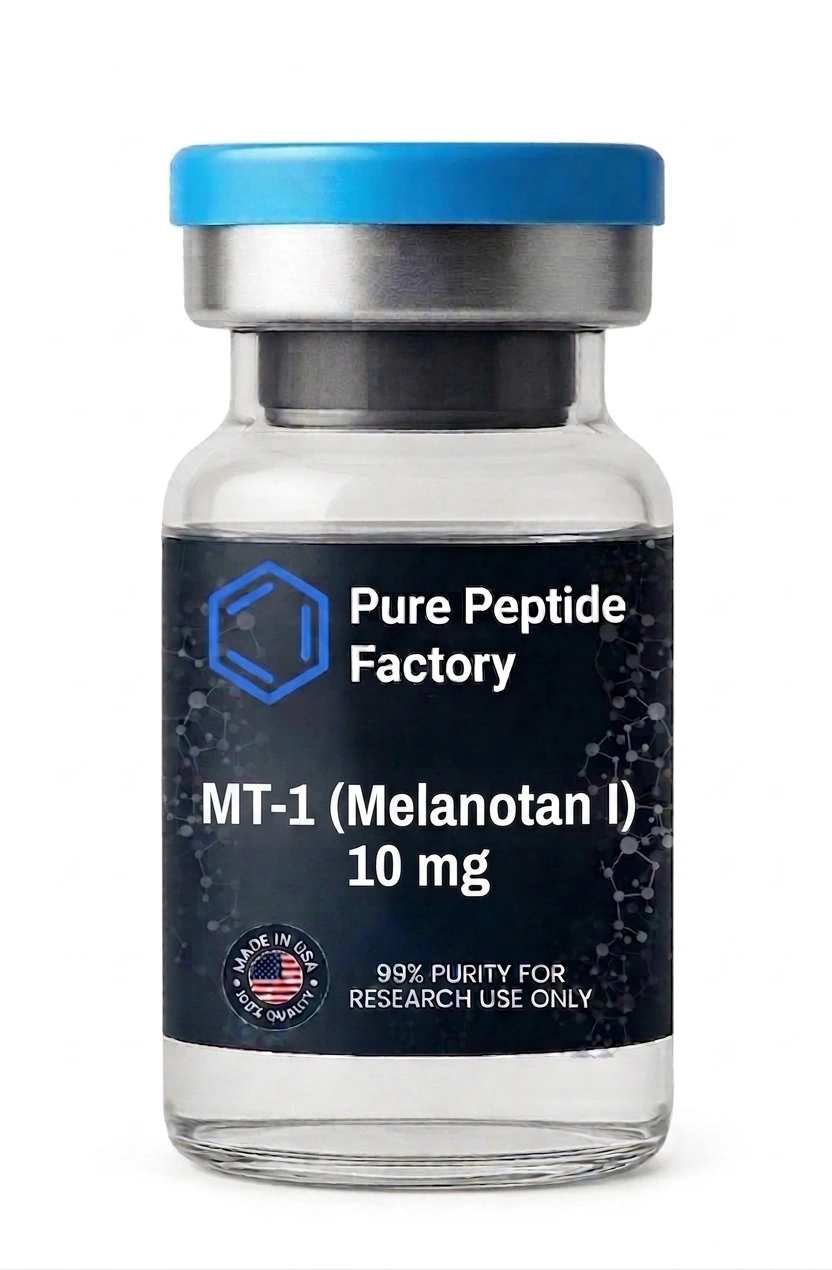
MT-1 (Melanotan I) 10 mg
$50.00
Research-grade Melanotan 1 (MT-1) peptide, 10mg lyophilized vial. 99.2% purity by HPLC. MC1R-selective melanocortin analog [Nle4, D-Phe7]-α-MSH. For photobiology, dermatology, and melanocortin receptor research. Batch #PPF-MT1-0513 with mass spectrometry verification. View reconstitution guide.
Melanotan 1 for Sale: MT-1 Peptide
Melanotan 1 (MT-1, afamelanotide) is a synthetic 13-amino acid analog of alpha-melanocyte-stimulating hormone (α-MSH), modified at positions 4 and 7 to enhance metabolic stability and MC1R receptor potency. Researchers who purchase melanotan 1 for sale from Pure Peptide Factory receive the precisely sequenced peptide ([Nle4,D-Phe7]-α-MSH) that activates the melanocortin-1 receptor (MC1R) with high affinity — approximately 26 times more potent than native α-MSH in adenylate cyclase assays — while resisting serum enzymatic degradation. Consequently, this engineered stability supports longer-duration experiments compared to native α-MSH (1).
Unlike melanotan-II (MT-2), which broadly activates multiple melanocortin receptors (MC1R, MC3R, MC4R, MC5R) and produces significant off-target effects including spontaneous erections and appetite suppression, melanotan-I is a more selective MC1R agonist. Furthermore, this selectivity makes melanotan 1 for sale the preferred research tool when your hypothesis centers on skin pigmentation pathways without the confounding variables of sexual arousal or metabolic effects that accompany MT-2 administration. Moreover, the FDA approval of afamelanotide (Scenesse) for erythropoietic protoporphyria provides a clinically validated pharmacological framework that no other melanocortin peptide can claim (2).
Why Researchers Choose Pure Peptide Factory for Melanotan 1 for Sale
Verified Cyclic Peptide with Documented Purity
Melanotan-I is a precisely sequenced 13-amino acid peptide (Ac-Ser-Tyr-Ser-Nle-Glu-His-D-Phe-Arg-Trp-Gly-Lys-Pro-Val-NH₂) with a molecular formula of C₇₈H₁₁₁N₂₁O₁₉ and a molecular weight of 1,646.85 g/mol. Every batch we ship includes lot-specific HPLC and mass spectrometry documentation verifying purity (99.2% on current batch #PPF-MT1-0513) and molecular identity. Additionally, you can download the Certificate of Analysis before your compound ships. Therefore, researchers who purchase melanotan 1 for sale from our facility can trust the peptide’s receptor-binding integrity before beginning any protocol.
10mg Vial Format with Established Dosing Reference
Our 10mg vial configuration provides the quantity needed for standard research protocols. Published Phase I clinical data established that 0.16 mg/kg/day subcutaneously for 10 days produced significantly enhanced and prolonged tanning compared to light exposure alone. Specifically, subjects achieved equivalent pigmentation using approximately 50% less sun exposure time and exhibited a 47% reduction in sunburn cells at irradiated sites (3). As a result, these reference points allow researchers who purchase melanotan 1 for sale to design protocols anchored to published clinical data rather than relying on anecdotal dosing.
Domestic Cold-Chain Integrity
This synthetic peptide remains stable as lyophilized powder but degrades with moisture exposure and temperature excursion after reconstitution. Consequently, we store all melanotan 1 for sale inventory under domestic cold-storage conditions at -20°C and ship using phase-change cooling rated for 96-hour protection. Most orders arrive within 1 to 3 business days, protecting peptide conformation from warehouse to laboratory bench. For proper reconstitution, researchers typically pair MT-1 with our bacteriostatic water, also stocked domestically under identical cold-chain conditions.
Synthesis Logs Archived for 24 Months
Should your IRB or compliance office request chain-of-custody records, we provide them without delay.
What Is Melanotan 1?
A Selective MC1R Agonist, Not a Broad Melanocortin Stimulant
Melanotan 1 (also known as afamelanotide or [Nle4, D-Phe7]-α-MSH) is a synthetic 13-amino acid peptide representing a modified analog of the endogenous melanocortin alpha-melanocyte-stimulating hormone (α-MSH). Sawyer et al. (1980) at the University of Arizona first synthesized and characterized this compound, engineering it to overcome the rapid enzymatic degradation of native α-MSH while preserving — and enhancing — its biological activity at the melanocortin-1 receptor (MC1R) (1).
Two critical structural modifications define the analog’s performance. First, the substitution of methionine at position 4 with norleucine (Nle) eliminates oxidative susceptibility and extends metabolic stability. Second, the substitution of L-phenylalanine at position 7 with D-phenylalanine confers resistance to chymotryptic cleavage and dramatically prolongs biological activity. Together, these changes yield an analog approximately 26 times more potent than native α-MSH in adenylate cyclase assays, with marked resistance to serum enzymatic degradation (1).
Critically, melanotan-I is more selective for MC1R than melanotan-II, which binds with similar affinity to MC1R, MC3R, MC4R, and MC5R. MC1R expresses primarily on melanocytes and serves as the key regulator of the switch between pheomelanin (red/yellow pigment) and eumelanin (brown/black pigment). By selectively activating MC1R, MT-1 drives eumelanin production without the anorexigenic effects, sexual arousal, or blood pressure changes associated with MT-2’s broader receptor engagement. Therefore, this selectivity is why melanotan 1 for sale is the compound of choice for researchers studying pigmentary biology in isolation from other melanocortin pathways. For laboratories investigating the broader melanocortin receptor family, our melanotan 2 product offers the non-selective alternative for multi-pathway studies.
Molecular Profile:
- Sequence: Ac-Ser-Tyr-Ser-Nle-Glu-His-D-Phe-Arg-Trp-Gly-Lys-Pro-Val-NH₂
- Molecular Formula: C₇₈H₁₁₁N₂₁O₁₉
- Molecular Weight: 1,646.85 g/mol
- CAS Number: 75921-69-6
- Classification: Synthetic melanocortin-1 receptor (MC1R) agonist
- Synonyms: Melanotan-I, MT-1, [Nle4,D-Phe7]-α-MSH, CUV1647, afamelanotide
- Half-Life: ~0.8-1.7 hours (subcutaneous, beta-phase; Ugwu et al. 1997)
- Clinical analogue: Afamelanotide (Scenesse) — FDA-approved controlled-release implant for erythropoietic protoporphyria
How Does Melanotan 1 Work?
MT-1 operates as a high-affinity agonist at the melanocortin-1 receptor (MC1R), a Gαs-coupled seven-transmembrane receptor expressed primarily on melanocytes — the pigment-producing cells of the skin. Upon binding, MT-1 activates adenylyl cyclase to increase intracellular cyclic AMP. Subsequently, the resulting cAMP/PKA signaling cascade phosphorylates the transcription factor CREB, which in turn upregulates the microphthalmia-associated transcription factor (MITF). MITF functions as the master regulator of melanocyte function, driving the expression of tyrosinase, tyrosinase-related protein-1 (TRP-1), and TRP-2 — the three enzymes that catalyze the conversion of tyrosine to eumelanin (3).
The result is a shift in melanin synthesis from pheomelanin (yellow/red, which provides little UV protection) to eumelanin (brown/black, which absorbs UV radiation and scavenges reactive oxygen species). Furthermore, this eumelanin-dominant phenotype reduces DNA damage following UV exposure, enhances nucleotide excision repair, and increases resistance to UV-induced apoptosis. Notably, the cAMP/PKA pathway independently activates survival signals that protect melanocytes and keratinocytes from UV-induced cell death. Consequently, MT-1 provides both pigment-dependent (physical) and pigment-independent (signaling) photoprotection.
Unlike native α-MSH, which undergoes rapid clearance and degradation, MT-1’s structural modifications confer prolonged receptor engagement and reduced susceptibility to proteolytic inactivation. Ugwu et al. (1997) established the pharmacokinetic profile of MT-1, finding subcutaneous administration to be completely bioavailable compared to intravenous dosing, with a beta-phase half-life of 0.8-1.7 hours. However, oral administration produced no detectable plasma levels, confirming the necessity of parenteral delivery for systemic activity (4).
A common misconception suggests that α-MSH analogs might stimulate melanoma development. However, preclinical data indicates that MC1R signaling actually stimulates DNA repair, reduces pro-inflammatory cytokines, and increases eumelanin — a photoprotective pigment that scavenges reactive oxygen species and reduces UVB penetration. Moreover, since MC1R does not express on melanocyte stem cells, these cells remain unactivated by α-MSH analogs (2).
Difference Between Melanotan 1 and 2
The distinction between these two melanocortin analogs is among the most frequently researched topics in this class. Understanding their structural and pharmacological differences is essential for correct experimental design:
| Feature | Melanotan 1 (MT-1 / Afamelanotide) | Melanotan 2 (MT-2) |
|---|---|---|
| Structure | Linear 13-amino acid peptide; Ac-Nle4-D-Phe7-α-MSH | Cyclic heptapeptide (7 aa); lactam bridge Asp2-Lys7 |
| Primary Receptor | MC1R (highly selective) | MC1R, MC3R, MC4R, MC5R (non-selective) |
| Mechanism | cAMP-mediated tyrosinase activation; eumelanin synthesis | Multi-receptor activation; broader systemic effects |
| Research Focus | Photobiology, dermatology, pigment response, EPP models | Metabolism, appetite, sexual function, pigmentation |
| Onset | Gradual, controlled pigmentation | Faster, more intense pigmentation |
| Duration | Longer-lasting pigmentation effects | Shorter duration; requires more frequent dosing |
| Side Effect Profile | Mild: transient flushing, nausea, fatigue | Broader: nausea, appetite suppression, flushing, libido changes |
| Clinical Status | FDA-approved (Scenesse) for EPP (2019) | No FDA approval; research chemical only |
| WADA Status | Prohibited (S2 category) | Prohibited (S2 category) |
Researchers select MT-1 when the experimental goal requires MC1R-specific signaling without the confounding effects of MC3R/MC4R activation on metabolism, appetite, or sexual function. By contrast, MT-2 is the appropriate choice for studies investigating the broader melanocortin receptor family or multi-pathway metabolic modeling. Researchers who need melanotan 1 for sale for clean MC1R studies should select MT-1 and reserve our MT-2 product for systemic melanocortin research.
MT-1 Peptide Benefits in Research
The benefits of MT-1 peptide in laboratory and clinical research contexts include:
- MC1R Selectivity: High-affinity, receptor-specific agonism enables clean pigmentation signaling without off-target metabolic or behavioral effects.
- Photoprotection Data: Clinical trials demonstrate reduced sunburn cell formation (47% reduction) and enhanced UV tolerance, supporting research into photodermatoses and skin cancer prevention models (3).
- Metabolic Stability: 26-fold greater potency than native α-MSH with resistance to serum enzymatic degradation, supporting longer-duration experiments (1).
- FDA-Validated Mechanism: The approval of afamelanotide (Scenesse) for EPP provides a clinically verified pharmacological framework for MC1R-targeted research (2).
- Established Dosing: Extensive Phase I-III data provides reference ranges for translational research protocols.
Melanotan 1 Dosage Reference for Preclinical Research
For laboratory protocols only. We do not provide human dosing recommendations.
| Study Type | Dose | Route | Frequency | Duration | Key Finding |
|---|---|---|---|---|---|
| Phase I tanning (Dorr et al.) | 0.08-0.16 mg/kg/day | Subcutaneous | Once daily (M-F) | 2-4 weeks | 50% less sun exposure; 47% fewer sunburn cells; tanning persisted 3+ weeks longer |
| Pharmacokinetic (Ugwu et al.) | 0.16 mg/kg | SC / IV / PO | Single dose | Crossover | SC completely bioavailable vs IV; oral zero bioavailability; t½ 0.8-1.7h |
| EPP clinical (Langendonk et al.) | 16 mg implant | Subcutaneous implant | Every 60 days | Long-term | Quality of life from 31% to 74%; high adherence; safe |
| In vitro melanocyte culture | 10-100 nM | Cell culture media | Continuous | 24-72 hours | Tyrosinase upregulation; increased melanin content |
| Rodent skin tanning model | 0.1-1 mg/kg/day | Subcutaneous | Daily | 2-4 weeks | Visible eumelanin-dominant pigmentation |
In Dorr et al.’s Phase I trials, the 0.16 mg/kg dose produced superior tanning outcomes compared to 0.08 mg/kg, with no dose-limiting toxicities observed. Specifically, adverse effects remained limited to transient facial flushing, mild nausea, and afternoon fatigue — all self-limiting and non-cumulative. Researchers who purchase melanotan 1 for sale can use these published reference points to design dose-finding experiments. Notably, investigators observed no pathological findings at any UV-exposed site.
How to Reconstitute Melanotan 1 10mg
Step-by-Step Laboratory Protocol
- Sanitize the vial stopper with 70% isopropyl alcohol.
- Using our bacteriostatic water, inject the sterile diluent slowly against the vial wall. Allow the diluent to trickle down; do not force-stream directly at the lyophilized cake.
- Allow the powder to dissolve without agitation for 1-2 minutes. The peptide is soluble in aqueous solution.
- Gently swirl until the solution is completely clear. Do NOT shake or vortex — mechanical stress can denature the peptide.
- Inspect for clarity. Discard if turbid or containing particulate matter.
- Label with reconstitution date and concentration.
Reconstitution Reference for 10mg Vial
| Diluent Volume | Concentration | 0.1 mL Aliquot | Common Research Use |
|---|---|---|---|
| 5.0 mL | 2.0 mg/mL | 0.2 mg (200 mcg) | Standard in vivo dosing |
| 10.0 mL | 1.0 mg/mL | 0.1 mg (100 mcg) | Cell culture / pilot studies |
| 20.0 mL | 0.5 mg/mL | 0.05 mg (50 mcg) | Dose-finding assays |
Storage Requirements
- Lyophilized powder: 24 months at -20°C, protected from light and moisture.
- Reconstituted solution: 14-28 days at 2-8°C. Do NOT freeze. Avoid repeated freeze-thaw cycles.
- Protect from UV light at all stages. Amber vials or foil wrapping are recommended.
Melanotan 1 Safety in Research
In controlled clinical trials, MT-1 demonstrated a favorable safety profile at therapeutic doses. Langendonk et al. (2015) reported that afamelanotide (Scenesse) provided safe and effective photoprotection in 115 EPP patients over long-term observation, with high adherence rates and low incidence of serious adverse events. Notably, quality-of-life scores improved from 31% at baseline to 74% during treatment and sustained over time (2).
A common misconception suggests that α-MSH analogs might stimulate melanoma development. However, preclinical data indicates that MC1R signaling actually stimulates DNA repair, reduces pro-inflammatory cytokines, and increases eumelanin — a photoprotective pigment that scavenges reactive oxygen species and reduces UVB penetration. Moreover, since MC1R does not express on melanocyte stem cells, α-MSH analogs do not activate these cells. Melanotan-I (and all melanotan peptides) are classified as prohibited substances by the World Anti-Doping Agency (WADA) under Category S2. Therefore, researchers who purchase melanotan 1 for sale must adhere to research-use-only terms and institutional oversight for all animal work.
Product Specifications
Available Configuration
Melanotan-I is available in 10mg lyophilized powder vials. Select your quantity from the product options above.
Quality Verification
- Purity: 99.2% by RP-HPLC (current batch #PPF-MT1-0513)
- Identity: Confirmed by MALDI-TOF mass spectrometry against monoisotopic mass 1,646.85 Da
- Endotoxin: Less than 0.05 EU/µg by LAL assay
- Sterility: Verified per USP 71
- Form: Lyophilized powder
- Storage: -20°C long-term, 2-8°C after reconstitution
- CAS Number: 75921-69-6
Current Batch: #PPF-MT1-0513
Purity: 99.2%
Download: HPLC Certificate | Mass Spec Report
Frequently Asked Questions
What does melanotan peptide do in research?
Melanotan peptides activate melanocortin receptors to stimulate melanin synthesis. Specifically, MT-1 targets MC1R to increase eumelanin production, making it a tool for studying pigmentation biology, photoprotection mechanisms, and melanocortin receptor pharmacology. Sawyer et al. (1980) established that the [Nle4, D-Phe7] modification produces 26-fold greater potency than native α-MSH while resisting enzymatic degradation.
How does melanotan 1 work compared to natural tanning?
Natural tanning requires UV exposure to trigger α-MSH release and MC1R activation. By contrast, MT-1 bypasses the UV trigger by directly binding MC1R, stimulating tyrosinase and eumelanin synthesis independently of light exposure. In Dorr et al.’s trials, MT-1 combined with reduced UV exposure produced equivalent or superior tanning compared to sunlight alone, with 47% fewer sunburn cells and tanning persisting 3+ weeks longer.
What is the difference between melanotan 1 and 2?
MT-1 is a linear 13-amino acid MC1R-selective agonist with a focus on pigmentation and photoprotection. MT-2, by contrast, is a cyclic 7-amino acid non-selective agonist acting on MC1R, MC3R, MC4R, and MC5R, producing broader systemic effects including appetite modulation and sexual function changes. MT-1 has FDA approval (Scenesse) for EPP; MT-2 has no approved clinical indication. Researchers choose MT-1 for clean pigmentation data and our MT-2 product for multi-receptor pathway studies.
What are the MT-1 peptide benefits for laboratory research?
Key research benefits include: MC1R specificity without off-target receptor activation, established clinical safety and efficacy data from Phase I-III trials, resistance to enzymatic degradation for longer-duration experiments, validated photoprotection mechanisms for dermatology and photobiology studies, and a well-characterized pharmacokinetic profile supporting reproducible dosing.
Where can I buy melanotan 1 for research?
Researchers can find melanotan 1 for sale from verified suppliers providing third-party HPLC and mass spectrometry documentation. Pure Peptide Factory supplies research-grade MT-1 domestically with same-day cold-chain shipping. Each batch includes a Certificate of Analysis confirming identity, purity, and endotoxin levels. This product is strictly for laboratory research and not for human consumption.
Does melanotan 1 change eye color?
No clinical evidence indicates that MT-1 alters iris pigmentation. MC1R does not significantly express in iris melanocytes, and no published trials have reported eye color changes as an outcome of afamelanotide administration. This question appears to conflate MT-1 with prostaglandin analogs used in glaucoma therapy, which darken iris pigmentation through a different mechanism.
Is melanotan 1 safe for research models?
In controlled clinical trials, MT-1 demonstrated a favorable safety profile at therapeutic doses. The most common side effects — transient facial flushing, mild nausea, and afternoon fatigue — are self-limiting and non-cumulative. Investigators observed no pathological findings at any UV-exposed site. All in vivo work requires IACUC approval.
How do I reconstitute melanotan 1 10mg?
Add 5-20 mL of our bacteriostatic water to the lyophilized powder, depending on desired concentration. Swirl gently — do not shake or vortex. Store at 2-8°C and use within 14-28 days. See the full reconstitution guide above with concentration reference table.
Is melanotan 1 FDA approved?
Yes — as afamelanotide (Scenesse), a controlled-release subcutaneous implant approved in 2019 for erythropoietic protoporphyria (EPP). However, the research-grade peptide supplied here is not Scenesse and is not for human use. It is strictly for laboratory research.
Buy Melanotan 1 for Your Research
Secure Checkout
- Credit card, cryptocurrency, or wire transfer
- Same-day dispatch for orders placed before 2 PM EST
- Cold-chain packaging with phase-change cooling
- Discreet labeling and full tracking
Institutional Accounts
Net-30 terms and purchase orders accepted for universities and research institutions. Contact us for bulk pricing on 50 vials or more, including matched orders alongside our bacteriostatic water, melanotan 2, and other melanocortin research compounds.
Add to cart and get batch-verified melanotan-I delivered with the documentation your MC1R pharmacology, melanogenesis, or photoprotection research requires.
Related products
-
Triptorelin
$45.00