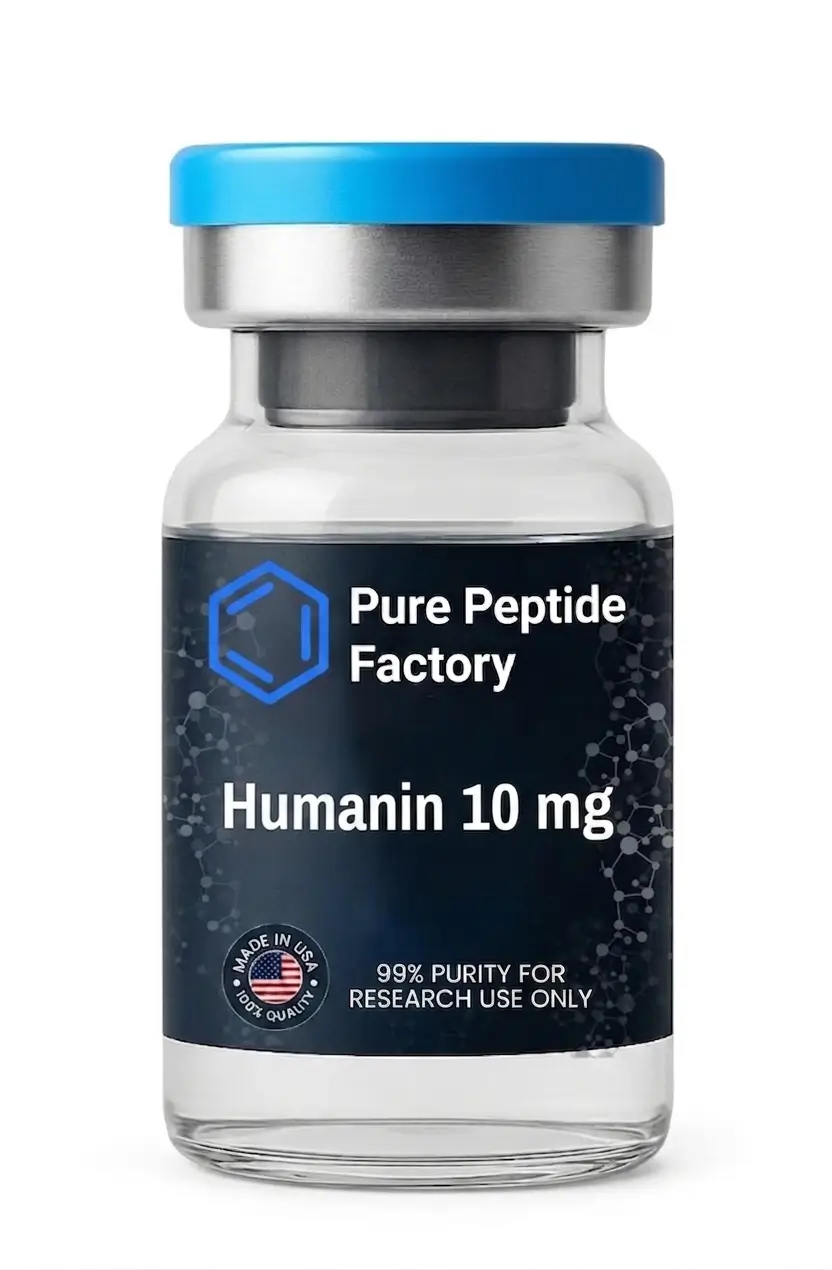
Humanin 10 mg
Original price was: $147.00.$100.00Current price is: $100.00.
10 mg/vial, 10 vials/kit | For research use only.
Buy Humanin Peptide: The Mitochondrial Neuroprotective Compound Researchers Are Studying
Humanin is the peptide that launched an entirely new field of biology. When researchers first identified it in 2001 while screening for genes that rescue neurons from Alzheimer’s disease cell death, they discovered something unexpected: a functional peptide encoded not in nuclear DNA but in the mitochondrial genome. That discovery opened the door to what we now call mitochondrial-derived peptides, a class that includes MOTS-C and the SHLPs, all of which communicate from mitochondria outward to regulate cell survival, metabolism, and aging.
If you are looking to buy Humanin for laboratory research, Pure Peptide Factory offers domestic cold-chain shipping, batch-specific HPLC verification, and the documentation your institution requires. No sourcing uncertainty, no overseas shipping gambles.
Why Researchers Buy Humanin from Pure Peptide Factory
Documentation That Holds Up Under Scrutiny
Every batch of Humanin we ship includes a lot-specific HPLC chromatogram and mass spectrometry report. You can verify the molecular weight against the published value of 2687.3 g/mol and confirm sequence integrity before running your protocol. This matters for a compound where low-quality sourcing produces results that do not replicate across labs.
Domestic Cold-Chain from Order to Delivery
Humanin is temperature sensitive. We store at -80°C and ship with phase-change cooling. Most orders arrive within 1 to 3 business days. International suppliers cannot offer that timeline or that temperature reliability, which is why researchers who need consistent compound quality increasingly source domestically.
Synthesis Logs Archived for 24 Months
Batch records are maintained and available on request. If your IRB or compliance office requires chain-of-custody documentation, it is ready before your compound arrives.
Stack Research Made Simple
We stock Humanin alongside MOTS-C, the other extensively studied mitochondrial-derived peptide. Researchers running comparative mitochondrial signaling studies or combination protocols can source both from the same supplier under identical handling conditions, eliminating inter-vendor batch variability from their data.
What Is Humanin?
A Peptide Encoded in Mitochondrial DNA
Humanin is encoded within the 16S ribosomal RNA gene of the mitochondrial genome. Its length depends on where it is synthesized: 21 amino acids when produced inside the mitochondria, and 24 amino acids when synthesized in the cytosol. Both forms exhibit biological activity. The peptide exerts its effects through two main routes: binding with intracellular molecules involved in apoptosis, and interacting with G protein-coupled receptors on cell surfaces involved in neurological function.
Molecular Profile:
- Molecular Formula: C119H204N34O32S2
- Molecular Weight: 2687.3 g/mol
- CAS: 330936-69-1
- Also known as: HNGF6A protein, mitochondrial-derived peptide Humanin
How Humanin Works
Humanin operates through several distinct mechanisms depending on tissue and context.
At the apoptosis level, it binds the Bax protein in its inactive form, blocking the conformational change that triggers cell death. It also binds actinin-4 and phosphoprotein 8, two additional apoptosis mediators, producing cytoprotective effects across multiple cell types.
At the receptor level, Humanin binds FPRL-1 and FPRL-2 receptors on neuronal surfaces, the same receptors that amyloid beta uses as an entry point for neurotoxic signaling. By occupying these receptors, Humanin may block amyloid beta binding and reduce neurological degradation in models of Alzheimer’s disease pathology.
At the metabolic level, Humanin activates STAT-3 signaling in the hypothalamus, enhancing central insulin sensitivity and improving glucose handling in peripheral tissues including the liver.
Humanin Peptide Benefits: What the Research Shows
Neuroprotection and Cognitive Function
The peptide was first identified for its ability to rescue neurons from Alzheimer’s-related cell death. Subsequent studies confirmed and extended this finding. In 9-month-old mouse models carrying high amyloid protein loads, animals receiving Humanin for 3 months showed significantly improved learning ability and enhanced memory compared to placebo controls. The mechanism involves both Bax inhibition and competitive binding at FPRL-1 and FPRL-2 receptors that amyloid beta uses to induce neuronal damage.
Further research examined Humanin’s protective action against neurotoxicity from Calyculin A in cortical neurons. Results indicated that preincubation with Humanin preserved cell viability, reduced oxidative stress, maintained protein phosphatase 2A activity, and inhibited tau hyperphosphorylation at sites critical to neurodegenerative pathology. Researchers studying Alzheimer’s disease mechanisms, tau biology, and neuroprotective compounds use these findings to design Humanin protocols.
Insulin Sensitivity and Metabolic Regulation
In nonobese diabetic mouse models, Humanin administration restored glucose tolerance within 6 weeks and delayed the onset of diabetes over 20 weeks of treatment. In high-fat diet models, Humanin reduced weight gain by approximately 20% without affecting food intake, alongside increased energy expenditure and decreased fasting glucose levels.
The central mechanism operates through hypothalamic STAT-3 activation. Continuous central nervous system exposure to Humanin improved whole-body insulin sensitivity, with the effect reversed when STAT-3 was co-inhibited, confirming this pathway as essential rather than incidental to the compound’s metabolic actions. Researchers investigating insulin resistance, hypothalamic metabolic regulation, and type 2 diabetes models use Humanin to study central-peripheral metabolic crosstalk.
Mitochondrial Function and Oxidative Stress
Mitochondria are susceptible to damage from reactive oxygen species (ROS). Humanin appears to inhibit ROS production and restore mitochondrial bioenergetics in stressed cells. In isolated retinal pigment epithelial cells exposed to tert-butyl hydroperoxide to induce oxidative stress, cells preincubated with Humanin showed inhibited ROS formation and restored mitochondrial function compared to untreated controls.
This antioxidant and mitochondrial protective action makes Humanin relevant for researchers studying age-related macular degeneration, retinal cell biology, oxidative stress models, and mitochondrial dysfunction across multiple tissue types.
Cellular Longevity and IGF-1 Signaling
The relationship between Humanin and longevity was clarified through studies examining GH and IGF-1 levels in murine models. In GH-transgenic mice with elevated growth hormone and IGF-1, Humanin levels were approximately 70% lower than controls, alongside accelerated aging and reduced lifespan. In dwarf mice with undetectable GH and IGF-1, Humanin levels were 40% higher and lifespan was extended. These findings established an inverse relationship between the IGF-1 axis and Humanin, framing the peptide as a longevity signal suppressed by high growth factor activity.
Ischemia and Cardiovascular Protection
In cerebral ischemia models, continuous Humanin administration reduced ischemic volume by approximately 30%. Post-ischemia administration further reduced ischemic damage, suggesting a therapeutic window that researchers are working to characterize. In a large animal porcine model of myocardial ischemia-reperfusion injury, Humanin reduced infarct size by 41% when administered alongside standard reperfusion intervention after a 60-minute ischemic period. This effect was not observed when the ischemic period extended to 75 minutes, pointing to a critical time-dependent window for the compound’s cardioprotective action.
Researchers studying stroke models, cardiac ischemia-reperfusion, and organ protection protocols use these findings as the foundation for Humanin cardiovascular work.
Hypoxia and Cell Survival
In isolated retinal cells exposed to cobalt chloride to induce hypoxia and trigger apoptosis, Humanin administration reversed the impact of hypoxia and protected cells from oxygen deprivation. Additional studies suggest Humanin increases metabolic activity and cell survival rates in lymphocytes under serum-deprived conditions, with implications for ischemia research and immune cell biology.
Anxiety and Behavioral Research
Humanin binds the FPR2 receptor in the brain, the same receptor class involved in formyl peptide signaling. Studies in murine models showed potential anxiolytic action following FPR2 binding. Researchers studying anxiety models, neuroimmune signaling, and central neuropeptide effects have begun incorporating Humanin protocols based on these findings.
Humanin and MOTS-C: The Mitochondrial Peptide Pair
Two Compounds, Complementary Research Applications
Humanin and MOTS-C are the two most studied mitochondrial-derived peptides. Researchers who search “humanin and mots c” are typically designing protocols that use both to probe different aspects of mitochondrial biology. Understanding where they differ is critical for experiment design:
| Feature | Humanin | MOTS-C |
|---|---|---|
| Encoding gene | 16S rRNA | 12S rRNA |
| Primary pathway | STAT3, Bax inhibition, FPRL receptors | AMPK, folate cycle suppression |
| Main research area | Neuroprotection, apoptosis, longevity | Metabolism, exercise, insulin sensitivity |
| Tissue focus | Brain, pancreas, retina, heart | Skeletal muscle, adipose, bone |
| Age relationship | Inversely correlated with IGF-1 | Declines with age, linked to metabolic decline |
| Key structural feature | 21 or 24 amino acids depending on synthesis site | 16 amino acids, stable single form |
Neither compound substitutes for the other. Labs studying the full scope of mitochondrial signaling run both in parallel. We stock both and can fulfill combination orders under the same batch conditions.
Humanin Peptide Dosage: What Published Research Used
Animal Model Protocols in Peer-Reviewed Literature
Researchers searching for Humanin peptide dosage information will find the literature more developed than for most mitochondrial peptides, given the compound’s longer research history. Published protocols include:
- Neurological studies: 2 to 10 nanomoles per mouse administered intracerebroventricularly or intraperitoneally
- Metabolic studies: 2.1 mg/kg daily subcutaneous injection in high-fat diet murine models
- Ischemia studies: Low concentrations administered pre-ischemia and at 0, 2, 4, and 6 hours post-event in rodent stroke models
- Longevity studies: Endogenous levels measured rather than exogenous administration, with the data used to correlate circulating Humanin with lifespan markers
These protocols come from publications in journals including PNAS, Cell Metabolism, and Stroke. They provide validated frameworks for laboratory protocol design. Translation to other species requires allometric scaling specific to your model.
We do not provide human dosage guidance. Humanin is not approved for human use and is sold strictly for research purposes.
How to Reconstitute Humanin
Step-by-Step Laboratory Protocol
- Sanitize the vial stopper with 70% isopropyl alcohol
- Inject bacteriostatic water slowly against the vial wall. Do not direct the stream at the lyophilized cake
- Allow the cake to dissolve without agitation for 2 to 3 minutes
- Gently swirl until the solution runs fully clear. Do not shake
- Inspect for clarity and particulate matter before use
- Label with reconstitution date and concentration
Concentration reference for 10mg vial:
- 10mg + 1mL bacteriostatic water = 10mg/mL
- 10mg + 2mL bacteriostatic water = 5mg/mL
- 10mg + 5mL bacteriostatic water = 2mg/mL
Adjust to your protocol’s required working concentration.
Storage Requirements
- Lyophilized powder: 24 months at -20°C, protected from light
- Reconstituted solution: 14 days at 2 to 8°C under sterile conditions. Do not freeze
- Avoid repeated freeze-thaw cycles
- Protect from light at all stages
Regulatory Context and Research Use
Current Status
Humanin is not FDA approved for any therapeutic indication and is not scheduled under the Controlled Substances Act. It is available for laboratory research under research-use-only terms without a prescription. You must agree to these terms at checkout. This compound is not for human consumption, veterinary use, or diagnostic application of any kind.
Why Purity Verification Matters for Humanin
The compound has a longer research history than most peptides in this niche, which means more published reference data exists to verify your compound against. Our mass spectrometry reports confirm the molecular weight at 2687.3 g/mol and the amino acid sequence against published values. This verification step is not optional for research that needs to replicate.
Product Specifications
Available Configuration
Humanin is available in 10mg vials. Select your quantity from the product options above.
Quality Verification
- Purity: 99% minimum (HPLC verified)
- Identity: Mass spectrometry confirmed
- Endotoxin: Less than 0.1 EU/mL
- Sterility: Verified per USP 71
- Form: Lyophilized powder
- Storage: -20°C long-term, 2 to 8°C short-term
Current Batch: #PPF-HUM-0426 Purity: 99.1% Download: HPLC Certificate | MS Report
FAQ
What is Humanin peptide used for in research?
Humanin is used to study neuroprotection, apoptosis inhibition, insulin sensitivity, mitochondrial oxidative stress, cellular longevity, ischemia-reperfusion injury, and hypothalamic metabolic regulation. It is one of two extensively studied mitochondrial-derived peptides alongside MOTS-C.
What are the benefits of Humanin peptide in research models?
Published animal studies show neuroprotective effects in Alzheimer’s models, improved insulin sensitivity through STAT-3 activation, reduced ischemic injury in stroke and cardiac models, protection against oxidative stress in retinal cells, and an inverse correlation with IGF-1 signaling linked to extended cellular lifespan.
How does Humanin peptide dosage work in laboratory studies?
Published protocols use 2 to 10 nanomoles intracerebroventricularly for neurological work, and 2.1 mg/kg subcutaneous injection for metabolic studies in rodent models. Dosing varies significantly by endpoint, species, and administration route. Human dosage data does not exist in peer-reviewed literature.
What is the difference between Humanin and MOTS-C?
Both are mitochondrial-derived peptides, but they operate through different pathways. Humanin signals through STAT3 and Bax inhibition with primary applications in neuroprotection and apoptosis. MOTS-C operates through AMPK and the folate cycle with primary applications in metabolism, exercise biology, and insulin sensitivity. They are complementary research tools, not substitutes.
Is S14G-Humanin different from standard Humanin?
S14G-Humanin is an analog where serine at position 14 is substituted with glycine, producing a compound reported to have up to 1000 times greater neuroprotective potency than native Humanin in some assays. It is used in research protocols that require enhanced potency at lower concentrations. We carry standard Humanin; contact us regarding S14G-Humanin availability.
Can Humanin peptide be combined with MOTS-C?
Some research protocols combine both to study complementary aspects of mitochondrial signaling. Humanin covers the neuroprotective and apoptosis axis; MOTS-C covers the metabolic and exercise axis. We stock both for combination order fulfillment under identical handling conditions.
How should Humanin be stored after reconstitution?
Reconstituted Humanin stores at 2 to 8°C for up to 14 days under sterile conditions. Do not freeze. Lyophilized powder stores at -20°C for up to 24 months.
Where can I buy Humanin peptide for research?
Pure Peptide Factory stocks research-grade Humanin with domestic cold-chain shipping and batch-specific documentation. Orders placed before 2 PM EST ship same-day and arrive within 1 to 3 business days.
Order Humanin Peptide for Research
Secure Checkout
- Credit card, cryptocurrency, or wire transfer
- Same-day dispatch for orders placed before 2 PM EST
- Cold-chain packaging with phase-change cooling
- Discreet labeling and full tracking
Institutional Accounts
Net-30 terms and purchase order acceptance available for universities and pharmaceutical companies. Contact us for bulk pricing on 50 vials or more.
Add to cart and get batch-verified Humanin with the documentation your research requires.
Related products
-
Pinealon 10mg
$130.00