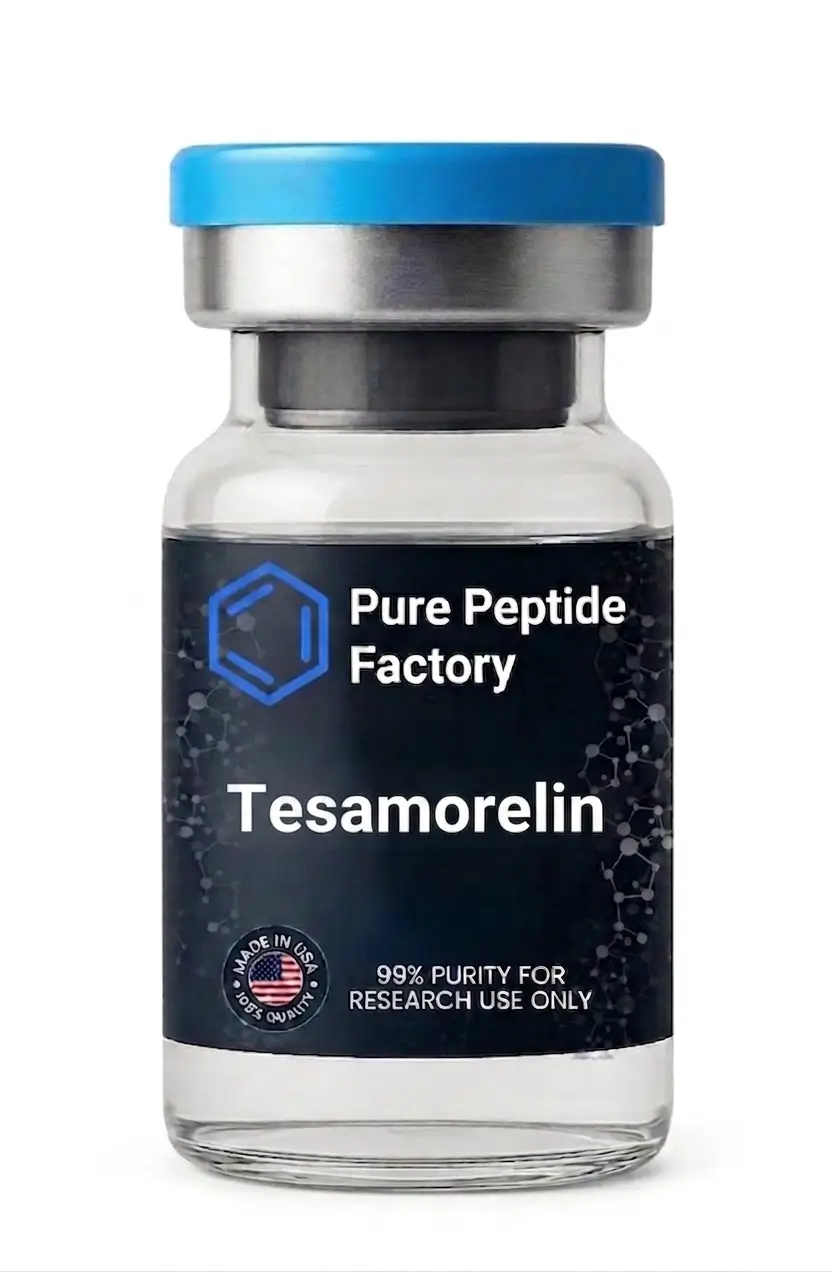
Tesamorelin
$25.00 $120.00Price range: $25.00 through $120.00
Tesamorelin is a synthetic GHRH analog and the only compound in its class with FDA approval behind it, having received regulatory clearance as Egrifta for HIV-associated lipodystrophy. Research-grade Tesamorelin is supplied as lyophilized powder in 2mg, 5mg, 10mg, and 20mg vials for flexible protocol design. HPLC verified, batch-documented, domestic cold-chain shipping. Research use only.
Tesamorelin Peptide Buy: The FDA-Backed GHRH Analog in Four Research Configurations
Most GHRH analogs used in research have never seen a regulatory review. Tesamorelin has. It was developed, trialed in two pivotal Phase 3 studies, and approved by the FDA as Egrifta for reducing excess visceral fat in HIV-associated lipodystrophy. That approval process generated a depth of clinical data, dosing validation, and safety documentation that no other GHRH analog in the research market can match.
When researchers buy Tesamorelin peptide for laboratory use, they are working with a compound whose mechanism, pharmacokinetics, and tissue-specific effects are supported by published human trial data, not just animal studies. Pure Peptide Factory supplies research-grade Tesamorelin in 2mg, 5mg, 10mg, and 20mg vials with batch-specific HPLC documentation and domestic cold-chain shipping.
Why Researchers Buy Tesamorelin from Pure Peptide Factory
Four Vial Sizes, One Supplier
The leading competitor in this category stocks a single 10mg configuration. We carry 2mg, 5mg, 10mg, and 20mg. Pilot studies and dose-finding work at the low end. Extended institutional protocols and multi-cohort studies at the high end. One supplier covers the entire range under the same quality standard and the same batch documentation framework.
The Only GHRH Analog with Clinical Trial Data
Tesamorelin’s FDA approval required two placebo-controlled Phase 3 trials demonstrating consistent visceral fat reduction over 26 weeks and maintained results through 52 weeks. That clinical infrastructure means when you review your Tesamorelin protocol against published literature, you are working with human-validated dosing data and characterized safety profiles. No synthetic GHRH analog in the research catalog has that foundation behind it.
Batch-Specific Documentation for Every Order
Every vial ships with a lot-specific HPLC chromatogram and mass spectrometry report. Synthesis logs are archived for 24 months. If your IRB or compliance office requires chain-of-custody documentation, it is ready before your compound arrives.
Domestic Cold-Chain Protects Compound Integrity
Tesamorelin is a 44-amino-acid peptide. Larger peptides are more vulnerable to temperature-related degradation than smaller compounds. We store at -80°C and ship with phase-change cooling. Most orders arrive within 1 to 3 business days. International sourcing cannot match that reliability for a compound this size and this sensitivity.
What Is Tesamorelin?
A Stabilized GHRH Analog Built for Research
Tesamorelin is a synthetic analog of human growth hormone releasing hormone (GHRH), the 44-amino-acid hypothalamic peptide that stimulates the anterior pituitary to synthesize and secrete growth hormone. Native GHRH degrades rapidly under physiological conditions, primarily through dipeptidyl peptidase IV cleavage at the N-terminus, producing a half-life measured in minutes. Tesamorelin solves this problem structurally.
A trans-3-hexenoic acid group is added at the N-terminal end of the GHRH sequence. This modification blocks DPP-IV cleavage while preserving full receptor binding activity and downstream GH secretory signaling. The result is a GHRH analog that activates the pituitary through the same physiological receptor as native GHRH but with meaningfully extended duration of action.
Molecular Profile:
- Molecular Formula: C221H366N72O67S
- Molecular Weight: 5135.77 g/mol
- CAS: 218949-48-5
- Also known as: Egrifta, Egrifta SV, TH9507
The GH Axis Pathway Tesamorelin Activates
Tesamorelin binds GHRH receptors on anterior pituitary somatotroph cells. Receptor activation stimulates adenylate cyclase through Gs protein coupling, raising intracellular cAMP and activating protein kinase A. The downstream result is GH synthesis and pulsatile GH release into circulation.
Released GH acts on multiple target tissues. In the liver it drives IGF-1 synthesis, which mediates most of GH’s anabolic effects including protein synthesis, nitrogen retention, and cell proliferation. In adipose tissue, particularly visceral fat depots, GH directly activates hormone-sensitive lipase, promoting lipolysis and free fatty acid release. This visceral adipose tissue specificity is the mechanistic basis for both the FDA approval and the research interest in body composition applications.
Tesamorelin Research Applications
Tesamorelin for Fat Loss: Visceral Adipose Tissue Research
The primary evidence base for Tesamorelin in fat loss research comes from the pivotal trials that generated FDA approval. In the Phase 3 studies, Tesamorelin reduced visceral adipose tissue by approximately 15 to 20% from baseline over 26 weeks. Critically, this reduction was specific to visceral fat rather than subcutaneous fat, reflecting GH’s preferential lipolytic action on visceral adipocyte populations.
The mechanism is direct: GH activates hormone-sensitive lipase in visceral adipocytes, releasing stored triglycerides as free fatty acids. Visceral adipocytes have higher density of GH receptors and greater sensitivity to GH-driven lipolysis than subcutaneous adipocytes, which explains the tissue-specific effect that Tesamorelin research consistently demonstrates.
Researchers studying visceral fat metabolism use Tesamorelin to examine:
- GH-mediated lipolysis mechanisms in visceral versus subcutaneous adipocyte models
- Dose-response relationships for visceral fat area reduction using CT or MRI quantification
- Metabolic consequences of visceral fat reduction including triglyceride levels and insulin sensitivity
- Lipodystrophy models and visceral fat accumulation reversal
Tesamorelin for Muscle Growth Research
Tesamorelin is increasingly studied for muscle metabolism applications, and the keyword reflects growing researcher interest in this angle. The mechanism connects through IGF-1. Tesamorelin stimulates pulsatile GH release. GH drives hepatic IGF-1 synthesis. IGF-1 binds IGF-1 receptors on muscle satellite cells and myofibers, stimulating protein synthesis, nitrogen retention, and muscle hypertrophy signaling.
In the clinical trial populations, lean mass was preserved or modestly increased alongside visceral fat reduction, consistent with the anabolic effects of elevated GH and IGF-1 on skeletal muscle. Researchers studying age-related muscle loss, GH deficiency models, and the GH/IGF-1 axis in muscle metabolism use Tesamorelin to probe these pathways through physiological GHRH receptor activation rather than exogenous GH administration.
Key research endpoints include:
- IGF-1 elevation dynamics following Tesamorelin administration in aging models
- Muscle protein synthesis rates measured through nitrogen balance and stable isotope methods
- Satellite cell activation and myofiber size changes in GH-deficient models
- Comparison with direct GH administration for muscle anabolic outcomes
Cognitive Function and Neuroprotection Research
Clinical data from the Tesamorelin trials in HIV-associated neurocognitive disorder showed that subjects receiving Tesamorelin demonstrated improvements in cognitive performance on verbal memory and executive function tests. The proposed mechanism involves IGF-1’s neurotrophic actions in the hippocampus and prefrontal cortex, where IGF-1 supports synaptic plasticity, neuronal survival, and myelination.
Researchers studying age-related cognitive decline, GH/IGF-1 axis effects on brain function, and neuroprotection have incorporated Tesamorelin as a tool to study these pathways through physiological GH stimulation. The fact that cognitive benefits were observed as a secondary endpoint in clinical trials strengthens the research foundation for protocol design.
Metabolic Disease and Lipodystrophy Models
Tesamorelin’s FDA-approved indication for HIV lipodystrophy provides a well-characterized disease model with published dosing protocols, safety data, and validated biomarkers. Researchers studying metabolic dyslipidemia, visceral fat accumulation syndromes, antiretroviral therapy metabolic complications, and lipodystrophy pathophysiology use this existing clinical infrastructure as the foundation for their laboratory work.
The compound also reduces triglycerides and improves lipid profiles as secondary effects of visceral fat reduction, making it relevant for cardiometabolic research programs examining the relationship between GH axis activity and lipid metabolism.
GH Pulsatility and Somatotroph Reserve Studies
Unlike exogenous GH administration, which suppresses the natural GH axis through negative feedback, Tesamorelin stimulates endogenous GH release through the GHRH receptor and preserves the pulsatile secretory pattern characteristic of normal GH physiology. This distinction makes it more suitable than exogenous GH for research examining GH axis feedback regulation, somatotroph secretory reserve, and the consequences of restoring physiological GH pulsatility in GH-deficient models.
Tesamorelin vs CJC-1295: Choosing the Right GHRH Analog
Two GHRH Analogs, Different Research Profiles
Researchers selecting a GHRH analog frequently compare Tesamorelin against CJC-1295. Both activate the GHRH receptor but differ in structure, half-life, and the quality of supporting data:
| Feature | Tesamorelin | CJC-1295 (no DAC) | CJC-1295 (with DAC) |
|---|---|---|---|
| Structural modification | N-terminal trans-3-hexenoic acid | Amine-reactive moieties | Drug Affinity Complex albumin binding |
| Half-life | 20 to 30 minutes | 30 minutes | 6 to 8 days |
| GH pulsatility preserved | Yes | Yes | No (continuous elevation) |
| Clinical trial data | Extensive (FDA approved) | Limited | Limited |
| Human safety profile | Characterized through Phase 3 | Not characterized | Not characterized |
| Best for studying | Clinical translation, visceral fat, validated dosing | Pulsatile GH, short-window protocols | Extended GH elevation, less frequent dosing |
Use Tesamorelin when clinical relevance, validated dosing data, and characterized safety profiles matter to your research design. Use CJC-1295 without DAC for short-window pulsatile protocols. Use CJC-1295 with DAC when extended GH elevation with minimal administration frequency is the priority.
Tesamorelin Side Effects: Published Safety Data
Clinical Trial Safety Profile
Because Tesamorelin completed Phase 3 clinical trials, its safety profile is better documented than virtually any other GHRH analog in the research market. Commonly reported adverse findings in clinical populations include:
- Injection site reactions including erythema, pruritus, and pain, the most frequently reported adverse effect class
- Peripheral edema from GH-mediated fluid retention, dose-dependent and typically transient
- Arthralgia and myalgia associated with IGF-1 elevation and fluid shifts
- Glucose metabolism effects: GH’s insulin-antagonizing properties can affect glucose tolerance, particularly in subjects with pre-existing metabolic dysfunction
Contraindication Findings from Clinical Data
The clinical trials identified the following contraindication signals:
- Active malignancy: GH and IGF-1 are mitogenic. Tesamorelin is contraindicated in subjects with active cancer in clinical use
- Pituitary disorders: Hypopituitarism or hypothalamic damage may blunt the GH response
- Pregnancy: GHRH analogs are not studied in pregnancy and present theoretical developmental risks
These clinical findings provide critical context for researchers designing animal models and cell culture studies involving Tesamorelin. All in vivo protocols require appropriate institutional oversight and monitoring.
How to Reconstitute Tesamorelin
Step-by-Step Laboratory Protocol
- Sanitize the vial stopper with 70% isopropyl alcohol
- Inject bacteriostatic water slowly against the vial wall. Do not aim at the lyophilized cake
- Allow the cake to dissolve without agitation for 3 to 5 minutes. Tesamorelin is a large peptide and dissolves more slowly than shorter compounds
- Gently swirl until fully clear. Do not shake
- Inspect for clarity before use. Discard if particulate matter is visible
- Label with reconstitution date, concentration, and lot number
Concentration reference:
| Vial Size | Bacteriostatic Water | Final Concentration |
|---|---|---|
| 2mg | 1 mL | 2 mg/mL |
| 2mg | 2 mL | 1 mg/mL |
| 5mg | 1 mL | 5 mg/mL |
| 5mg | 2.5 mL | 2 mg/mL |
| 10mg | 2 mL | 5 mg/mL |
| 10mg | 5 mL | 2 mg/mL |
| 20mg | 4 mL | 5 mg/mL |
| 20mg | 10 mL | 2 mg/mL |
Storage Requirements
- Lyophilized powder: 24 months at -20°C, protected from light
- Reconstituted solution: 14 days at 2 to 8°C under sterile conditions. Do not freeze
- Large peptides like Tesamorelin are more prone to aggregation when frozen in solution. Maintain cold chain without freezing after reconstitution
- Protect from light at all stages
Tesamorelin Dosage in Research Protocols
Reference Dosing from Published Literature
| Model | Dose | Route | Frequency | Endpoint |
|---|---|---|---|---|
| Human (FDA-approved) | 2 mg | Subcutaneous | Once daily | Visceral fat reduction |
| Rodent metabolic studies | 100 to 200 mcg/kg | Subcutaneous | Once daily | GH/IGF-1 elevation, body composition |
| Rodent GH axis studies | 1 to 2 mg/kg | Intraperitoneal | Per protocol | Somatotroph reserve characterization |
| Cognitive function studies | 1 mg | Subcutaneous | Once daily (human) | Neurocognitive endpoint assessment |
These figures come from published peer-reviewed literature and the FDA-approved clinical trial program. Translation between species requires allometric scaling appropriate to your model. We do not provide human dosage recommendations for research compound procurement.
Regulatory Context
FDA Approval Status
Tesamorelin is FDA approved as Egrifta for HIV-associated lipodystrophy and in an updated formulation as Egrifta SV. These approvals cover the commercial pharmaceutical product manufactured and distributed under prescription by Theratechnologies.
Research-grade Tesamorelin peptide is a separate category. It is available for laboratory procurement without prescription under research-use-only terms. The FDA restricts marketing and medical claims made about research peptides, not legitimate laboratory procurement.
Research Use Only
This compound is sold exclusively for in vitro and controlled in vivo research. Not for human consumption, veterinary use, or diagnostic purposes. You must agree to research-use-only terms at checkout.
Product Specifications
Available Configurations
| SKU | Vial Size | Best For |
|---|---|---|
| TM2 | 2mg | Pilot studies, dose-finding, low-dose protocols |
| TM5 | 5mg | Standard rodent metabolic studies |
| TM10 | 10mg | Extended protocols, multi-cohort studies |
| TM20 | 20mg | Institutional programs, high-volume research |
Quality Verification
- Purity: 98% minimum (HPLC verified)
- Identity: Mass spectrometry confirmed at 5135.77 g/mol
- Endotoxin: Less than 0.1 EU/mL
- Sterility: Verified per USP 71
- Form: Lyophilized powder
- Storage: -20°C long-term, 2 to 8°C short-term
Current Batch: #PPF-TES-0426 Purity: 98.5% Download: HPLC Certificate | MS Report
FAQ
What makes tesamorelin different from other GHRH analogs?
Tesamorelin is the only GHRH analog with FDA approval and completed Phase 3 clinical trial data. This gives it a validated human dosing protocol, a characterized safety profile, and a depth of peer-reviewed outcome data that no other synthetic GHRH analog in the research market possesses.
Is tesamorelin good for fat loss research?
Yes. Tesamorelin has the strongest evidence base for visceral fat reduction of any GHRH analog in the research catalog. The mechanism involves GH-driven activation of hormone-sensitive lipase in visceral adipocytes, producing selective visceral fat lipolysis. Phase 3 clinical data shows 15 to 20% visceral fat reduction over 26 weeks.
How does tesamorelin support muscle growth research?
Tesamorelin stimulates pulsatile GH release which drives hepatic IGF-1 synthesis. IGF-1 activates protein synthesis, nitrogen retention, and satellite cell signaling in skeletal muscle. Clinical trial populations showed lean mass preservation alongside visceral fat reduction, providing a basis for muscle metabolism research protocols.
What are the tesamorelin side effects in clinical data?
The most commonly reported effects in clinical trials were injection site reactions, peripheral edema, arthralgia, and transient glucose metabolism changes. Active malignancy and pituitary disorders were identified as contraindication signals. Full safety data is available in the FDA label for Egrifta.
How does tesamorelin compare to CJC-1295?
Tesamorelin has extensive clinical trial data and FDA approval. CJC-1295 has limited published human data. Tesamorelin preserves GH pulsatility. CJC-1295 with DAC produces continuous GH elevation. Tesamorelin is the better choice when clinical relevance and validated dosing matter.
Why does Pure Peptide Factory offer four vial sizes?
Different research protocols require different compound quantities. Dose-finding and pilot studies waste compound with a 10mg vial. Extended institutional protocols run out of 2mg vials quickly. We offer 2mg, 5mg, 10mg, and 20mg so your vial size matches your protocol, not the other way around.
Can tesamorelin and ipamorelin be used together?
Yes. The tesamorelin ipamorelin blend is one of the most studied GHRH plus GH secretagogue combinations in research. Tesamorelin activates the GHRH receptor; Ipamorelin activates the ghrelin receptor. The two pathways produce synergistic GH release. We offer both compounds individually and as a pre-matched combo kit.
Where can I buy tesamorelin peptide for research?
Pure Peptide Factory stocks research-grade Tesamorelin in four configurations from 2mg to 20mg per vial. Orders placed before 2 PM EST ship same-day from domestic cold-storage.
Order Tesamorelin Peptide for Research
Secure Checkout
- Credit card, cryptocurrency, or wire transfer
- Same-day dispatch for orders placed before 2 PM EST
- Cold-chain packaging with phase-change cooling
- Discreet labeling and full tracking
Institutional Accounts
Net-30 terms and purchase order acceptance available for universities and pharmaceutical companies. Contact us for bulk pricing on 50 vials or more.
Add to cart and get the only GHRH analog with real clinical data behind it, in the vial size your protocol actually requires.
Related products
-
PEG MGF 2 mg
$50.00 -
MGF 2 mg
$35.00