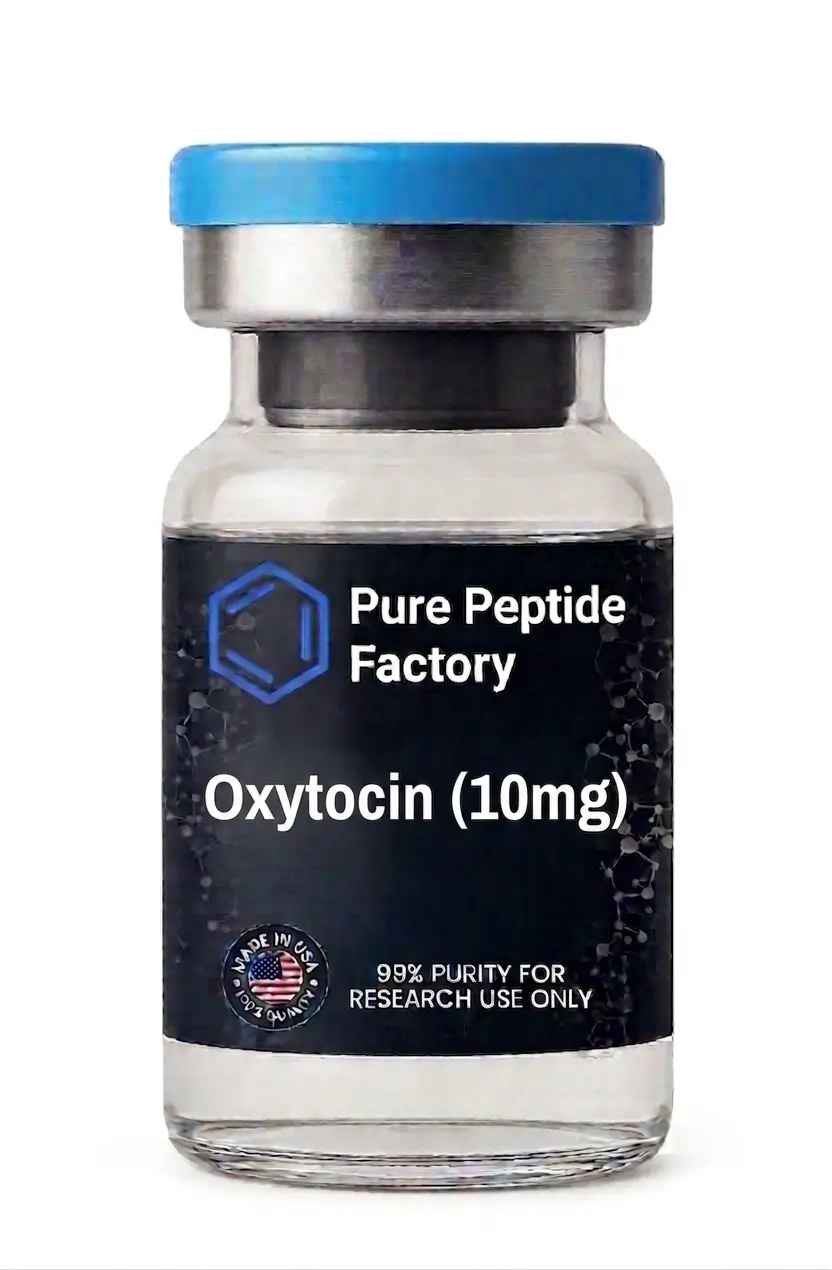
Oxytocin 10 mg
$25.00 $55.00Price range: $25.00 through $55.00
Oxytocin buy options at Pure Peptide Factory come with documentation most vendors do not provide. Research-grade cyclic nonapeptide (C43H66N12O12S2), HPLC verified at 98% minimum purity, batch-specific COA available before purchase. The neuropeptide studied in OXTR signaling, social behavior, sarcopenia reversal via MAPK/ERK, VTA dopamine modulation, and autism spectrum research.
Oxytocin Buy Options for Researchers: Cyclic Nonapeptide with 100+ Years of Study
Oxytocin is one of the most extensively studied peptides in neuroscience. First isolated in 1906, synthesized by Vincent du Vigneaud in 1953 (work that won him the Nobel Prize), and examined in over 25,000 peer-reviewed publications since. It is also one of the most difficult compounds to source reliably at research grade. The FDA-approved form (Pitocin) is restricted to obstetric use. Compounding pharmacies vary in consistency. Most peptide vendors carry oxytocin but few provide the batch-specific documentation serious research protocols require.
Pure Peptide Factory stocks research-grade Oxytocin with lot-specific HPLC chromatograms, mass spectrometry confirmation, and domestic cold-chain shipping. If you are looking to oxytocin buy from a supplier that treats analytical documentation as standard rather than optional, this is it.
Why Researchers Source Oxytocin from Pure Peptide Factory
Documentation Every Protocol Demands
Oxytocin is a nine-amino-acid cyclic peptide with a disulfide bridge between Cys1 and Cys6. That disulfide bond is sensitive to oxidation and reducing conditions, which means storage and handling errors produce degraded product that looks identical on the label but performs differently in experiments. Every batch we ship includes a lot-specific HPLC chromatogram confirming intact cyclic structure, a mass spectrometry report verifying the 1007.19 g/mol molecular weight, and a Certificate of Analysis you can download before your compound ships.
Domestic Cold-Chain for a Temperature-Sensitive Peptide
Oxytocin degrades rapidly above 8°C in solution. We ship from domestic cold-storage using phase-change cooling packs rated for 96-hour protection, not 12-hour gel packs that fail in transit. Most orders reach your lab within 1 to 3 business days, which matters for a compound this sensitive.
Three Vial Sizes for Any Protocol Scale
We stock Oxytocin in 2mg, 5mg, and 10mg configurations. Small dose-finding studies, standard rodent protocols, and institutional research programs all have a vial size that matches without splitting or overbuying.
Synthesis Logs Archived for 24 Months
Every batch is documented and retained. If your IRB or compliance office requests chain-of-custody records, synthesis documentation, or retention samples, they are available on request.
What Is Oxytocin?
A Cyclic Nonapeptide with Dual Function
Oxytocin is a nine-amino-acid cyclic peptide synthesized in the paraventricular and supraoptic nuclei of the hypothalamus, transported via axonal projections to the posterior pituitary, and released into systemic circulation. It also functions as a central neurotransmitter, with oxytocin receptors distributed throughout the brain including the amygdala, hippocampus, prefrontal cortex, ventral tegmental area, and nucleus accumbens.
This dual function as both a circulating hormone and a central neuromodulator is what makes Oxytocin distinctive among peptides. It operates on peripheral tissues (uterus, mammary gland, skeletal muscle, cardiovascular system) and on central social-cognitive circuits simultaneously. Researchers studying either peripheral endocrine function or central neuromodulation use the same compound, but the route of administration and experimental design determines what can be measured.
Molecular Profile:
- Sequence: Cys-Tyr-Ile-Gln-Asn-Cys-Pro-Leu-Gly-NH2 (CYIQNCPLG)
- Structural Feature: Disulfide bridge between Cys1 and Cys6 forming a six-residue ring with a three-residue tail
- Molecular Formula: C43H66N12O12S2
- Molecular Weight: 1007.19 g/mol
- CAS: 50-56-6
- Synonyms: Pitocin, Syntocinon, Endopituitrina
How Oxytocin Works at the Receptor Level
Oxytocin binds the oxytocin receptor (OXTR), a Gq-coupled G-protein coupled receptor (GPCR). Receptor activation triggers phospholipase C, which generates IP3 and DAG, releasing intracellular calcium and activating protein kinase C. The calcium release drives smooth muscle contraction in peripheral tissues and neuromodulatory changes in central circuits.
In skeletal muscle, OXTR signaling also activates the MAPK/ERK pathway. Elabd et al. (Nature Communications, 2014) demonstrated that this pathway is central to muscle stem cell activation and the age-related muscle regeneration effects that have become a major research focus over the past decade.
The receptor has measurable structural polymorphisms (rs53576, rs2254298) that alter signaling efficiency, which is why pharmacogenomic approaches to oxytocin research have gained traction. Individuals and populations respond measurably differently to exogenous administration based on these OXTR variants.
The Positive Feedback Mechanism
Oxytocin operates through one of the clearest examples of physiological positive feedback in mammalian endocrinology. Initial release triggers effects (uterine contraction, milk ejection) that stimulate further release at higher concentrations and intensity. This makes Oxytocin distinct from most hormonal systems, which use negative feedback for homeostasis. Research protocols examining Oxytocin pharmacokinetics must account for this amplifying behavior, particularly in labor induction and lactation studies.
Oxytocin Research Applications
Autism Spectrum Research and Social Behavior
Oxytocin’s role in social cognition has driven the largest body of clinical research on the peptide. Cochran et al. (Harvard Review of Psychiatry, 2013) provided the foundational review of Oxytocin’s role across psychiatric disorders, documenting lower plasma Oxytocin levels in autistic subjects compared to neurotypical controls, with improved Vineland Adaptive Behavior Scale scores following exogenous administration.
The SOARS-B trial (Sikich et al., NEJM 2021) was a 24-week, multicenter, double-blind, placebo-controlled study of intranasal oxytocin in 290 children and adolescents with autism spectrum disorder. The primary endpoint did not reach significance on the full cohort, but a 2025 reanalysis (medRxiv) using machine-learning-derived composite outcomes found measurable improvements in social-emotional reciprocity during the open-label extension phase.
A 2025 dose-response meta-analysis published in Frontiers in Psychiatry (Zhang et al.) synthesized randomized controlled trial data and identified optimal intranasal dose ranges for social impairment endpoints versus repetitive behavior endpoints. These are different optima, which is part of why earlier trials produced inconsistent results.
Research using our compound examines:
- OXTR signaling variation across autism phenotypes
- Amygdala reactivity changes measured by fMRI under oxytocin exposure
- Eye gaze and emotion recognition in animal social behavior models
- Polymorphism-stratified protocols examining rs53576 and rs2254298 response differences
Sarcopenia and Muscle Regeneration
The Elabd et al. 2014 Nature Communications study fundamentally changed how researchers view Oxytocin. The team at UC Berkeley’s Conboy Laboratory demonstrated that circulating oxytocin declines with age, OXTR expression on muscle stem cells decreases, and exogenous administration in aged mice restored muscle regeneration to roughly 80% of young-mouse capacity through MAPK/ERK pathway activation.
The effect was age-specific. Young mice with intact endogenous oxytocin showed no additional benefit from supplementation, which ruled out non-specific anabolic effects and pointed to genuine restoration of age-depleted signaling. Genetic knockout of oxytocin produced premature sarcopenia without developmental muscle defects, confirming the peptide’s role is maintenance and repair rather than initial muscle formation.
Research endpoints include muscle stem cell proliferation rates, MAPK/ERK phosphorylation markers, fiber type composition in aged muscle, and comparison with other circulating age-specific factors including GDF11 identified by Conboy and Wagers groups.
Dopamine Signaling, Reward, and Sexual Behavior
Oxytocin modulates dopaminergic activity in the ventral tegmental area (VTA) and nucleus accumbens, the two regions that anchor the mesolimbic reward system. Melis and Argiolas (International Journal of Molecular Sciences, 2021) detailed the mechanism: Oxytocin projections to the VTA activate oxytocin receptors on dopaminergic neurons, triggering nitric oxide synthesis and enhancing dopamine release in the nucleus accumbens. This increases reward salience and motivational responses to social and sexual stimuli.
The pathway is not exclusively direct. Oxytocin also modulates glutamatergic and GABAergic neurons in the hippocampus and amygdala that project onto VTA and nucleus accumbens circuits, producing indirect modulation of dopaminergic tone. Researchers studying reward processing, social reinforcement learning, and pair bonding use Oxytocin to examine this peptide-catecholamine interaction that cannot be replicated with selective dopamine compounds.
Labor Induction and Obstetric Research
Oxytocin’s role in parturition is the FDA-approved indication for Pitocin, but research continues to refine protocols. Diven et al. (American Journal of Obstetrics and Gynecology, 2012) conducted a randomized controlled trial in 252 pregnant subjects comparing continuous Oxytocin administration versus discontinuation at 5cm cervical dilation during induced labor. The discontinuation group showed fewer cesarean deliveries (24 versus 32) with similar neonatal outcomes, suggesting Oxytocin dosing protocols can be optimized for reduced intervention rates.
Rabow et al. (BMC Pregnancy and Childbirth, 2018) examined Oxytocin’s cardiovascular effects during labor using non-invasive pulse wave analysis, reporting vasodilation of peripheral arteries and elevated left ventricular ejection time, findings relevant to maternal cardiovascular research beyond uterine effects.
Lactation and Milk Ejection Biology
Oxytocin triggers milk ejection through contraction of myoepithelial cells surrounding mammary alveolar ducts. The positive feedback loop (suckling stimulates Oxytocin release, which drives further ejection and further stimulation) is a textbook example of neuroendocrine coupling. Gomes et al. (Journal of Obstetrics and Gynaecology, 2018) retrospectively analyzed 200 subjects comparing intrapartum synthetic Oxytocin exposure versus none, finding short-term breastfeeding differences that diminished over a three-month window. The study flagged pre-gestational BMI as a confounding variable, which is relevant for researchers designing lactation protocols in metabolic disease models.
Cardiovascular and Metabolic Research
Oxytocin receptors are expressed in cardiomyocytes, endothelial cells, and adipose tissue. Research in rodent models has examined cardioprotection against ischemia-reperfusion injury, reduced atherosclerotic plaque development, and peripheral metabolic effects including improved insulin sensitivity in skeletal muscle.
Barengolts and colleagues reported that circulating oxytocin levels are lower in type 2 diabetes compared to normoglycemic subjects, with negative correlation to HbA1c and insulin resistance markers. Combined with the Rabow vasodilation findings and rodent cardioprotection data, this drives research into oxytocin’s role in energy homeostasis, vascular tone, and metabolic syndrome beyond its better-known social behavior effects.
Bone Density and Osteoporosis Research
Elabd’s earlier 2008 work in Stem Cells demonstrated that Oxytocin controls differentiation of human mesenchymal stem cells and reverses osteoporosis in ovariectomized mice. The peptide stimulates osteoblast differentiation and bone formation while modulating osteoclast activity, which is why bone metabolism research programs increasingly include Oxytocin alongside more obvious bone-targeted compounds.
Neuroplasticity and Synaptic Function
Bakos et al. (Neural Plasticity, 2018) reviewed the molecular mechanisms of Oxytocin signaling at the synapse. OXTR activation on neurons produces context-dependent effects on neurotransmitter release, enhancing glutamatergic transmission in some circuits while modulating GABAergic signaling in others. This excitation-inhibition balance is central to normal circuit function, and Oxytocin appears to tune it rather than uniformly activate or suppress it.
The peptide also interacts with astrocytes and neural progenitor cells, extending its influence beyond classical neurotransmission. Research endpoints include synaptic plasticity markers (LTP/LTD), dendritic spine morphology changes, astrocytic glutamate uptake under OXTR modulation, and neural progenitor cell fate decisions in adult neurogenesis models.
Stress Response and HPA Axis Modulation
Oxytocin suppresses corticotropin-releasing hormone (CRH) release from the paraventricular nucleus, attenuating hypothalamic-pituitary-adrenal axis activation under stress. Research in this area examines cortisol response curves, amygdala reactivity to threat stimuli, and the interaction between Oxytocin and vasopressin signaling in stress regulation. The anxiolytic effects observed in animal models have driven interest in translational protocols for anxiety disorder research.
Oxytocin vs Dopamine vs Serotonin: Understanding the Neurochemistry
Three Signaling Systems, Three Distinct Roles
Researchers regularly compare Oxytocin to dopamine and serotonin because all three are involved in social and emotional behavior, but the mechanisms differ fundamentally:
| System | Type | Primary Receptor | Half-Life | Main Research Focus |
|---|---|---|---|---|
| Oxytocin | Cyclic nonapeptide | OXTR (Gq-coupled GPCR) | 3 to 5 minutes (plasma) | Social bonding, trust, pair bonding, maternal behavior |
| Dopamine | Monoamine neurotransmitter | D1 through D5 receptors | Seconds | Reward prediction, motivation, motor control |
| Serotonin | Monoamine neurotransmitter | 5-HT1 through 5-HT7 | Seconds | Mood regulation, appetite, sleep-wake cycles |
The interactions between these systems matter more than the isolated differences. Dopamine release in the nucleus accumbens is modulated by Oxytocin signaling during social reward, as documented in VTA circuit research. Serotonin and Oxytocin interact in modulating anxiety-like behaviors. Researchers designing behavioral protocols need to account for all three rather than studying any in isolation.
Oxytocin vs Prolactin: Pituitary Peptides with Different Jobs
Both Oxytocin and prolactin are pituitary peptides involved in lactation, but they operate on different tissues and receptor systems. Oxytocin triggers milk ejection through smooth muscle contraction of mammary myoepithelial cells via OXTR. Prolactin drives milk production through PRLR signaling and lactogenesis. Researchers studying lactation biology or pituitary hormone regulation use both compounds, often in the same protocol.
Oxytocin vs Pitocin: Same Molecule, Different Context
Pitocin is the brand name for the FDA-approved Oxytocin formulation used for labor induction and postpartum hemorrhage. The active peptide in Pitocin is identical to our research-grade Oxytocin. The difference is formulation (IV solution with preservatives and pH buffers versus lyophilized powder), regulatory status (prescription-only for specific obstetric indications versus research-use-only), and the flexibility to work with custom concentrations and administration vehicles that clinical formulations do not permit.
Oxytocin Nasal Spray: What Reddit and Research Literature Actually Say
Why Intranasal Administration Dominates Research Protocols
Intranasal administration bypasses the blood-brain barrier limitations that restrict systemic Oxytocin from reaching central receptors. The compound reaches the brain through olfactory and trigeminal nerve pathways, producing measurable CSF concentration increases within 30 to 60 minutes of administration. This is why nearly all central nervous system Oxytocin research uses the nasal spray route rather than injection.
Published protocols in autism, anxiety, and social cognition research have typically used doses of 16 to 40 IU (International Units) administered intranasally. The 2025 Frontiers meta-analysis found different optimal ranges for different endpoints, which is a meaningful finding for researchers designing new protocols rather than replicating older ones.
Reddit discussions about oxytocin nasal spray reflect researcher uncertainty about compounding pharmacy reliability and commercial product consistency. Our research-grade lyophilized powder eliminates that variable. You reconstitute to your target concentration with the vehicle appropriate for your protocol, verify batch purity against the provided COA, and work with known-quantity compound.
We Do Not Provide Human Dosing Recommendations
Oxytocin is not approved for the research applications discussed on this page outside of its narrow FDA-approved obstetric indications. This compound is sold strictly for laboratory research purposes. The dosing references above come from peer-reviewed publications and are provided for protocol design context only.
How to Reconstitute Oxytocin
Step-by-Step Laboratory Protocol
- Sanitize the vial stopper with 70% isopropyl alcohol
- Inject bacteriostatic water slowly against the vial wall. Do not aim directly at the lyophilized cake
- Allow the cake to dissolve without agitation for 2 to 3 minutes
- Gently swirl until the solution is clear. Do not shake, as shaking can disrupt the disulfide bridge
- Inspect for clarity before use. Label with date and concentration
Concentration reference:
- 2mg vial + 1mL water = 2mg/mL
- 5mg vial + 1mL water = 5mg/mL, or + 2.5mL = 2mg/mL
- 10mg vial + 2mL water = 5mg/mL, or + 5mL = 2mg/mL
- Scale ratios for your specific protocol requirements
Storage Requirements
- Lyophilized powder: 24 months at -20°C, protected from light
- Reconstituted solution: 14 days at 2 to 8°C. Do not freeze reconstituted oxytocin, as freeze-thaw cycles disrupt the disulfide bond
- The cyclic structure is pH-sensitive. Solutions between pH 4.0 and 5.0 are most stable. Avoid alkaline conditions
- Keep away from reducing agents that can break the disulfide bridge
Oxytocin Buy: Regulatory Context
H3: FDA Approval and Research Status
Oxytocin is FDA approved as Pitocin for induction of labor and postpartum hemorrhage management. These approvals apply to the commercial injectable formulation dispensed by prescription in obstetric settings.
Research-grade Oxytocin peptide is a separate category. It is available for laboratory procurement under research-use-only terms without a prescription. This compound is not for human consumption, veterinary use, or diagnostic application of any kind. You must agree to research-use terms at checkout.
Where to Get Oxytocin for Research
Most peptide vendors carry Oxytocin but vary significantly in documentation quality. When searching where to get oxytocin, the practical filter is whether the vendor provides batch-specific HPLC and mass spectrometry documentation, ships in temperature-controlled packaging, and maintains synthesis logs. We built our process around those three criteria because they are the ones that matter for reproducible research.
Product Specifications
Available Configurations
Oxytocin is available in 2mg, 5mg, and 10mg vials. Select your configuration from the product options above.
Quality Verification
- Purity: 98% minimum (HPLC verified)
- Identity: Mass spectrometry confirmed against the 1007.19 g/mol target
- Disulfide integrity: Verified by Ellman’s reagent or equivalent
- Endotoxin: Less than 0.1 EU/mL
- Sterility: Verified per USP 71
- Form: Lyophilized powder
- Storage: -20°C long-term, 2 to 8°C short-term after reconstitution
Current Batch: #PPF-OXT-0426 Purity: 98.7% Download: HPLC Certificate | MS Report
FAQ
What is Oxytocin used for in research?
Oxytocin is studied in social behavior and bonding research, autism spectrum disorder clinical trials, sarcopenia and muscle regeneration via MAPK/ERK signaling, VTA dopamine modulation and reward research, stress and HPA axis studies, cardiovascular protection, bone density and osteoporosis, and metabolic research including insulin sensitivity. It is one of the most broadly applicable peptides in neuroscience and endocrine research.
Where can I buy oxytocin peptide for research?
Pure Peptide Factory stocks research-grade Oxytocin in 2mg, 5mg, and 10mg vials with batch-specific HPLC and mass spectrometry documentation. Domestic cold-chain shipping delivers most orders within 1 to 3 business days.
What is the difference between Oxytocin and Pitocin?
Pitocin is the FDA-approved brand name for the commercial injectable Oxytocin used in obstetrics. The active peptide is identical to research-grade Oxytocin. The difference is formulation, regulatory status, and the flexibility to work with custom concentrations that commercial products do not offer.
How is Oxytocin different from dopamine and serotonin?
Oxytocin is a cyclic nine-amino-acid peptide that signals through the OXTR G-protein coupled receptor. Dopamine and serotonin are small-molecule monoamine neurotransmitters signaling through different receptor families with different kinetics. All three are involved in social and emotional behavior, but they operate on distinct mechanisms and timescales. Oxytocin also modulates dopamine release in VTA and nucleus accumbens circuits, which is why researchers studying reward often examine both together.
What does the Reddit community discuss about oxytocin nasal spray?
Reddit discussions reflect researcher and consumer uncertainty about compounding pharmacy consistency and commercial product quality. Published research protocols typically use intranasal administration at 16 to 40 IU doses. The 2025 Frontiers meta-analysis identified different optimal dose ranges for different endpoints, which is relevant for protocol design. We supply research-grade compound with batch verification so you work with known quantity rather than unknown formulation.
What is the maximum oxytocin dose in research?
Published research doses vary significantly by endpoint, species, route of administration, and study design. Intranasal autism research typically uses 16 to 40 IU per administration. Rodent protocols for sarcopenia used systemic subcutaneous administration at doses scaled by body weight. We do not provide human dosing recommendations. This compound is for research use only.
How does Oxytocin affect muscle aging?
Elabd et al. (Nature Communications, 2014) demonstrated that circulating Oxytocin declines with age, OXTR expression on muscle stem cells decreases, and exogenous Oxytocin administration in aged mice restored muscle regeneration to roughly 80% of young-mouse capacity through MAPK/ERK signaling. The effect was age-specific, absent in young animals with intact endogenous Oxytocin levels.
What is Oxytocin’s role in autism research?
Intranasal Oxytocin has been studied in over a dozen randomized controlled trials for autism spectrum disorder, with the SOARS-B trial (Sikich et al., NEJM 2021) being the largest. A 2025 reanalysis using machine-learning-derived composite outcomes found measurable improvements in social-emotional reciprocity during the open-label extension phase. Research continues on which patient subgroups, doses, and endpoints produce the most consistent effects.
Does Oxytocin affect dopamine release?
Yes. Oxytocin projections to the ventral tegmental area activate oxytocin receptors on dopaminergic neurons, enhancing dopamine release in the nucleus accumbens through a mechanism involving nitric oxide synthesis (Melis and Argiolas, 2021). This pathway is central to research on reward processing, social reinforcement, and pair bonding.
How should Oxytocin be stored?
Lyophilized powder stores at -20°C for up to 24 months protected from light. Reconstituted solution stores at 2 to 8°C for up to 14 days. Do not freeze reconstituted Oxytocin, as the disulfide bridge is sensitive to freeze-thaw cycles. Keep pH between 4.0 and 5.0 for maximum stability.
Why is Oxytocin cheaper than Pitocin?
Research peptide pricing reflects the compound itself without commercial formulation costs, obstetric packaging requirements, sterile injectable preparation overhead, and pharmacy dispensing fees built into FDA-approved products.
Order Oxytocin for Research
Secure Checkout
- Credit card, cryptocurrency, or wire transfer
- Same-day dispatch for orders placed before 2 PM EST
- Cold-chain packaging with phase-change cooling
- Discreet labeling with full tracking
Institutional Accounts
Net-30 terms and purchase order acceptance available for universities and pharmaceutical companies. Contact us for bulk pricing on 50 vials or more.
Add to cart and get batch-verified Oxytocin delivered to your lab with the documentation your protocol requires.
Related products
-
MT-1 (Melanotan I) 10 mg
$50.00 -
PT-141 10 mg
$60.00 -
Triptorelin
$45.00