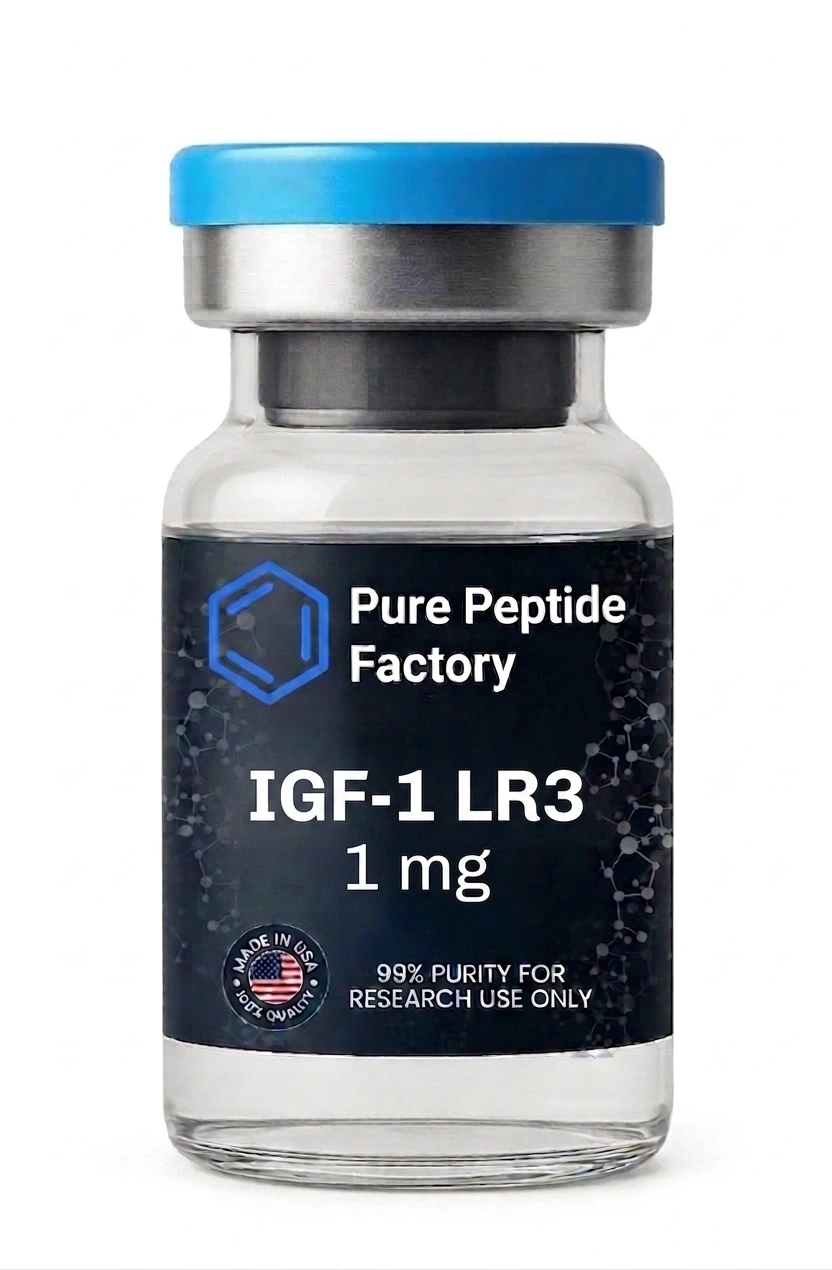
IGF-1 LR3 1 mg
$30.00 $90.00Price range: $30.00 through $90.00
IGF-1 LR3 peptide , research-grade Long R3 insulin-like growth factor-1 analog (83 amino acids, 9,117.5 g/mol). Engineered with reduced IGFBP affinity for sustained receptor activation in myocyte differentiation, C2C12 myotube hypertrophy, and mTOR pathway research. 0.1mg and 1mg vials. HPLC verified at 99.2% purity. Domestic cold-chain shipping. Research use only.
IGF-1 LR3 Peptide for Sale: Research-Grade Long R3 IGF-1 Analog
Researchers studying skeletal muscle hypertrophy, myoblast differentiation, or the IGF-1 receptor signaling cascade need a reliable domestic source for the Long R3 variant of insulin-like growth factor-1. Pure Peptide Factory supplies research-grade igf 1 lr3 peptide in 0.1mg and 1mg lyophilized vials with full batch documentation and cold-chain integrity. When you buy igf 1 lr3 peptide from our domestic stock, you receive the precisely engineered 83-amino acid analog that remains bioavailable in experimental systems for extended periods — typically 20 to 30 hours — due to structural modifications that reduce sequestration by IGF binding proteins (1).
Unlike native IGF-1, which is rapidly buffered by six IGF binding proteins (IGFBP-1 through IGFBP-6) that control its bioavailability in serum and extracellular fluid, the LR3 variant substitutes arginine for glutamic acid at position 3 and adds a 13-amino acid N-terminal extension derived from methionyl porcine growth hormone. These modifications reduce IGFBP affinity without impairing IGF-1 receptor (IGF-1R) binding. Consequently, the igf 1 lr3 peptide activates canonical PI3K-AKT/mTOR and MAPK/ERK signaling cascades with sustained potency, making it the preferred analog for multi-day myocyte differentiation protocols and long-term in vivo studies where native IGF-1’s 12-15 hour half-life would require impractically frequent dosing (2).
Why Researchers Buy IGF-1 LR3 Peptide from Pure Peptide Factory
Verified 83-Amino Acid Analog with Documented Purity
IGF-1 LR3 peptide is a precisely structured 83-amino acid recombinant analog with a molecular formula of C400H625N111O115S9 and a molecular weight of 9,117.5 g/mol. Its biological activity depends on correct disulfide bond formation and tertiary structure. Every batch we ship includes lot-specific HPLC and mass spectrometry documentation verifying purity (99.2% on current batch #PPF-IGF-0513) and molecular identity. The Certificate of Analysis is downloadable before your compound ships. Therefore, researchers who buy igf 1 lr3 peptide from our facility can trust that the analog’s receptor-binding conformation is intact.
Two SKU Configurations for Protocol Flexibility
We stock this peptide in 0.1mg (100 mcg) and 1mg (1,000 mcg) lyophilized vials. The 0.1mg configuration accommodates pilot assays, media optimization, and dose-finding studies where working concentrations of 10-100 nM are tested in cell culture. The 1mg format supports extended in vivo rodent protocols where 50-100 mcg/kg/day is the standard published dose range for anabolic rescue and muscle hypertrophy models spanning 2-6 weeks. Consequently, you can match vial size to experimental duration without splitting vials or compromising sterile handling.
Domestic Cold-Chain Integrity for a Complex Recombinant Protein
This 83-amino acid analog contains multiple disulfide bonds critical for IGF-1R binding. Temperature excursions and freeze-thaw cycles denature tertiary structure and reduce receptor activation. We store all igf 1 lr3 peptide inventory under domestic refrigeration at -20°C and ship using phase-change cooling rated for 96-hour protection. Most orders arrive within 1 to 3 business days, preserving the analog’s conformational integrity from warehouse to laboratory bench.
Compare Against Complementary Muscle Biology Peptides Without Batch Variables
Many research protocols compare this long-acting IGF-1 analog against other myogenic compounds such as MGF (Mechano Growth Factor), GHRP-6, or tesamorelin. Because we stock these complementary compounds under identical cold-storage conditions, researchers who buy igf 1 lr3 peptide alongside them eliminate supplier variability from cross-compound data.
Synthesis Logs Archived for 24 Months
Should your IRB or compliance office request chain-of-custody records, we provide them without delay.
What Is IGF-1 LR3 Peptide?
A Long-Acting IGF-1 Analog Engineered for Sustained Receptor Engagement
IGF-1 LR3 peptide (insulin-like growth factor-1 long arginine 3) is a recombinant analog of endogenous IGF-1, a 70-amino acid polypeptide produced primarily in the liver in response to growth hormone stimulation. The LR3 variant incorporates two structural modifications: an arginine substitution at position 3 (replacing the native glutamic acid) and a 13-amino acid N-terminal extension derived from methionyl porcine growth hormone. These changes yield an 83-amino acid chain with markedly altered binding kinetics — specifically, reduced affinity for the six IGF binding proteins that normally sequester and inactivate IGF-1 in biological matrices. By evading this inhibitory buffering system, the analog remains bioavailable for prolonged periods, producing sustained IGF-1R activation without the pulsatile clearance of the native hormone (1).
This extended bioavailability is why researchers choose igf 1 lr3 peptide for studies requiring continuous receptor engagement: multi-day myotube differentiation assays, chronic in vivo muscle hypertrophy models, and protocols where the 12-15 hour half-life of native IGF-1 would necessitate impractically frequent dosing. The analog activates the same downstream signaling cascades as native IGF-1 — PI3K-AKT/mTOR driving protein synthesis and MAPK/ERK driving proliferation — but with more predictable and sustained kinetics due to its IGFBP-resistant design (2).
Molecular Profile:
- Classification: Recombinant insulin-like growth factor-1 analog (Long R3 IGF-1)
- Length: 83 amino acids (native IGF-1: 70 aa)
- Key Modifications: Arg3 substitution; +13 aa N-terminal extension
- Molecular Formula: C400H625N111O115S9
- Molecular Weight: 9,117.5 g/mol
- CAS Number: 143045-27-6
- Synonyms: Long R3 IGF-1, IGF-1 LR3, Long Arg3 IGF-1, LR3-IGF-1
- Half-Life: ~20-30 hours (vs ~12-15 hours for native IGF-1; ~5-10 minutes for DES)
- Receptor: IGF-1R (retains full receptor affinity); minimal insulin receptor cross-talk
- IGFBP Affinity: Markedly reduced (primary distinguishing feature from native IGF-1)
How IGF-1 LR3 Peptide Works: The IGFBP Evasion Advantage
The functional advantage of igf 1 lr3 peptide in research stems from two structural features that converge on a single outcome: more free ligand available to activate IGF-1R for longer periods.
The arginine-3 substitution disrupts the IGFBP binding interface. Native IGF-1 is tightly controlled by six binding proteins (IGFBP-1 through IGFBP-6) that sequester over 99% of circulating IGF-1 in an inactive complex. Replacing glutamic acid at position 3 with arginine introduces a positively charged residue into the IGFBP recognition site, sterically and electrostatically hindering the interaction without affecting the IGF-1R binding surface. The result is a dramatic reduction in sequestration — the analog remains free in solution rather than being buffered into an inactive reservoir.
The N-terminal extension provides additional steric hindrance and protease resistance. The 13-amino acid leader sequence further blocks IGFBP access while simultaneously protecting the analog from proteolytic degradation. The combined effect is an operational half-life of approximately 20 to 30 hours in experimental systems — roughly double that of native IGF-1 — enabling once-daily media supplementation in cell culture or single daily injections in rodent models without the rapid clearance that plagues shorter-acting IGF-1 variants (3).
Once bound to the IGF-1 receptor tyrosine kinase, the LR3 analog activates the same intracellular cascades as native IGF-1. The PI3K-AKT/mTOR pathway drives ribosomal protein S6 phosphorylation and protein synthesis. The MAPK/ERK pathway promotes myoblast proliferation. The critical difference is not the downstream targets but the sustained nature of receptor engagement: continuous signaling produces stronger cumulative effects on myotube hypertrophy and protein accretion than the intermittent pulses characteristic of native IGF-1 in IGFBP-rich environments (2).
IGF-1 LR3 vs Native IGF-1 vs IGF-1 DES
Researchers who buy igf 1 lr3 peptide often compare it against other IGF-1 variants. Understanding the structural and functional distinctions is essential for correct experimental design:
| Feature | IGF-1 LR3 | Native IGF-1 | IGF-1 DES |
|---|---|---|---|
| Length | 83 amino acids | 70 amino acids | 67 amino acids (des[1-3]) |
| Key Modification | +13 aa N-terminus; Arg3 substitution | Native sequence | Truncated N-terminus (lacks first 3 aa) |
| IGFBP Affinity | Markedly reduced | High (strongly sequestered) | Absent (no IGFBP binding) |
| Half-Life | ~20-30 hours | ~12-15 hours | ~5-10 minutes |
| Primary Research Use | Cell culture; long-term exposure studies; chronic in vivo protocols | Baseline control; endocrine studies | Site-specific injection; acute localized studies |
| Receptor Selectivity | IGF-1R (standard affinity); minimal insulin receptor cross-talk | IGF-1R / insulin receptor hybrid | Preferential IGF-1R binding (no insulin receptor cross-talk) |
IGF-1 LR3 is the preferred analog when experiments require sustained systemic or media-level activity without the pulsatile clearance of native IGF-1 or the ultra-short duration of DES. DES is typically reserved for localized acute administration where its 5-10 minute half-life provides tight temporal control. LR3 supports continuous culture supplementation and once-daily in vivo dosing.
IGF-1 LR3 vs hGH: Different Levels of the GH/IGF-1 Axis
| Feature | IGF-1 LR3 | Human Growth Hormone (hGH) |
|---|---|---|
| Type | IGF-1 receptor agonist (83 aa analog) | Growth hormone receptor agonist (191 aa) |
| Site of Action | Direct: IGF-1R on target tissues (muscle, bone, fat) | Indirect: GHR on liver → IGF-1 secretion; direct GHR effects on tissues |
| IGF-1 Elevation | Exogenous (provides the active ligand directly) | Endogenous (stimulates hepatic IGF-1 production) |
| Half-Life | ~20-30 hours | ~20-30 minutes (pulsatile); ~9 hours (sustained formulation) |
| IGFBP Interaction | Minimal (evaded by design) | Indirect: elevates both IGF-1 and IGFBPs |
| Research Focus | Direct IGF-1R signaling, myocyte hypertrophy, mTOR pathway | Whole-body GH/IGF-1 axis, hepatic IGF-1 output, longitudinal growth |
IGF-1 LR3 bypasses the GH/IGF-1 axis entirely and provides the active ligand directly to target tissues. hGH stimulates endogenous IGF-1 production but also elevates IGFBPs, which buffer the resulting IGF-1. For researchers studying pure IGF-1R signaling without the complexity of the GH/IGF-1 feedback loop, igf 1 lr3 peptide is the appropriate tool.
IGF-1 LR3 vs CJC-1295: Receptor-Level Distinction
| Feature | IGF-1 LR3 | CJC-1295 (with DAC) |
|---|---|---|
| Receptor | IGF-1R (direct ligand) | GHRH receptor (stimulates GH secretion) |
| Half-Life | ~20-30 hours | ~6-8 days |
| IGF-1 Elevation | Exogenous (direct receptor activation) | Endogenous (via GH → hepatic IGF-1) |
| Research Focus | Muscle cell biology, direct IGF-1R signaling | GH pulsatility, hepatic IGF-1 output, sustained GHRH activation |
The two compounds operate at entirely different levels of the GH/IGF-1 axis. CJC-1295 stimulates the pituitary to release GH, which then stimulates hepatic IGF-1 production — a multi-step cascade. IGF-1 LR3 peptide provides the active ligand directly at the target receptor. Researchers comparing these compounds should recognize that CJC-1295 studies the upstream regulatory axis, while IGF-1 LR3 studies the downstream effector.
IGF-1 LR3 Before and After: What Published Research Shows
The search phrase “igf 1 lr3 before and after” typically refers to preclinical body composition and muscle hypertrophy data. In published rodent studies, investigators have documented the following outcomes following LR3 administration:
- Increased myofiber cross-sectional area in skeletal muscle, with measurable hypertrophy within 2-4 weeks of daily dosing at 50-100 mcg/kg subcutaneously
- Enhanced C2C12 myotube formation in cell culture, with increased fusion index and myotube diameter at 10-100 nM concentrations
- Reduced adipose tissue mass in some rodent models, consistent with IGF-1R-mediated lipolysis and metabolic effects, though this is not the primary research endpoint
- Preserved lean mass in dexamethasone-treated catabolic rat models, demonstrating the analog’s anabolic rescue capacity established by Tomas et al. (1992) (1)
These are animal and cell culture data only. They demonstrate the analog’s biological activity in controlled experimental systems and should not be extrapolated to human therapeutic or cosmetic outcomes. Researchers who buy igf 1 lr3 peptide for body composition studies should use published endpoints — myofiber cross-sectional area, myotube diameter, protein synthesis rates — rather than subjective “before and after” visual assessments.
IGF-1 LR3 Dosage Reference for Preclinical Research
For laboratory protocols only. We do not provide human dosing recommendations.
| Research Model | Concentration / Dose | Frequency | Duration | Route | Key Finding |
|---|---|---|---|---|---|
| C2C12 myoblast differentiation | 10-100 nM in media | Continuous (media change every 48h) | 5-7 days | Cell culture | Enhanced myotube formation; increased fusion index |
| Primary satellite cell culture | 10-50 nM | Continuous | 7-14 days | Cell culture | Dose-dependent hypertrophy in primary myotubes |
| Rodent anabolic rescue (dexamethasone catabolic model) | 50-100 mcg/kg/day | Once daily | 2-6 weeks | Subcutaneous | Preserved lean mass; protein synthesis restoration |
| Glucose uptake assay | 1-10 nM (EC50 comparable to native IGF-1) | Acute exposure (30-120 min) | Single dose | Cell culture | GLUT4 translocation and glucose uptake |
| Rodent muscle hypertrophy (dose ceiling study) | 80-120 mcg/kg twice daily | Twice daily | 2-4 weeks | Subcutaneous | 80 and 120 mcg/kg produced near-identical outcomes; ceiling effect observed |
Higher concentrations do not necessarily produce superior outcomes. In growth hormone insensitivity studies, twice-daily doses of 80 mcg/kg and 120 mcg/kg produced nearly identical anabolic effects, suggesting a receptor saturation ceiling beyond which additional igf 1 lr3 peptide provides no further benefit. Consequently, researchers should titrate from the lower end of the published range. For cell culture work, 10-100 nM is the standard concentration window; for rodent in vivo protocols, 50-100 mcg/kg/day is the most commonly cited range.
How to Reconstitute and Inject IGF-1 LR3 Peptide
Step-by-Step Reconstitution Protocol
- Sanitize the vial stopper with 70% isopropyl alcohol.
- Inject bacteriostatic water (0.9% benzyl alcohol) or 0.6% acetic acid solution slowly against the vial wall. Acetic acid enhances solubility for this analog. Do not aim the stream directly at the lyophilized cake — this can denature the disulfide-bonded tertiary structure.
- Allow the powder to dissolve without agitation for 2-3 minutes. The 83-amino acid recombinant protein dissolves more slowly than short synthetic peptides.
- Gently swirl until the solution is completely clear. Do NOT shake or vortex — mechanical stress disrupts disulfide bonds and reduces receptor binding affinity.
- Inspect for clarity. Discard if turbid, discolored, or containing particulate matter.
- Label with reconstitution date and concentration.
Reconstitution Reference Table
| SKU | Vial Content | Diluent Volume | Concentration |
|---|---|---|---|
| IGF-0.1MG | 0.1 mg (100 mcg) | 1 mL | 0.1 mg/mL (100 mcg/mL) |
| IGF-1MG | 1 mg (1,000 mcg) | 1 mL | 1 mg/mL (1,000 mcg/mL) |
| IGF-1MG (dilute) | 1 mg (1,000 mcg) | 2 mL | 0.5 mg/mL (500 mcg/mL) |
How to Inject IGF-1 LR3 in Research Models
The following protocols apply to research administration in animal models. All injections must be performed under aseptic conditions with IACUC approval. Researchers who buy igf 1 lr3 peptide for in vivo protocols should select the route appropriate to their species and experimental endpoints.
Subcutaneous Injection (SC) — Preferred Route for Rodent Models
- Cleanse the injection site (lower abdomen, scruff of the neck, or flank) with 70% isopropyl alcohol.
- Using a 29-31 gauge insulin syringe, pinch a 1-2 inch fold of skin and insert the needle at a 45-90 degree angle into the subcutaneous fat layer.
- Release the pinched skin. Aspirate briefly to confirm the needle is not in a blood vessel.
- Inject slowly over 5-10 seconds. Hold the needle in place for 10 seconds before withdrawing to prevent backflow.
- Apply gentle pressure with sterile gauze. Do not rub the injection site.
- Rotate injection sites for repeated daily administrations.
Subcutaneous vs Intramuscular for IGF-1 LR3
In published rodent studies, subcutaneous injection is the standard route for systemic IGF-1 LR3 delivery. The analog’s 20-30 hour half-life and reduced IGFBP binding mean it distributes effectively from the subcutaneous depot into systemic circulation. Intramuscular injection produces a more rapid peak but is typically reserved for site-specific acute studies where localized muscle exposure is the experimental endpoint. Researchers who purchase igf 1 lr3 peptide for chronic systemic protocols should use the SC route; those studying site-specific muscle hypertrophy may consider IM at the target muscle.
Storage Requirements
- Lyophilized powder: 24 months at -20°C, protected from light and moisture.
- Reconstituted solution: 14-21 days at 2-8°C. Do NOT freeze reconstituted solution — freeze-thaw cycles denature the analog’s tertiary structure and reduce IGF-1R binding.
- Avoid repeated freeze-thaw cycles. If extended storage is required, aliquot the solution into single-use sterile vials upon reconstitution.
- Protect from UV light at all stages. Amber vials or foil wrapping are recommended.
IGF-1 LR3 Peptide: Regulatory and Research Context
IGF-1 LR3 peptide is not FDA approved for any human therapeutic indication. It is a recombinant IGF-1 analog intended exclusively for in vitro and controlled laboratory animal studies. This compound is not a dietary supplement, drug, or cosmetic. The World Anti-Doping Agency (WADA) classifies IGF-1 analogs under Category S2 (Peptide Hormones, Growth Factors, and Related Substances) as prohibited substances. Researchers who buy igf 1 lr3 peptide must agree to research-use-only terms at checkout. This product is not for human consumption, veterinary use outside approved IACUC protocols, or diagnostic application.
Additionally, Li et al. (2015) demonstrated that myostatin attenuation in vivo reduces adiposity but activates adipogenesis, highlighting the complex interplay between growth factors and metabolic regulation that IGF-1 LR3 research seeks to untangle. Researchers studying the IGF-1/mTOR/myostatin regulatory network should design protocols that capture both anabolic and metabolic endpoints to avoid misinterpreting single-pathway data.
Product Specifications
Available Configurations
IGF-1 LR3 peptide is available in 0.1mg (100 mcg) and 1mg (1,000 mcg) lyophilized powder vials. Select your configuration from the product options above.
Quality Verification
- Purity: 99.2% by RP-HPLC (current batch #PPF-IGF-0513)
- Identity: Mass spectrometry confirmed against monoisotopic mass 9,117.5 Da
- Endotoxin: Less than 0.05 EU/µg by LAL assay
- Sterility: Verified per USP 71
- Form: Lyophilized powder
- Storage: -20°C long-term, 2-8°C after reconstitution
- CAS Number: 143045-27-6
Current Batch: #PPF-IGF-0513
Purity: 99.2%
Download: HPLC Certificate | MS Report
Frequently Asked Questions
Where can I buy IGF-1 LR3 peptide for research?
Pure Peptide Factory supplies research-grade igf 1 lr3 peptide domestically in 0.1mg and 1mg vials with same-day cold-chain shipping. Orders placed before 2 PM EST ship same-day and most arrive within 1-3 business days with full HPLC and mass spectrometry documentation.
How do I use IGF-1 LR3 peptide in cell culture?
Add reconstituted igf 1 lr3 peptide directly to serum-containing or serum-free differentiation media at 10-100 nM final concentration. Because the LR3 analog exhibits reduced IGFBP affinity, it maintains more consistent activity across varying serum batches compared to native IGF-1, improving experimental reproducibility in long-term culture protocols.
What is the IGF-1 LR3 half-life in research models?
Pharmacokinetic data indicates an approximate half-life of 20-30 hours in plasma or culture conditions, roughly double that of native IGF-1 (~12-15 hours). This extended duration supports once-daily media supplementation or single daily dosing in in vivo protocols without the rapid clearance seen with endogenous IGF-1 or IGF-1 DES.
What are the benefits of IGF-1 LR3 peptide in laboratory studies?
Primary research benefits include sustained IGF-1R activation due to reduced IGFBP sequestration, predictable dose-response relationships in serum-supplemented media, enhanced myotube formation in C2C12 models, preserved lean mass in catabolic rodent protocols, and preserved metabolic signaling (GLUT4 translocation, glucose uptake) comparable to native IGF-1.
How does IGF-1 LR3 compare to IGF-1 DES?
IGF-1 LR3 peptide is optimized for sustained systemic or media-level activity (20-30 hr half-life, reduced IGFBP binding). IGF-1 DES is a truncated 67-amino acid variant with virtually no IGFBP affinity and a ~5-10 minute half-life, making it suitable for acute localized injection studies. LR3 supports chronic exposure; DES supports pulse experiments.
Is there an IGF-1 LR3 bodybuilding dosage for research?
Rodent anabolic rescue studies have employed 50-100 mcg/kg/day subcutaneously for 2-6 weeks. These are animal data only and cannot be translated to human administration. Any research involving vertebrate models requires IACUC approval and institutional oversight. Published research shows a ceiling effect where 80-120 mcg/kg produced near-identical outcomes, suggesting receptor saturation.
What is the difference between IGF-1 LR3 and hGH?
IGF-1 LR3 provides the active IGF-1 ligand directly at target receptors. hGH stimulates the liver to produce endogenous IGF-1 through a multi-step cascade. LR3 bypasses the GH/IGF-1 axis entirely, making it the appropriate tool for studying direct IGF-1R signaling without the complexity of upstream regulation.
How should I store IGF-1 LR3 after reconstitution?
Store reconstituted solution at 2-8°C and use within 14-21 days. Do not freeze. Avoid repeated freeze-thaw cycles. For extended storage, aliquot into single-use sterile vials immediately after reconstitution and store at -20°C.
Is IGF-1 LR3 safe for research models?
In published rodent studies, the analog is well-tolerated at 50-100 mcg/kg/day for 2-6 weeks. At supraphysiological doses, it can cause hypoglycemia due to insulin receptor cross-talk and organ enlargement from sustained IGF-1R activation. All animal work must have IACUC approval and appropriate monitoring.
Can IGF-1 LR3 be combined with other peptides in research?
Yes. Researchers studying the GH/IGF-1 axis may combine it with tesamorelin (GHRH analog) for contrast studies. Combination protocols with MGF examine complementary actions on satellite cell proliferation (MGF) versus differentiation and hypertrophy (IGF-1 LR3). All combination protocols should include single-agent controls.
Buy IGF-1 LR3 Peptide for Your Research
Secure Checkout
- Credit card, cryptocurrency, or wire transfer
- Same-day dispatch for orders placed before 2 PM EST
- Cold-chain packaging with phase-change cooling
- Discreet labeling and full tracking
Institutional Accounts
Net-30 terms and purchase orders accepted for universities and research institutions. Contact us for bulk pricing on 50 vials or more, including matched orders alongside MGF, GHRP-6, tesamorelin, and other muscle biology research peptides.
Add to cart and get batch-verified igf 1 lr3 peptide delivered with the documentation your myocyte biology, muscle hypertrophy, or IGF-1 receptor signaling research requires.
Related products
-
GDF-8 1 mg
$20.00