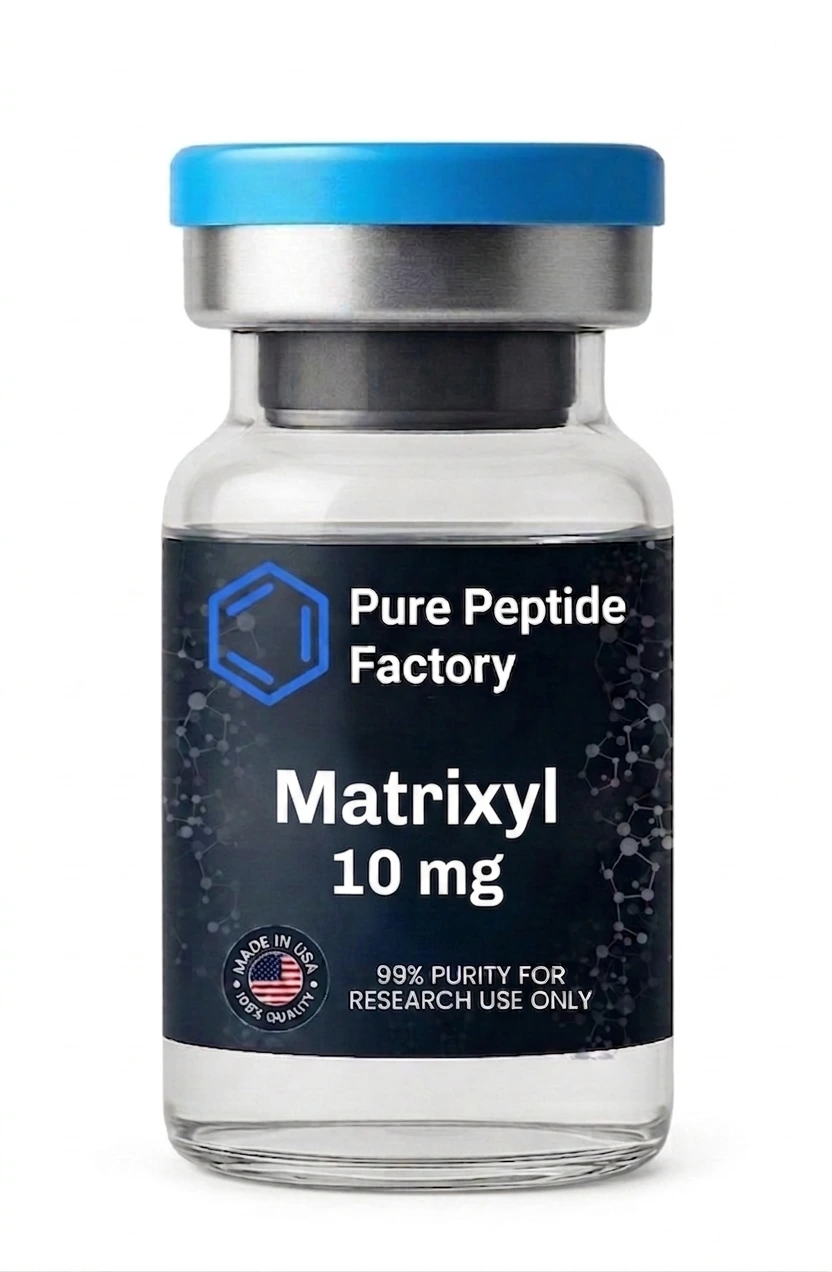
Matrixyl 10 mg
$30.00
Matrixyl 3000 serum peptide for cosmetic formulation research, synergistic lipopeptide complex of Palmitoyl Tripeptide-1 (Pal-GHK, CAS 147732-56-7) and Palmitoyl Tetrapeptide-7 (Pal-GQPR, CAS 221227-05-0). For collagen synthesis, dermal fibroblast signaling, and extracellular matrix remodeling studies. 10mg vials. HPLC verified at 98.5% purity. Research use only.
Matrixyl 3000 Serum Peptide for Research: Pal-GHK and Pal-GQPR Lipopeptide Complex
Matrixyl 3000 is a synergistic anti-aging lipopeptide complex consisting of two matrikine peptides: Palmitoyl Tripeptide-1 (Pal-GHK) and Palmitoyl Tetrapeptide-7 (Pal-GQPR). Researchers studying collagen synthesis, dermal fibroblast signaling, or extracellular matrix remodeling need a reliable domestic source for this compound. Pure Peptide Factory supplies research-grade matrixyl 3000 serum peptide 10 mg lyophilized powder vials with full batch documentation and cold-chain integrity. Developed by Sederma (now part of Croda), this second-generation cosmetic peptide complex serves as a standard research tool for investigating matrikine biology, the signaling function of matrix protein fragments that regulate dermal homeostasis (1).
What distinguishes this lipopeptide blend from single-agent cosmetic peptides is its synergistic dual mechanism. Pal-GHK binds TGF-β receptors on dermal fibroblasts, triggering Smad signaling cascades that upregulate production of collagen types I, III, and IV, as well as fibronectin and glycosaminoglycans. Meanwhile, Pal-GQPR reduces interleukin-6 (IL-6) secretion from keratinocytes and fibroblasts, suppressing the chronic low-grade inflammation (“inflammaging”) that accelerates matrix metalloproteinase activity and collagen degradation. Consequently, researchers who purchase matrixyl 3000 serum peptide obtain a research tool that models both sides of collagen homeostasis: increased synthesis and decreased breakdown. This dual mechanism explains why the complex requires 8 to 12 weeks to produce measurable extracellular matrix changes, the time required for fibroblasts to synthesize new collagen, for the collagen to organize into functional fibrils, and for the dermis to structurally remodel (2).
Why Researchers Buy Matrixyl 3000 Serum Peptide from Pure Peptide Factory
Verified Lipopeptide Complex with Documented Purity and Ratio
This matrixyl 3000 serum complex contains two distinct palmitoylated peptides at a precise 1:1 synergistic ratio. The biological activity of the blend depends on both peptides being present at the correct proportion; incorrect ratios produce different fibroblast responses and confound data interpretation. Every batch we ship includes lot-specific HPLC and mass spectrometry documentation verifying purity (98.5% on current batch #PPF-MTX-0513) and confirming the Pal-GHK to Pal-GQPR ratio. The Certificate of Analysis is downloadable before your compound ships. Therefore, researchers who purchase this lipopeptide blend from our facility can trust the synergistic ratio is correct before beginning any dermal fibroblast or collagen synthesis protocol.
Three Gram Configurations for Formulation and Assay Flexibility
We stock this peptide complex in 10 mg lyophilized powder vials. The 10 mg configuration accommodates pilot formulation studies, dose-response curves, and small-scale in vitro fibroblast assays. The 5 mg format supports standard cosmetic formulation batches where the clinical benchmark is 2% to 8% w/w in finished products. The 10 mg size serves scale-up formulation work, stability testing, and multi-arm comparative studies. Consequently, researchers can match vial size to experimental scale without splitting or overbuying. For related cosmetic peptide comparison studies, our catalog also includes GHK-Cu (Copper Peptide) and bacteriostatic water for reconstitution, all stocked domestically under identical conditions.
Domestic Cold-Chain Integrity for Palmitoylated Peptides
The palmitic acid moiety grafted to both peptides is essential for their function, it facilitates passive diffusion through the stratum corneum in topical research models. However, this lipophilic modification also makes the lyophilized powder more susceptible to moisture absorption and oxidation than unmodified peptides. We store all matrixyl 3000 serum peptide inventory under domestic cold-storage conditions and ship using phase-change cooling rated for 96-hour protection. Most orders arrive within 1 to 3 business days, protecting the palmitoyl conjugates from degradation during transit.
Compare Against Complementary Cosmetic Peptides Without Batch Variables
Many formulation research protocols compare Matrixyl 3000 against other cosmetic peptides such as Argireline (Acetyl Hexapeptide-8), GHK-Cu, or Matrixyl (palmitoyl pentapeptide-4). Because we stock the full cosmetic peptide panel under identical cold-storage conditions, researchers who source this lipopeptide blend alongside these complementary compounds eliminate supplier variability from their cross-compound data.
Synthesis Logs Archived for 24 Months
Should your compliance office request chain-of-custody records, we provide them without delay.
What Is Matrixyl 3000 Serum Peptide?
A Second-Generation Synergistic Lipopeptide Complex
This cosmetic peptide complex was developed by Sederma, a French laboratory specializing in active ingredients for skincare. It combines two matrikine peptides — small endogenous fragments of matrix proteins that act as cell signaling molecules, into a single synergistic formulation. The two components work through distinct but complementary mechanisms. Palmitoyl Tripeptide-1 (Pal-GHK) is a biomimetic fragment of type I collagen (Gly-His-Lys) conjugated to palmitic acid for enhanced lipophilicity and stratum corneum penetration. It binds to the TGF-β receptor on dermal fibroblasts, triggering signaling cascades that stimulate production of collagen types I, III, and IV, as well as fibronectin and glycosaminoglycans. Palmitoyl Tetrapeptide-7 (Pal-GQPR), by contrast, is a matrikine that reduces interleukin-6 (IL-6) production, a pro-inflammatory cytokine driving chronic collagen degradation (“inflammaging”). By modulating this inflammatory pathway, Pal-GQPR protects existing collagen while enabling Pal-GHK to stimulate new synthesis (3).
The Palmitic Acid Modification: Why It Matters
The palmitic acid moiety grafted to both peptides is functionally critical. Without this lipophilic modification, the hydrophilic peptide fragments cannot penetrate the stratum corneum — the skin’s outermost hydrophobic barrier, in sufficient quantity to reach the dermis where fibroblasts reside. The fatty acid chain facilitates passive diffusion through the lipid-rich intercellular spaces of the epidermis. Additionally, the palmitoyl group protects both peptides from rapid proteolytic degradation, extending their functional half-life in the dermal microenvironment. This structural feature is what transforms simple tripeptide and tetrapeptide sequences into skin-penetrant fibroblast signaling molecules suitable for topical research applications.
Molecular Profile:
- Component 1: Palmitoyl Tripeptide-1 (Pal-GHK) — CAS 147732-56-7, MW 578.8 g/mol, formula C₃₀H₅₄N₆O₅
- Component 2: Palmitoyl Tetrapeptide-7 (Pal-GQPR) — CAS 221227-05-0, MW 694.9 g/mol, formula C₃₄H₆₂N₈O₇
- Ratio: 1:1 Pal-GHK to Pal-GQPR (synergistic optimum)
- Classification: Cosmetic lipopeptide complex / matrikine blend
- Developer: Sederma (Croda International)
- Generation: Second-generation (successor to Matrixyl / palmitoyl pentapeptide-4)
- Synonyms: Matrixyl 3000, Pal-GHK + Pal-GQPR complex
- Effective Concentration (in formulation): 2% to 8% w/w; clinical optimum at 4% to 8%
Matrixyl Peptide Benefits in Cosmetic Formulation Research
The documented benefits of matrixyl 3000 serum in cosmetic and dermatological research include:
- Collagen Synthesis Stimulation: In vitro studies demonstrate a 190% increase in type I collagen synthesis and an 80% increase in type IV collagen when fibroblasts are exposed to the complex. Researchers measure this by quantitative ELISA and Western blot analysis of culture supernatants (1).
- Extracellular Matrix Remodeling: Beyond collagen, the lipopeptide blend upregulates fibronectin and glycosaminoglycan production — key components of the dermal ground substance that provides hydration and structural support.
- Anti-Inflammatory Protection: Pal-GQPR reduces IL-6 secretion by keratinocytes and fibroblasts, addressing the low-grade chronic inflammation that accelerates matrix degradation during aging.
- Wrinkle Depth Reduction: Clinical profilometry studies show significant reduction in wrinkle surface area (up to 36%), wrinkle depth, and skin roughness after 12 weeks of topical application at 2% to 8% concentration.
- Skin Volume and Density: High-frequency ultrasound measurements confirm increased dermal density and improved epidermal-dermal junction integrity after 2 months of twice-daily use in formulated products.
- Superior Tolerability vs Retinoids: Unlike retinoids, which cause irritation, photosensitivity, and barrier disruption, this peptide complex is well-tolerated by all skin types with no adjustment period or photosensitization risk.
Matrixyl vs Argireline: Understanding the Critical Research Distinction
These two cosmetic peptides are the most frequently compared in formulation research, but they operate through fundamentally different biological pathways. Understanding their distinction is essential for correct experimental design when comparing matrixyl vs argireline:
| Feature | Matrixyl 3000 (Pal-GHK + Pal-GQPR) | Argireline (Acetyl Hexapeptide-8) |
|---|---|---|
| Classification | Signal / matrikine peptide | Neuromodulating peptide |
| Cellular Target | Dermal fibroblasts | Neuromuscular junction (SNARE complex) |
| Primary Mechanism | Stimulates collagen I, III, IV plus ECM components | Inhibits acetylcholine release; reduces muscle contraction |
| Wrinkle Type | Static wrinkles (volume loss, sagging, photoaging) | Dynamic wrinkles (expression lines, crow’s feet, forehead) |
| Onset of Action | 8 to 12 weeks (matrix rebuilding) | 2 to 4 weeks (muscle relaxation) |
| Effective Concentration | 2% to 8% in formulation | 5% to 10% in formulation |
| Clinical Evidence | 190% collagen increase (in vitro); 36% wrinkle reduction (in vivo) | 30% periorbital wrinkle reduction (30 days, 10%) |
| Irritation Risk | None — well-tolerated, no photosensitivity | None — well-tolerated, no photosensitivity |
| Research Use Case | Dermal matrix reconstruction, collagen biochemistry | Neuromuscular pharmacology, muscle relaxant modeling |
For laboratories studying the full spectrum of skin aging, these peptides are complementary rather than competitive. This matrixyl 3000 serum complex addresses the structural degradation of the dermis (static component), while Argireline addresses the repetitive muscle contractions that etch lines into the skin (dynamic component). Most facial wrinkles have both static and dynamic dimensions, forehead lines, for example, are carved by frontalis muscle contraction but worsen with age-related collagen loss. A research framework incorporating both mechanisms provides more complete modeling of wrinkle pathogenesis. Both peptides are available from our catalog under identical conditions for formulation comparison studies.
Matrixyl 3000 Before and After: Clinical Research Data
The landmark study on the original Matrixyl (palmitoyl pentapeptide-4, the first-generation precursor to this second-generation complex) was published in 2005 in the International Journal of Cosmetic Science by Robinson et al. This double-blind, placebo-controlled trial demonstrated that topical application of palmitoyl pentapeptide-4 for 12 weeks significantly reduced wrinkle surface area by up to 36%, wrinkle depth, and skin roughness, with results comparable to 0.07% retinol but without any irritation, peeling, or photosensitivity (1).
Subsequent studies by Sederma on the matrixyl 3000 serum complex (the synergistic Pal-GHK plus Pal-GQPR combination) confirmed several key findings. In vitro, researchers measured a 190% increase in type I collagen synthesis, an 80% increase in type IV collagen, and significant upregulation of fibronectin and hyaluronic acid. In vivo, investigators documented measurable improvement in skin volume and density by profilometry and high-frequency ultrasound after 2 months of twice-daily application in formulated serums at 4% concentration. Mechanistically, the data confirmed that Pal-GHK activates TGF-β receptor signaling while Pal-GQPR suppresses IL-6-mediated inflammaging, and the combination produces synergistic effects greater than either peptide alone.
Matrixyl Peptide Formulation Guidelines for Research
For cosmetic formulation research, the following parameters optimize the stability and efficacy of matrixyl 3000 serum peptide complex:
| Parameter | Recommended Range | Notes |
|---|---|---|
| Concentration | 2% to 8% w/w | Clinical efficacy demonstrated at ≥2%; optimal at 4% to 8% |
| pH | 5.0 to 7.0 | Peptide stability optimal in mildly acidic to neutral pH |
| Vehicle | Water, glycerin, butylene glycol, hyaluronic acid | Avoid strong alcohols and high concentrations of acids |
| Temperature | Add during cool-down phase (below 40°C) | Heat denatures peptides; add post-emulsification |
| Compatibility | Vitamin C, niacinamide, hyaluronic acid, ceramides | Compatible with most actives except strong acids (pH below 3.5) |
| Preservation | Standard cosmetic preservatives (phenoxyethanol, ethylhexylglycerin) | Peptides do not interfere with common preservative systems |
| Packaging | Airless pump, opaque glass, UV-protected | Minimize oxidation and light exposure |
This lipopeptide complex remains stable in standard cosmetic emulsions and serums but degrades in strongly acidic environments (pH below 3.5) or high-temperature processing (above 50°C). When formulating with vitamin C (L-ascorbic acid), researchers should use a separate layer or alternate application timing rather than co-formulating at low pH. Niacinamide and hyaluronic acid are fully compatible and synergistic. For reconstitution and formulation work, researchers typically use our bacteriostatic water stocked domestically under identical cold-chain conditions.
Matrixyl 3000 Side Effects in Research
The safety profile of this lipopeptide complex is excellent in both preclinical and clinical studies:
- No Irritation: Unlike retinoids, which cause erythema, peeling, and barrier disruption, this peptide blend produces no visible irritation, stinging, or dryness at concentrations up to 10%.
- No Photosensitivity: Peptides do not interact with UV radiation or increase sunburn risk. No phototoxicity or photoallergy has been reported.
- No Adjustment Period: Researchers do not observe a “retinization” phase of increased sensitivity and transient worsening. Effects are gradual and cumulative.
- All Skin Types: Compatible with sensitive, rosacea-prone, and post-procedure skin models. No contraindications for any Fitzpatrick skin type.
- No Systemic Absorption: The palmitoyl modification and molecular weight prevent significant systemic penetration. Peptides act locally within the dermis.
Product Specifications
Available Configurations
Matrixyl 3000 serum peptide complex is available in 10 mg lyophilized powder vials. Select your configuration from the product options above.
Quality Verification
- Purity: 98.5% by RP-HPLC (current batch #PPF-MTX-0513)
- Ratio: Confirmed 1:1 Pal-GHK to Pal-GQPR by HPLC
- Identity: Verified by MALDI-TOF mass spectrometry for both peptides
- Pal-GHK CAS: 147732-56-7 | Pal-GQPR CAS: 221227-05-0
- Endotoxin: Less than 0.05 EU/µg by LAL assay
- Sterility: Verified per USP 71
- Form: Lyophilized powder (lipopeptide complex)
- Storage: -20°C long-term, 2 to 8°C after reconstitution
Current Batch: #PPF-MTX-0513
Purity: 98.5%
Download: HPLC Certificate | Mass Spec Report
Frequently Asked Questions
What is Matrixyl peptide used for in research?
Researchers use matrixyl 3000 serum peptide to study dermal fibroblast signaling, collagen synthesis kinetics, extracellular matrix remodeling, and anti-inflammatory mechanisms in cosmetic formulation research. It is a standard tool for developing anti-aging skincare prototypes and investigating matrikine biology.
How does Matrixyl 3000 work?
This lipopeptide complex works through two synergistic mechanisms. Pal-GHK binds TGF-β receptors on fibroblasts, stimulating collagen types I, III, and IV synthesis plus fibronectin and glycosaminoglycan production. Pal-GQPR reduces IL-6 secretion, suppressing the chronic inflammation that degrades existing collagen. The net effect is increased matrix synthesis plus decreased matrix breakdown.
What is the difference between Matrixyl and Argireline?
Matrixyl is a signal peptide that rebuilds the dermal extracellular matrix by stimulating collagen production, targeting static wrinkles from aging and photoaging. Argireline is a neuromodulating peptide that inhibits acetylcholine release at the neuromuscular junction, reducing muscle contractions that cause dynamic expression lines. They are complementary: Matrixyl addresses structural loss; Argireline addresses muscular etching. Both are available from our catalog.
Where can I buy Matrixyl peptide for research?
Pure Peptide Factory supplies research-grade matrixyl 3000 serum peptide domestically in 10 mg vials with same-day cold-chain shipping. Orders placed before 2 PM EST ship same-day and most arrive within 1 to 3 business days with full HPLC and mass spectrometry documentation.
Is Matrixyl better than retinol for research?
This peptide complex and retinol address different mechanisms. Retinol accelerates epidermal turnover and stimulates collagen via retinoic acid receptors but causes irritation, photosensitivity, and barrier disruption. The lipopeptide blend signals fibroblasts via TGF-β without irritation or photosensitivity. For research requiring chronic, well-tolerated collagen stimulation without confounding barrier effects, the peptide complex is the superior tool. For studies requiring rapid epidermal renewal, retinol remains appropriate.
What concentration of Matrixyl is effective in formulation?
Clinical studies demonstrate efficacy at 2% to 8% concentration in finished formulations. The manufacturer (Sederma/Croda) recommends 3% as a standard effective dose. In vitro collagen synthesis data shows dose-dependent increases up to 8%, with plateau effects beyond that range. Researchers should test 2%, 4%, and 8% concentrations to establish dose-response curves for their specific models.
Can Matrixyl be combined with other cosmetic peptides in research?
Yes. Many formulation researchers combine this lipopeptide complex with Argireline for complementary static and dynamic wrinkle modeling, or with GHK-Cu for additive collagen and wound healing studies. All compounds are available from our catalog under identical storage conditions for clean comparative data.
Buy Matrixyl 3000 Serum Peptide for Your Research
Secure Checkout
- Credit card, cryptocurrency, or wire transfer
- Same-day dispatch for orders placed before 2 PM EST
- Cold-chain packaging with phase-change cooling
- Discreet labeling and full tracking
Institutional Accounts
Net-30 terms and purchase orders accepted for universities and research institutions. Contact us for bulk pricing on 50 vials or more, including matched orders alongside Argireline, GHK-Cu, bacteriostatic water, and other cosmetic formulation research compounds.
Add to cart and get batch-verified Matrixyl 3000 lipopeptide complex delivered with the documentation your collagen synthesis, dermal fibroblast signaling, or cosmetic formulation research requires.
Related products
-
Dermorphin
$25.00