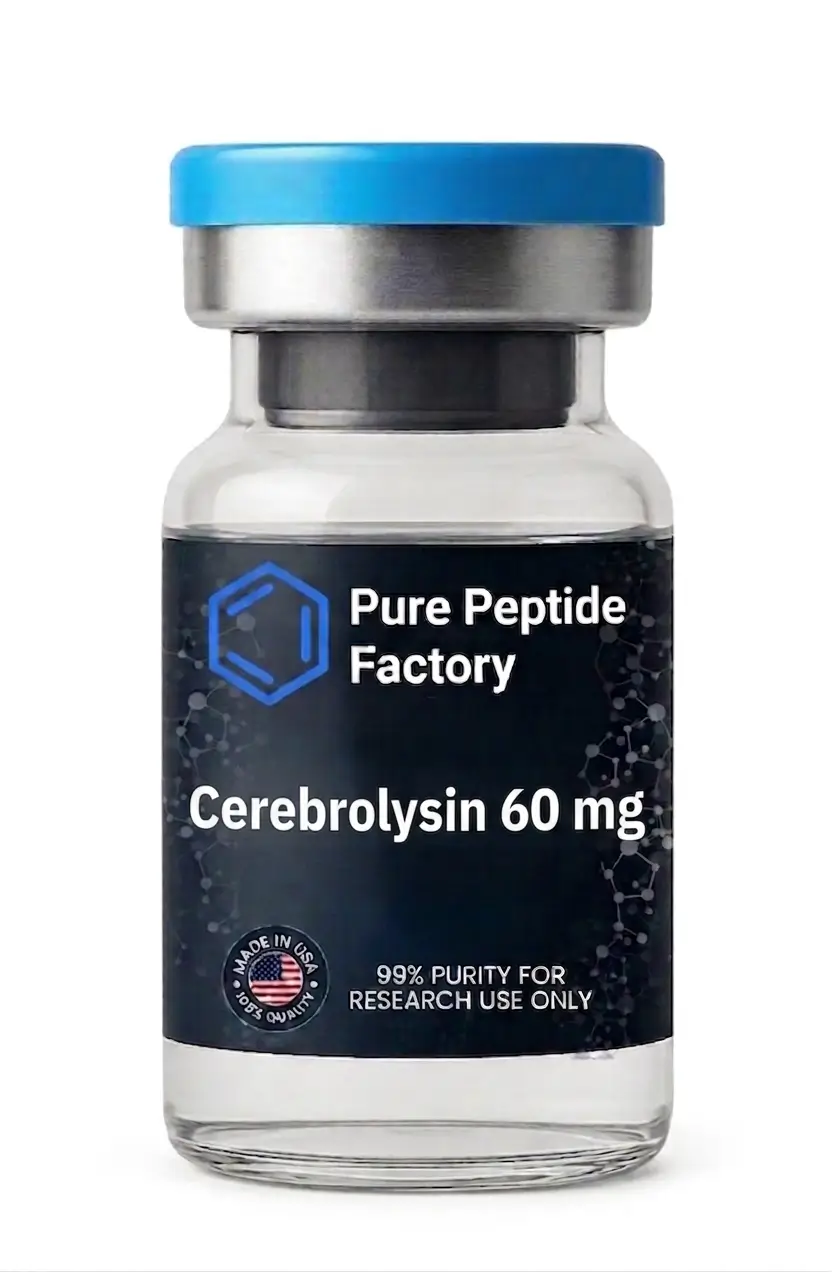
Cerebrolysin 60 mg x 6
$50.00
Buy cerebrolysin for neuroregeneration research. Cerebrolysin is a porcine brain hydrolysate containing low molecular weight peptides and amino acids that penetrate the blood-brain barrier. Researchers use it to study neuroprotection, stroke recovery, cognitive function, and neurodegenerative disease models. Available in 60mg lyophilized vials with batch-specific HPLC verification. Domestic cold-chain shipping. Research use only.
Buy Cerebrolysin: Research-Grade Neurotrophic Factor Complex (60mg)
Researchers who need to buy cerebrolysin for neurodegenerative disease studies, ischemic stroke models, or traumatic brain injury research require a reliable domestic source. Pure Peptide Factory supplies this standardized, porcine-derived neurotrophic factor complex with full batch documentation, HPLC verification, and cold-chain shipping that delivers to your laboratory within 1 to 3 business days.
Unlike single synthetic peptides that target one receptor or pathway, cerebrolysin provides a multi-modal research tool containing brain-derived neurotrophic factor (BDNF), glial cell line-derived neurotrophic factor (GDNF), nerve growth factor (NGF), and ciliary neurotrophic factor (CNTF). Furthermore, it is one of the most extensively studied neuropeptide preparations in clinical research, with randomized controlled trials spanning Alzheimer’s disease, vascular dementia, acute ischemic stroke, and traumatic brain injury. When you buy cerebrolysin from our domestic stock, you receive a consistent, well-characterized preparation ready for immediate reconstitution and use in your protocols.
Why Researchers Buy Cerebrolysin from Pure Peptide Factory
A Multi-Modal Neurotrophic Research Tool
Cerebrolysin is not a single molecule but a standardized complex containing active neurotrophic factors including BDNF, GDNF, NGF, and CNTF. As a result, every batch we ship includes lot-specific HPLC and mass spectrometry documentation verifying the peptide profile. Therefore, researchers who buy cerebrolysin from our facility can be confident that each study uses a consistent, well-characterized preparation.
Domestic Cold-Chain for Temperature-Sensitive Neuropeptides
Neuropeptide complexes degrade with temperature excursion. Consequently, we store all inventory domestically under controlled cold-chain conditions and ship using phase-change cooling rated for 96-hour protection. Most orders reach your laboratory within 1 to 3 business days, protecting the neurotrophic factors from degradation during transit. For this reason, researchers searching for where to buy cerebrolysin with guaranteed cold-chain integrity choose Pure Peptide Factory.
Compare Against Other Neuroprotective Research Compounds
Many protocols compare this neurotrophic complex against single-agent neuroprotective peptides like Semax, Cortexin, or P21. Because we stock the full neuroprotective panel under identical cold-storage conditions, your comparison data remains free of supplier variability. Furthermore, researchers who buy cerebrolysin alongside these complementary compounds from a single source eliminate batch-to-batch variability as a confounding factor.
Synthesis and Processing Logs Archived for 24 Months
Should your compliance office or IRB request chain-of-custody records or processing documentation for the porcine-derived preparation, we provide them without delay.
What Is Cerebrolysin?
A Standardized Porcine-Derived Neurotrophic Complex
Cerebrolysin is produced by the standardized enzymatic breakdown of purified porcine brain proteins, yielding a defined mixture of low-molecular-weight peptides (no larger than 10,000 Daltons) and free amino acids. Unlike synthetic single-chain peptides, it contains a reproducible profile of biologically active neurotrophic factors that mimic endogenous neurotrophic support (1). The active constituents include BDNF, GDNF, NGF, CNTF, and other peptide fragments that collectively support neuronal survival, differentiation, and synaptic plasticity.
This peptide complex is approved as a pharmaceutical product in over 44 countries across Europe and Asia for neurodegenerative and cerebrovascular indications. However, in the United States, it is available strictly as a research compound for laboratory investigation. The extensive clinical trial history, spanning more than 14 randomized controlled trials in stroke alone, provides researchers who buy cerebrolysin with a rich pharmacokinetic and safety reference base unmatched by most other neuropeptide preparations.
Key Properties
- Source: Standardized enzymatic hydrolysate of purified porcine brain proteins
- Active constituents: BDNF, GDNF, NGF, CNTF, and low-molecular-weight peptide fragments
- Molecular profile: Complex mixture of peptides ≤10,000 Da and free amino acids
- CAS Number: 12656-61-0
- Synonyms: Cerebrolysin, FPF-1070, Cerebrolysinum
- Clinical status: Approved in 44+ countries; research-use only in the United States
- Vial size: 60mg lyophilized powder
How Cerebrolysin Works: Four Converging Mechanisms
Research has identified four primary mechanisms through which this neurotrophic complex exerts its effects in preclinical models. Understanding these overlapping pathways is central to designing effective research protocols (2).
Neurotrophicity: The BDNF, NGF, and CNTF components directly activate TrkB, TrkA, and CNTFRα receptors, promoting neuronal survival, differentiation, and neurite outgrowth. Specifically, BDNF-TrkB signaling enhances long-term potentiation and synaptic strength, while NGF-TrkA signaling supports cholinergic neuron health in the basal forebrain.
Neuroprotection: The preparation reduces excitotoxic damage by modulating cell-death proteins in the ischemic penumbra. Specifically, it downregulates caspase-3 and Bax pro-apoptotic proteins while upregulating Bcl-2 anti-apoptotic proteins after reperfusion injury. Furthermore, research demonstrates that it attenuates oxidative stress markers and reduces blood-brain barrier breakdown following traumatic brain injury (3).
Neuroplasticity: Cerebrolysin enhances dendritic arborization, increases spine density, and promotes axonal sprouting in models of stroke and TBI. Consequently, functional recovery in these models is associated with measurable structural plasticity changes rather than neuroprotection alone.
Neurogenesis: The peptide complex stimulates neural progenitor cell proliferation in the subventricular zone and hippocampal dentate gyrus, promoting the generation of new neurons that can migrate to injured areas. This mechanism is particularly relevant for chronic recovery models where endogenous repair processes are the primary target.
Buy Cerebrolysin: Research Applications
Ischemic Stroke and Cerebrovascular Research
The most extensively studied application for this neurotrophic complex is acute ischemic stroke. A 2025 systematic review and meta-analysis of 14 randomized controlled trials concluded that it appears safe and potentially beneficial for improving early neurological recovery after stroke, with a number-needed-to-treat of 7.1 for early NIHSS score improvements (4). Researchers who buy cerebrolysin for stroke models examine infarct volume reduction, neurobehavioral outcomes, and the time window for therapeutic intervention.
Alzheimer’s Disease and Cognitive Aging
Multiple randomized controlled trials have evaluated this preparation in mild-to-moderate Alzheimer’s disease. Meta-analyses of these trials provide evidence for an overall beneficial effect and a favorable benefit-risk ratio, with significant improvements in global clinical function sustained for months after treatment cessation (5). Preclinical researchers use transgenic AD models to study amyloid pathology modulation, cholinergic function preservation, and neurotrophic factor expression changes.
Traumatic Brain Injury and Neurorecovery
Both preclinical and clinical research support the use of this complex in TBI models. In rat studies, doses of 2.5 mL/kg administered intraperitoneally starting 4 hours after injury significantly improved functional recovery and reduced astrogliosis and axonal injury (6). The CAPTAIN II trial evaluated efficacy and safety in moderate-severe TBI patients, and prospective cohort studies have demonstrated improved functional neurorecovery in clinical populations.
Vascular Dementia and Cognitive Impairment
Randomized controlled trials specifically targeting vascular dementia have assessed the efficacy of this neurotrophic complex in this population. It has been shown to improve cognitive function in vascular dementia models through combined neurotrophic and cerebrovascular mechanisms.
Spinal Cord Injury Research
Research demonstrates that this preparation enhances spinal cord conduction and reduces blood-spinal cord barrier breakdown, edema formation, immediate early gene expression, and cord pathology after injury. Consequently, it serves as a research tool for spinal cord neuroprotection and repair studies.
Cerebrolysin vs Semax vs Cortexin vs P21: Choosing the Right Neuroprotective Research Compound
Researchers who buy cerebrolysin often compare it against other neuroprotective compounds. However, each has a fundamentally different composition and mechanism:
| Feature | Cerebrolysin | Semax | Cortexin | P21 |
|---|---|---|---|---|
| Type | Porcine-derived neurotrophic factor complex | Synthetic heptapeptide (ACTH 4-10 fragment) | Polypeptide extract from bovine cerebral cortex | Synthetic peptide (CNTF-mimetic) |
| Composition | Multi-component: BDNF, GDNF, NGF, CNTF + free amino acids | Single defined synthetic peptide | Multi-component polypeptide complex | Single defined synthetic peptide |
| Primary mechanism | Multi-modal | BDNF/TrkB upregulation | Multi-receptor: AMPA, kainate, mGluR, GABAA | CNTF receptor agonism |
| Molecular weight | Mixture ≤10,000 Da | 813.9 g/mol | Multi-component mixture | ~2,400 g/mol |
| Route in research | ICV, IP, IV | Intranasal, IP | IM, IP | SC, IP |
| Clinical evidence | 14+ RCTs in stroke, multiple RCTs in AD, TBI, VaD | Limited; primarily Russian clinical data | Approved in Russia for stroke, TBI, epilepsy | Preclinical only |
| Best for studying | Multi-pathway neuroprotection, recovery after injury, clinical translation | BDNF-mediated plasticity, intranasal delivery | Multi-receptor neuroprotection | CNTF pathway, neurogenesis |
Choose cerebrolysin when your protocol requires a multi-modal neurotrophic tool with extensive clinical reference data for translational research. Furthermore, researchers who buy cerebrolysin benefit from the largest clinical evidence base of any neuropeptide preparation available for preclinical investigation.
Buy Cerebrolysin: Dosage Reference for Research
The following reference is compiled from published preclinical studies and serves strictly as a laboratory research design context. We do not provide human dosing recommendations.
| Research Model | Typical Dose | Route | Frequency | Key Finding |
|---|---|---|---|---|
| Rat mild TBI (closed head injury) | 2.5 mL/kg | Intraperitoneal | Daily for 10 days, starting 4h post-injury | Significantly improved functional recovery, reduced astrogliosis |
| Rat acute stroke (MCAO) | ≥2.5 mL/kg | Intraperitoneal | Daily | Dose of 5 mL/kg reduced infarct volume |
| Rat TBI dose-response | 0.8, 2.5, 7.5 mL/kg | Intraperitoneal | Daily | ≥0.8 mL/kg improved cognitive outcome; 2.5 mL/kg optimal |
| Mouse Alzheimer’s model | 2.5-5 mL/kg | Intraperitoneal | 5 days/week for 4 weeks | Modulated pro-NGF/NGF ratio, ameliorated cholinergic deficit |
| Spinal cord injury (rat) | 2.5 mL/kg | Intraperitoneal | Daily | Enhanced spinal cord conduction, reduced barrier breakdown |
For researchers seeking dosing guidance, the published preclinical literature provides model-specific ranges. The 2.5 mL/kg dose is the most commonly employed and well-characterized reference point across multiple injury models.
Cerebrolysin Side Effects and Safety Profile in Published Research
The safety of this preparation has been evaluated across multiple systematic reviews and meta-analyses of randomized controlled trials. A 2025 systematic review and meta-analysis of 14 RCTs in acute ischemic stroke concluded that it appears safe, with neutral effects on mortality and serious adverse events compared to placebo (4). Furthermore, a comprehensive safety meta-analysis of twelve randomized-controlled trials confirmed the safety profile, with the highest doses (50 mL) associated with a moderate reduction in serious adverse events relative to placebo (7).
A pooled analysis of recent studies published in 2026 examined the risk of hemorrhagic transformation and found that the evidence supports a reduced risk after acute ischemic stroke, though the effect estimates are imprecise due to small sample sizes. The most commonly reported side effects in clinical settings are mild and transient, including dizziness, headache, and agitation. As with all research compounds, institutional biosafety oversight and IACUC approval are required for any animal work.
How to Reconstitute Cerebrolysin
Step-by-Step Laboratory Protocol
- Sanitize the vial stopper with 70% isopropyl alcohol.
- Inject bacteriostatic water or sterile saline slowly against the vial wall. Because this is a complex mixture of peptides rather than a single molecular species, avoid directing the stream at the lyophilized cake.
- Allow the powder to dissolve without agitation for 3 to 5 minutes. The multi-component nature means dissolution may not be instantaneous.
- Gently swirl until the solution is fully clear. Do not shake vigorously; foaming can denature the neurotrophic peptide components.
- Verify a clear, colorless to pale yellow solution. Discard if any turbidity or particulate matter remains.
- Label with reconstitution date and concentration.
Concentration Reference for 60mg Vial:
- 60mg vial + 1 mL bacteriostatic water = 60 mg/mL
- 60mg vial + 2 mL bacteriostatic water = 30 mg/mL
- 60mg vial + 3 mL bacteriostatic water = 20 mg/mL
Storage Requirements
- Lyophilized powder: 24 months at -20°C, protected from light and moisture.
- Reconstituted solution: 14 days at 2 to 8°C. Do not freeze. For longer storage, aliquot and store at -20°C for up to 6 months.
- Because the preparation contains multiple peptide species with varying stability profiles, avoid repeated freeze-thaw cycles.
Buy Cerebrolysin: Regulatory Context
International Regulatory Status
Cerebrolysin is approved as a pharmaceutical product in over 44 countries, primarily in Europe and Asia, for neurodegenerative and cerebrovascular indications including Alzheimer’s disease, vascular dementia, and acute ischemic stroke. The manufacturer is Ever Neuro Pharma GmbH (Austria). However, it is not FDA approved for any indication in the United States. Researchers who buy cerebrolysin from Pure Peptide Factory receive a research-grade preparation sold exclusively for in vitro and controlled laboratory animal studies. This product is not the pharmaceutical formulation and is not for human use.
Research Use Only
This product is strictly for laboratory research. It is not intended for human consumption, veterinary use, or diagnostic application. You must agree to research-use-only terms at checkout.
Product Specifications
Available Configuration
Cerebrolysin is available in 60mg lyophilized powder vials. This is the standard research configuration. Select your quantity from the product options above.
Quality Verification
- Purity: ≥98% (HPLC verified)
- Identity: Mass spectrometry confirmed neuropeptide profile
- Endotoxin: Less than 0.1 EU/mL
- Sterility: Verified per USP 71
- Form: Lyophilized powder
- Storage: -20°C long-term, 2 to 8°C short-term after reconstitution
- CAS Number: 12656-61-0
Current Batch: #PPF-CERE-0526
Purity: 98.7%
Download: HPLC Certificate | MS Report
Buy Cerebrolysin : Frequently Asked Questions
Where can I buy cerebrolysin for research?
Pure Peptide Factory supplies research-grade cerebrolysin domestically with same-day dispatch and cold-chain shipping. Orders placed before 2 PM EST ship same-day and most arrive within 1 to 3 business days with full HPLC and mass spectrometry documentation.
What is cerebrolysin used for in research?
Researchers use cerebrolysin to study multi-modal neuroprotection, neuroplasticity, neurogenesis, and functional recovery in preclinical models of ischemic stroke, traumatic brain injury, Alzheimer’s disease, vascular dementia, spinal cord injury, and cognitive aging.
Is cerebrolysin a single peptide or a mixture?
It is a standardized, porcine-derived complex of low-molecular-weight neuropeptides and free amino acids, not a single synthetic peptide. Active constituents include BDNF, GDNF, NGF, and CNTF. This multi-component nature is central to its multi-modal mechanism of action.
What is the difference between cerebrolysin and Semax?
Semax is a single defined synthetic heptapeptide (ACTH 4-10 fragment) that primarily upregulates BDNF/TrkB signaling. Cerebrolysin is a multi-component neurotrophic complex with broader mechanisms spanning neurotrophicity, neuroprotection, neuroplasticity, and neurogenesis. See the comparison table above for full details.
What are the side effects of cerebrolysin in research models?
Multiple systematic reviews and meta-analyses of randomized controlled trials indicate a favorable safety profile. The most commonly reported adverse events are mild and transient, including dizziness and headache. A 2025 meta-analysis of 14 stroke RCTs found neutral effects on mortality and serious adverse events.
What is the dosage used in preclinical research?
In rat models of TBI and stroke, the most commonly employed dose is 2.5 mL/kg administered intraperitoneally daily. Dose-response studies have evaluated ranges from 0.8 to 7.5 mL/kg. Refer to the dosage reference table above for model-specific details. We do not provide human dosing recommendations.
Is cerebrolysin FDA approved?
No. It is approved as a pharmaceutical in over 44 countries but has not received FDA approval. Researchers who buy cerebrolysin from Pure Peptide Factory receive a research-grade preparation for laboratory use exclusively.
How should I reconstitute and store cerebrolysin?
Reconstitute with bacteriostatic water or sterile saline. Store lyophilized powder at -20°C for up to 24 months. Reconstituted solution should be kept at 2 to 8°C and used within 14 days. For longer storage, aliquot and freeze at -20°C for up to 6 months.
How does cerebrolysin compare to Cortexin?
Cortexin is a polypeptide extract from bovine cerebral cortex, while cerebrolysin is derived from porcine brain. Both are multi-component preparations, but they have different receptor targets and tissue sources. Cortexin interacts with AMPA, kainate, mGluR1, and GABAA receptors, while cerebrolysin’s effects are primarily mediated through its neurotrophic factor constituents.
Can cerebrolysin be used with other neuroprotective peptides in research?
Yes. Many research protocols combine cerebrolysin with other neuroprotective peptides such as Semax, Cortexin, or P21 to study additive or synergistic effects. All compounds are available from our catalog for comparison and combination studies.
Why is cerebrolysin so widely discussed on research forums?
Its extensive clinical trial history (14+ RCTs in stroke alone), approval in 44+ countries, and multi-modal mechanism have generated substantial discussion in research communities. However, researchers should base protocol design on published literature, not community anecdotes.
Buy Cerebrolysin for Your Research
Secure Checkout
- Credit card, cryptocurrency, or wire transfer
- Same-day dispatch for orders placed before 2 PM EST
- Cold-chain packaging with phase-change cooling
- Discreet labeling with full tracking
Institutional Accounts
Net-30 terms and purchase order acceptance available for universities and research institutions. Contact us for bulk pricing on 50 vials or more, including matched orders alongside our Semax, Cortexin, P21, and other neuroprotective research peptides.
Add to cart and obtain the most extensively clinically characterized neurotrophic factor complex for your neurodegenerative disease, stroke, or TBI research program.
Related products
-
PE-22-28 5 mg
$210.00 -
P21 (P021) 5 mg
$120.00