Acetic Acid for Peptides (Water 0.6%)
$10.00 $30.00Price range: $10.00 through $30.00
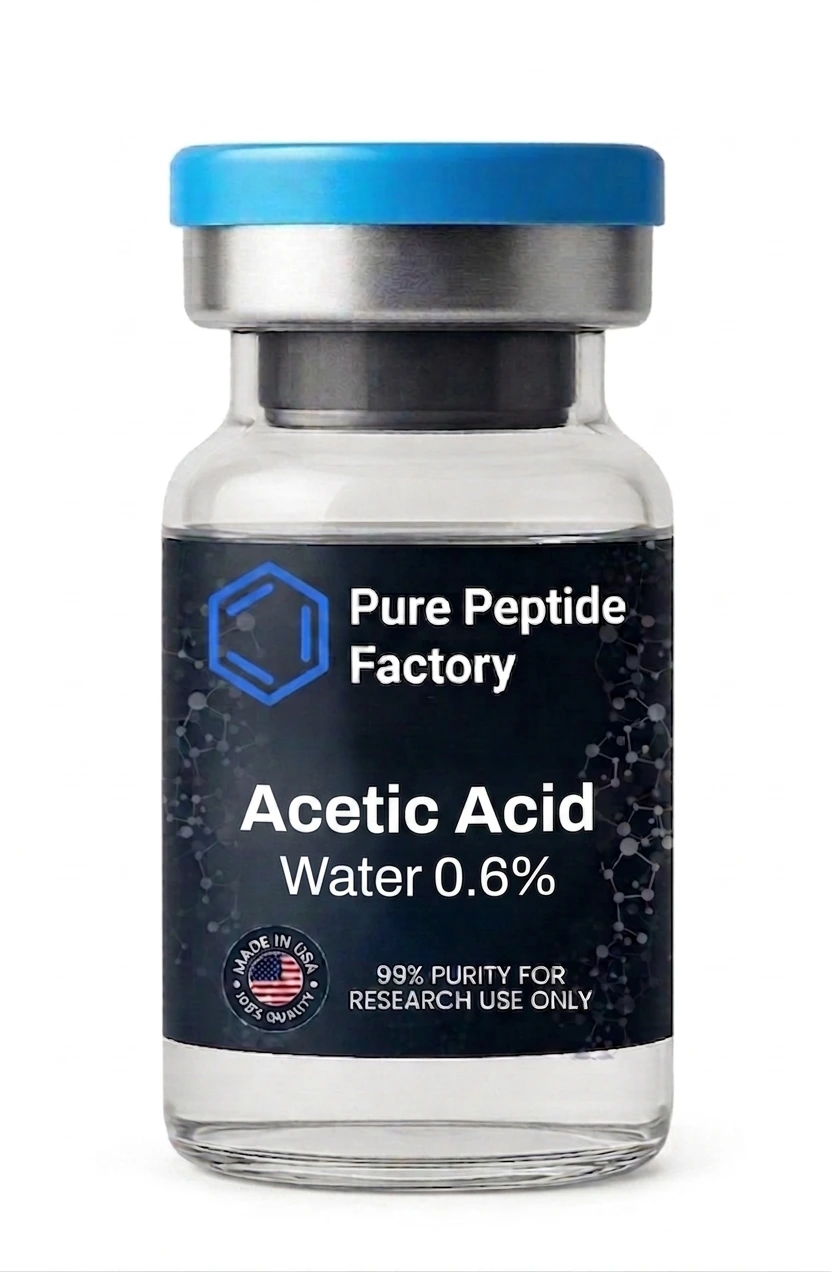
Acetic acid for peptides at Pure Peptide Factory in 3mL, 5mL, and 10mL vials. Specifically, our 0.6% acetic acid water solution is the alternative reconstitution diluent for peptides that exhibit gelling, self-association, or solubility problems in standard bacteriostatic water. Furthermore, AOD-9604, ARA-290, certain hydrophobic peptide blends, and other amphipathic compounds dissolve more reliably in acetic acid solution than in bacteriostatic water. Sterile, USP-grade, US-manufactured. 3mL, 5mL, and 10mL vials. Research use only.
Acetic Acid for Peptides: 0.6% Reconstitution Solution for Gel-Prone Research Compounds
Acetic acid for peptides solves a problem that bacteriostatic water cannot: certain research peptides exhibit gelling, self-association, or solubility problems when reconstituted in standard bacteriostatic water with 0.9% benzyl alcohol. Specifically, AOD-9604 frequently forms gel-like aggregates in standard BAC water due to its amphipathic structure and disulfide-bridged conformation. Furthermore, ARA-290 (cibinetide) can self-associate in low-salt diluents, producing “glue-like” behavior that requires either PBS or dilute acetic acid as alternative reconstitution media.
For researchers studying compounds where standard bacteriostatic water produces inconsistent dissolution, acetic acid for peptides at 0.6% (approximately 0.1M) provides the slightly acidic environment that prevents self-association while maintaining sterility. Pure Peptide Factory stocks acetic acid for peptides in 3mL, 5mL, and 10mL multi-dose vials, USP-grade with sterile manufacturing standards. When researchers buy acetic acid for peptides for laboratory work, the slight acidic pH (~2.7) and ionic strength differences from bacteriostatic water matter for specific peptide compatibility.
Why Researchers Buy Acetic Acid for Peptides from Pure Peptide Factory
Peptide-Specific Compatibility Documentation
Most acetic acid water vendors sell the diluent without addressing which peptides actually require it. By contrast, our acetic acid for peptides product page documents specific compounds where this alternative reconstitution solution outperforms standard bacteriostatic water. Therefore, researchers reconstituting AOD-9604, ARA-290, certain hydrophobic peptide blends, or other gel-prone compounds can verify the correct diluent immediately rather than testing multiple reconstitution media to find what works.
Sterile USP-Grade Manufacturing
Our acetic acid for peptides solution meets USP standards with 0.6% (~0.1M) acetic acid in sterile water for injection at pH approximately 2.7. Specifically, the formulation uses pharmaceutical-grade glacial acetic acid diluted to research-standard concentration with no preservatives that could interfere with peptide activity. Each lot ships with documentation of sterility testing and concentration verification.
Three Configurations for Different Research Protocols
We stock acetic acid for peptides in 3mL, 5mL, and 10mL vials. Specifically, the 3mL vial accommodates single-peptide reconstitution protocols where minimal diluent is needed. By contrast, the 5mL and 10mL vials support extended research workflows where multiple peptides require acetic acid reconstitution. Therefore, researchers can match vial size to protocol scale without paying for diluent volume that may exceed the post-puncture stability window.
Domestic Cold-Chain Compatible Shipping
Acetic acid for peptides solution stores at controlled room temperature prior to use, simplifying shipping logistics. However, our customers typically order acetic acid water alongside lyophilized peptides that require cold-chain handling. Therefore, we ship acetic acid for peptides packaged with peptide orders under phase-change cooling rated for 96-hour protection, eliminating the need for separate orders.
What Is Acetic Acid for Peptides? Understanding the 0.6% Solution
USP-Grade Sterile Acetic Acid in Water for Injection
Acetic acid for peptides is sterile water containing 0.6% (approximately 0.1M, or 6 mg/mL) glacial acetic acid as the active diluent component. Specifically, the chemical composition is H₂O with acetic acid (CH₃COOH) added at a concentration that produces pH approximately 2.7, packaged in multi-dose vials designed for repeated withdrawals during peptide reconstitution protocols.
By contrast with bacteriostatic water (which uses 0.9% benzyl alcohol as a preservative), acetic acid for peptides uses the acid itself as both the active component and the bacteriostatic agent. Specifically, the low pH environment inhibits microbial growth while simultaneously providing the acidic conditions that prevent self-association in amphipathic peptides like AOD-9604. Furthermore, the acetic acid is volatile and dissipates after dilution, leaving minimal residual acid in working peptide solutions.
Composition Reference for Acetic Acid for Peptides
- Active component: Acetic acid (CH₃COOH) at 0.6% (~0.1M)
- Diluent: Sterile water for injection
- pH: Approximately 2.7
- Sterility: USP compliant
- Pyrogenicity: Non-pyrogenic
- Container: Multi-dose vial (3mL, 5mL, or 10mL)
- Shelf life: 24 months unopened, 14-28 days post-puncture
- Storage: Controlled room temperature (20-25°C)
- Use: Specialized diluent for self-association-prone peptide reconstitution
How Acetic Acid for Peptides Works in Reconstitution
When a lyophilized peptide vial is reconstituted with acetic acid for peptides solution, three things happen simultaneously. First, the slightly acidic pH (approximately 2.7) protonates carboxylic acid side chains and modifies peptide surface charge distribution. As a result, electrostatic interactions that drive self-association in neutral pH bacteriostatic water are disrupted. Second, the ionic environment differs from bacteriostatic water, which prevents the salt-bridge formation that contributes to gelling in compounds like AOD-9604. Third, the acetate buffer capacity provides modest pH stability during repeated stopper punctures.
By contrast, standard bacteriostatic water at pH 5.7 supports peptide solubility for most compounds but fails for amphipathic peptides where self-association at neutral or slightly acidic pH produces aggregation. Therefore, acetic acid for peptides occupies a specific niche in research reconstitution rather than serving as a universal diluent replacement.
Acetic Acid for Peptides vs Bacteriostatic Water: When to Use Each
The most important question in research peptide reconstitution is which diluent fits which compound. Specifically, acetic acid for peptides and bacteriostatic water serve overlapping but distinct roles:
| Feature | Acetic Acid for Peptides (0.6%) | Bacteriostatic Water (0.9% Benzyl Alcohol) |
|---|---|---|
| Active component | 0.6% acetic acid (CH₃COOH) | 0.9% benzyl alcohol |
| pH | Approximately 2.7 | Approximately 5.7 |
| Bacteriostatic mechanism | Low pH inhibits microbial growth | Benzyl alcohol preservative |
| Best for | Amphipathic peptides prone to self-association | Standard peptide reconstitution |
| Specific peptide examples | AOD-9604, ARA-290 (alternative), certain hydrophobic blends | Tirzepatide, Semaglutide, BPC-157, MOTS-C, most peptides |
| Multi-dose use | 14-28 days post-puncture | 28 days post-puncture |
| Storage | Room temperature, refrigerate post-puncture | Room temperature, refrigerate post-puncture |
| Solubility advantages | Disrupts self-association in amphipathic peptides | Standard peptide compatibility, broader use |
| Limitations | Acidic pH may affect pH-sensitive peptides | Self-association problems with certain peptides |
The decision framework: Use bacteriostatic water as the default diluent for most research peptides. Switch to acetic acid for peptides specifically when you encounter gelling, cloudy reconstitution, or “glue-like” behavior in amphipathic compounds like AOD-9604 or ARA-290. Therefore, most labs maintain both diluents to handle the full range of peptide compatibility requirements.
Acetic Acid for Peptides: Specific Compound Compatibility Guide
The peptide-specific compatibility section is the unique value of acetic acid for peptides over generic vendor pages. Below is the documented compatibility matrix:
AOD-9604: The Primary Use Case for Acetic Acid for Peptides
AOD-9604 is the research peptide most frequently associated with bacteriostatic water gelling problems. Specifically, the compound’s amphipathic 16-amino-acid structure with the Cys7-Cys14 disulfide bridge produces self-association in standard BAC water that manifests as gel-like aggregates, cloudy solutions, or incomplete dissolution. By contrast, acetic acid for peptides at 0.6% prevents this self-association through the slightly acidic environment that disrupts the electrostatic interactions driving aggregation.
Researchers reconstituting AOD-9604 with acetic acid for peptides typically follow this protocol:
- Inject acetic acid for peptides solution into the lyophilized AOD-9604 vial
- Allow dissolution for 3-5 minutes with gentle swirling
- Verify clear solution before use (acetic acid reconstitution typically produces clear solutions where BAC water produces gelling)
- For working dilutions, dilute the acetic acid stock with bacteriostatic water or PBS to target concentration
- Use within 14 days refrigerated
For the full AOD-9604 reconstitution protocol with size-specific dilution math, see our AOD-9604 product page.
ARA-290 (Cibinetide): Acetic Acid Alternative to PBS Reconstitution
ARA-290 cibinetide can self-associate in low-salt diluents like bacteriostatic water, producing “glue-like” or gelatinous behavior that affects bioavailability. Specifically, the preferred reconstitution diluent for ARA-290 is 1× phosphate-buffered saline (PBS, pH 7.4), which prevents self-association through ionic strength rather than pH manipulation. However, acetic acid for peptides serves as an alternative when PBS is unavailable or when researchers prefer the volatile diluent characteristics for downstream protocols.
Furthermore, the methionine residues at positions 2 and 8 of ARA-290 can oxidize under various storage conditions. The acidic pH of acetic acid for peptides solution provides modest protection against oxidation compared to neutral pH diluents. For complete ARA-290 reconstitution guidance including PBS preference, see our ARA-290 product page.
Hydrophobic Peptide Blends
Multi-component peptide blends sometimes contain hydrophobic components that fail to fully dissolve in standard bacteriostatic water. Specifically, the KLOW blend (KPV + BPC-157 + TB-500 + GHK-Cu) generally reconstitutes well in bacteriostatic water due to the high concentration of hydrophilic components, but individual lipophilic peptides in some blends may benefit from acetic acid for peptides as an alternative diluent.
Peptides That Should NOT Use Acetic Acid for Peptides
Some research peptides perform poorly in acidic environments. Specifically, GHK-Cu (the copper-binding tripeptide in the KLOW blend) requires neutral pH to maintain its copper coordination chemistry. Therefore, GHK-Cu should be reconstituted with bacteriostatic water rather than acetic acid for peptides. Similarly, certain pH-sensitive peptides including LL-37 and some Khavinson bioregulators prefer neutral pH diluents to maintain optimal conformation.
For pH-neutral compatibility:
- Use bacteriostatic water for: Tirzepatide, Survodutide, Mazdutide, BPC-157, MOTS-C, SS-31, LL-37, Pinealon, Thymalin, Cortagen, GHK-Cu, KPV, TB-500, Cagrilintide, and most standard peptides
- Use acetic acid for peptides for: AOD-9604 (when gelling occurs in BAC water), ARA-290 alternative reconstitution, certain hydrophobic peptide blends
- Use PBS (pH 7.4) for: ARA-290 (preferred), VIP with carrier protein, peptides requiring physiological ionic strength
Acetic Acid for Peptides Reconstitution Protocol
Step-by-Step Laboratory Protocol
Researchers using acetic acid for peptides as the reconstitution diluent follow this step-by-step laboratory protocol:
- Place the lyophilized peptide vial and the acetic acid for peptides vial on a clean work surface
- Sanitize both vial stoppers with 70% isopropyl alcohol and let dry for 30 seconds
- Draw the calculated volume of acetic acid for peptides into a sterile syringe (typically 1-2 mL for AOD-9604 vials, scaled per protocol)
- Insert the needle into the lyophilized peptide vial, angled toward the vial wall (not directly at the lyophilized cake)
- Inject the acetic acid for peptides slowly, allowing it to run down the wall onto the cake. Specifically, do not aim directly at the cake (this can damage peptide structure)
- Allow 3-5 minutes for dissolution without agitation. Acetic acid reconstitution may take slightly longer than bacteriostatic water for amphipathic compounds
- Gently swirl the vial in a circular motion until the solution clears. Do not shake
- Inspect the solution for clarity. Specifically, successful acetic acid reconstitution produces clear solutions even for compounds that gel in standard bacteriostatic water
- Label the reconstituted vial with date, peptide name, concentration, and “acetic acid 0.6%” diluent designation
- Refrigerate at 2-8°C for storage
Concentration Reference for Acetic Acid for Peptides Vials
Standard vial sizes and corresponding peptide reconstitution capacity:
- 3mL vial: Suitable for single-peptide reconstitution (one AOD-9604 vial typically uses 1-2mL)
- 5mL vial: Suitable for two AOD-9604 vials or one larger peptide reconstitution
- 10mL vial: Suitable for multiple peptide reconstitutions across the 14-28 day post-puncture window
Storage and Stability
- Pre-puncture storage: Controlled room temperature (20-25°C), 24 months from manufacture
- Post-puncture storage: Refrigerate at 2-8°C, 14-28 days usable window
- The acidic pH provides bacteriostatic activity, but post-puncture contamination risk increases over time
- Discard if cloudiness, particulates, or color changes appear
Acetic Acid for Peptides Reddit Community Discussions
Reddit and peptide research forum discussions of acetic acid for peptides focus on several recurring research-community questions:
- The AOD-9604 gelling problem generates the most discussion. Specifically, researchers report that switching from bacteriostatic water to acetic acid for peptides resolves the gelling that affects AOD-9604 reconstitution. Furthermore, the 0.6% (or 0.1M) concentration is the most commonly cited research formulation.
- Tesamorelin reconstitution appears occasionally because researchers ask whether acetic acid for peptides works for Tesamorelin reconstitution. Specifically, Tesamorelin generally reconstitutes well in standard bacteriostatic water, but acetic acid serves as an alternative for protocols requiring volatile diluents.
- Concentration variations (0.1%, 0.6%, 1%) generate technical discussion. Specifically, 0.6% (0.1M) is the most common research formulation, while 1% concentrations appear in some compounding pharmacy products. Lower concentrations (0.1%) provide milder acidity for pH-sensitive applications.
- Self-association vs solubility distinction matters for research design. Specifically, AOD-9604’s gelling reflects self-association rather than poor solubility, which is why acetic acid prevents the problem while ionic strength alternatives like PBS do not always work as well.
- Working dilution preparation after acetic acid reconstitution is commonly discussed. Specifically, after reconstituting in acetic acid, researchers often dilute to working concentrations with bacteriostatic water or PBS for actual research applications.
We do not provide human protocols. Research protocol design should reference peer-reviewed publications and verified vendor documentation rather than community forum extrapolations.
Acetic Acid for Peptides: Regulatory and Research Context
Research Use Status
Acetic acid for peptides reconstitution solution is not FDA approved as a pharmaceutical drug for human use. Specifically, the product is sold as a research-use-only diluent for laboratory peptide reconstitution applications. By contrast, sterile water for injection and bacteriostatic water for injection are both FDA-approved pharmaceutical products with clinical applications beyond research.
Acetic acid itself appears in numerous FDA-approved pharmaceutical formulations as an excipient or active ingredient. Furthermore, dilute acetic acid solutions are used in compounding pharmacy applications including topical preparations and some injectable formulations. However, acetic acid for peptides at 0.6% concentration as sold for laboratory peptide reconstitution remains a research-use-only product.
Research Use Only
This compound is not for human consumption, veterinary use, or diagnostic application. You must agree to research-use-only terms at checkout. The acetic acid for peptides solution is supplied strictly for laboratory peptide reconstitution applications, and researchers using the diluent should follow appropriate institutional biosafety protocols.
Product Specifications
Available Configurations
Acetic acid for peptides is available in 3mL, 5mL, and 10mL multi-dose vials. Select your configuration from the product options above based on protocol scale and peptide quantity.
Quality Verification
- Composition: 0.6% (~0.1M) acetic acid in sterile water for injection
- pH: Approximately 2.7
- Sterility: USP compliant
- Pyrogenicity: Non-pyrogenic
- Container: Multi-dose vial with flip-top closure
- Shelf life: 24 months unopened, 14-28 days post-puncture
- Storage: Controlled room temperature (20-25°C) unopened, 2-8°C after puncture
- Manufacturing: US-manufactured to USP standards
Current Lot Documentation: Available on request for institutional and IRB-supervised research procurement
Acetic Acid for Peptides Frequently Asked Questions
What is acetic acid for peptides used for?
Acetic acid for peptides at 0.6% concentration serves as an alternative reconstitution diluent for research peptides that exhibit gelling, self-association, or solubility problems in standard bacteriostatic water. Specifically, AOD-9604 frequently gels in BAC water and dissolves cleanly in acetic acid solution. Furthermore, ARA-290 can use acetic acid as an alternative to PBS for self-association prevention.
Where can I buy acetic acid for peptides?
Pure Peptide Factory stocks USP-grade acetic acid for peptides in 3mL, 5mL, and 10mL multi-dose vials. Furthermore, ordering acetic acid for peptides alongside research peptides simplifies the workflow because both ship together under appropriate handling. Most orders deliver within 1 to 3 business days domestically.
Why use acetic acid for peptides instead of bacteriostatic water?
Acetic acid for peptides solves specific reconstitution problems that bacteriostatic water cannot address. Specifically, AOD-9604 forms gel-like aggregates in standard BAC water due to amphipathic self-association. By contrast, the slightly acidic pH (~2.7) of acetic acid solution disrupts the electrostatic interactions driving aggregation. Therefore, acetic acid for peptides is the right choice for compounds where BAC water produces gelling or cloudy solutions.
How is acetic acid for peptides different from bacteriostatic water?
Acetic acid for peptides contains 0.6% acetic acid in sterile water at pH approximately 2.7, while bacteriostatic water contains 0.9% benzyl alcohol at pH approximately 5.7. Specifically, the acidic pH of acetic acid solution prevents self-association in amphipathic peptides, while bacteriostatic water’s neutral pH supports standard peptide compatibility. See the comparison table above for full details.
Which peptides need acetic acid for peptides reconstitution?
The primary peptide requiring acetic acid for peptides reconstitution is AOD-9604, which frequently exhibits gelling in standard bacteriostatic water. Furthermore, ARA-290 (cibinetide) can use acetic acid as an alternative to PBS reconstitution. Certain hydrophobic peptide blends may also benefit from acetic acid solution. Most other research peptides reconstitute well in standard bacteriostatic water.
Does acetic acid for peptides need to be refrigerated?
Unopened acetic acid for peptides vials store at controlled room temperature (20-25°C). After first puncture, refrigerate at 2-8°C for the remaining 14-28 day usable window. Specifically, the acidic pH provides bacteriostatic activity, but post-puncture contamination risk increases over time, making refrigeration the safer storage approach.
How long does acetic acid for peptides last?
Unopened acetic acid for peptides has a 24-month shelf life from manufacture date. After first stopper puncture, the usable window is 14-28 days regardless of remaining volume. Specifically, the acidic pH provides bacteriostatic protection but does not eliminate microbial contamination risk over extended use periods.
What concentration is acetic acid for peptides?
Our acetic acid for peptides solution is 0.6% (approximately 0.1M, or 6 mg/mL) acetic acid in sterile water for injection. Specifically, this concentration produces pH approximately 2.7 and represents the most common research formulation referenced in peptide reconstitution literature. By contrast, some compounding pharmacy products use 1% concentrations.
Is acetic acid for peptides FDA approved?
Acetic acid for peptides at 0.6% concentration as sold for laboratory peptide reconstitution is not FDA approved as a pharmaceutical drug. However, acetic acid itself appears in many FDA-approved pharmaceutical formulations as an excipient or active ingredient. Furthermore, USP-grade manufacturing standards apply to the product. Research-grade acetic acid for peptides is available for laboratory procurement under research-use-only provisions.
Can I dilute acetic acid for peptides with bacteriostatic water?
Yes, after reconstituting peptides in acetic acid for peptides, researchers commonly dilute the resulting stock with bacteriostatic water or PBS to reach working concentrations. Specifically, this two-step process leverages acetic acid’s anti-aggregation properties for initial dissolution while reducing the final acid concentration in working solutions. Therefore, the workflow combines acetic acid for peptides with bacteriostatic water rather than treating them as mutually exclusive.
How should acetic acid for peptides be stored?
Store unopened acetic acid for peptides vials at controlled room temperature (20-25°C) protected from light and freezing. After first stopper puncture, refrigerate at 2-8°C and discard after 14-28 days. Specifically, room-temperature storage applies only to unopened vials; once punctured, refrigeration extends the usable window. Furthermore, working peptide solutions reconstituted with acetic acid follow the individual peptide’s storage requirements.
What is the difference between 0.6% and 1% acetic acid for peptides?
0.6% (~0.1M) and 1% acetic acid solutions both serve as alternative peptide reconstitution diluents but with different acidity. Specifically, 0.6% provides moderate acidity sufficient for AOD-9604 and ARA-290 reconstitution while minimizing impact on pH-sensitive peptides. By contrast, 1% solutions provide stronger acidic conditions that may be appropriate for highly aggregation-prone compounds but increase pH-related effects on peptide structure. Therefore, 0.6% is the standard research formulation balancing efficacy with peptide compatibility.
Order Acetic Acid for Peptides for Research
Bundle with Peptide Orders
Researchers buying lyophilized peptides from Pure Peptide Factory can add acetic acid for peptides to the same order. Specifically, this approach simplifies workflow logistics because both ship together under appropriate handling, eliminates separate ordering steps, and ensures adequate diluent supply for peptides requiring acidic reconstitution.
Recommended Bundle Combinations
Common ordering combinations include:
- AOD-9604 + Acetic Acid for Peptides: Pair our AOD-9604 vials with acetic acid solution to handle the gelling problem from initial reconstitution
- ARA-290 + Acetic Acid for Peptides: Order ARA-290 with acetic acid as an alternative to PBS reconstitution
- Mixed peptide protocol: Order acetic acid for peptides alongside bacteriostatic water to handle the full range of research peptide reconstitution requirements in your laboratory
Secure Checkout
- Credit card, cryptocurrency, or wire transfer
- Same-day dispatch for orders placed before 2 PM EST
- Standard packaging for acetic acid for peptides (room temperature shipping)
- Cold-chain packaging when bundled with cold-chain peptides
Institutional Accounts
Net-30 terms and purchase order acceptance available for universities and pharmaceutical companies. Furthermore, contact us for bulk pricing on case quantities (25+ vials) commonly used in research lab procurement cycles.
Cross-Reference for Peptide Reconstitution
For detailed reconstitution protocols beyond the compatibility guidance on this page, see the individual peptide product pages and our bacteriostatic water for peptides reference page. Furthermore, the FDA and USP websites provide regulatory standards context for sterile injectable diluents.
Add to cart and get research-grade acetic acid for peptides delivered with the documentation and reconstitution reference your peptide research workflow requires.