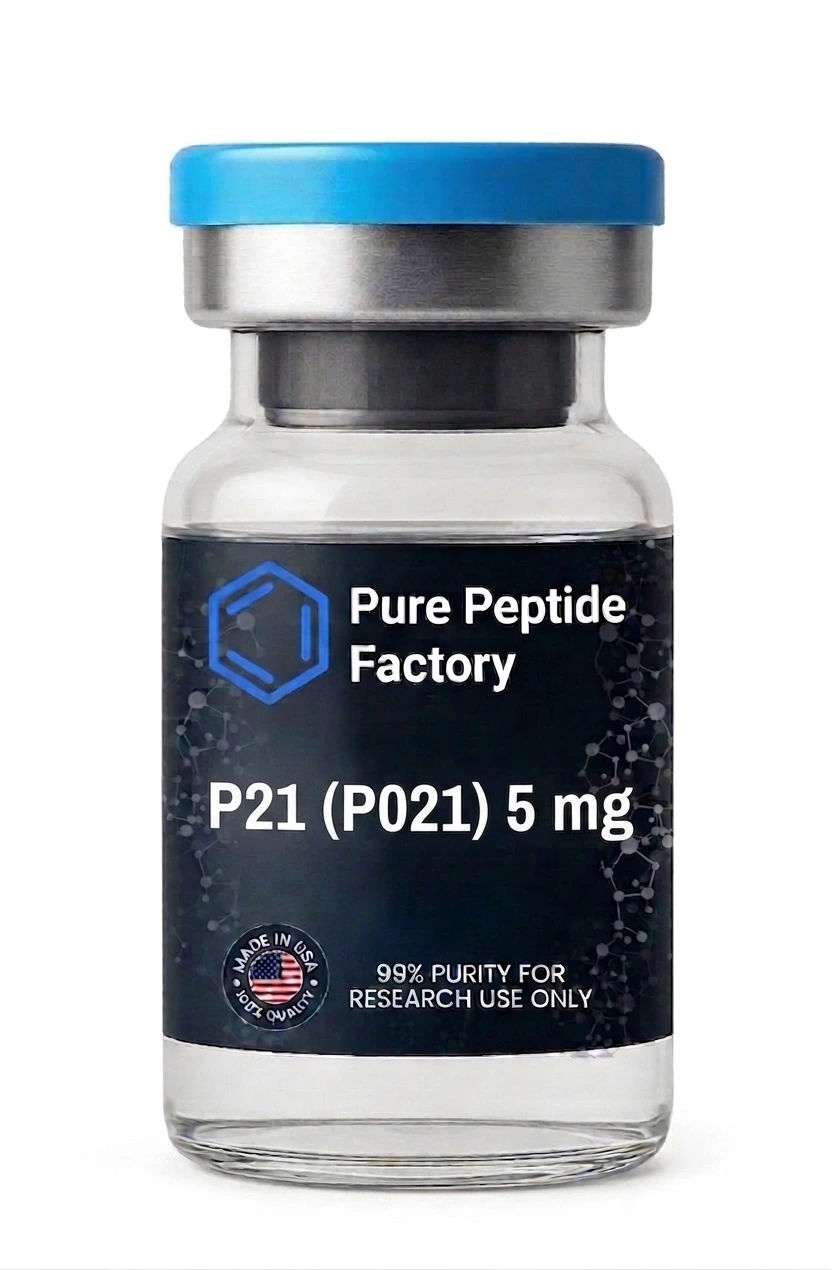
P21 (P021) 5 mg
$120.00
Research-grade P21 peptide (P021) 5mg lyophilized vial. Synthetic tetrapeptide Ac-DGGL(A)G-NH2 derived from CNTF, engineered for blood-brain barrier penetration and BDNF upregulation. 99.1% purity by HPLC. Batch PPF-P21-0513. For neurogenesis, synaptic plasticity, and neurodegeneration research.
P21 Peptide Benefits: Research-Grade P021 Nootropic Compound
P21 peptide, also known as P021, is a synthetic tetrapeptide derived from amino acid residues 148 to 151 of ciliary neurotrophic factor (CNTF). Researchers studying neurogenesis, BDNF-mediated synaptic plasticity, or tau pathology reduction need a reliable domestic source for this compound. Pure Peptide Factory supplies research-grade p21 peptide in 5mg lyophilized vials with full batch documentation and cold-chain integrity. Unlike its parent molecule CNTF, which Regeneron developed as Axokine but failed in clinical trials due to neutralizing antibody production and systemic side effects including anorexia and hyperalgesia, P21 is a small, defined peptide that does not trigger immune responses. Consequently, researchers who seek p21 peptide benefits in their neurodegeneration models obtain a compound engineered to overcome the pharmacological limitations that halted full-length CNTF development (1).
What distinguishes P21 structurally is the adamantane modification at the N-terminus. This lipophilic cage enhances passive diffusion across the blood-brain barrier, a critical design feature because unmodified CNTF-derived peptides cannot reach therapeutic concentrations in brain tissue. Furthermore, P21 demonstrates approximately 90% stability in gastric juice and greater than 97% stability in intestinal fluid at 37°C, with a plasma half-life exceeding 3 hours. These pharmacokinetic properties distinguish it from most peptides, which degrade rapidly in gastrointestinal environments. As a result, researchers can study p21 peptide benefits across multiple administration routes including oral, subcutaneous, intranasal, and intraperitoneal, a flexibility unavailable with most neurotrophic compounds (2).
Why Researchers Buy P21 Peptide from Pure Peptide Factory
Documentation for a Defined Synthetic Tetrapeptide
P21 is a precisely sequenced tetrapeptide (Ac-DGGL(A)G-NH₂) with a molecular formula of C₃₀H₅₄N₆O₅ and a molecular weight of 578.3 g/mol. The adamantane modification is the functional group responsible for blood-brain barrier penetration, and incomplete or incorrect adamantane conjugation will produce a compound that does not reach CNS tissue. Every batch we ship includes lot-specific HPLC and mass spectrometry documentation verifying purity (99.1% on current batch #PPF-P21-0513) and molecular identity. The Certificate of Analysis is downloadable before your compound ships. Therefore, researchers who purchase p21 peptide from our facility can trust the adamantane modification is intact before beginning any neurogenesis or tau pathology protocol.
5mg Vial Configuration for Preclinical Neurodegeneration Studies
Our 5mg vial configuration matches the standard dose range used in published 3xTg-AD mouse model studies. In the landmark Kazim et al. (2017) protocol, 0.1 mg/kg/day administered intraperitoneally for 8 to 12 weeks produced robust hippocampal neurogenesis, increased BDNF and neurotrophin-4 levels, and rescued episodic memory impairment. The 5mg vial provides sufficient material for pilot studies, dose-response experiments at multiple dose levels, or extended single-cohort protocols. Consequently, researchers who purchase p21 peptide can match vial size to the published preclinical dosing framework without splitting vials or compromising sterility.
Domestic Cold-Chain Integrity
This synthetic tetrapeptide remains stable as lyophilized powder but degrades with moisture exposure and temperature excursion after reconstitution. We store all p21 peptide inventory under domestic cold-storage conditions at -20°C and ship using phase-change cooling rated for 96-hour protection. Most orders arrive within 1 to 3 business days, protecting peptide integrity from warehouse to laboratory bench. For reconstitution, researchers typically pair P21 with our bacteriostatic water, also stocked domestically under identical cold-chain conditions.
Compare Against Complementary Neurotrophic Peptides Without Batch Variables
Many research protocols compare P21 against other neurotrophic compounds such as Cerebrolysin (porcine-derived neurotrophic complex), Semax (ACTH-derived nootropic), or Cortexin (bovine cerebral cortex extract). Because we stock the full neurotrophic peptide panel under identical cold-storage conditions, researchers who source p21 peptide alongside these complementary compounds eliminate supplier variability from their cross-compound data.
Synthesis Logs Archived for 24 Months
Should your IRB or compliance office request chain-of-custody records, we provide them without delay.
What Is P21 Peptide?
A CNTF-Derived Tetrapeptide Engineered for Brain Penetration
P21 (P021) is a synthetic tetrapeptide corresponding to amino acid residues 148 to 151 of ciliary neurotrophic factor (CNTF), a naturally occurring neurotrophic protein that supports neuronal survival and differentiation. Dr. Khalid Iqbal and colleagues at the New York State Institute for Basic Research in Developmental Disabilities developed P21 to retain the neurogenic and neuroprotective properties of full-length CNTF while overcoming its pharmacological limitations: poor blood-brain barrier penetration, systemic side effects (anorexia, hyperalgesia, weight loss), and immunogenicity (3).
The Adamantane Modification: Why It Matters
The adamantane modification at the N-terminus enhances lipophilicity, facilitating passive diffusion across the blood-brain barrier. Without this modification, the tetrapeptide core cannot reach therapeutic concentrations in CNS tissue. Furthermore, the adamantane cage also confers resistance to exopeptidase degradation, extending plasma stability to over 3 hours, which is substantially longer than unmodified peptides of similar size. This structural innovation is what transforms a simple four-amino-acid sequence into a brain-penetrant neurotrophic research tool. The P21 development story represents a targeted fragment-based approach: starting from the multi-component porcine brain extract Cerebrolysin, Iqbal’s group identified CNTF as a key active component, isolated its active domain (residues 148 to 151), then chemically optimized the fragment for CNS delivery. Consequently, researchers who study p21 peptide benefits work with the end product of a rational drug-design program, not an uncharacterized extract (4).
Molecular Profile:
- Sequence: Ac-DGGL(A)G-NH₂ (where (A) = adamantane-modified residue)
- Molecular Formula: C₃₀H₅₄N₆O₅
- Molecular Weight: 578.3 g/mol
- CAS Number: 1394011-91-6
- Classification: Synthetic CNTF-derived neurotrophic tetrapeptide
- Synonyms: P21, P021, P021 peptide, CNTF (148-151)-Ad
- Source: Synthetic; derived from ciliary neurotrophic factor residues 148 to 151
- Developer: Khalid Iqbal, NYS Institute for Basic Research in Developmental Disabilities
- Key Structural Feature: N-terminal adamantane cage for BBB penetration
P21 Peptide Benefits: What Published Research Shows
Neurogenesis and BDNF Upregulation
The most extensively documented p21 peptide benefits center on hippocampal neurogenesis. P21 increases brain-derived neurotrophic factor (BDNF) expression through inhibition of leukemia inhibitory factor (LIF) signaling, a negative regulator of BDNF transcription. In the 3xTg-AD mouse model, a transgenic strain developing both amyloid-beta plaques and tau tangles, P21 treatment promoted hippocampal neurogenesis, increased BDNF and neurotrophin-4 levels, and enhanced dentate gyrus activity sufficient to overcome age-related neurogenic limitations. Moreover, this neurogenic effect translated to measurable cognitive improvements, with treated animals demonstrating rescued episodic memory and reduced mortality rates compared to untreated controls (2).
Tau Pathology Reduction
In Alzheimer disease models, P21 markedly reduced abnormal hyperphosphorylation and accumulation of tau at neurofibrillary pathology-associated sites. Notably, when researchers administered P21 during the synaptic compensation period, before severe neurodegeneration, the peptide prevented both amyloid-beta and tau pathologies entirely. This preventive effect suggests a mechanism that intervenes upstream of the pathological cascade rather than merely treating downstream symptoms. Consequently, researchers studying tauopathies use p21 peptide to investigate whether early neurotrophic intervention can alter disease trajectory (4).
Synaptic Plasticity and Dendritic Health
P21 rescued deficits in dendritic morphology and synaptic transmission in diseased models. Specifically, it promoted formation of new dendritic spines (the protrusions where synaptic connections form) and reversed cognitive impairment that had already developed. Researchers measured increased levels of synapsin-1, PSD-95, and MAP2, three protein markers that reflect synaptic integrity, postsynaptic density, and dendritic structural health respectively. This dual action on both neuron generation and connection strengthening distinguishes P21 from compounds that address only one aspect of neural circuitry.
Neuroprotection Against Oxidative Stress
P21 demonstrated protective effects against reactive oxygen species-mediated neuronal damage and apoptosis in preclinical studies. By reducing oxidative stress and programmed cell death, two primary mechanisms of neuronal loss in aging and neurodegeneration, P21 exhibits a broad neuroprotective profile extending beyond single-disease mechanisms.
CDKL5 Deficiency Disorder
A 2024 study by Mottolese and colleagues expanded p21 peptide benefits research into CDKL5 Deficiency Disorder, a severe epileptic encephalopathy. In vitro results showed that P21 restored cell proliferation, survival, and neuronal maturation in CDKL5-knockout cells, suggesting potential applications across multiple neurological conditions characterized by neuronal developmental failure (5).
P21 vs Cerebrolysin: Understanding the Distinction
P21 was reverse-engineered from Cerebrolysin, a porcine brain-derived peptide mixture containing CNTF, BDNF, NGF, GDNF, and numerous other neurotrophic factors. Understanding their relationship is critical for selecting the correct research tool:
| Feature | P21 (P021) | Cerebrolysin |
|---|---|---|
| Composition | Single defined tetrapeptide (Ac-DGGLAG-NH₂) | Complex mixture of 100+ peptides and amino acids |
| Source | Synthetic; recombinant or solid-phase synthesis | Porcine brain tissue extract |
| Primary Mechanism | LIF inhibition, which upregulates BDNF | Broad neurotrophic support (CNTF, BDNF, NGF, GDNF) |
| Administration | Intranasal, subcutaneous, oral (gastric-stable) | Intramuscular or intravenous injection only |
| Immunogenicity | Very low (defined synthetic peptide) | Moderate (porcine-derived; anti-CNTF antibodies reported) |
| Neurogenesis | Strong (targeted BDNF pathway) | Moderate (broad but less focused) |
| Tau Protection | Strong (demonstrated in 3xTg-AD model) | Some evidence (less studied) |
| Human Clinical Data | None (preclinical only) | Extensive (approved in 44+ countries) |
For pure neurogenesis and tau-protective research, P21 may be more potent on a per-pathway basis due to its targeted LIF/BDNF mechanism. For broad-spectrum neural support requiring established human safety data, Cerebrolysin remains the standard. P21 also avoids the immunogenicity risk that can diminish Cerebrolysin efficacy over repeated administration. Researchers studying p21 peptide benefits alongside Cerebrolysin can use the two compounds as complementary tools, one providing pathway-specific mechanistic data, the other offering a clinically validated reference baseline.
P21 Peptide Dosage and Research Protocols
For laboratory protocols only. We do not provide human dosing recommendations.
| Model | Dose | Route | Frequency | Duration | Key Finding |
|---|---|---|---|---|---|
| 3xTg-AD mouse (neurogenesis) | 0.1 mg/kg/day | Intraperitoneal or Subcutaneous | Once daily | 8 to 12 weeks | Increased BDNF; reduced tau hyperphosphorylation |
| 3xTg-AD mouse (high-dose) | 0.5 to 1.0 mg/kg/day | Intraperitoneal or Subcutaneous | Once daily | 8 to 12 weeks | Plateau effect; no substantially greater benefit vs 0.1 mg/kg |
| Oral administration (rodent) | 1 to 5 mg/kg/day | Oral gavage | Once daily | 4 to 12 weeks | Gastric-stable; measurable brain BDNF increase |
| Intranasal (rodent) | 0.05 to 0.2 mg/kg/day | Intranasal instillation | Once daily | 4 to 8 weeks | Direct nose-to-brain delivery; lower systemic exposure |
| In vitro neural stem cells | 10 to 100 nM | Cell culture media | Continuous | 48 to 72 hours | Increased proliferation and neuronal differentiation |
| CDKL5-knockout cells | Per protocol (nM to µM range) | Cell culture | Continuous | Per assay | Restored cell proliferation and neuronal maturation |
Dose-response studies indicate a plateau effect at higher concentrations. In the 3xTg-AD model, 0.1 mg/kg produced robust neurogenic and cognitive benefits, while 0.5 to 1.0 mg/kg did not provide substantially greater efficacy. This suggests an optimal dosing window rather than a linear dose-response relationship. Consequently, researchers studying p21 peptide benefits should titrate from the lower end of the published range. The 5mg vial configuration supports all the dose levels listed above for rodent protocols.
How to Reconstitute P21 Peptide
Step-by-Step Laboratory Protocol
- Sanitize the vial stopper with 70% isopropyl alcohol.
- Using our bacteriostatic water (0.9% benzyl alcohol), inject the sterile diluent slowly against the vial wall. Allow diluent to trickle down; do not force-stream directly at the lyophilized cake.
- Allow the powder to dissolve without agitation for 1 to 2 minutes. The tetrapeptide is highly soluble.
- Gently swirl until the solution is completely clear. Do NOT shake or vortex. The adamantane modification makes the peptide slightly more hydrophobic, and vigorous agitation can cause aggregation.
- Inspect for clarity. Discard if turbid or containing particulate matter.
- Label with date, concentration, and store as directed below.
Concentration Reference for 5mg Vial
| Diluent Volume | Concentration | 0.1 mL Aliquot | Common Research Use |
|---|---|---|---|
| 2.5 mL | 2.0 mg/mL | 0.2 mg (200 mcg) | Standard in vivo dosing |
| 5.0 mL | 1.0 mg/mL | 0.1 mg (100 mcg) | Dose-finding and titration |
| 1.0 mL | 5.0 mg/mL | 0.5 mg (500 mcg) | High-concentration studies |
Storage Requirements
- Lyophilized powder: 24 months at -20°C, protected from light and moisture.
- Reconstituted solution: 14 to 28 days at 2 to 8°C. Avoid repeated freeze-thaw cycles.
- The adamantane group provides some protection against proteolysis, but standard peptide storage practices should still be followed.
P21 Peptide Side Effects in Research Models
Preclinical safety data for P21 is favorable but limited to animal studies. Key observations include:
- No Systemic Toxicity: Continuous administration for up to 12 months in mice showed no organ toxicity, tumorigenic effects, or behavioral abnormalities.
- No CNTF-Associated Side Effects: Unlike parent CNTF (Axokine), P21 does not produce anorexia, hyperalgesia, or weight loss. These are the adverse effects that halted Axokine clinical development.
- Local Irritation (Intranasal): Mild nasal irritation or dryness may occur with intranasal instillation in animal models, analogous to other nasal peptide administrations.
- Unknown Long-Term Effects: No human safety data exists. The compound’s mechanism involves fundamental brain signaling pathways (BDNF, GSK-3β, neurogenesis), and long-term consequences of sustained modulation are unknown.
Product Specifications
Available Configuration
P21 peptide is available in 5mg lyophilized powder vials. Select your quantity from the product options above.
Quality Verification
- Purity: 99.1% by RP-HPLC (current batch #PPF-P21-0513)
- Identity: Confirmed by MALDI-TOF mass spectrometry against monoisotopic mass 578.3 Da
- Endotoxin: Less than 0.05 EU/µg by LAL assay
- Sterility: Verified per USP 71
- Form: Lyophilized powder
- Storage: -20°C long-term, 2 to 8°C after reconstitution
- CAS Number: 1394011-91-6
Current Batch: #PPF-P21-0513
Purity: 99.1%
Download: HPLC Certificate | Mass Spec Report
Frequently Asked Questions
What are the primary P21 peptide benefits in research?
P21 peptide benefits documented in published studies include: hippocampal neurogenesis through BDNF upregulation via LIF pathway inhibition, reduction of tau hyperphosphorylation and amyloid-beta accumulation in the 3xTg-AD mouse model, rescue of dendritic spine formation and synaptic plasticity, neuroprotection against oxidative stress-induced apoptosis, and restoration of cell proliferation and neuronal maturation in CDKL5 Deficiency Disorder models.
What does P21 peptide do in research?
P21 promotes neurogenesis by upregulating BDNF through LIF pathway inhibition. In Alzheimer disease mouse models, researchers have documented that it reduces tau hyperphosphorylation, decreases amyloid-beta accumulation, rescues synaptic plasticity, and reverses cognitive impairment. It also demonstrates neuroprotective effects against oxidative stress and has shown promise in CDKL5 Deficiency Disorder models.
What is the P21 peptide dosage for research?
In rodent models, effective doses range from 0.1 mg/kg/day (IP or SC) for neurogenesis studies to 1 to 5 mg/kg/day for oral administration. In vitro neural stem cell cultures typically use 10 to 100 nM. Dose-response studies show a plateau effect, meaning higher doses do not necessarily produce greater benefits. Researchers should start at the lower end and titrate based on experimental readouts. We do not provide human dosing recommendations.
Where can I buy P21 peptide for research?
Pure Peptide Factory supplies research-grade p21 peptide domestically in 5mg vials with same-day cold-chain shipping. Orders placed before 2 PM EST ship same-day and most arrive within 1 to 3 business days with full HPLC and mass spectrometry documentation.
Is P021 peptide the same as P21?
Yes. P021 is the systematic designation; P21 is the common abbreviation. Both refer to the same compound: Ac-DGGL(A)G-NH₂, a synthetic tetrapeptide derived from CNTF residues 148 to 151 with an adamantane modification for enhanced blood-brain barrier penetration.
How does P21 compare to Cerebrolysin?
P21 was reverse-engineered from Cerebrolysin and represents a single defined tetrapeptide, whereas Cerebrolysin is a complex mixture of 100+ peptides from porcine brain. P21 provides targeted BDNF upregulation via LIF inhibition with strong tau protection data; Cerebrolysin provides broad neurotrophic support with extensive human clinical data in 44+ countries. See the full comparison table above. Both compounds are available from our catalog for comparative studies.
How does P21 compare to Semax for nootropic research?
Both increase BDNF but through different mechanisms. P21 works via LIF inhibition and CNTF pathway modulation, focusing on neurogenesis and tau protection. Semax is an ACTH analog that modulates serotonergic and dopaminergic systems, improving attention and mood. Semax has established clinical use in Russia; P21 has only preclinical data. They are complementary rather than competitive research tools.
What are P21 peptide side effects in research models?
Preclinical studies show no systemic toxicity, organ damage, or tumorigenic effects after 12 months of continuous administration in mice. Unlike parent CNTF (Axokine), P21 does not produce anorexia, hyperalgesia, or weight loss. Mild nasal irritation may occur with intranasal administration. No human safety data exists.
How should I store P21 peptide after reconstitution?
Store reconstituted solution at 2 to 8°C and use within 14 to 28 days. Avoid repeated freeze-thaw cycles. Reconstitute using our bacteriostatic water for optimal sterility and stability. The adamantane modification provides some proteolytic protection, but standard cold-storage practices should still be followed.
Buy P21 Peptide for Your Research
Secure Checkout
- Credit card, cryptocurrency, or wire transfer
- Same-day dispatch for orders placed before 2 PM EST
- Cold-chain packaging with phase-change cooling
- Discreet labeling and full tracking
Institutional Accounts
Net-30 terms and purchase orders accepted for universities and research institutions. Contact us for bulk pricing on 50 vials or more, including matched orders alongside Cerebrolysin, Semax, Cortexin, and bacteriostatic water for comprehensive neurodegeneration and neurogenesis research protocols.
Add to cart and get batch-verified P21 peptide delivered with the documentation your neurogenesis, tau pathology, or synaptic plasticity research requires.
Related products
-
Cerebrolysin 60 mg x 6
$50.00 -
PTD-DBM 1 mg
$50.00