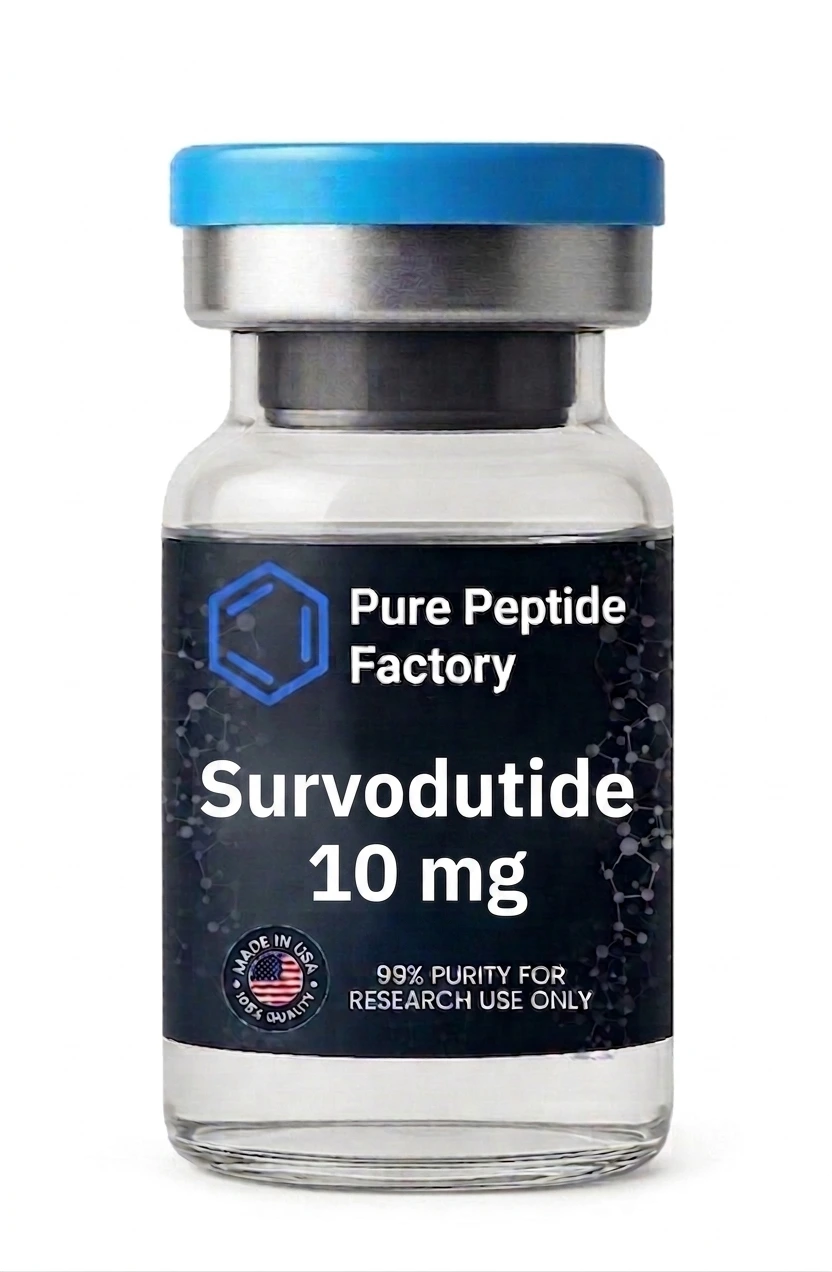
Survodutide 10 mg
$100.00
Survodutide peptide for sale at Pure Peptide Factory. Survodutide (BI 456906) is a 29-amino-acid acylated peptide with C18 fatty acid moiety, functioning as a dual GLP-1/glucagon receptor agonist with EC50 of 0.33 nM at GLP-1R and 0.52 nM at GCGR. The compound received FDA Breakthrough Therapy designation in September 2024 for MASH following its NEJM Phase 2 publication showing 62% MASH improvement at 4.8mg dose. Research-grade Survodutide, HPLC verified, batch-specific COA. 10mg vials. Research use only.
Survodutide Peptide for Sale: BI 456906, the Dual GLP-1/Glucagon Agonist with FDA Breakthrough Therapy Status
In September 2024, the FDA granted Breakthrough Therapy designation to Survodutide (BI 456906) for non-cirrhotic MASH with moderate or advanced fibrosis. Three months earlier, the New England Journal of Medicine published the Phase 2 trial showing 62% MASH improvement without worsening of fibrosis at the 4.8mg dose, compared to 14% on placebo. The European Medicines Agency PRIME scheme accepted Survodutide in November 2023. China’s NMPA granted Breakthrough Therapy status in June 2024. Boehringer Ingelheim is now running five Phase 3 trials (LIVERAGE, LIVERAGE-Cirrhosis, SYNCHRONIZE-1, SYNCHRONIZE-2, SYNCHRONIZE-CVOT) enrolling more than 5,000 participants globally.
For researchers studying GLP-1/glucagon dual receptor pharmacology, hepatic fibrosis biology, MASH endpoints, or comparative incretin compound development, Survodutide is the compound that pulled liver disease research from secondary endpoint to primary indication. Pure Peptide Factory stocks research-grade Survodutide with domestic cold-chain shipping and batch-specific HPLC documentation.
Why Researchers Choose Pure Peptide Factory for Survodutide
Documentation for a Newly Approved Research Compound
Because Survodutide is in active Phase 3 clinical development, research-grade supply is less established than for Semaglutide or Tirzepatide. The 29-amino-acid sequence with its C18 fatty diacid acylation requires sophisticated synthesis and analytical verification. Every batch we ship includes a lot-specific HPLC chromatogram, mass spectrometry report confirming the molecular weight target with lipidation verification, and Certificate of Analysis downloadable before your compound ships.
Domestic Cold-Chain Shipping for an Acylated Peptide
The C18 fatty diacid moiety provides Survodutide with albumin binding and once-weekly dosing kinetics, but it also makes the compound more hydrophobic than standard peptides. We ship from domestic cold-storage using phase-change cooling packs rated for 96-hour protection. Most orders reach your lab within 1 to 3 business days.
10mg Configuration for Research Protocols
Our 10mg vial configuration matches the standard configuration used in comparative metabolic research and provides flexibility across the 2.4mg to 6.0mg dose range used in the published Phase 2 MASH trial. Researchers running comparative protocols against Mazdutide, Tirzepatide, or Retatrutide work with matched vial configurations under identical handling conditions.
Synthesis Logs Archived for 24 Months
Every batch is documented and archived. If your IRB or compliance office requests chain-of-custody records or synthesis documentation, they are available on request.
What Is Survodutide?
A Boehringer Ingelheim/Zealand Pharma Dual Agonist
Survodutide is a 29-amino-acid synthetic peptide developed through a collaboration between Zealand Pharma and Boehringer Ingelheim. Zealand designed the original molecule as part of its peptide therapeutics portfolio. Boehringer Ingelheim licensed the compound and assumed global development and commercialization responsibility, with Zealand retaining a co-promotion right in Nordic countries.
The structural design pairs GLP-1 receptor activation with glucagon receptor activation, derived from oxyntomodulin, the natural gut hormone that activates both receptors simultaneously. This places Survodutide in the same mechanistic class as Mazdutide (Innovent’s GLP-1/glucagon dual agonist approved in China) but with distinct structural features and pharmacokinetic balance.
Molecular Profile:
- Type: 29-amino-acid acylated dual receptor agonist
- Acylation: C18 fatty diacid moiety for albumin binding and extended half-life
- GLP-1R EC50: 0.33 nM in CHO-K1 cells
- GCGR EC50: 0.52 nM in CHO-K1 cells
- CAS: 2805997-46-8
- Synonyms: BI 456906, BI-456906
- Origin compound: Oxyntomodulin (natural gut hormone)
- Discovery reference: Zimmermann et al., Molecular Metabolism 2022 (66:101633)
How Survodutide Works at Both Receptors
Survodutide simultaneously activates the GLP-1 receptor and the glucagon receptor with sub-nanomolar potency at both. The mechanism integrates two complementary metabolic pathways into a single compound:
GLP-1 receptor activation produces glucose-dependent insulin secretion, postprandial glucagon suppression, slowed gastric emptying, and central appetite reduction through hypothalamic POMC and AgRP neuron modulation. These are the established effects researchers know from Semaglutide and other GLP-1 selective agonists.
Glucagon receptor activation is where Survodutide diverges from GLP-1 mono-agonists. GCGR signaling in hepatocytes increases fatty acid oxidation through CPT1a upregulation, reduces de novo lipogenesis through SREBP-1c suppression, and stimulates hepatic glucose output kinetics. In adipose tissue, GCGR activation drives lipolysis. In thermogenically active tissue, it increases energy expenditure through brown adipose activity.
In isolation, glucagon receptor activation raises blood glucose, which appears counterproductive for diabetes research. However, when paired with GLP-1R activation’s potent insulin secretion, the net result is glucose-lowering plus the hepatic and energy expenditure benefits of glucagon receptor engagement. This dual mechanism is why Survodutide produced the MASH outcomes that GLP-1 mono-agonists could not match.
The C18 fatty diacid acylation provides albumin binding, which extends the half-life to support once-weekly subcutaneous dosing in clinical research protocols.
Survodutide and MASH: The FDA Breakthrough Therapy Research
The Sanyal et al. NEJM Phase 2 Trial
Published in the New England Journal of Medicine on June 7, 2024 (with print publication July 25, 2024), the Sanyal et al. Phase 2 trial randomized 293 adults with biopsy-confirmed MASH and fibrosis stage F1 to F3 to receive once-weekly subcutaneous Survodutide at 2.4mg, 4.8mg, 6.0mg, or placebo across 48 weeks. The trial used a 24-week rapid-dose-escalation phase followed by a 24-week maintenance phase.
Primary endpoint outcomes (MASH improvement without worsening of fibrosis):
| Treatment Arm | MASH Improvement | Liver Fat ≥30% Reduction | Fibrosis ≥1 Stage Improvement |
|---|---|---|---|
| Placebo | 14% | 14% | 22% |
| Survodutide 2.4mg | 47% | 63% | 34% |
| Survodutide 4.8mg | 62% | 67% | 36% |
| Survodutide 6.0mg | 43% | 57% | 34% |
The dose-response curve was best fit by a quadratic model (P<0.001), with the 4.8mg dose producing the strongest MASH improvement and the 2.4mg and 4.8mg doses producing comparable liver fat reductions.
FDA Breakthrough Therapy Designation
In September 2024, the FDA granted Breakthrough Therapy designation to Survodutide for non-cirrhotic MASH with moderate or advanced fibrosis (stages 2 or 3). This designation expedites development and review of compounds for serious conditions where preliminary clinical evidence indicates substantial improvement over available therapies.
Other regulatory recognition for MASH:
- European Medicines Agency PRIME scheme acceptance: November 2023
- China NMPA Breakthrough Therapy designation: June 2024
- US FDA Breakthrough Therapy designation: September 2024
This is the convergent regulatory recognition that places Survodutide as a leading candidate to become the first GLP-1/glucagon dual agonist approved for MASH in major markets.
Phase 3 LIVERAGE Trial Program
Boehringer Ingelheim launched two Phase 3 MASH trials following the Phase 2 readout:
- LIVERAGE: ~1,800 adults with MASH and moderate/advanced fibrosis (F2-F3), 52-week treatment for fibrosis improvement, ~7-year follow-up for end-stage liver disease outcomes
- LIVERAGE-Cirrhosis: ~1,590 adults with compensated MASH cirrhosis (F4), ~4.5-year follow-up
The LIVERAGE program represents one of the largest Phase 3 MASH treatment investigations ever conducted, totaling over 3,300 participants. Research using our Survodutide compound benefits from the depth of clinical data being generated in parallel.
Survodutide vs Mazdutide vs Tirzepatide: Comparing Dual and Triple Agonist Compounds
This is the comparison researchers studying GLP-1 class compounds increasingly need to make. Each compound targets a different receptor combination and produces distinct research profiles:
| Feature | Survodutide | Mazdutide | Tirzepatide |
|---|---|---|---|
| Receptor targets | GLP-1R + GCGR | GLP-1R + GCGR | GLP-1R + GIP-R |
| Developer | Boehringer/Zealand | Innovent/Lilly | Eli Lilly |
| Code | BI 456906 | IBI-362 / LY-3305677 | LY-3298176 |
| Length | 29 amino acids | 33 amino acids | 39 amino acids |
| Receptor potency (GLP-1R EC50) | 0.33 nM | Higher than 28.6 nM Ki | Sub-nanomolar |
| Receptor potency (GCGR EC50) | 0.52 nM | 17.7 nM Ki | Not applicable |
| Phase 2 obesity weight loss | 14.9% mean, up to 19% | Not directly measured at parity | Not applicable |
| Phase 3 obesity weight loss | In progress (SYNCHRONIZE) | 14.84% (GLORY-1, NEJM 2025) | 22.5% (SURMOUNT-1) |
| Phase 2 MASH results | 62% improvement (NEJM 2024) | Not yet published in MASH | 62% MASH resolution (Loomba NEJM 2024) |
| FDA Breakthrough Therapy | Yes (MASH, 2024) | No | Approved as Mounjaro/Zepbound |
| Approval status | Phase 3 globally | Approved in China (2025) | FDA approved |
| Best for studying | MASH endpoints, dual agonist liver effects | Energy expenditure, GCGR biology | GIP/GLP-1 synergy, insulin secretion |
When to choose Survodutide:
- MASH and hepatic fibrosis research protocols
- Studies focused on glucagon receptor liver signaling specifically
- Research benchmarking against the LIVERAGE Phase 3 program
- Protocols requiring the specific BI 456906 receptor potency profile
When to choose Mazdutide:
- Energy expenditure and metabolic rate research
- Protocols benchmarking against the GLORY trial program
- Research on the Innovent/Lilly oxyntomodulin analog series
When to choose Tirzepatide:
- GIP receptor biology research
- Protocols requiring the most extensive published clinical dataset
- Research using the FDA-approved comparator status
We stock all three compounds under identical cold-storage protocols. Researchers running head-to-head comparison studies eliminate batch variability by sourcing from the same supplier.
Survodutide Research Applications
MASH and Hepatic Fibrosis Research
The Sanyal NEJM publication established Survodutide as the leading GLP-1/glucagon dual agonist research compound for MASH. The mechanism explanation is that GCGR activation in hepatocytes drives fatty acid oxidation, reduces lipogenesis, and improves liver fat handling beyond what GLP-1 receptor activation alone produces. Research applications include:
- MRI-PDFF liver fat quantification and dose-response curves
- Histological MASH improvement scoring (NAS, SAF score)
- Fibrosis stage progression and regression endpoints (F1 through F4)
- Hepatic stellate cell activation markers
- Comparison protocols with Tirzepatide (Loomba 2024 NEJM) and other dual agonists in MASH models
Obesity and Body Composition Research
The Phase 2 obesity trial (BI 1404-0006) showed mean weight loss of 14.9% with up to 19% at the highest dose over 46 weeks. The Phase 3 SYNCHRONIZE program is currently evaluating Survodutide across multiple obesity sub-populations:
- SYNCHRONIZE-1: Adults with overweight and obesity, with comorbidities
- SYNCHRONIZE-2: Adults with type 2 diabetes
- SYNCHRONIZE-CVOT: Cardiovascular outcomes trial in adults with established cardiovascular disease, chronic kidney disease, or risk factors
- SYNCHRONIZE-JP: Japanese sub-population
- SYNCHRONIZE-CN: Chinese sub-population
Research endpoints in obesity protocols include total body weight change, visceral adipose tissue quantification, lean mass preservation, and cardiometabolic marker changes independent of weight loss.
Energy Expenditure and Thermogenic Research
The glucagon receptor arm of Survodutide’s mechanism produces measurable energy expenditure increases. Boehringer’s preclinical pharmacology described “robust anti-obesity efficacy achieved by increasing energy expenditure and decreasing food intake,” distinguishing Survodutide from GLP-1 mono-agonists that act primarily through appetite reduction. Research using Survodutide examines:
- Indirect calorimetry measurements of resting and total energy expenditure
- Brown adipose tissue activity and UCP1 expression
- Thermogenic gene expression in white adipose tissue browning protocols
- Substrate utilization shifts (RER changes) under chronic dosing
Cardiovascular and Renal Research
The SYNCHRONIZE-CVOT Phase 3 trial specifically examines cardiovascular outcomes, building on the cardiometabolic research framework that emerged from Semaglutide and Tirzepatide cardiovascular outcome data. Research applications include:
- Endothelial function and inflammatory marker modulation
- Blood pressure and heart rate effects of dual receptor agonism
- Lipid profile changes independent of weight loss
- Diabetic kidney disease progression biomarkers (eGFR, albuminuria)
Type 2 Diabetes and Glycemic Research
The dual GLP-1/glucagon mechanism produces complex effects on glucose homeostasis. The GLP-1 component drives glucose-dependent insulin secretion. The glucagon component would, in isolation, raise glucose, but the balanced potency design produces net glucose-lowering when both receptors engage simultaneously. Research uses Survodutide to examine:
- HbA1c response curves at varying GLP-1R/GCGR potency ratios
- Beta-cell function preservation versus stimulation effects
- Hepatic glucose output kinetics under combined receptor activation
- Comparative glycemic control versus GLP-1 selective agonists
Survodutide Peptide Dosage Research Protocols
The published Phase 2 dosing framework provides the foundation for research protocol design:
| Research Context | Dose | Route | Frequency | Reference |
|---|---|---|---|---|
| MASH Phase 2 (low dose) | 2.4 mg | Subcutaneous | Once weekly | Sanyal NEJM 2024 |
| MASH Phase 2 (mid dose) | 4.8 mg | Subcutaneous | Once weekly | Sanyal NEJM 2024 |
| MASH Phase 2 (high dose) | 6.0 mg | Subcutaneous | Once weekly | Sanyal NEJM 2024 |
| Obesity Phase 2 | Up to 4.8 mg | Subcutaneous | Once weekly | Le Roux 2024 |
| Phase 3 LIVERAGE/SYNCHRONIZE | Per protocol | Subcutaneous | Once weekly | Ongoing |
| Preclinical DIO mice | Per mg/kg protocol | SC | Variable | Zimmermann 2022 |
| Cell culture (CHO-K1, HEK) | Sub-nanomolar to nanomolar | In vitro | Per assay | Multiple |
Dose escalation protocol: All published clinical trials used rapid dose escalation rather than initiating at target dose. The Phase 2 MASH trial escalated over 24 weeks before the maintenance phase began. Research protocols designed around clinical trial dosing should incorporate the escalation phase to match published tolerability data.
We do not provide human dosing recommendations. The dosing references above come from peer-reviewed publications and clinicaltrials.gov registered protocols. They are provided for laboratory research design context only.
How to Reconstitute Survodutide
Step-by-Step Laboratory Protocol
- Sanitize the vial stopper with 70% isopropyl alcohol
- Inject bacteriostatic water slowly against the vial wall. Do not aim directly at the lyophilized cake
- Allow the cake to dissolve without agitation for 3 to 5 minutes. The C18 fatty diacid acylation makes Survodutide more hydrophobic than standard peptides, so patient dissolution matters
- Gently swirl until the solution is clear. Do not shake vigorously
- Verify a clear, colorless solution before use
Concentration reference:
- 10mg vial + 1mL water = 10mg/mL
- 10mg vial + 2mL water = 5mg/mL
- 10mg vial + 5mL water = 2mg/mL
- Scale to match your protocol target concentration
Storage Requirements
- Lyophilized powder: 24 months at -20°C, protected from light
- Reconstituted solution: 28 days at 2 to 8°C. Do not freeze reconstituted Survodutide
- The C18 fatty diacid moiety increases hydrophobicity. Dissolve slowly and protect from light at all stages
- Avoid repeated freeze-thaw cycles on reconstituted solution
Survodutide for Sale: Regulatory Context
Global Approval and Designation Status
Survodutide is not yet approved for marketing in any jurisdiction as of this writing. However, the regulatory designations granted across major markets establish its development trajectory:
- US FDA: Breakthrough Therapy designation for MASH (September 2024)
- EMA: PRIME scheme acceptance (November 2023)
- China NMPA: Breakthrough Therapy designation for MASH (June 2024)
- Phase 3 trials: LIVERAGE and LIVERAGE-Cirrhosis (MASH), SYNCHRONIZE-1, SYNCHRONIZE-2, SYNCHRONIZE-CVOT, SYNCHRONIZE-JP, SYNCHRONIZE-CN (obesity sub-populations)
Boehringer Ingelheim and Zealand Pharma project multiple regulatory submission timelines for both MASH and obesity indications across the next 2 to 4 years pending Phase 3 readouts.
Research-Grade Availability
Research-grade Survodutide is a separate category from any future commercial formulation. It is available for laboratory procurement under research-use-only terms without a prescription. This compound is not for human consumption, veterinary use, or diagnostic application. You must agree to research-use terms at checkout.
Product Specifications
Available Configuration
Survodutide is available in 10mg vials. Select your quantity from the product options above.
Quality Verification
- Purity: 98% minimum (HPLC verified)
- Identity: Mass spectrometry confirmed against the BI 456906 target with C18 fatty diacid lipidation verification
- Endotoxin: Less than 0.1 EU/mL
- Sterility: Verified per USP 71
- Form: Lyophilized powder
- Storage: -20°C long-term, 2 to 8°C short-term after reconstitution
Current Batch: #PPF-SVD-0426 Purity: 98.7% Download: HPLC Certificate | MS Report
FAQ
What is Survodutide used for in research?
Survodutide is used in MASH and hepatic fibrosis research, obesity and body composition studies, GLP-1/glucagon dual receptor pharmacology, energy expenditure and thermogenic research, type 2 diabetes glycemic control protocols, and cardiometabolic disease research. The FDA Breakthrough Therapy designation for MASH makes it the leading dual agonist research compound for hepatic indications.
Where can I buy Survodutide for research?
Pure Peptide Factory stocks research-grade Survodutide in 10mg vials with batch-specific HPLC and mass spectrometry documentation. Domestic cold-chain shipping delivers most orders within 1 to 3 business days.
How does Survodutide compare to Mazdutide?
Both are GLP-1/glucagon dual receptor agonists derived from oxyntomodulin. Survodutide (BI 456906) is 29 amino acids with sub-nanomolar EC50 at both receptors. Mazdutide (IBI-362/LY-3305677) is 33 amino acids. Survodutide has FDA Breakthrough Therapy designation for MASH and is in Phase 3 globally. Mazdutide is approved in China for weight management. They occupy similar mechanistic space but represent distinct development programs from different sponsors.
How does Survodutide compare to Tirzepatide?
Survodutide targets GLP-1 and glucagon receptors. Tirzepatide targets GLP-1 and GIP receptors. The MASH research is particularly relevant: both produced similar MASH improvement rates in their respective Phase 2 trials (62% for Survodutide 4.8mg, 62% MASH resolution for Tirzepatide), but the mechanisms differ. Survodutide adds glucagon receptor-mediated hepatic effects. Tirzepatide adds GIP receptor-mediated effects on adipose tissue.
What did the Sanyal NEJM 2024 trial show?
The Phase 2 MASH trial randomized 293 adults to Survodutide at 2.4, 4.8, or 6.0 mg or placebo for 48 weeks. MASH improvement without worsening of fibrosis occurred in 47%, 62%, and 43% respectively versus 14% on placebo. Liver fat reduction by ≥30% occurred in 63%, 67%, and 57% versus 14% placebo. Fibrosis improvement by ≥1 stage occurred in 34%, 36%, and 34% versus 22% placebo.
What is FDA Breakthrough Therapy designation?
Breakthrough Therapy designation is an FDA program that expedites development and review of compounds for serious conditions where preliminary clinical evidence indicates substantial improvement over available therapies. Survodutide received this designation in September 2024 for non-cirrhotic MASH with moderate or advanced fibrosis based on the Phase 2 data.
What dosage does Survodutide research use?
Published Phase 2 trials used 2.4mg, 4.8mg, and 6.0mg subcutaneous once-weekly after rapid dose escalation. Phase 3 trials use protocol-specified dosing within similar ranges. Preclinical rodent studies use mg/kg dosing scaled by species. We do not provide human dosing recommendations.
Is Survodutide FDA approved?
Not yet. Survodutide has FDA Breakthrough Therapy designation for MASH but has not received marketing approval. Phase 3 trials (LIVERAGE for MASH, SYNCHRONIZE for obesity) are ongoing. Boehringer Ingelheim projects regulatory submissions following Phase 3 readouts over the next several years.
How should Survodutide be stored?
Lyophilized powder stores at -20°C for up to 24 months protected from light. Reconstituted solution stores at 2 to 8°C for up to 28 days. Do not freeze reconstituted Survodutide. The C18 fatty diacid acylation requires careful reconstitution with patient dissolution and minimal agitation.
What is the difference between Survodutide and Semaglutide?
Semaglutide is a GLP-1 receptor selective agonist. Survodutide adds glucagon receptor activation alongside GLP-1R engagement. The dual mechanism produces additional hepatic and energy expenditure effects beyond what GLP-1 mono-agonism alone achieves. This is why Survodutide has driven the MASH research breakthrough that GLP-1 selective compounds like Semaglutide could not match in equivalent endpoints.
Order Survodutide for Research
Secure Checkout
- Credit card, cryptocurrency, or wire transfer
- Same-day dispatch for orders placed before 2 PM EST
- Cold-chain packaging with phase-change cooling
- Discreet labeling with full tracking
Institutional Accounts
Net-30 terms and purchase order acceptance available for universities and pharmaceutical companies. Contact us for bulk pricing on 50 vials or more, including matched bulk orders for Survodutide, Mazdutide, and Tirzepatide for comparative dual/triple agonist research protocols.
Add to cart and get research-grade Survodutide delivered with the documentation your MASH or metabolic research requires.
Related products
-
Cagrisema 5 mg
$50.00