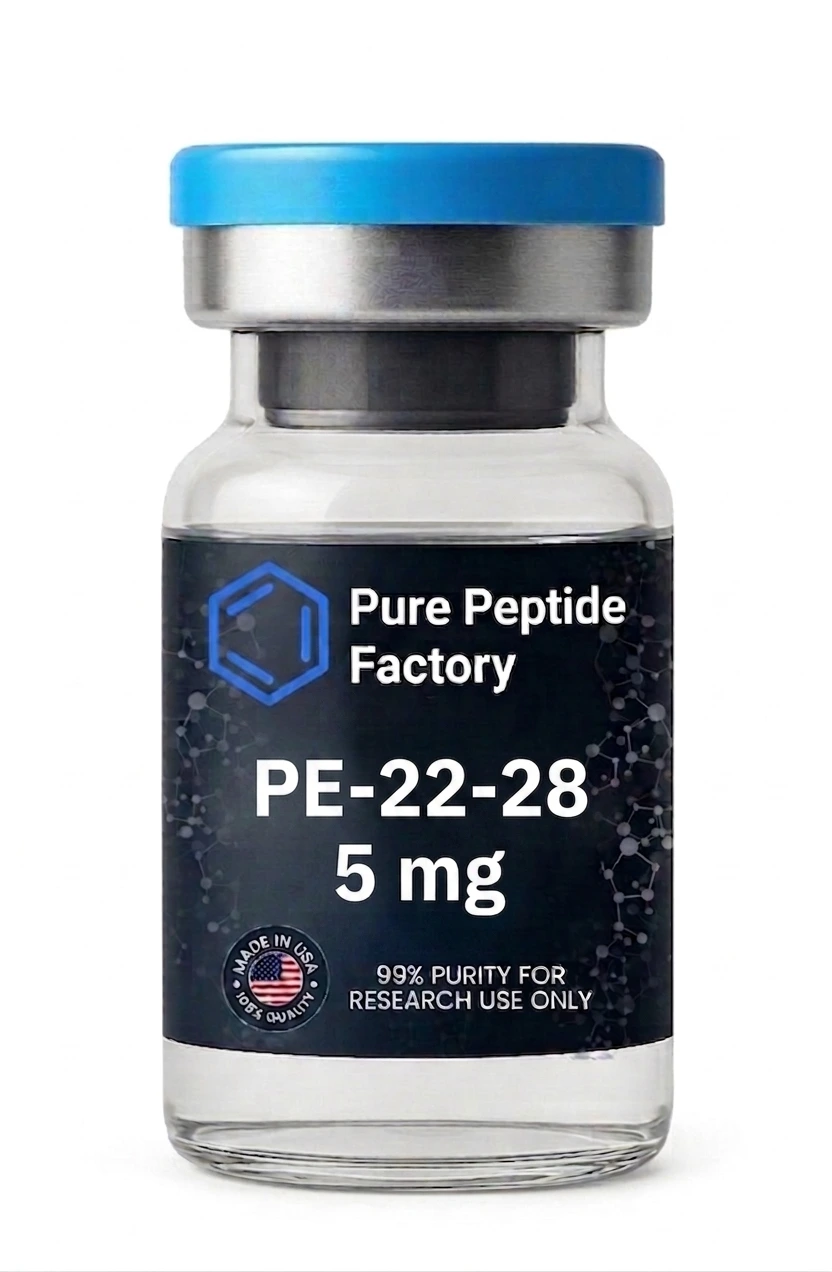
PE-22-28 5 mg
$210.00
Buy PE-22-28, a synthetic 7-amino-acid heptapeptide derived from spadin through research at the Institut de Pharmacologie Moléculaire et Cellulaire in France. PE-22-28 inhibits the TREK-1 potassium channel with an IC50 of 0.12 nM, making it 300 to 500 times more potent than parent spadin. The compound is studied for depression, neurogenesis, and anxiety research through the Djillani-Borsotto framework. HPLC verified at 98% minimum purity, batch-specific COA. 5mg vials. Research use only.
100 in stock
Buy PE-22-28: The Spadin-Derived Heptapeptide with 300x TREK-1 Potency
PE-22-28 is a 7-amino-acid synthetic heptapeptide developed by Alaeddine Djillani, Marc Borsotto, Catherine Heurteaux, and colleagues at the Institut de Pharmacologie Moléculaire et Cellulaire (Université Côte d’Azur) in France. The compound emerged from research on spadin (PE 12-28), itself a 17-amino-acid peptide derived from sortilin/neurotensin receptor 3 maturation. By studying the blood degradation products of spadin, the French research group identified PE-22-28 as the minimal active sequence, and critically, the sequence that outperforms parent spadin by 300 to 500 fold in TREK-1 channel inhibition.
This matters because TREK-1 (TWIK-related potassium channel 1) has been validated as a molecular target for antidepressant research. TREK-1 knockout mice show natural resistance to depression-like behaviors, and SSRI treatment produces its effects partly through TREK-1 downregulation. PE-22-28 bypasses the serotonergic system entirely, inhibiting TREK-1 directly with an IC50 of 0.12 nM. For researchers studying ion channel pharmacology, novel antidepressant mechanisms, or adult hippocampal neurogenesis, PE-22-28 is the tool that isolates TREK-1 blockade without the indirect effects of SSRI-based approaches.
Pure Peptide Factory stocks research-grade PE-22-28 with domestic cold-chain shipping and batch-specific HPLC documentation. If you need to buy PE-22-28 from a supplier that correctly characterizes the compound (it is a spadin derivative, not a galanin fragment as some vendors wrongly claim), this is the supplier.
Why Researchers Choose Pure Peptide Factory for PE-22-28
Correct Scientific Characterization
Several peptide vendors mischaracterize PE-22-28 in their product listings. Some describe it as a “galanin fragment” (wrong — galanin is a different neuropeptide with different receptors). Some describe it as a “TRPM4 inhibitor” (wrong — that is a different stroke research peptide with a similar-sounding target). PE-22-28 is a truncated spadin analog that targets the TREK-1 two-pore-domain potassium channel. We get this right because research protocols depend on correct compound identity.
Batch-Specific HPLC and Mass Spectrometry Documentation
PE-22-28 is a short heptapeptide with a simple sequence, which makes it easy to synthesize correctly but also easy to mislabel. Every batch we ship includes a lot-specific HPLC chromatogram and mass spectrometry report verifying the 773.9 g/mol molecular weight target, with Certificate of Analysis downloadable before your compound ships.
Domestic Cold-Chain Shipping
Small peptides remain stable in lyophilized form at -20°C for extended periods, but reconstituted solutions are temperature-sensitive. We ship from domestic cold-storage using phase-change cooling packs rated for 96-hour protection. Most orders reach your lab within 1 to 3 business days.
5mg Configuration for Research Protocols
Our 5mg vial configuration matches standard research protocol dosing. PE-22-28 is used at very low concentrations in published studies due to its sub-nanomolar potency at TREK-1, which means a single 5mg vial covers extensive pilot work or multiple standard rodent protocols without splitting vials or compromising reconstituted solution freshness.
Synthesis Logs Archived for 24 Months
Every batch is documented and archived. If your IRB or compliance office requests chain-of-custody records, synthesis documentation, or retention samples, they are available on request.
What Is PE-22-28?
A Spadin-Derived Heptapeptide
PE-22-28 is a 7-amino-acid synthetic peptide corresponding to positions 22 through 28 of the parent PE propeptide. The PE propeptide is a 44-amino-acid sequence released into circulation during the maturation of sortilin (also called neurotensin receptor 3, NTSR3). Sortilin is a type-1 transmembrane receptor involved in protein sorting and neurotrophin signaling.
When sortilin undergoes proteolytic maturation, the propeptide is cleaved and further degraded in the blood. Spadin (PE 12-28), a 17-amino-acid peptide, was identified as the first active fragment with antidepressant activity in the sequence. By studying the degradation products of spadin itself, the Djillani-Borsotto group discovered that the shorter PE 22-28 retained full TREK-1 inhibitory activity while gaining superior pharmacokinetic stability and potency.
Molecular Profile:
- Sequence: 7-amino-acid heptapeptide, positions 22-28 of the PE propeptide
- Molecular Weight: ~773.9 g/mol
- Parent compound: Spadin (PE 12-28, 17 aa)
- Origin molecule: PE propeptide (44 aa) from sortilin/NTSR3 maturation
- CAS: 1239309-61-7
- Synonyms: Mini-spadin, short spadin analog
How PE-22-28 Works: TREK-1 Channel Inhibition
TREK-1 is a two-pore-domain potassium channel (K2P family) that provides background potassium conductance, which stabilizes the resting membrane potential of neurons. In research models, TREK-1 is highly expressed in brain regions relevant to depression and mood regulation: prefrontal cortex, cingulate cortex, amygdala, hippocampus, nucleus accumbens, and dorsal raphe nucleus.
The pharmacological significance of TREK-1 inhibition in depression research comes from three converging lines of evidence:
First, TREK-1 knockout mice show natural resistance to depression-like behaviors in forced swim, tail suspension, and novelty suppressed feeding tests. Serotonergic neurons in these mice show increased activation similar to the effect chronic antidepressant treatment produces in wild-type animals.
Second, chronic SSRI treatment produces TREK-1 downregulation as part of its mechanism, suggesting TREK-1 inhibition contributes to antidepressant action even when the primary target is the serotonin transporter.
Third, selective TREK-1 blockers bypass the serotonergic system entirely, producing antidepressant-like effects through a parallel pathway. This is why PE-22-28 research has drawn attention as a tool compound: it allows researchers to isolate TREK-1 blockade from the indirect effects produced by SSRI-based approaches.
Potency comparison in hTREK-1/HEK cell patch-clamp assays:
| Compound | TREK-1 IC50 | Relative Potency |
|---|---|---|
| PE-22-28 | 0.12 nM | Reference (1x) |
| Spadin (PE 12-28) | 40 to 60 nM | 333 to 500x less potent |
This 300 to 500-fold potency increase, combined with improved in vivo stability, is why PE-22-28 has largely superseded spadin in contemporary TREK-1 inhibitor research.
PE-22-28 Research Applications
Depression and Antidepressant Research
The primary research application for PE-22-28 is behavioral depression modeling. Published Djillani et al. (Frontiers in Pharmacology, 2017) data documented efficacy across three standard rodent behavioral tests:
- Forced swim test: Significant reduction in immobility time following PE-22-28 treatment, consistent with antidepressant-like effects
- Novelty suppressed feeding test: Reduced latency to eat after 4-day sub-chronic treatment
- Tail suspension test: Reduced immobility duration in treated animals
A critical finding was that PE-22-28 produced these effects without the classical SSRI delayed onset. Standard SSRIs require 2 to 4 weeks of treatment before behavioral effects appear. PE-22-28 produced measurable effects within 4 days in rodent models, suggesting TREK-1 direct inhibition bypasses the receptor desensitization kinetics that delay SSRI efficacy.
Research using PE-22-28 in depression protocols examines:
- TREK-1 current inhibition in hippocampal and cortical neurons
- Serotonergic neuron firing rate changes under TREK-1 blockade
- Behavioral paradigm comparison with SSRIs and atypical antidepressants
- Chronic mild stress models and reversal efficacy
- Post-stroke depression research models examining TREK-1 overexpression reversal
Adult Hippocampal Neurogenesis
The Djillani 2017 study documented neurogenesis induction after only 4 days of PE-22-28 treatment, which is remarkable given that standard antidepressants typically require weeks to produce measurable neurogenic effects. This finding has positioned PE-22-28 as a research tool for studying the neurogenesis-depression link without the confound of delayed pharmacokinetics.
Research endpoints include:
- BrdU/DCX double-labeling in subgranular zone of dentate gyrus
- Newborn neuron maturation and integration timelines
- BDNF and TrkB signaling changes under TREK-1 inhibition
- Correlation between neurogenesis markers and behavioral recovery
The G/A-PE-22-28 analog, a modified version studied by the same group, showed prominent neurogenic effects and remains a research tool for protocols where enhanced neurogenesis readouts are the primary endpoint.
Anxiety and Stress Resilience Research
TREK-1 expression in the amygdala and hippocampus positions it as a target for anxiety research beyond pure depression modeling. Published protocols examine PE-22-28 effects on:
- Elevated plus maze and open field anxiety paradigms
- Acute stress response and HPA axis activation
- Chronic stress resilience and adaptation markers
- Fear conditioning and extinction learning
The absence of the classical SSRI side effect profile (sexual dysfunction, emotional blunting, GI effects, withdrawal syndrome) makes PE-22-28 a research-clean tool for studying anxiety mechanisms without confounds that complicate SSRI-based protocols.
TREK-1 Ion Channel Pharmacology
Beyond depression and anxiety, PE-22-28 serves as a selective pharmacological probe for TREK-1 biology in any research context where the channel’s role is under investigation. TREK-1 is also expressed in the pancreas, lungs, kidneys, heart, and muscle tissue, and PE-22-28 has been used as a tool to examine TREK-1’s function outside the central nervous system.
Research applications include:
- Mechanosensation and stretch-activated channel biology
- Polyunsaturated fatty acid regulation of K2P channels
- Cardiac arrhythmia and TREK-1 role in membrane potential
- Pulmonary smooth muscle function
Post-Stroke Depression Research
Post-stroke depression is a common complication of cerebral ischemia that is often resistant to conventional antidepressant therapy. Research has identified TREK-1 overexpression as a contributing mechanism. Published studies using both SSRIs and PE-22-28 in post-stroke depression models showed that PE-22-28 produced beneficial effects without the side effect burden of SSRIs, and with faster onset of action. This research thread extends PE-22-28’s applications into cerebrovascular research alongside primary depression protocols.
PE-22-28 vs Dihexa: Comparing Two Peptide Nootropic Research Compounds
The PE-22-28 vs Dihexa comparison is a common researcher question because both compounds target central nervous system pathways with reported cognitive and neurogenic effects. However, they work through fundamentally different mechanisms:
| Feature | PE-22-28 | Dihexa |
|---|---|---|
| Type | 7-amino-acid heptapeptide | 6-amino-acid oligopeptide |
| Origin | Spadin derivative (sortilin maturation) | Angiotensin IV analog |
| Primary target | TREK-1 potassium channel (K2P) | Hepatocyte growth factor (HGF)/c-Met |
| Mechanism | Direct channel inhibition | HGF/c-Met signaling amplification |
| Primary research focus | Depression, anxiety, TREK-1 biology | Synaptogenesis, memory, Alzheimer’s models |
| Behavioral endpoints | Forced swim, novelty suppressed feeding | Water maze, novel object recognition |
| Neurogenesis evidence | Adult hippocampal (4-day onset) | Dendritic spine formation, synaptogenesis |
| Oral bioavailability | Limited (standard heptapeptide) | Reported oral activity |
| Preferred administration | Subcutaneous or intranasal | Oral or subcutaneous |
When to choose PE-22-28: Depression and anxiety research, TREK-1 ion channel pharmacology, protocols requiring rapid-onset antidepressant-like behavioral effects, adult hippocampal neurogenesis studies.
When to choose Dihexa: Memory and learning research, synaptogenesis protocols, Alzheimer’s disease models focused on cognitive rescue, HGF/c-Met signaling studies.
Researchers running head-to-head cognitive or antidepressant protocols sometimes use both compounds to isolate different mechanisms within the same experimental design. Both are available from our facility under identical handling conditions.
PE-22-28 Nasal Spray: Intranasal Administration Research
PE-22-28 research protocols frequently use intranasal administration to target central nervous system targets while bypassing the blood-brain barrier limitations that affect peptide CNS delivery. The rationale is the same as for intranasal oxytocin in autism research: direct olfactory and trigeminal nerve pathway delivery to the brain with minimal systemic exposure.
Published research using intranasal PE-22-28 documents:
- Faster CNS onset compared to subcutaneous administration
- Reduced peripheral exposure, minimizing off-target effects at TREK-1 in peripheral tissues
- Compatibility with chronic dosing protocols where repeated injection burden would confound behavioral readouts
- Concentration-dependent CNS effects matching behavioral outcome measures
Research-grade lyophilized PE-22-28 can be reconstituted in sterile saline or bacteriostatic water to the target concentration and used in appropriate intranasal delivery devices for laboratory protocols. The nasal spray formulations sold by some vendors are pre-reconstituted lab-ready formats that eliminate the reconstitution step but are harder to customize to specific concentration requirements.
PE-22-28 Dosage Research Protocols
Published preclinical research dosing in rodent models:
| Research Context | Dose Range | Route | Frequency | Reference |
|---|---|---|---|---|
| Acute behavioral (forced swim) | Low dose, single administration | Intraperitoneal | Single dose pre-test | Djillani 2017 |
| Sub-chronic antidepressant (novelty suppressed feeding) | Per protocol, ng/kg range | Intraperitoneal | Daily x 4 days | Djillani 2017 |
| Neurogenesis induction | Per protocol | Intraperitoneal | Daily x 4 days | Djillani 2017 |
| Chronic stress reversal | Extended dosing | IP or IV | Per study design | Variable |
| TREK-1 electrophysiology | Sub-nanomolar IC50 | In vitro bath application | Dose-response | PMC5601071 |
| Intranasal CNS research | Protocol-dependent | Intranasal | Variable | Variable |
Because PE-22-28 produces sub-nanomolar TREK-1 inhibition, research protocols use substantially lower molar concentrations than typical peptides. The potency difference relative to spadin (300 to 500x) means PE-22-28 protocols are designed around the IC50 of 0.12 nM rather than the bulk peptide mass.
We do not provide human dosing recommendations. PE-22-28 has not been tested in human clinical trials. The dosing references above come from peer-reviewed rodent studies and are provided for research protocol design context only.
PE-22-28 Reddit Community Discussions
Reddit and peptide research forum discussions of PE-22-28 focus on several recurring research-community questions:
- The mechanism clarification — community discussions frequently correct the vendor misinformation labeling PE-22-28 as a galanin fragment. It is a spadin derivative targeting TREK-1, not galanin.
- Comparison with established antidepressants — the published 4-day onset in rodent behavioral models contrasts sharply with the 2 to 4 week SSRI onset, driving interest in TREK-1-selective mechanisms.
- Intranasal versus subcutaneous administration — community protocols often use intranasal routes, though systematic comparison research is limited.
- Combination with neurogenesis-focused compounds — PE-22-28 and Dihexa combination protocols appear in community discussions, though no peer-reviewed research has directly examined this pairing.
We do not provide human protocols. Research protocol design should reference peer-reviewed Djillani-Borsotto publications rather than community forum extrapolations.
How to Reconstitute PE-22-28
Step-by-Step Laboratory Protocol
- Sanitize the vial stopper with 70% isopropyl alcohol
- Inject bacteriostatic water slowly against the vial wall. Do not aim directly at the lyophilized powder
- Allow the cake to dissolve without agitation for 2 to 3 minutes
- Gently swirl until the solution is clear. Do not shake
- Inspect for clarity and label with date and concentration before use
Concentration reference:
- 5mg vial + 1mL water = 5mg/mL
- 5mg vial + 2.5mL water = 2mg/mL
- 5mg vial + 5mL water = 1mg/mL
- For sub-nanomolar research applications, prepare serial dilutions from reconstituted stock
Because PE-22-28 is used at very low concentrations in most research protocols, serial dilution from a concentrated stock is typical. Work from your IC50 target and allometric scaling rather than bulk peptide mass when designing dosing.
Storage Requirements
- Lyophilized powder: 24 months at -20°C, protected from light
- Reconstituted solution: 14 days at 2 to 8°C. Do not freeze reconstituted PE-22-28
- Working dilutions should be prepared fresh for behavioral studies where reproducibility is critical
- Avoid repeated freeze-thaw cycles on stock solutions
Buy PE-22-28: Regulatory Context
Research Use Status
PE-22-28 is not FDA approved for any indication and has not been tested in human clinical trials. The compound remains in preclinical research status. It is available for laboratory procurement under research-use-only terms without a prescription. This compound is not for human consumption, veterinary use, or diagnostic application. You must agree to research-use terms at checkout.
Why PE-22-28 Research Matters
TREK-1 as an antidepressant target represents one of the most promising new directions in depression research. Traditional SSRIs work through serotonergic mechanisms with known limitations: delayed onset, substantial side effect burden, partial response rates, and discontinuation syndromes. TREK-1 direct inhibition offers a mechanistically distinct pathway with faster kinetics in rodent models. PE-22-28 is the research tool that allows this mechanism to be studied in isolation. For the research community working on novel antidepressant development, this compound is foundational rather than optional.
Product Specifications
Available Configuration
PE-22-28 is available in 5mg vials. Select your quantity from the product options above.
Quality Verification
- Purity: 98% minimum (HPLC verified)
- Identity: Mass spectrometry confirmed against the 773.9 g/mol target
- Endotoxin: Less than 0.1 EU/mL
- Sterility: Verified per USP 71
- Form: Lyophilized powder
- Storage: -20°C long-term, 2 to 8°C short-term after reconstitution
Current Batch: #PPF-PE22-0426 Purity: 98.9% Download: HPLC Certificate | MS Report
FAQ
What is PE-22-28 used for in research?
PE-22-28 is used in depression and antidepressant research, anxiety paradigms, adult hippocampal neurogenesis studies, TREK-1 ion channel pharmacology, post-stroke depression models, and ion channel biology research across multiple tissue types. It serves as a selective research tool for isolating TREK-1 blockade effects from serotonergic system involvement.
Where can I buy PE-22-28 for research?
Pure Peptide Factory stocks research-grade PE-22-28 in 5mg vials with batch-specific HPLC and mass spectrometry documentation. Domestic cold-chain shipping delivers most orders within 1 to 3 business days.
What is PE-22-28’s mechanism of action?
PE-22-28 selectively inhibits the TREK-1 two-pore-domain potassium channel (K2P family) with an IC50 of 0.12 nM. TREK-1 inhibition produces antidepressant-like effects in behavioral models by increasing neuronal excitability in brain regions including prefrontal cortex, hippocampus, amygdala, and dorsal raphe nucleus. The mechanism is independent of the serotonergic system, which distinguishes it from SSRIs and most classical antidepressants.
What are PE-22-28’s benefits in research models?
Published research in rodent models documents rapid-onset antidepressant-like behavioral effects (4 days versus 2 to 4 weeks for SSRIs), induction of adult hippocampal neurogenesis, reduced immobility in forced swim and tail suspension tests, and anxiolytic-like effects in open field and elevated plus maze paradigms. Notably, these effects occur without the SSRI side effect profile documented in classical antidepressant research.
How does PE-22-28 compare to Dihexa?
PE-22-28 targets TREK-1 for depression and anxiety research. Dihexa targets HGF/c-Met signaling for synaptogenesis and memory research. They operate through completely different mechanisms and answer different research questions. See the comparison section above for full detail.
What is the correct dosage for PE-22-28 in research?
Published rodent protocols use low doses (sub-microgram to low microgram ranges) reflecting PE-22-28’s sub-nanomolar TREK-1 IC50. Exact dosing depends on model, route, and endpoint. Acute behavioral studies use single administration. Sub-chronic neurogenesis studies use daily x 4 days. We do not provide human dosing recommendations.
Is PE-22-28 the same as spadin?
No. Spadin is a 17-amino-acid peptide (PE 12-28 position). PE-22-28 is a shorter 7-amino-acid fragment derived from spadin through blood degradation product analysis. PE-22-28 is 300 to 500 times more potent at TREK-1 than parent spadin and has better in vivo stability. Both compounds target TREK-1, but PE-22-28 is the research-preferred tool due to its improved pharmacology.
Is PE-22-28 a galanin fragment?
No. PE-22-28 is a spadin derivative (spadin is itself derived from sortilin/neurotensin receptor 3 maturation). It is not related to galanin. Some peptide vendors mislabel it in product descriptions, but the correct mechanism target is the TREK-1 potassium channel.
Can PE-22-28 be administered intranasally?
Intranasal administration is a common research route for PE-22-28 to target CNS expression of TREK-1 while bypassing blood-brain barrier limitations that affect peptide CNS delivery. Research protocols using intranasal delivery document faster CNS onset with reduced peripheral exposure compared to subcutaneous routes.
How should PE-22-28 be stored?
Lyophilized powder stores at -20°C for up to 24 months protected from light. Reconstituted solution stores at 2 to 8°C for 14 days. Do not freeze reconstituted PE-22-28. Prepare working dilutions fresh from stock for behavioral studies requiring reproducibility.
Order PE-22-28 for Research
Secure Checkout
- Credit card, cryptocurrency, or wire transfer
- Same-day dispatch for orders placed before 2 PM EST
- Cold-chain packaging with phase-change cooling
- Discreet labeling with full tracking
Institutional Accounts
Net-30 terms and purchase order acceptance available for universities and pharmaceutical companies. Contact us for bulk pricing on 50 vials or more.
Add to cart and get research-grade PE-22-28 delivered with the documentation your TREK-1 pharmacology or antidepressant research requires.
Related products
-
P21 (P021) 5 mg
$120.00