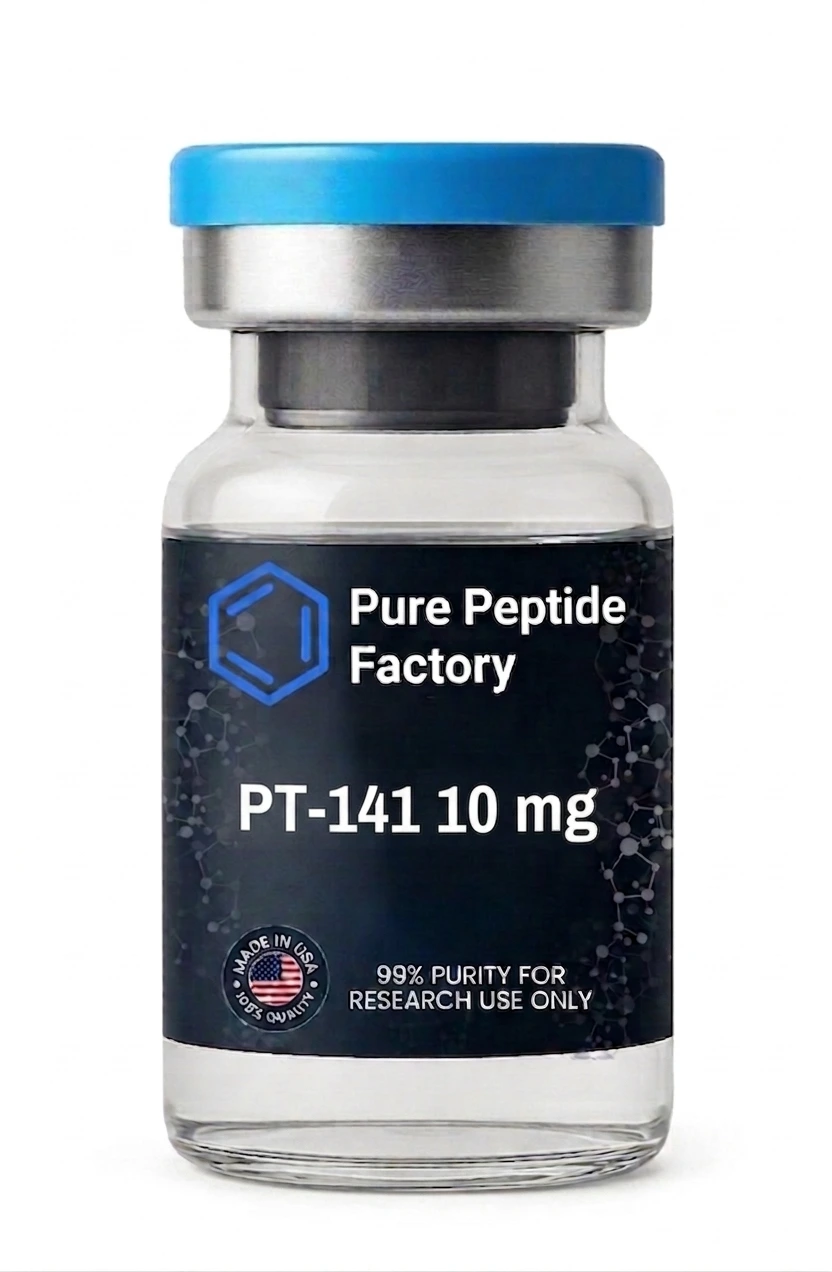
PT-141 10 mg
$60.00
PT-141, also known as bremelanotide, is a cyclic heptapeptide melanocortin receptor agonist and the active ingredient in Vyleesi, FDA-approved for hypoactive sexual desire disorder in premenopausal women. Research-grade PT-141 is studied for melanocortin receptor pharmacology, autonomic nervous system signaling, sexual function mechanisms, pigmentation biology, and cardiovascular effects. Available in 10mg vials. HPLC verified at 99% minimum purity, batch-documented, domestic cold-chain shipping. Research use only.
PT-141 Side Effects, Dosage, and Research Data: Bremelanotide 10mg
PT-141 side effects are among the most thoroughly documented of any research peptide because bremelanotide, the active compound in Vyleesi, completed Phase 3 clinical trials and received FDA approval in 2019. Consequently, researchers studying melanocortin receptor pharmacology, sexual function mechanisms, and autonomic nervous system signaling work with a compound that has a validated human safety profile that most research peptides simply do not have.
Furthermore, PT-141 is structurally distinct from all other peptides in our catalog. It is the only melanocortin-specific cyclic peptide we carry, and its receptor selectivity for MC3R and MC4R over MC1R differentiates it mechanistically from alpha-MSH and ACTH-derived compounds. As a result, researchers building melanocortin pathway studies need PT-141 as a specific pharmacological probe that no other compound in this niche can replace.
Pure Peptide Factory stocks research-grade PT-141 in 10mg vials with batch-specific HPLC documentation and domestic cold-chain shipping. Additionally, because Peptide Sciences has permanently shut down operations, researchers who previously sourced PT-141 there need a verified domestic alternative. We maintain consistent inventory with same-day dispatch.
Why Researchers Buy PT-141 from Pure Peptide Factory
PT-141 Side Effects Are Documented Through FDA Clinical Trials
Bremelanotide’s FDA approval as Vyleesi means that PT-141 side effects, pharmacokinetics, and human safety data are documented through a regulatory process rather than estimated from limited animal studies. Consequently, researchers designing translational protocols have access to validated human data including absorption kinetics, adverse effect frequencies, and contraindication signals that most research peptides lack entirely. Furthermore, this clinical infrastructure makes PT-141 one of the most research-ready compounds in the melanocortin field.
Batch-Specific HPLC Documentation for a Cyclic Peptide
PT-141 is a cyclic heptapeptide, meaning its ring structure requires confirmation beyond simple molecular weight verification. Specifically, the lactam bridge between lysine and aspartic acid residues defines the cyclic conformation responsible for receptor selectivity. Because linear analogs and degraded cyclic peptides can share similar molecular weights, mass spectrometry confirmation of the cyclic structure is essential for research integrity. Every vial we ship includes a lot-specific HPLC chromatogram and mass spectrometry report confirming both the molecular weight at 1025.2 g/mol and cyclic structure identity.
Domestic Cold-Chain When Peptide Sciences Has Closed
Peptide Sciences permanently ceased operations in 2026. Because they were a primary domestic PT-141 source for many researchers, their closure created an immediate supply gap. We maintain active domestic synthesis batches with consistent inventory in 10mg configurations. Additionally, all orders ship same-day from cold-storage with phase-change cooling and arrive within 1 to 3 business days.
The Melanocortin Research Ecosystem
We stock PT-141 alongside ACTH 1-39, the full-length ACTH peptide that contains the alpha-MSH sequence within it, giving researchers building comprehensive melanocortin pathway studies access to both a selective MC3R/MC4R agonist and the broader melanocortin hormone from one supplier under identical batch handling conditions.
What Is PT-141?
Bremelanotide: A Cyclic Melanocortin Peptide Derived from Melanotan II
PT-141 is a synthetic cyclic heptapeptide derived from melanotan II, which is itself an analog of alpha-melanocyte-stimulating hormone. Specifically, the synthesis of PT-141 from melanotan II involved removing the C-terminal amide group and allowing cyclization through a lactam bridge. Consequently, PT-141 has enhanced metabolic stability compared to linear melanocortin peptides and greater MC3R/MC4R selectivity compared to its melanotan II precursor.
Furthermore, PT-141’s selectivity profile distinguishes it from alpha-MSH and ACTH-derived compounds. While alpha-MSH and ACTH activate MC1R with high affinity for melanogenic effects, PT-141 shows lower MC1R affinity and higher selectivity for MC3R and MC4R, which mediate central nervous system effects including autonomic responses, energy balance, and neuroendocrine signaling. As a result, PT-141 side effects research focuses on these central pathways rather than the pigmentation responses that dominate alpha-MSH studies.
Molecular Profile:
- Sequence: Cyclo(Nle-Asp-His-D-Phe-Arg-Trp-Lys) (cyclic lactam)
- Molecular Formula: C50H69N15O9
- Molecular Weight: 1025.2 g/mol
- CAS: 189691-06-3
- Also known as: Bremelanotide, Vyleesi (brand name), PT141
How PT-141 Works: The MC3R and MC4R Pathway
PT-141 binds melanocortin receptors, particularly MC3R in the hypothalamus and limbic system and MC4R throughout the central nervous system, with lower affinity for MC1R compared to alpha-MSH and ACTH. Upon MC3R and MC4R activation, PT-141 triggers Gs protein coupling and downstream cAMP elevation, which researchers study for its role in central autonomic signaling.
Furthermore, the MC4R pathway is of particular research interest because of its established role in energy homeostasis, autonomic nervous system regulation, and cardiovascular effects. Because MC4R expression occurs in both central and peripheral tissues including the heart and vasculature, PT-141 activation of this receptor produces effects that extend beyond the neuroendocrine axis into cardiovascular physiology. Consequently, PT-141 side effects on heart rate and blood pressure are mechanistically linked to this peripheral MC4R distribution and form a key area of cardiovascular melanocortin research.
PT-141 Side Effects: Complete Clinical Trial Safety Data
Published PT-141 Side Effects from FDA Approval Research
Because bremelanotide completed Phase 3 clinical trials for FDA approval, PT-141 side effects are documented with a specificity and statistical power that preclinical-only compounds cannot match. Consequently, researchers designing in vivo protocols have access to a characterized adverse effect profile rather than extrapolating from limited rodent data. The following PT-141 side effects were documented in the clinical trial populations:
| PT-141 Side Effect | Frequency in Clinical Trials | Mechanism |
|---|---|---|
| Nausea | 40% of subjects | MC3R activation in area postrema, central emetic pathway |
| Flushing | 20% of subjects | Peripheral vasodilation through melanocortin receptor activation |
| Headache | 11% of subjects | Vasodilatory effects, central MC4R activation |
| Blood pressure elevation | Transient, dose-dependent | MC4R cardiovascular activation, typically resolves within 12 hours |
| Heart rate increase | Transient, dose-dependent | Sympathetic nervous system activation through central MC4R |
| Hyperpigmentation | Focal, injection site | Residual MC1R activity on local melanocytes |
Furthermore, the FDA label identifies cardiovascular disease as a contraindication signal for bremelanotide, specifically elevated baseline blood pressure, because of the transient hypertensive PT-141 side effects observed in clinical populations. Additionally, the nausea profile is consistent with central MC3R activation at the area postrema. As a result, researchers designing animal models should incorporate cardiovascular monitoring and gastric motility measurement as appropriate endpoints when using PT-141 at higher doses.
PT-141 Nasal Spray Side Effects vs Injectable Side Effects
Researchers examining PT-141 nasal spray side effects versus subcutaneous injection side effects should understand that route of administration affects both absorption kinetics and the relative severity of adverse events. Specifically, intranasal delivery produces lower peak plasma concentrations compared to subcutaneous injection at equivalent doses, consequently reducing the magnitude of cardiovascular and emetic PT-141 side effects while achieving meaningful central nervous system exposure through olfactory and systemic routes.
In research models, intranasal administration is therefore used when researchers need to study central melanocortin effects while minimizing peripheral PT-141 side effects that can confound behavioral endpoints. Subcutaneous injection, on the other hand, is preferred when systemic bioavailability and defined pharmacokinetics are the study priority.
PT-141 Peptide Benefits: Research Applications
PT-141 Peptide Benefits for Melanocortin Receptor Pharmacology
The primary application of PT-141 in research is as a selective pharmacological probe for MC3R and MC4R. Because of its preferential selectivity over MC1R, PT-141 allows researchers to activate the central melanocortin axis while minimizing the confounding pigmentation and immunomodulatory effects that alpha-MSH and ACTH produce through strong MC1R agonism. Consequently, researchers studying MC4R-dependent effects on energy balance, autonomic regulation, and neuroendocrine signaling use PT-141 to isolate these pathways from the melanogenic response.
Furthermore, PT-141 peptide benefits for receptor pharmacology include its cyclic structure stability, which makes it more reliable as an experimental probe than linear peptide analogs that degrade rapidly under assay conditions. As a result, concentration-response relationships remain consistent across extended incubation periods in cell-based assays, which is a practical advantage that linear melanocortin ligands do not offer.
PT-141 Peptide Benefits for Sexual Function Research
The sexual function research profile of PT-141 is the most extensively documented of any melanocortin compound, given its path through clinical trials to FDA approval as Vyleesi. Specifically, Wessells et al. published in the Journal of Urology in 2003 demonstrated that PT-141 produced measurable physiological responses through central MC3R and MC4R activation rather than through vascular smooth muscle directly. This central mechanism distinguishes PT-141 mechanistically from PDE5 inhibitors, which act peripherally through nitric oxide pathways.
Additionally, Shadiack et al. published in the Journal of Sexual Medicine in 2007 confirmed that PT-141 mechanism involves hypothalamic and limbic MC4R activation, producing autonomic responses that researchers study as a model for central nervous system control of arousal in both male and female rodent models. Consequently, PT-141 is used to investigate how MC4R signaling in the hypothalamus integrates with peripheral physiological responses, a research question with implications beyond sexual function to broader autonomic neuroscience.
PT-141 Peptide Benefits for Cardiovascular and Autonomic Research
Beyond its central nervous system effects, PT-141 activates MC4R receptors in cardiovascular tissue, producing transient heart rate and blood pressure changes that researchers study to characterize the cardiovascular role of the melanocortin system. Furthermore, the cardiovascular PT-141 side effects documented in clinical trials make this compound particularly useful for researchers specifically studying melanocortin cardiovascular biology rather than trying to avoid these effects as confounders.
Specifically, researchers use PT-141 to examine how MC4R activation in the nucleus tractus solitarius and other brainstem regions influences cardiovascular autonomic tone, blood pressure regulation, and heart rate variability. As a result, studies of the melanocortin cardiovascular axis frequently use PT-141 as their primary pharmacological tool because its receptor selectivity profile provides cleaner mechanistic data than non-selective melanocortin ligands.
PT-141 Half Life and Pharmacokinetics
PT-141 Half Life Data from Clinical Research
The PT-141 half life from human pharmacokinetic data is approximately 2.7 hours following subcutaneous administration. Furthermore, maximum plasma concentration is reached within approximately 1 hour of subcutaneous injection. Consequently, researchers designing sampling protocols should plan their measurement windows within 30 to 90 minutes of administration to capture peak receptor engagement and extend monitoring to 4 to 6 hours to characterize the full pharmacokinetic profile.
Additionally, the PT-141 half life varies by administration route. Intranasal delivery produces a longer time to maximum concentration but a similar half life once absorbed. Intraperitoneal administration in rodent models produces faster absorption and a shorter time to peak compared to subcutaneous in the same species. As a result, researchers should use published route-specific pharmacokinetic data for their specific model species when designing sampling schedules and planning for the onset of PT-141 side effects in monitoring protocols.
The metabolic stability conferred by PT-141’s cyclic lactam structure contributes to its extended half life compared to linear melanocortin peptides, which typically clear within 30 to 60 minutes. Consequently, PT-141’s 2.7-hour half life enables study designs that capture extended receptor activation effects that linear analog protocols cannot investigate.
PT-141 Dosage: Reference Protocols for Research
Peptide PT-141 Dosage in Published Animal Research
Researchers searching for peptide PT-141 dosage data will find a well-developed literature base given the compound’s clinical trial history. Furthermore, the existence of FDA-approved human dosing data provides a validated reference point for scaling animal model protocols through allometric conversion.
| Model | Dose | Route | Endpoint |
|---|---|---|---|
| Male rat sexual function | 0.1 to 1 mg/kg | Subcutaneous | Behavioral and physiological response markers |
| Female rodent model | 0.1 to 0.3 mg/kg | Subcutaneous | Autonomic and behavioral endpoints |
| Cardiovascular PT-141 side effects monitoring | 0.3 to 1 mg/kg | IV or subcutaneous | Blood pressure, heart rate, autonomic tone |
| MC4R receptor pharmacology | 1 nM to 10 microM | In vitro cell culture | cAMP, receptor binding, downstream signaling |
| Human (Vyleesi FDA-approved) | 1.75 mg total dose | Subcutaneous, single injection | HSDD primary endpoint, PT-141 side effects profile |
PT-141 Dosage in mL: Converting Your Working Concentration
Researchers frequently search for PT-141 dosage in mL because the conversion from weight-based dose to injection volume requires knowing the reconstituted concentration of your specific vial. Furthermore, because PT-141 is supplied as a 10mg lyophilized powder, the volume added during reconstitution directly determines the concentration and consequently the injection volume for each dose. Correct concentration also ensures PT-141 side effects are not exaggerated by accidental overdosing from miscalculated volumes.
| Water Added to 10mg Vial | Final Concentration | Volume for 0.1mg dose | Volume for 0.5mg dose | Volume for 1mg dose |
|---|---|---|---|---|
| 1 mL | 10 mg/mL | 0.01 mL (10 mcL) | 0.05 mL (50 mcL) | 0.1 mL (100 mcL) |
| 2 mL | 5 mg/mL | 0.02 mL (20 mcL) | 0.1 mL (100 mcL) | 0.2 mL (200 mcL) |
| 5 mL | 2 mg/mL | 0.05 mL (50 mcL) | 0.25 mL (250 mcL) | 0.5 mL (500 mcL) |
| 10 mL | 1 mg/mL | 0.1 mL (100 mcL) | 0.5 mL (500 mcL) | 1 mL |
PT-141 10mg Dosage Considerations for Protocol Design
Because our standard vial is 10mg, researchers planning extended animal studies should calculate total compound requirements before ordering to avoid disrupting protocols with reorder delays. Specifically, a standard 4-week rodent study using 1 mg/kg daily in 250g rats requires approximately 7mg of compound for a single animal. Consequently, the 10mg vial covers one animal through a complete study cycle with margin for dose-finding and pilot runs. Additionally, researchers monitoring PT-141 side effects across dose escalation protocols should budget additional compound for the lower-dose exploratory phase before committing to the primary study concentration.
We do not provide human dosing recommendations. PT-141 is sold strictly for laboratory research purposes. The FDA-approved human dose of 1.75mg for Vyleesi is provided as a reference point for translational scaling only.
How to Reconstitute PT-141: Minimizing Side Effects Through Correct Preparation
Why Correct Reconstitution Matters for PT-141 Side Effects Research
Correct reconstitution technique directly affects compound integrity and helps researchers distinguish true PT-141 side effects from preparation-related artefacts in their assay systems. Specifically, contaminated or improperly prepared solutions introduce inflammatory responses at injection sites that can mimic or mask genuine melanocortin-mediated PT-141 side effects, confounding the adverse event profile documented in clinical trials. Furthermore, use bacteriostatic water rather than sterile water for injection to enable multi-draw use over the 28-day post-puncture window.
- Allow the PT-141 vial to reach room temperature before reconstitution to avoid thermal shock.
- Sanitize the vial stopper with 70% isopropyl alcohol and allow to dry for 30 seconds.
- Draw the required volume of bacteriostatic water into a sterile syringe.
- Insert the needle at an angle and inject water slowly against the vial wall. Do not aim the stream at the lyophilized cake.
- Allow to dissolve without agitation for 1 to 2 minutes. PT-141 dissolves readily due to its moderate hydrophilicity.
- Gently swirl until fully clear. Do not shake vigorously as this promotes aggregation in cyclic peptides.
- Inspect for clarity before use. Label with reconstitution date, concentration, and lot number.
PT-141 Side Effects Monitoring: Storage and Stability Notes
Proper storage prevents compound degradation that produces impurity profiles capable of triggering non-specific inflammatory PT-141 side effects in sensitive animal models. Additionally, protecting reconstituted PT-141 from light is essential because the tryptophan residue in the sequence is sensitive to UV exposure and can oxidize under inadequate storage conditions.
- Lyophilized powder: 24 months at -20°C, protected from light
- Reconstituted solution: 14 to 28 days at 2 to 8°C under sterile conditions. Do not freeze
- Aliquot into single-use volumes for protocols requiring multiple weekly administrations to minimize freeze-thaw cycling
- Furthermore, label every vial with reconstitution date and concentration to avoid dosing errors that exaggerate PT-141 side effects
PT-141 and Vyleesi: FDA Approval Context for Researchers
The Same Molecule, Different Regulatory Contexts
Bremelanotide is the International Nonproprietary Name for PT-141. Vyleesi is the brand name for the FDA-approved subcutaneous formulation indicated for hypoactive sexual desire disorder in premenopausal women. Consequently, PT-141 as a research compound and Vyleesi as a pharmaceutical product contain the same active molecule but differ in formulation, excipients, and regulatory status. Furthermore, the commercial product does not permit the custom concentrations, vehicles, and administration routes that research protocols require, which is why researchers source the lyophilized research-grade compound rather than reformulating from the finished pharmaceutical product.
Additionally, the FDA approval of Vyleesi means that the PT-141 side effects profile, pharmacokinetics, and contraindication signals are characterized through a regulatory process. As a result, researchers working with PT-141 have access to a level of background clinical data that makes translational protocol design considerably more straightforward than for compounds that have never reached clinical trials. The clinical pharmacology data published by Hadley et al. provides a validated reference framework for designing dose-response and PT-141 side effects monitoring protocols.
PT-141 Side Effects: Product Specifications and Quality Standards
PT-141 10mg Vial Specifications
Batch purity verification is particularly important for PT-141 side effects research because compound impurities at the injection site can produce inflammatory responses that confound the melanocortin-specific adverse effect profile documented in clinical trials. Every vial we supply undergoes the following verification before release:
| SKU | Configuration | Best For |
|---|---|---|
| PT141-10 | 10mg per vial, 10 vials per kit | Receptor pharmacology, PT-141 side effects monitoring studies, cardiovascular research, extended protocols |
- Purity: 99% minimum (HPLC verified)
- Identity: Mass spectrometry confirmed at 1025.2 g/mol, cyclic structure verified
- Endotoxin: Less than 0.1 EU/mL
- Sterility: Verified per USP 71
- Form: Lyophilized powder
- Storage: -20°C long-term, 2 to 8°C short-term
Current Batch: #PPF-PT141-0426
Purity: 99.4%
Download: HPLC Certificate | MS Report
Frequently Asked Questions About PT-141 Side Effects and Research Use
What are the PT-141 side effects in clinical research?
Clinical trial data from the Vyleesi FDA approval process documents nausea in approximately 40% of subjects, flushing in 20%, headache in 11%, and transient blood pressure elevation as the primary PT-141 side effects. Furthermore, focal hyperpigmentation at the injection site has been observed due to residual MC1R activity on local melanocytes. All PT-141 side effects are dose-dependent and generally resolve within 12 hours of administration.
What is the PT-141 half life?
The PT-141 half life is approximately 2.7 hours following subcutaneous administration in humans, with maximum plasma concentration reached within 1 hour. Consequently, researchers should plan sampling windows accordingly when designing PT-141 side effects monitoring and pharmacodynamic protocols. The cyclic lactam structure extends the half life significantly beyond linear melanocortin peptide analogs.
What are the PT-141 peptide benefits for research?
PT-141 peptide benefits for research include its high selectivity for MC3R and MC4R over MC1R, enabling targeted melanocortin pathway studies without the melanogenic confounders of alpha-MSH. Furthermore, its cyclic structure provides metabolic stability in cell-based assays, and the availability of FDA-approved human pharmacokinetic and PT-141 side effects data makes it one of the most translatable research compounds in the melanocortin field.
How does PT-141 dosage for women research differ from men?
The FDA-approved dose for Vyleesi in premenopausal women is 1.75mg subcutaneously as a single dose. In animal models, published female rodent protocols typically use lower dose ranges of 0.1 to 0.3 mg/kg compared to male rodent protocols of 0.1 to 1 mg/kg for equivalent behavioral and physiological endpoints. Additionally, PT-141 side effects including cardiovascular responses may differ between sexes in rodent models, which is why sex-specific dosing literature should guide protocol design rather than applying male-derived doses to female subjects.
What is the PT-141 10mg dosage protocol for receptor pharmacology?
For in vitro receptor pharmacology assays, researchers typically use nanomolar to micromolar concentrations derived from high-concentration stock solutions in DMSO diluted into assay buffer. For in vivo rodent protocols, the 10mg vial reconstituted to 2mg/mL provides a practical working stock for weight-based dosing across cohorts of 250g to 350g rats over 4-week study timelines. Furthermore, researchers should monitor cardiovascular PT-141 side effects across dose levels to characterize the therapeutic window for their specific research endpoints.
Is PT-141 the same as bremelanotide?
Yes. PT-141 is the research designation for bremelanotide. Vyleesi is the brand name for the FDA-approved pharmaceutical formulation. All three names refer to the same cyclic heptapeptide melanocortin receptor agonist with CAS number 189691-06-3.
What are PT-141 nasal spray side effects compared to injection?
Intranasal PT-141 produces lower peak plasma concentrations than subcutaneous injection at equivalent doses. Consequently, PT-141 nasal spray side effects including nausea, flushing, and blood pressure elevation are typically less pronounced than with injection, though central MC4R receptor engagement for autonomic and neuroendocrine endpoints can still be achieved through the intranasal route via olfactory and systemic absorption pathways. Researchers who need to study PT-141 side effects specifically should therefore use subcutaneous administration to replicate the clinical trial conditions under which the adverse effect profile was characterized.
Where can I find PT-141 after Peptide Sciences closed?
Pure Peptide Factory maintains active domestic PT-141 inventory in 10mg vials with same-day shipping. Furthermore, we provide batch-specific HPLC and mass spectrometry documentation including cyclic structure verification, which is essential for researchers who need to confirm compound integrity and distinguish true PT-141 side effects from preparation-related artefacts before incorporating the compound into their protocols.
What is the PT-141 dosage in mL for a 250g rat?
For a 250g rat at 0.5 mg/kg using a 2mg/mL reconstituted solution, the injection volume is 0.0625 mL or 62.5 microliters. Specifically, calculate dose in mg (0.5 mg/kg multiplied by 0.25 kg equals 0.125 mg), then divide by concentration (0.125 mg divided by 2 mg/mL equals 0.0625 mL). Additionally, our dosage-in-mL table above pre-calculates common dose and concentration combinations for quick protocol reference, reducing the calculation errors that produce accidental overdosing and exaggerated PT-141 side effects in animal models.
Order PT-141 for Research
Secure Checkout
- Credit card, cryptocurrency, or wire transfer
- Same-day dispatch for orders placed before 2 PM EST
- Cold-chain packaging with phase-change cooling
- Discreet labeling and full tracking
Institutional Accounts
Net-30 terms and purchase order acceptance are available for universities and pharmaceutical companies. Furthermore, multi-year supply agreements are available for research programs that need consistent PT-141 inventory following the closure of Peptide Sciences. Contact our research team to discuss requirements.
Add to cart and get batch-verified PT-141 with cyclic structure confirmation, FDA-backed clinical PT-141 side effects data, and same-day domestic delivery.
Related products
-
Triptorelin
$45.00