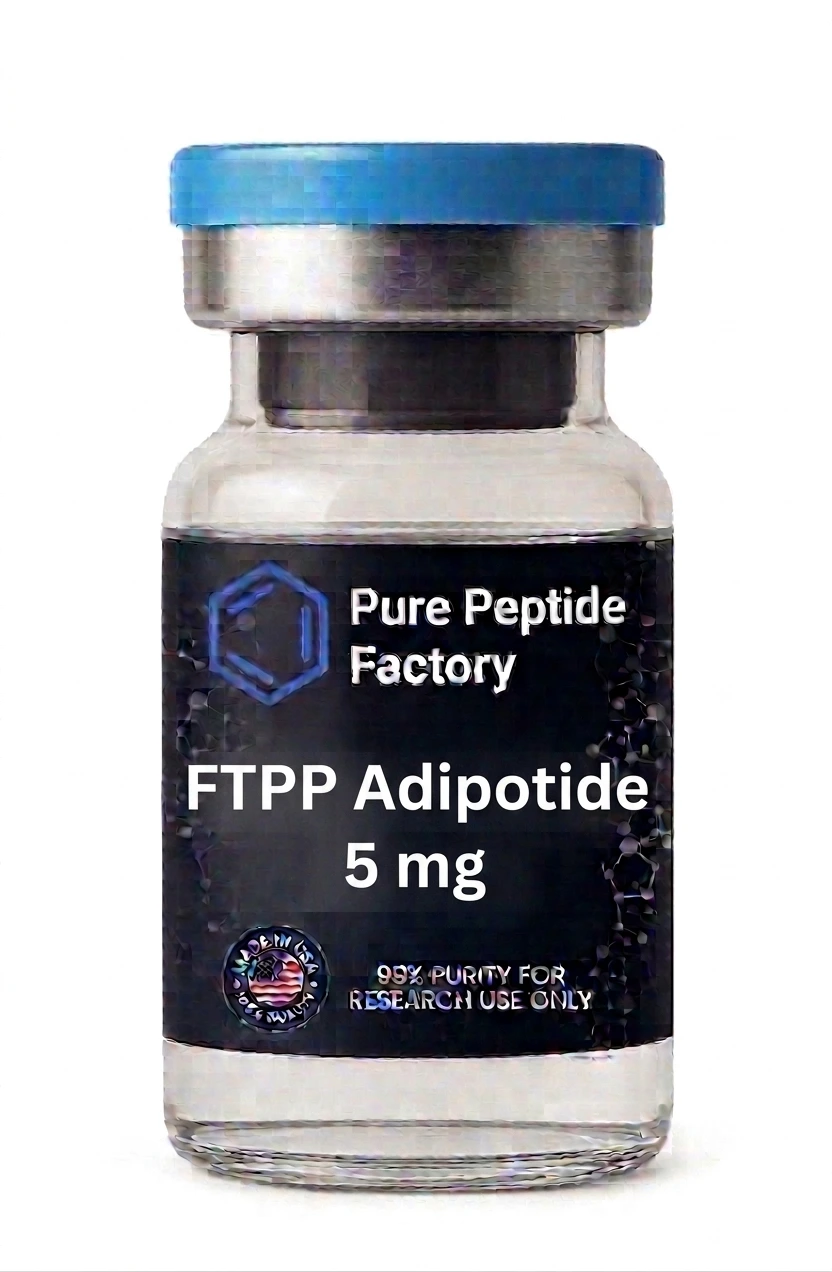
FTPP Adipotide 5 mg
$85.00
Adipotide FTPP is a fat-targeted proapoptotic peptide that destroys white adipose tissue vasculature in research models. Supplied as 5mg lyophilized powder per vial, 10 vials per kit, with batch-specific HPLC verification and mass spectrometry confirmation. Domestic cold-chain shipping. Research use only.
Adipotide FTPP for Sale: The Peptide That Cuts Off Fat at the Source
Most research compounds try to burn fat by speeding up metabolism or suppressing appetite. Adipotide FTPP does neither. It goes after the blood vessels that feed fat cells and shuts them down. In primate studies, this approach produced an 11% drop in body weight and a 39% reduction in body fat without changing how much the animals ate. The fat simply died because its supply line was severed.
Pure Peptide Factory stocks research-grade Adipotide FTPP in 5mg vials, 10 vials per kit, with batch-specific HPLC verification and domestic cold-chain shipping. If your adipose biology or metabolic research program needs a compound that works through vascular apoptosis rather than hormonal manipulation, this is the one.
Why Researchers Buy Adipotide FTPP from Pure Peptide Factory
Purity Documentation You Can Verify Before You Order
Adipotide FTPP is a short peptide sequence. Short peptides are cheap to make and just as easy to degrade during synthesis or storage. A compromised batch will not trigger the same vascular apoptosis response, which means your data becomes unreliable before you even start. Every batch we ship includes a lot-specific HPLC chromatogram and mass spectrometry report. Download the COA, check the molecular weight against published data, and confirm sequence integrity. No generic certificates. No guesswork.
Domestic Cold-Chain That Protects Compound Stability
We ship from domestic cold-storage with phase-change cooling. Most orders arrive within 1 to 3 business days. Adipotide FTPP is sensitive to temperature degradation, and overseas suppliers cannot guarantee cold-chain integrity across customs and freight delays. We can.
One Kit, No Overbuying
Each kit contains 10 vials at 5mg per vial. That is 50mg total, which suits most dose-finding studies, short-term animal protocols, and cell culture work. You get exactly what your protocol needs without splitting vials or wasting compound.
Synthesis Logs Archived for 24 Months
Every batch is logged and archived. If your IRB or compliance office requests chain-of-custody documentation, it is ready before your compound arrives.
What Is Adipotide FTPP?
A Peptide Engineered to Starve Fat Cells
Adipotide FTPP stands for Fat-Targeted Proapoptotic Peptide. It is also known as Prohibitin-TPP or KGGRAKD-TPP. The compound is an 8-amino-acid sequence (KGGRAKD) fused to a proapoptotic domain (D-(KLAKLAK)2). This design is deliberate. It performs two distinct jobs in sequence.
First, the KGGRAKD sequence binds to prohibitin, a receptor found almost exclusively on blood vessels feeding white adipose tissue. Second, the proapoptotic domain triggers programmed cell death in those same endothelial cells. The result is selective vascular destruction inside fat deposits. Without blood supply, adipocytes shrink and die. The body clears the debris through normal metabolic pathways.
Molecular Profile:
-
Sequence: KGGRAKD-D-(KLAKLAK)2
-
Molecular Formula: C111H204N36O28S2
-
Molecular Weight: 2512.26 g/mol (some sources cite 2555.22 g/mol or 2611.41 g/mol depending on salt form and counterion)
-
CAS: 137525-51-0 (also reported as 859216-15-2 for acetate salt)
-
Target: Prohibitin on adipose vasculature
-
Mechanism: Proapoptotic vascular destruction
How Adipotide FTPP Works at the Cellular Level
Adipotide FTPP operates through a dual-action mechanism that no other research compound replicates. The process unfolds in three stages.
First, the KGGRAKD motif binds to prohibitin receptors on adipose endothelial cells. Prohibitin is virtually absent from vascular endothelium in other tissues, which creates the selectivity that makes this compound interesting to researchers.
Second, the peptide crosses the endothelial cell membrane and enters the cytoplasm.
Third, the D-(KLAKLAK)2 domain disrupts mitochondrial membranes, triggering cytochrome c release and activating caspase-dependent programmed cell death. The endothelial cells die, the vasculature collapses, and the adipose tissue undergoes ischemic necrosis followed by macrophage clearance.
What makes this mechanism unique is the tissue specificity. Adipotide FTPP does not circulate and attack random blood vessels. It homes in on prohibitin-expressing vasculature, which in research models is concentrated in white adipose deposits. This selectivity is why the primate data showed dramatic fat loss without systemic toxicity at therapeutic doses.
Adipotide FTPP Peptide Benefits: What the Research Shows
Primate Fat Loss Data That Changed the Field
The landmark study that established Adipotide FTPP’s research profile was conducted in obese rhesus monkeys. The results were stark.
-
11% reduction in body weight over 28 days
-
39% reduction in body fat measured by MRI
-
No change in food intake or water consumption
-
Improved insulin sensitivity and reduced HbA1c
-
No significant toxicity at therapeutic doses
These monkeys did not eat less. They did not move more. The fat simply died because its blood supply was cut off. For researchers studying adipose biology, metabolic disease, or vascular targeting, this data set remains the foundational reference .
Rodent Models and Mechanistic Validation
Before primate studies, Adipotide FTPP was validated in multiple rodent models.
-
Diet-induced obese mice showed significant fat pad reduction after subcutaneous administration
-
Improved glucose tolerance and insulin sensitivity accompanied fat loss
-
Magnetic resonance imaging confirmed selective white adipose tissue reduction without muscle wasting
-
Histological analysis showed apoptotic endothelial cells, collapsed vasculature, and macrophage infiltration consistent with the proposed mechanism
These studies established the dose-response relationship and confirmed that effects were specific to white adipose tissue, not brown fat or muscle .
Insulin Sensitivity and Metabolic Parameters
Fat loss in Adipotide FTPP studies was accompanied by metabolic improvements that matter for diabetes research. Fasting glucose dropped. Insulin sensitivity improved. HbA1c trended downward. These effects were likely secondary to reduced adipose mass rather than a direct metabolic action, but the correlation is strong enough that researchers use this compound to study the metabolic consequences of selective fat reduction independent of caloric restriction or exercise .
Kidney Safety Considerations in Research Models
Here is what other suppliers will not tell you. Adipotide FTPP caused kidney toxicity in a subset of primate studies at higher doses or extended protocols. The mechanism appears to be related to prohibitin expression in renal tissue under certain conditions, leading to off-target vascular effects. Phase 1 human trials were discontinued partly due to these renal findings.
This is not a reason to avoid the compound in research. It is a reason to respect it. Researchers designing protocols need this information to set appropriate dosing windows, monitor renal biomarkers, and understand the full safety profile. We include this data because your protocol depends on accurate information, not marketing hype .
Adipotide FTPP Dosage: Published Research Protocols
Animal Model Dosing
Researchers searching for ftpp adipotide dosage data will find the literature limited but specific. Published protocols include:
-
Primate studies: 43 to 430 micrograms per kilogram, administered subcutaneously once daily for 28 days
-
Rodent studies: 10 to 50 nanomoles per kilogram, administered intraperitoneally or subcutaneously, typically for 14 to 28 day protocols
-
Cell culture: 1 to 10 micromolar concentration in media for in vitro apoptosis assays
These figures come from peer-reviewed publications and provide validated frameworks for protocol design. Translation between species requires allometric scaling appropriate to your research model.
Adipotide FTPP Dosage Reference Table
| Body Weight | Primate-Equivalent Dose (Low) | Primate-Equivalent Dose (High) |
|---|---|---|
| 250g rat | 10.8 mcg | 107.5 mcg |
| 500g rat | 21.5 mcg | 215 mcg |
| 1kg animal | 43 mcg | 430 mcg |
We do not provide human dosing recommendations. Adipotide FTPP is not approved for human use and is sold strictly for research purposes.
How to Reconstitute Adipotide FTPP
Step-by-Step Laboratory Protocol
-
Sanitize the vial stopper with 70% isopropyl alcohol
-
Inject bacteriostatic water slowly against the vial wall. Do not aim directly at the lyophilized cake
-
Allow the cake to dissolve without agitation for 2 to 3 minutes
-
Gently swirl until fully clear. Do not shake
-
Inspect for clarity and label with date and concentration before storage
Concentration Reference
-
5mg vial + 1mL bacteriostatic water = 5mg/mL
-
5mg vial + 2mL bacteriostatic water = 2.5mg/mL
-
5mg vial + 5mL bacteriostatic water = 1mg/mL
Adjust to your protocol’s required working concentration.
Storage Requirements
-
Lyophilized powder: 24 months at -20°C, protected from light
-
Reconstituted solution: 14 days at 2 to 8°C under sterile conditions. Do not freeze
-
Avoid repeated freeze-thaw cycles
-
Protect from light at all stages
Adipotide FTPP vs Other Fat-Targeting Research Compounds
Where Adipotide FTPP Fits in the Research Landscape
Researchers often compare Adipotide FTPP to other compounds studied for adipose modulation. Understanding the differences matters for protocol design:
| Feature | Adipotide FTPP | GLP-1 Agonists | MOTS-C |
|---|---|---|---|
| Mechanism | Vascular apoptosis | Appetite suppression, gastric emptying | AMPK activation, metabolic regulation |
| Target tissue | White adipose vasculature | Pancreas, gut, brain | Skeletal muscle, adipose, bone |
| Primary effect | Direct fat destruction | Indirect fat loss via reduced intake | Improved metabolic flexibility |
| Food intake effect | None | Significant reduction | None |
| Research stage | Preclinical (primates) | Approved therapeutics | Preclinical and clinical |
| Key consideration | Kidney monitoring required | Nausea, GI effects common | Well-tolerated in research models |
Adipotide FTPP is the only compound in this group that destroys fat directly rather than manipulating appetite or metabolism. That makes it essential for researchers studying adipose tissue biology independent of behavioral or hormonal confounders.
Regulatory Context and Research Use
Current Status
Adipotide FTPP is not FDA approved for any indication. Phase 1 human trials were initiated and subsequently discontinued due to kidney toxicity signals. The compound is not scheduled under the Controlled Substances Act. It is available for laboratory research under research-use-only terms without a prescription.
You must agree to research-use-only terms at checkout. This compound is not for human consumption, veterinary use, or diagnostic application.
Why Sourcing Quality Matters for Adipotide FTPP
The compound’s discontinuation from clinical development means no pharmaceutical-grade supply chain exists. All available material comes from peptide synthesis vendors, and quality varies dramatically. The short sequence makes it easy to produce but also easy to degrade during synthesis or storage. Impure material may still show some biological activity but will not replicate published primate data.
Our batch-specific HPLC and mass spectrometry documentation addresses this directly. Every COA is lot-specific, downloadable before purchase, and verifiable against published molecular data. That is the standard your research requires.
Product Specifications
Available Configuration
Adipotide FTPP is available in 5mg vials, 10 vials per kit. Select your quantity from the product options above.
Quality Verification
-
Purity: 98% minimum (HPLC verified)
-
Sequence identity: Mass spectrometry confirmed against published KGGRAKD-D-(KLAKLAK)2 sequence
-
Molecular weight: 2512.26 g/mol
-
Endotoxin: Less than 0.1 EU/mL
-
Sterility: Verified per USP 71
-
Form: Lyophilized powder
-
Storage: -20°C long-term, 2 to 8°C short-term
-
Current Batch: #PPF-AFT-0426 Purity: 98.7% Download: HPLC Certificate | MS Report
FAQ
What is Adipotide FTPP used for in research?
Adipotide FTPP is used to study selective vascular targeting of white adipose tissue, proapoptotic mechanisms in endothelial cells, metabolic consequences of rapid fat loss, and prohibitin receptor biology. It is the only research compound that destroys fat through direct vascular apoptosis rather than appetite suppression or metabolic manipulation.
What are the benefits of Adipotide FTPP peptide in research models?
Published primate studies show 11% body weight reduction and 39% body fat reduction over 28 days without changes in food intake. Rodent studies confirm selective white adipose tissue destruction, improved insulin sensitivity, and reduced HbA1c. The mechanism is well-characterized through prohibitin-targeted vascular apoptosis.
What is the Adipotide FTPP dosage in animal studies?
Primate protocols used 43 to 430 mcg/kg subcutaneously daily for 28 days. Rodent studies typically use 10 to 50 nmol/kg intraperitoneally or subcutaneously for 14 to 28 days. Cell culture work uses 1 to 10 micromolar concentrations. All dosing requires species-specific allometric scaling.
What are the side effects of Adipotide FTPP in research models?
The primary documented concern is kidney toxicity, which emerged in primate studies at higher doses or extended protocols. This led to discontinuation of Phase 1 human trials. Researchers should monitor renal biomarkers and design protocols within published safety windows. No significant systemic toxicity was observed at therapeutic doses in primate studies.
Is Adipotide FTPP the same as FTPP peptide?
Yes. Adipotide FTPP, FTPP, Prohibitin-TPP, and KGGRAKD-TPP all refer to the same compound. The naming varies by research context. Adipotide and FTPP are the most common designations in current literature.
How does Adipotide FTPP compare to MOTS-C for metabolic research?
Adipotide FTPP and MOTS-C serve completely different research purposes. Adipotide FTPP directly destroys adipose tissue vasculature and causes rapid fat loss. MOTS-C activates AMPK and improves metabolic flexibility without destroying tissue. Researchers studying adipose biology and vascular targeting use Adipotide FTPP. Researchers studying mitochondrial signaling and metabolic regulation use MOTS-C. We stock both.
Can I buy Adipotide FTPP for research?
Yes. Pure Peptide Factory stocks research-grade Adipotide FTPP with domestic cold-chain shipping. Orders placed before 2 PM EST ship same-day and arrive within 1 to 3 business days. You must agree to research-use-only terms at checkout.
How should Adipotide FTPP be stored?
Lyophilized powder stores at -20°C for up to 24 months. Reconstituted solution stores at 2 to 8°C for up to 14 days under sterile conditions. Do not freeze reconstituted solution and protect from light at all stages.
What is the purity of your Adipotide FTPP?
Our current batch tests at 98.7% purity by HPLC with sequence confirmation by mass spectrometry. The Certificate of Analysis is available for download with your order.
What is ftpp adipotide peptide dosing in published research?
Published rodent protocols use 10 to 50 nmol/kg for in vivo studies and 1 to 10 micromolar for cell culture work. Primate studies used 43 to 430 mcg/kg subcutaneously. All dosing should follow published protocols appropriate to your specific research model and endpoints.
Order Adipotide FTPP for Research
Secure Checkout
-
Credit card, cryptocurrency, or wire transfer
-
Same-day dispatch for orders placed before 2 PM EST
-
Cold-chain packaging with phase-change cooling
-
Discreet labeling and full tracking
Institutional Accounts
Net-30 terms and purchase order acceptance available for universities and pharmaceutical companies. Contact us for bulk pricing on 50 vials or more.
Add to cart and get batch-verified Adipotide FTPP delivered to your lab with the documentation your protocol demands.
Related products
-
ACE-031 1 mg
$60.00 -
SLU-PP-322 10 mg
$90.00