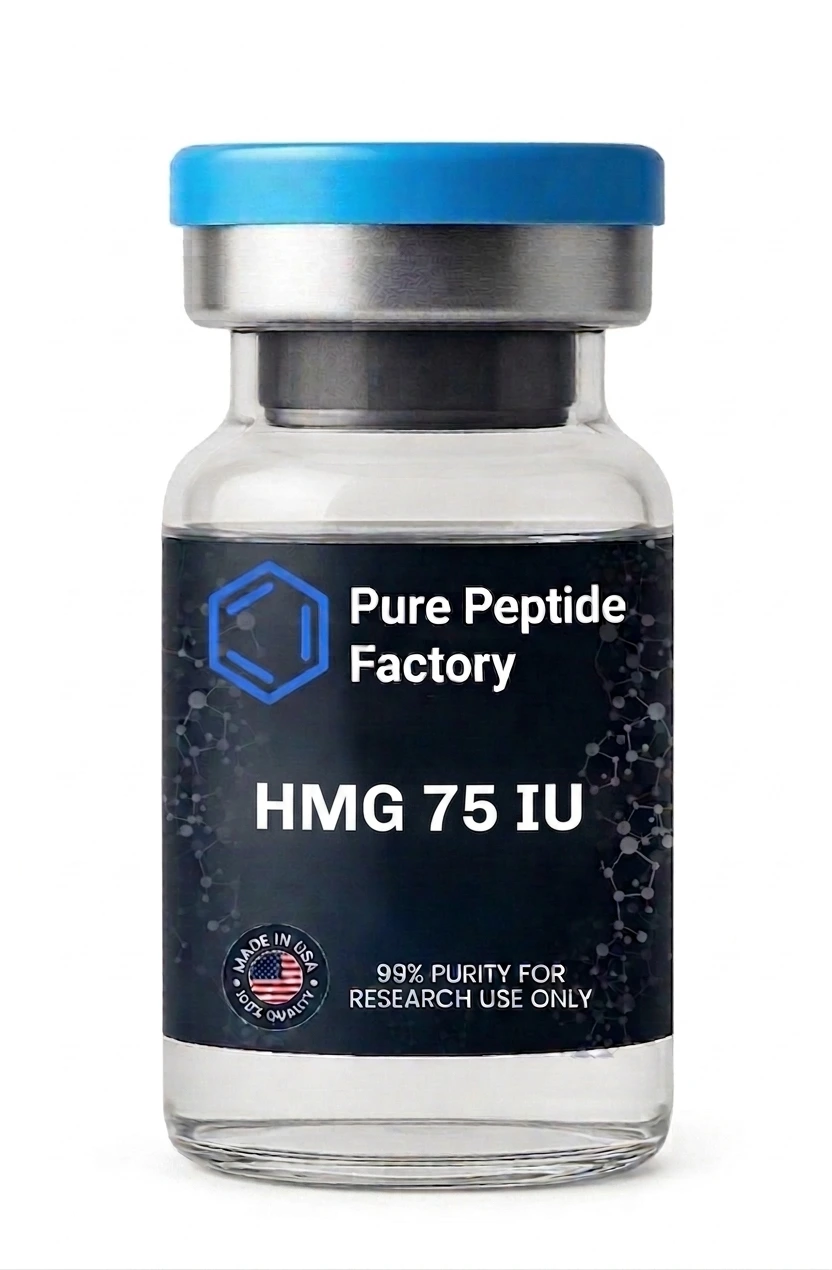
HMG 75 IU
$30.00
Research-grade HMG peptide — human menopausal gonadotropin containing follicle-stimulating hormone (FSH) and luteinizing hormone (LH) in a 1:1 ratio. HPLC-verified at 99%+ purity. Batch PPF-HMG-0513. For reproductive endocrinology, fertility research, and pituitary-gonadal axis studies.
HMG Peptide for Sale: Research-Grade Human Menopausal Gonadotropin
Researchers studying reproductive endocrinology, spermatogenesis, or ovarian follicular development need a reliable domestic source for human menopausal gonadotropin. Pure Peptide Factory supplies research-grade hmg peptide in 75 IU lyophilized vials with full batch documentation and cold-chain integrity. Unlike single-hormone preparations that isolate either FSH or LH, HMG provides both gonadotropins in a 1:1 ratio — the same dual-signal architecture the pituitary naturally delivers. Consequently, when you source hmg peptide for sale from our domestic stock, you receive a compound that models physiological gonadotropin signaling rather than an isolated pharmacological signal (1).
The peptide complex is not a single molecular species but a precisely characterized mixture of two heterodimeric glycoprotein hormones. Both FSH and LH share a common alpha subunit of 92 amino acids, while their unique beta subunits (111 amino acids for FSH, 121 amino acids for LH) determine receptor specificity. Furthermore, this structural homology explains why both hormones co-purify from postmenopausal urine and why HMG has remained a foundational tool in fertility research for over six decades. From the original isolation by Donini in 1949 to the introduction into clinical use by Lunenfeld in 1961, to modern highly purified preparations verified by LC-MS/MS, researchers who buy hmg peptide work with a compound anchored in one of the longest continuous translational research traditions in endocrinology (2).
Why Researchers Buy HMG Peptide from Pure Peptide Factory
Dual Gonadotropin Activity in a Single Vial
HMG peptide contains both FSH and LH at a standardized 1:1 activity ratio. Therefore, a single injection stimulates both Sertoli cells (via FSH receptor) and Leydig cells (via LH receptor) simultaneously. This dual signaling more closely mimics endogenous pituitary output than administering recombinant FSH and LH from separate vials. Moreover, sourcing the combined preparation eliminates the batch-to-batch variability that arises when two separate peptides are reconstituted independently. As a result, researchers who purchase hmg peptide for sale from Pure Peptide Factory can trust that every dose delivers the same FSH:LH ratio across their entire protocol.
Documentation You Can Verify Before Ordering
HMG is a glycoprotein complex whose biological activity depends on correct folding, proper glycosylation, and intact alpha-beta subunit association. Denatured or aggregated material will produce variable receptor activation and unreliable data. Consequently, every batch we ship includes lot-specific HPLC documentation, FSH and LH activity verification by in vitro bioassay, and Western blot confirmation against alpha and beta subunit antibodies. Current batch #PPF-HMG-0513 tested at 99.1% purity with endotoxin below 0.05 EU/µg. The Certificate of Analysis is downloadable before your compound ships.
Domestic Cold-Chain Integrity for Glycoprotein Hormones
Glycoproteins are more structurally fragile than short synthetic peptides. Their disulfide bonds and tertiary conformation degrade with temperature excursion, freeze-thaw cycles, and mechanical stress. We store all hmg peptide inventory under domestic refrigeration at 2-8°C and ship using phase-change cooling rated for 96-hour protection. Most orders arrive within 1 to 3 business days, protecting the hormone complex from degradation during transit. For reconstitution, researchers typically pair HMG with our bacteriostatic water, also stocked domestically under identical conditions.
Compare Against Complementary Gonadotropins Without Batch Variables
Many research protocols compare HMG against other reproductive peptides such as HCG (LH analog), gonadorelin (GnRH), or kisspeptin-10 (upstream HPG regulator). Because we stock the full reproductive endocrinology panel under identical cold-storage conditions, researchers who source hmg peptide alongside these complementary compounds eliminate supplier variability from their cross-compound data.
Synthesis Logs Archived for 24 Months
Should your IRB or compliance office request chain-of-custody records or urinary-source processing documentation, we provide them without delay.
What Is HMG Peptide?
A Dual Gonadotropin Complex, Not a Single Peptide
Human menopausal gonadotropin (HMG), also known as menotropin, is a hormonally active peptide complex that researchers extract from the urine of postmenopausal women. The urine of postmenopausal women reflects the hypergonadotropic state of menopause — specifically, levels of FSH and LH rise markedly — and contains a mixture of these gonadotropins. Piero Donini developed a relatively simple extraction method in 1949, and Bruno Lunenfeld successfully introduced menotropins into clinical use in 1961. Consequently, HMG is one of the oldest continuously used biological products in reproductive medicine.
Structural Composition: Alpha and Beta Subunits
HMG is not a single peptide but a mixture of two distinct glycoprotein hormones. Both FSH and LH share a common alpha subunit (92 amino acids) but have unique beta subunits that confer receptor specificity: FSH beta (111 amino acids) and LH beta (121 amino acids). The beta subunit determines which gonadal receptor each hormone activates. In research settings, hmg peptide is used to study follicular development, spermatogenesis, and the hypothalamic-pituitary-gonadal (HPG) axis.
Glycosylation and Impurity Profile
Cole et al. (2014) reviewed the use of LH and HCG in assisted reproductive technology, noting that urinary-derived HMG preparations contain not only FSH and LH but also small amounts of human chorionic gonadotropin (hCG), which contributes to the LH activity of the preparation (1). Modern highly purified (HP) HMG preparations have reduced protein impurities but still retain the native glycosylation patterns that distinguish urinary from recombinant products. A 2024 LC-MS/MS analysis revealed that beta-hCG constitutes 18-47% of the LH-activity component in some urinary products, with protein impurities estimated at 20-30% of total content (2). This analytical data provides researchers with a quantitative framework for interpreting LH-activity measurements in their experimental systems.
Molecular Profile:
- Composition: Mixture of FSH and LH glycoprotein hormones (1:1 activity ratio)
- Alpha Subunit: 92 amino acids (common to FSH, LH, TSH, hCG)
- FSH Beta Subunit: 111 amino acids (confers Sertoli cell / granulosa cell specificity)
- LH Beta Subunit: 121 amino acids (confers Leydig cell / theca cell specificity)
- Source: Highly purified from postmenopausal urine
- Activity: 75 IU per vial (standard research configuration)
- Classification: Gonadotropin glycoprotein hormone complex
- Synonyms: Menotropin, HMG, human menopausal gonadotropin, Menopur (brand)
- FDA Status: FDA-approved as Menopur and other brands for specific fertility indications
HMG Peptide Benefits in Research
The benefits of hmg peptide in laboratory and clinical research contexts include:
- Dual Gonadotropin Activity: The 1:1 FSH:LH ratio provides combined follicle-stimulating and luteinizing activity in a single preparation, simplifying experimental design for ovarian stimulation and spermatogenesis studies.
- Established Clinical Framework: Over six decades of clinical use in assisted reproductive technology (ART) provides a robust reference for translational research protocols.
- Native Glycosylation: Urinary-derived HMG retains native glycan structures that may differ pharmacokinetically from recombinant FSH or LH, making it valuable for comparative glycoprotein hormone research.
- Spermatogenesis Modeling: In male hypogonadotropic models, HMG supports research into FSH-driven Sertoli cell function and LH-driven Leydig cell testosterone production — the two cell types that together govern sperm production.
- Follicular Development: In female models, HMG is the standard for multi-follicular recruitment studies and ovarian reserve assessment.
HMG Peptide for Men: Research Applications in Male Endocrinology
Why Researchers Study HMG in Male Models
While HMG is widely recognized in female fertility research, its utility in male reproductive endocrinology is equally significant. Moreover, the dual FSH and LH activity makes hmg peptide for men a uniquely appropriate research tool for studying complete spermatogenic recovery. In hypogonadal male models, the FSH component stimulates Sertoli cells within the seminiferous tubules, supporting germ cell maturation and spermatogenesis. The LH component acts on Leydig cells to promote testosterone synthesis, creating a dual mechanism that more closely mimics natural pituitary signaling than LH analogs alone.
Clinical Evidence Supporting Combined FSH/LH Therapy
Van Wely et al. (2011) conducted a Cochrane systematic review comparing recombinant versus urinary gonadotrophins for ovarian stimulation and found no significant difference in live birth rates between the two sources. However, the review noted that urinary preparations like HMG contain both FSH and LH activity, whereas early recombinant FSH products lacked LH, making HMG a distinct comparator for studies requiring combined gonadotropin signaling (3). For male fertility research, HMG is typically investigated at doses of 150 IU per day over 3-6 month protocols to assess spermatogenic recovery in hypogonadotropic hypogonadism models. This extended duration reflects the approximately 74-day spermatogenic cycle required for germ cell maturation from spermatogonia to spermatozoa. Consequently, researchers who purchase hmg peptide for male reproductive studies should design protocols that span at least one full spermatogenic cycle to capture meaningful endpoints.
HMG Peptide vs HCG: Understanding the Critical Difference
Human chorionic gonadotropin (HCG) and HMG are both gonadotropin preparations, but they differ fundamentally in composition, source, and research applications. Understanding this distinction is critical for correct experimental design when comparing hmg peptide vs hcg:
| Feature | HMG (Menotropin) | HCG (Chorionic Gonadotropin) |
|---|---|---|
| Source | Urine of postmenopausal women | Urine of pregnant women or recombinant |
| Hormone Content | FSH + LH (1:1 ratio) | LH analog only (binds LH receptor) |
| Alpha Subunit | Shared 92-aa alpha with FSH/LH/TSH | Shared 92-aa alpha with FSH/LH/TSH |
| Beta Subunit | FSH-beta (111 aa) + LH-beta (121 aa) | hCG-beta (145 aa) — unique C-terminal extension |
| Primary Research Use | Follicular recruitment, spermatogenesis, combined FSH/LH studies | Final oocyte maturation, luteal support, Leydig cell testosterone stimulation |
| Half-Life | ~24 hours | ~24-36 hours (longer due to beta-CTP glycosylation) |
| Glycosylation | Native pituitary-type glycans (sulfated) | Placental-type glycans (non-sulfated) |
| FSH Activity | Present — stimulates follicular/spermatogenic growth | Absent — pure LH-mimetic activity |
| Best for Studying | Spermatogenesis, follicular recruitment, complete HPG axis modeling | Leydig cell function, testosterone recovery, ovulation trigger |
For researchers deciding between hmg peptide and HCG, the key question is whether the protocol requires FSH activity. If the experimental endpoint is Leydig cell testosterone production alone, HCG is sufficient and simpler. However, if the protocol examines spermatogenesis, follicular development, or any process requiring FSH receptor activation, HMG is the appropriate tool because HCG provides zero FSH activity. Lehert et al. (2014) confirmed that adding LH to FSH protocols improves pregnancy rates in poor ovarian responders, supporting the biological rationale for combined gonadotropin therapy that HMG uniquely provides (4).
HMG Peptide Dosage in Research Protocols
For laboratory protocols only. We do not provide human dosing recommendations.
| Study Model | Typical Dose | Route | Frequency | Duration |
|---|---|---|---|---|
| Ovarian stimulation (ART research) | 150-225 IU/day | Subcutaneous or IM | Daily | ~10 days (follicular phase) |
| Male hypogonadism (spermatogenesis) | 150 IU/day | Subcutaneous or IM | Daily | 3-6 months (one full spermatogenic cycle) |
| In vitro Sertoli cell culture | 10-50 IU/L media | Cell culture | Continuous | 48-72 hours |
| In vitro granulosa cell assay | 10-50 IU/L media | Cell culture | Continuous | 48-96 hours |
In controlled ovarian stimulation protocols, dose adjustment based on follicular response (monitored via ultrasound and estradiol levels) is standard practice. Overstimulation can lead to ovarian hyperstimulation syndrome (OHSS) in susceptible models. Researchers who purchase hmg peptide for in vivo gonadotropin studies should implement monitoring protocols analogous to clinical fertility treatment. For male studies, note that the 75 IU vial configuration is suited to small-animal protocols; published clinical reference doses of 150 IU/day reflect human therapeutic dosing and must be scaled to species.
How to Reconstitute HMG Peptide
Step-by-Step Laboratory Protocol
- Sanitize the vial stopper with 70% isopropyl alcohol.
- Using our bacteriostatic water (0.9% benzyl alcohol), inject the sterile diluent slowly against the vial wall. Allow diluent to trickle down; do not force-stream directly at the lyophilized cake — glycoproteins are shear-sensitive and mechanical stress disrupts tertiary structure.
- Allow the powder to dissolve without agitation for 2-3 minutes. Glycoprotein hormones dissolve more slowly than short synthetic peptides due to their larger size and glycosylation.
- Gently swirl until the solution is completely clear. Do NOT shake or vortex — disulfide bonds and subunit associations are disrupted by vigorous mechanical agitation.
- Inspect for clarity. A properly reconstituted solution should be clear and colorless. Discard if turbid, discolored, or containing particulate matter.
- Label with date, concentration, and IU/mL.
Concentration Reference for 75 IU Vial
| Diluent Volume | Concentration | 0.1 mL Aliquot | Common Research Use |
|---|---|---|---|
| 1.0 mL | 75 IU/mL | 7.5 IU | Standard in vivo dosing |
| 0.5 mL | 150 IU/mL | 15 IU | High-concentration injection studies |
| 2.0 mL | 37.5 IU/mL | 3.75 IU | Dose-finding and titration assays |
Storage Requirements
- Lyophilized powder: 24 months at 2-8°C, protected from light and moisture. Do NOT store at room temperature — glycoprotein hormones degrade.
- Reconstituted solution: 14-30 days at 2-8°C. Do NOT freeze — freeze-thaw cycles denature glycoprotein tertiary structure. Use within this window or aliquot and store at -20°C.
- Protect from UV and visible light at all stages. Amber vials or foil wrapping recommended.
HMG Peptide Side Effects in Research Models
In clinical fertility protocols, HMG administration is associated with well-documented adverse effects that researchers should monitor in animal models:
- Ovarian Hyperstimulation Syndrome (OHSS): The most serious complication, characterized by ovarian enlargement, fluid shift, and hemoconcentration. Incidence increases with higher doses and in polycystic ovary-susceptible models.
- Multiple Gestation: Multi-follicular recruitment increases the risk of twin, triplet, or higher-order pregnancies in breeding studies.
- Local Injection Reactions: Erythema, pain, and bruising at subcutaneous or intramuscular injection sites.
- Hormonal Fluctuations: Transient estradiol elevation and fluid retention in responsive models.
- Protein Impurity Sensitivity: Urinary-derived preparations contain 20-30% non-gonadotropin proteins which may trigger immune responses in sensitive animal strains (2).
Product Specifications
Available Configuration
HMG peptide is available in 75 IU lyophilized powder vials. This is the standard research configuration for menotropin. Select your quantity from the product options above.
Quality Verification
- Purity: 99.1% by RP-HPLC (current batch #PPF-HMG-0513)
- FSH Activity: Verified by in vitro bioassay
- LH Activity: Verified by in vitro bioassay
- Identity: Confirmed by Western blot against alpha and beta subunit antibodies
- Endotoxin: Less than 0.05 EU/µg by LAL assay
- Sterility: Verified per USP 71
- Form: Lyophilized powder (glycoprotein complex)
- Storage: 2-8°C long-term, 2-8°C after reconstitution
Current Batch: #PPF-HMG-0513
Purity: 99.1%
Download: HPLC Certificate | Bioassay Report
Frequently Asked Questions
What is HMG peptide used for in research?
HMG peptide is used to study follicular development, ovulation induction, spermatogenesis, and pituitary-gonadal axis function. Its dual FSH and LH activity makes it a standard tool in reproductive endocrinology, assisted reproductive technology (ART) research, and male fertility models. The combined gonadotropin signaling more closely mimics natural hypothalamic-pituitary output than single-hormone preparations.
What does HMG peptide do in male research models?
In male models, HMG’s FSH component stimulates Sertoli cells to support germ cell maturation and spermatogenesis, while its LH component drives Leydig cell testosterone production. This dual action is particularly valuable in hypogonadotropic hypogonadism research, where combined FSH/LH replacement is required for full spermatogenic recovery. Lehert et al. (2014) confirmed that adding LH to FSH protocols improves pregnancy rates, supporting the biological rationale for combined gonadotropin therapy (4).
How does HMG peptide compare to HCG?
HMG contains both FSH and LH activity, whereas HCG is a pure LH analog. HMG supports follicular recruitment and spermatogenic initiation through FSH, plus final maturation through LH. HCG is typically used for final oocyte maturation trigger and luteal support. In male research, HMG is superior for long-term spermatogenesis because FSH is required for Sertoli cell function, while HCG alone only restores testosterone without supporting germ cell development. See the full comparison table above.
What are the HMG peptide benefits for men in research?
Research benefits include: combined FSH/LH signaling that mimics natural pituitary output, support for complete spermatogenic recovery in hypogonadotropic models, established clinical dosing frameworks from six decades of fertility medicine, native glycoprotein structure for studies requiring natural glycosylation patterns, and cost-effectiveness compared to purchasing recombinant FSH and LH separately.
What is the HMG peptide dosage for rodent studies?
Published protocols for hmg peptide in rodent models use bodyweight-adjusted doses scaled from clinical reference ranges. Ovarian stimulation protocols typically use 150-225 IU/day (scaled to species), while male spermatogenesis studies use doses designed to span at least one full spermatogenic cycle. In vitro Sertoli and granulosa cell assays use 10-50 IU/L. Refer to the dosage table above. We do not provide human dosing recommendations.
Where can I buy HMG peptide for research?
Pure Peptide Factory supplies research-grade hmg peptide for sale domestically in 75 IU vials with same-day cold-chain shipping. Orders placed before 2 PM EST ship same-day and most arrive within 1-3 business days with full HPLC, bioassay, and Western blot documentation.
Is HMG peptide used in bodybuilding research?
HMG appears in discussions of post-cycle therapy (PCT) modeling because it stimulates endogenous testosterone production through LH activity while supporting spermatogenesis through FSH — functions that are suppressed by exogenous androgen administration. However, these are research contexts only. Any application to human performance enhancement falls outside the scope of legitimate laboratory research and is not endorsed by this product description.
How should I store HMG peptide after reconstitution?
Store reconstituted solution at 2-8°C and use within 14-30 days. Do NOT freeze reconstituted HMG — freeze-thaw cycles denature glycoprotein tertiary structure and disrupt alpha-beta subunit association. For extended storage, aliquot and store at -20°C. Reconstitute using our bacteriostatic water for optimal sterility and stability.
Can HMG peptide be combined with other gonadotropins in research?
Yes. Many researchers combine HMG with HCG for protocols that require both FSH-driven follicular recruitment and HCG-triggered final oocyte maturation. Combination protocols with gonadorelin (GnRH) examine the hypothalamic-pituitary-gonadal axis at multiple levels. All compounds are available from our catalog under identical storage conditions.
Buy HMG Peptide for Your Research
Secure Checkout
- Credit card, cryptocurrency, or wire transfer
- Same-day dispatch for orders placed before 2 PM EST
- Cold-chain packaging with phase-change cooling
- Discreet labeling and full tracking
Institutional Accounts
Net-30 terms and purchase orders accepted for universities and research institutions. Contact us for bulk pricing on 50 vials or more, including matched orders alongside HCG, gonadorelin, kisspeptin-10, and bacteriostatic water for comprehensive reproductive endocrinology research protocols.
Add to cart and get batch-verified HMG peptide delivered with the documentation your spermatogenesis, ovarian stimulation, or HPG axis research requires.