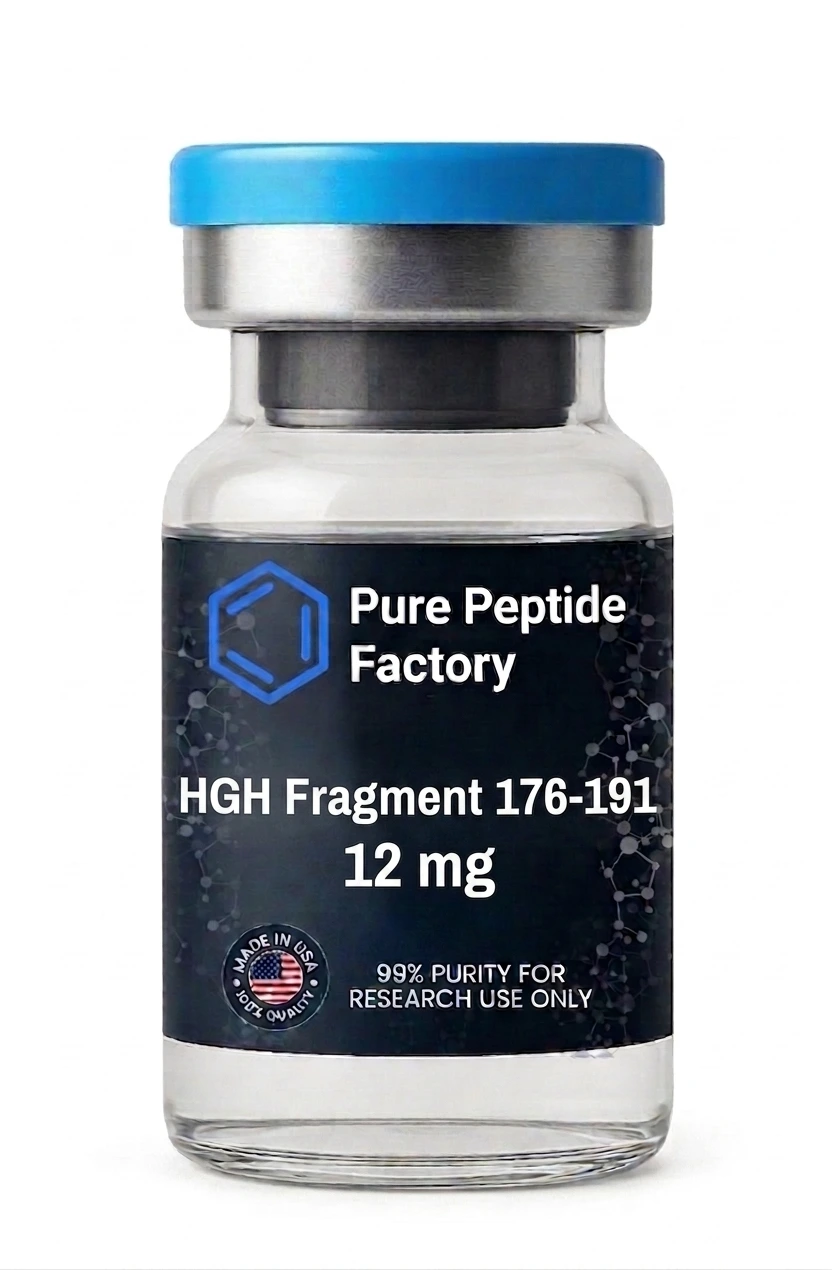
HGH Fragment 176-191
$20.00 $90.00Price range: $20.00 through $90.00
Buy HGH Fragment 176-191 for research, native 16-amino acid C-terminal peptide of human growth hormone (YLRIVQCRSVEGSCGF, MW 1,817.12 Da). For adipocyte lipolysis, ACC inhibition, and β3-AR modulation studies.HPLC verified, domestic cold-chain shipping. Research use only.
Buy HGH Fragment 176-191: Research-Grade C-Terminal GH Lipolytic Peptide
Researchers studying selective adipocyte lipolysis, acetyl‑CoA carboxylase (ACC) inhibition, or the metabolic dissociation of growth hormone signaling need a reliable domestic source for the C‑terminal peptide of human growth hormone. Pure Peptide Factory supplies research‑grade HGH Fragment 176‑191 in 1mg, 2mg, 5mg, 10mg, and 12mg lyophilized vials with full batch documentation and cold‑chain integrity. When you buy hgh fragment 176-191 from our domestic stock, you receive the exact 16‑amino acid sequence (YLRIVQCRSVEGSCGF) that retains the fat‑mobilizing properties of intact hGH while eliminating interaction with the growth hormone receptor (GHR) and the downstream IGF‑1 axis (1).
Unlike the full 191‑amino acid hormone, which activates GHR/JAK2/STAT5 signaling and stimulates both somatic growth and hepatic IGF‑1 production, the C‑terminal 176‑191 fragment selectively targets adipocyte metabolism. Specifically, it suppresses acetyl‑CoA carboxylase activity, reduces malonyl‑CoA levels, and shifts adipose tissue from lipid storage to beta‑oxidation (2). This mechanistic uncoupling — lipolysis without growth promotion — is what makes HGH Fragment 176‑191 a valuable tool for researchers studying fat metabolism in the absence of systemic anabolic signals. When you buy hgh fragment 176-191, you obtain the unmodified native sequence, not a stabilized analog like AOD9604, ensuring your data reflects the pure endogenous lipolytic domain.
Why Researchers Buy HGH Fragment 176-191 from Pure Peptide Factory
Unmodified Native Sequence for Precise Mechanism Studies
Our HGH Fragment 176‑191 is the native 16‑residue C‑terminal peptide of human growth hormone (Tyr‑Leu‑Arg‑Ile‑Val‑Gln‑Cys‑Arg‑Ser‑Val‑Glu‑Gly‑Ser‑Cys‑Gly‑Phe, MW 1,817.12 g/mol). Unlike stabilized analogs such as AOD9604, which carry an added N‑terminal tyrosine and altered disulfide bridging, this fragment contains the exact residues found in the full‑length hormone. Consequently, researchers studying the structure‑function relationships of the hGH lipolytic domain can work with the unmodified reference compound. Every batch ships with HPLC and mass spectrometry documentation verifying the correct sequence and disulfide bond integrity, which is essential for maintaining the peptide’s bioactive conformation.
Five SKU Configurations for Any Protocol Scale
We stock this peptide in 1mg, 2mg, 5mg, 10mg, and 12mg lyophilized vials. The 1‑2mg sizes suit pilot adipocyte assays and dose‑finding studies. The 5‑10mg formats support standard rodent obesity protocols (e.g., Zucker rat or DIO mouse models). The 12mg vial accommodates multi‑group experimental designs and extended administration protocols. Therefore, you can match vial size to your experimental design without splitting vials or compromising sterile handling.
Domestic Cold‑Chain Integrity
This 16‑amino acid peptide contains two cysteine residues that form an intrachain disulfide bridge critical for bioactivity. Improper storage allows oxidation or reduction of this bridge, leading to misfolded peptide with altered receptor interactions. We store all inventory under domestic refrigeration and ship with phase‑change cooling. Most orders arrive within 1 to 3 business days, protecting peptide conformation from the moment it leaves our facility.
Compare Against GH‑Axis Peptides Without Batch Variables
Many research protocols compare HGH Fragment 176‑191 against full‑length GH, the stabilized analog AOD9604, or GHRH analogs like tesamorelin. Because we stock these complementary compounds under identical cold‑storage conditions, researchers who buy hgh fragment 176-191 alongside them eliminate supplier variability from cross‑compound data.
Synthesis Logs Archived for 24 Months
Should your IRB or compliance office request chain‑of‑custody records, we provide them without delay.
What Is HGH Fragment 176-191?
The Unmodified C-Terminal Lipolytic Domain of Human Growth Hormone
HGH Fragment 176‑191 is a 16‑amino acid synthetic peptide corresponding to the extreme C‑terminal residues (Tyr‑Leu‑Arg‑Ile‑Val‑Gln‑Cys‑Arg‑Ser‑Val‑Glu‑Gly‑Ser‑Cys‑Gly‑Phe) of the 191‑amino acid human growth hormone. It was first characterized in the 1990s by Ng and colleagues, who demonstrated that this C‑terminal fragment reproduces the lipolytic effects of intact hGH without activating the growth hormone receptor or elevating circulating IGF‑1 (1). The fragment contains a single intrachain disulfide bond (Cys‑182 to Cys‑189 using native hGH numbering) that is essential for its metabolic activity; reduction or scrambling of this disulfide abolishes the peptide’s lipolytic effects.
Unlike the synthetic analog AOD9604, which is derived from the hGH 177‑191 sequence with a non‑native N‑terminal tyrosine and engineered disulfide modifications for enhanced gastric stability, HGH Fragment 176‑191 represents the unmodified native fragment. Researchers who buy hgh fragment 176-191 for structure‑function studies work with the precise sequence that exists naturally as part of the full‑length hormone, not an engineered variant. The peptide contains no methionine residues and no additional modifications beyond the native intrachain disulfide.
Molecular Profile:
- Sequence: Tyr‑Leu‑Arg‑Ile‑Val‑Gln‑Cys‑Arg‑Ser‑Val‑Glu‑Gly‑Ser‑Cys‑Gly‑Phe (YLRIVQCRSVEGSCGF)
- Molecular Formula: C₇₈H₁₂₃N₂₁O₂₃S₂
- Molecular Weight: 1,817.12 g/mol (monoisotopic); 1,818.08 g/mol (average)
- CAS Number: 66004‑57‑7
- Classification: Synthetic C‑terminal fragment of human growth hormone
- Synonyms: hGH (176‑191), Somatotropin (176‑191), GH lipolytic fragment
- Disulfide bond: Cys⁷‑Cys¹⁴ (intramolecular)
How HGH Fragment 176-191 Works: ACC Inhibition and β3‑AR Modulation
The fragment operates through mechanisms that are entirely distinct from the classical GH receptor/JAK2/STAT5 signaling cascade. Because it does not bind GHR with appreciable affinity, it does not induce hepatic IGF‑1 production, stimulate longitudinal bone growth, or promote organ enlargement. Instead, research documents two converging anti‑lipogenic pathways (2).
First, acetyl‑CoA carboxylase (ACC) inhibition. The fragment reduces ACC activity, the rate‑limiting enzyme that converts acetyl‑CoA to malonyl‑CoA. Malonyl‑CoA is both a substrate for de novo lipogenesis and an allosteric inhibitor of carnitine palmitoyltransferase‑1 (CPT‑1), the enzyme that shuttles fatty acids into mitochondria for beta‑oxidation. By lowering malonyl‑CoA levels, the fragment simultaneously suppresses fat synthesis and removes the brake on mitochondrial fatty acid uptake, shifting adipocyte metabolism from storage to oxidation. Heffernan et al. demonstrated this effect in obese Zucker rats, where oral administration of the fragment reduced fat pad weight without altering lean mass, blood glucose, or IGF‑1 levels (2).
Second, beta‑3 adrenergic receptor (β3‑AR) restoration. In rodent models of obesity, β3‑AR expression in white adipose tissue is significantly downregulated compared to lean controls. Research by Weltman and colleagues (2005) demonstrated that the fragment restores β3‑AR mRNA levels to those observed in lean mice, an effect that correlates with reduced adipose mass. However, lipolytic‑receptor‑knockout murine models suggest β3‑AR modulation is not the sole mechanism, indicating that the fragment’s metabolic effects are multi‑pathway (3).
Crucially, the fragment does not impair insulin sensitivity or elevate fasting glucose in preclinical models — a significant contrast to intact GH, which induces insulin resistance at supraphysiological doses (4). This metabolic selectivity makes the 176‑191 fragment a clean tool for studying adipose lipolysis without the confounding variables of altered glucose homeostasis or systemic growth signaling.
HGH Fragment 176-191 vs Full-Length hGH: Research Comparison
Researchers who buy hgh fragment 176-191 often need to contrast its effects with intact growth hormone. The table below highlights the critical differences:
| Feature | HGH Fragment 176‑191 | Intact Human Growth Hormone (191 aa) |
|---|---|---|
| Receptor | Does not bind GHR; GHR‑independent mechanism | Binds GHR (JAK2/STAT5 signaling) |
| IGF‑1 | No elevation observed | Significant hepatic IGF‑1 induction |
| Bone/Organ Growth | Absent | Well‑documented anabolic effect |
| Insulin Sensitivity | No impairment observed | Risk of insulin resistance with chronic dosing |
| Primary Metabolic Effect | Adipocyte lipolysis (ACC inhibition, β3‑AR restoration) | Whole‑body protein anabolism, lipolysis, insulin antagonism |
| Clinical Status | Preclinical only; not FDA approved | FDA approved for specific deficiency syndromes |
HGH Fragment 176-191 vs AOD9604: Native Fragment vs Stabilized Analog
AOD9604 is frequently confused with HGH Fragment 176‑191. They are chemically distinct and not interchangeable in research:
| Feature | HGH Fragment 176‑191 | AOD9604 |
|---|---|---|
| Source Sequence | Native hGH residues 176‑191 (16 aa) | Modified hGH 177‑191 with added N‑terminal Tyr; disulfide bridge modification |
| Structure | Unmodified native fragment | Engineered for enhanced stability and oral delivery |
| IGF‑1 Interaction | None | None |
| Clinical Trial History | Preclinical only | Phase II (metabolic disease; osteoarthritis) |
| Research Focus | Pure GH lipolytic domain structure‑function studies | Chronic obesity models; cartilage repair |
Choose HGH Fragment 176‑191 when your hypothesis involves the native C‑terminal lipolytic sequence and you wish to avoid the confounding variable of structural modifications. Choose AOD9604 when your protocol models oral peptide stability, extended half‑life requirements, or osteoarthritis pathology where the engineered analog has prior Phase II data.
HGH Fragment 176-191 Before and After: What Published Research Shows
The search phrase “hgh fragment 176 191 before and after” typically refers to preclinical body composition data. In the landmark study by Heffernan et al., obese Zucker rats receiving the fragment showed reduced adipose tissue mass and increased markers of lipolysis compared to vehicle controls, with no change in lean tissue mass or blood glucose (2). These are animal data only and cannot be extrapolated to human outcomes. Researchers designing protocols should focus on the measurable endpoints from this literature: epididymal fat pad weight, plasma free fatty acid concentrations, and ACC enzyme activity in adipocyte lysates.
HGH Fragment 176-191 Dosage Reference for Preclinical Models
For laboratory protocols only. We do not provide human dosing recommendations.
| Research Model | Typical Dose | Route | Frequency | Key Finding |
|---|---|---|---|---|
| Obese Zucker rat (oral gavage) | 500 µg/kg/day | Oral | Daily for 2‑4 weeks | Reduced fat pad weight; no change in IGF‑1 or glucose |
| Isolated rat adipocytes (in vitro) | 0.1‑10 µg/mL | In vitro | Acute (1‑4 h) | Increased glycerol release; ACC inhibition |
| Obese mouse (β3‑AR study) | 500 µg/kg/day | Subcutaneous | Daily for 2 weeks | Restored β3‑AR mRNA; reduced fat mass |
| Cartilage defect (rabbit, combination study) | Per protocol (with hyaluronic acid) | Intra‑articular | Weekly | Improved cartilage morphology scores |
The published literature establishes a consistent dose range of 500 µg/kg/day for rodent oral and subcutaneous protocols. Researchers who buy hgh fragment 176-191 can use this reference to design dose‑finding experiments.
How to Reconstitute and Inject HGH Fragment 176-191
Step‑by‑Step Reconstitution Protocol
- Sanitize the vial stopper with 70% isopropyl alcohol.
- Inject bacteriostatic water slowly against the vial wall. Do not aim the stream directly at the lyophilized cake — this can denature the disulfide‑bonded peptide.
- Allow the powder to dissolve without agitation for 2‑3 minutes. The fragment is soluble in aqueous buffer.
- Gently swirl until the solution is completely clear. Do NOT shake — mechanical stress can rupture the intrachain disulfide bond.
- Inspect for clarity. Discard if turbid or containing particulate matter.
- Label with reconstitution date and concentration.
Reconstitution Reference Table
| Vial Size | Diluent Volume | Concentration |
|---|---|---|
| 1 mg | 1 mL | 1 mg/mL |
| 2 mg | 2 mL | 1 mg/mL |
| 5 mg | 2.5 mL | 2 mg/mL |
| 10 mg | 5 mL | 2 mg/mL |
| 12 mg | 3 mL | 4 mg/mL |
Subcutaneous Injection Technique for Research Models
- Cleanse the injection site (lower abdomen, scruff, or flank) with 70% isopropyl alcohol.
- Using a 29‑31 gauge insulin syringe, pinch a 1‑2 inch fold of skin and insert the needle at a 45‑90 degree angle into the subcutaneous fat layer.
- Inject slowly over 5‑10 seconds. Hold the needle in place for 10 seconds before withdrawing to prevent backflow.
- Apply gentle pressure with sterile gauze. Do not rub the injection site.
- Rotate injection sites for repeated administrations.
Storage Requirements
- Lyophilized powder: 24 months at -20°C, protected from light and moisture. The peptide is stable under these conditions.
- Reconstituted solution: 14‑28 days at 2‑8°C. Do NOT freeze reconstituted solution — freeze‑thaw cycles can reduce disulfide bond integrity.
- Protect from UV light at all stages. Amber vials or foil wrapping are recommended.
Regulatory Context and Research Use
HGH Fragment 176‑191 is not FDA approved for any human therapeutic indication. It is a synthetic peptide fragment of human growth hormone intended exclusively for in vitro and controlled laboratory animal studies. This compound is not a dietary supplement, drug, or cosmetic. The World Anti‑Doping Agency (WADA) classifies this peptide under Category S2 (Peptide Hormones, Growth Factors, and Related Substances) as a prohibited substance. Researchers who buy hgh fragment 176-191 must agree to research‑use‑only terms at checkout. This product is not for human consumption, veterinary use outside approved IACUC protocols, or diagnostic application.
Product Specifications
Available Configurations
HGH Fragment 176‑191 is available in 1mg, 2mg, 5mg, 10mg, and 12mg lyophilized powder vials. Select your configuration from the product options above.
Quality Verification
- Purity: ≥99% (HPLC verified). Current batch PPF-HGHF-0513: 99.2%
- Identity: Mass spectrometry confirmed against monoisotopic mass 1,817.12 Da
- Endotoxin: Less than 0.1 EU/mL
- Sterility: Verified per USP 71
- Form: Lyophilized powder
- Storage: -20°C long‑term, 2‑8°C after reconstitution
- CAS Number: 66004‑57‑7
Current Batch: #PPF-HGHF-0513
Purity: 99.2%
Download: HPLC Certificate | MS Report
Frequently Asked Questions
Where can I buy HGH Fragment 176-191 for research?
Pure Peptide Factory supplies research‑grade HGH Fragment 176‑191 domestically in 1mg‑12mg vials with same‑day cold‑chain shipping. Orders placed before 2 PM EST ship same‑day and most arrive within 1‑3 business days.
Is HGH Fragment 176-191 the same as taking growth hormone?
No. This fragment is a 16‑amino acid C‑terminal peptide that does not bind the growth hormone receptor. It does not induce systemic growth, organ enlargement, or IGF‑1 elevation. Its effects are limited to adipocyte lipolysis via ACC inhibition and β3‑AR modulation.
What does “before and after” mean in HGH Fragment 176-191 research?
In preclinical studies, investigators measured reduced adipose tissue mass and increased free fatty acid levels following fragment administration compared to vehicle controls. These are animal data only and cannot be interpreted as human outcome evidence.
How does HGH Fragment 176-191 compare to AOD9604?
AOD9604 is an engineered analog with a modified N‑terminus and disulfide bridge for enhanced oral stability. HGH Fragment 176‑191 is the unmodified native sequence. They are chemically distinct and should not be used interchangeably in research.
What is the best time to administer HGH Fragment 176-191 in animal studies?
In published rodent protocols, the fragment was administered during fasting or post‑absorptive states to isolate lipolytic effects from dietary confounders. Exact timing should be dictated by your IACUC‑approved protocol.
Is HGH Fragment 176-191 FDA approved?
No. It is a research‑grade peptide not approved for human use. AOD9604 (the engineered analog) reached Phase II trials, but the native fragment remains preclinical only.
How should I store HGH Fragment 176-191?
Store lyophilized powder at -20°C for up to 24 months. After reconstitution, keep at 2‑8°C and use within 14‑28 days. Do not freeze reconstituted solution. Protect from light at all stages.
Can HGH Fragment 176-191 be combined with other research peptides?
Yes. Some researchers combine it with tesamorelin for GHR‑dependent vs GHR‑independent contrast studies, or with AICAR for AMPK pathway investigation. Combination protocols should be validated in your specific model.
Buy HGH Fragment 176-191 for Your Research
Secure Checkout
- Credit card, cryptocurrency, or wire transfer
- Same‑day dispatch for orders placed before 2 PM EST
- Cold‑chain packaging with phase‑change cooling
- Discreet labeling and full tracking
Institutional Accounts
Net‑30 terms and purchase orders accepted for universities and research institutions. Contact us for bulk pricing on 50 vials or more, including matched orders alongside tesamorelin, AICAR, and other metabolic research compounds.
Add to cart and get batch‑verified HGH Fragment 176‑191 delivered with the documentation your adipocyte biology or metabolic research protocol requires.