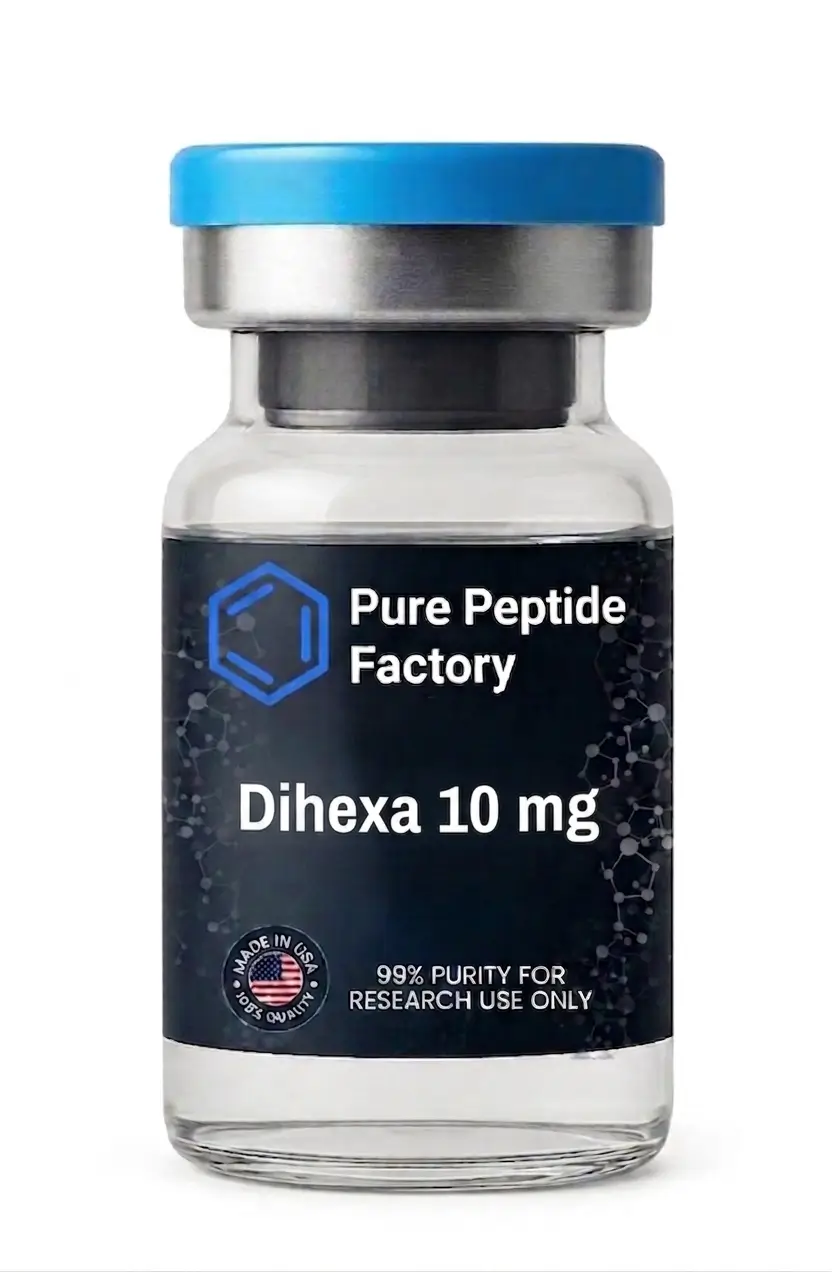
Dihexa 10 mg
$20.00 $40.00Price range: $20.00 through $40.00
Dihexa for sale at Pure Peptide Factory in research-grade configurations. Specifically, dihexa is a synthetic 6-amino-acid oligopeptide developed by Joseph Harding and colleagues at Washington State University as an angiotensin IV analog. Furthermore, the 2012 McCoy et al. JPET paper documented that dihexa promotes dendritic spine formation at concentrations 10 million times lower than BDNF, the most potent endogenous synaptogenic factor previously known. HPLC verified at 98% minimum purity, batch-specific COA. Research use only.
Dihexa for Sale: The 10-Million-Fold More Potent Than BDNF Synaptogenic Research Peptide
Dihexa for sale at Pure Peptide Factory delivers the synthetic oligopeptide that Joseph Harding and his research team at Washington State University engineered to outperform BDNF, the most potent endogenous synaptogenic factor previously known. Specifically, the 2012 McCoy, Foster, Wright, Bahar, and Harding paper in the Journal of Pharmacology and Experimental Therapeutics documented that dihexa promotes dendritic spine formation at concentrations 10⁷-fold lower than BDNF (effective concentrations in the femtomolar range). Furthermore, dihexa achieves this through a fundamentally different mechanism than BDNF: activation of the hepatocyte growth factor (HGF)/c-Met receptor system rather than the BDNF/TrkB pathway.
For researchers studying synaptogenesis, dendritic spine biology, hepatocyte growth factor signaling, c-Met receptor pharmacology, age-related cognitive decline, Alzheimer’s disease research, or the next generation of nootropic compounds, dihexa is the foundational research tool. Pure Peptide Factory stocks research-grade dihexa with domestic cold-chain shipping and batch-specific HPLC documentation. When researchers buy dihexa for sale online, the angiotensin IV analog structure with the N-hexanoic acid and L-tyrosine modifications requires sophisticated synthesis verification that not all vendors provide. Dihexa for sale at Pure Peptide Factory is matched with batch-specific HPLC documentation that confirms compound identity before your purchase ships.
Why Researchers Buy Dihexa for Sale from Pure Peptide Factory
Documentation for Every Dihexa for Sale Order
Dihexa for sale at our facility comes with documentation that supports research reproducibility. Specifically, dihexa is a 6-amino-acid synthetic peptide with critical structural modifications that distinguish it from native angiotensin IV. The N-hexanoic acid modification and the L-tyrosine substitutions confer oral bioavailability and substantially extended half-life compared to the parent angiotensin IV. Furthermore, these modifications also confer blood-brain barrier permeability, which is the structural feature that enables the compound’s CNS effects. Therefore, every dihexa for sale order ships with a lot-specific HPLC chromatogram and mass spectrometry report verifying the molecular weight target with sequence integrity confirmation. The Certificate of Analysis is downloadable before your compound ships.
Domestic Cold-Chain Shipping for Dihexa for Sale Orders
Dihexa for sale ships from domestic cold-storage using phase-change cooling rated for 96-hour protection. Specifically, dihexa’s structural stability is good in lyophilized form, but reconstituted solution handling matters significantly for research protocol design. Furthermore, our customers ordering dihexa for sale typically pair it with bacteriostatic water for reconstitution. Consequently, most dihexa for sale orders reach your lab within 1 to 3 business days.
Research-Grade Configuration for Dihexa for Sale
Our dihexa for sale vial configuration matches the standard research scale used in published preclinical research. Specifically, the 2012 McCoy JPET protocols used femtomolar to nanomolar concentrations for cell culture work and oral mg/kg dosing scaled by species for animal protocols. Therefore, our vial size accommodates extensive dose-response work across multiple research applications without splitting vials or compromising reconstituted solution freshness.
Synthesis Logs Archived for 24 Months
We document and archive every batch. Therefore, if your IRB or compliance office requests chain-of-custody records or synthesis documentation, we can provide them on demand.
What Is Dihexa? The Compound Behind Dihexa for Sale
An Angiotensin IV Analog Engineered for CNS Activity
Dihexa is a synthetic 6-amino-acid oligopeptide derived from angiotensin IV (AT4), the metabolite of angiotensin II that activates the AT4 receptor system in brain tissue. Specifically, native angiotensin IV has substantial CNS effects on memory, learning, and synaptic plasticity, but its short half-life and limited blood-brain barrier penetration constrain therapeutic applications. By contrast, dihexa was engineered with N-hexanoic acid and L-tyrosine modifications that confer oral bioavailability, extended half-life, and improved CNS penetration while preserving the synaptogenic activity of the parent angiotensin IV.
The Joseph Harding research group at Washington State University developed dihexa over more than a decade of research on AT4 receptor pharmacology and HGF/c-Met receptor activation. Furthermore, the compound represents the most advanced AT4 analog from this research program, with patent protection (WO2009110002) and clinical development efforts through PNB Vesta.
Molecular Profile of Dihexa
- Type: Synthetic 6-amino-acid oligopeptide (angiotensin IV analog)
- Chemical name: N-hexanoic-Tyr-Ile-(6) amino hexanoic amide
- Molecular Formula: C30H50N4O5
- Molecular Weight: 546.74 g/mol
- CAS: 1401708-83-5
- Receptor target: HGF/c-Met receptor system (indirect activation)
- Synonyms: N-hexanoic-Tyr-Ile-(6) amino hexanoic amide, AT4 analog, PNB-0408
- Developer: Joseph Harding lab, Washington State University
- Patent: WO2009110002
- Clinical development: PNB Vesta (program ended)
How Dihexa Works: HGF/c-Met Receptor Activation
The mechanistic innovation of dihexa is indirect activation of the hepatocyte growth factor (HGF)/c-Met receptor system. Specifically, HGF is a pleiotropic growth factor that activates c-Met (also called MET), a receptor tyrosine kinase expressed throughout the central nervous system. Furthermore, HGF/c-Met signaling drives synaptogenesis, neurite outgrowth, dendritic spine formation, and neuronal survival in published research.
Dihexa potentiates HGF/c-Met signaling rather than acting as a direct c-Met agonist. Specifically, the compound facilitates HGF dimerization and receptor activation, amplifying endogenous HGF signaling at concentrations far below what HGF alone produces. Once c-Met activates, downstream signaling cascades include:
PI3K-Akt pathway. Phosphoinositide 3-kinase activation leads to Akt phosphorylation, which inhibits apoptotic signaling and promotes neuronal survival under stress conditions.
MAPK/ERK pathway. Mitogen-activated protein kinase activation drives gene expression changes supporting synaptogenesis, dendritic complexity, and synaptic protein synthesis.
PLCγ signaling. Phospholipase C gamma activation produces calcium signaling that supports synaptic plasticity and long-term potentiation maintenance.
The 2012 McCoy et al. paper in the Journal of Pharmacology and Experimental Therapeutics quantified dihexa’s potency relative to BDNF, the most potent endogenous synaptogenic factor previously known. Specifically, dihexa promoted dendritic spine formation at concentrations approximately 10 million times lower than BDNF effective concentrations. By contrast with BDNF (which signals through TrkB receptors), dihexa engages the entirely separate HGF/c-Met system, providing researchers with a mechanistically distinct synaptogenic research tool.
Dihexa for Sale: Research Applications and Use Cases
Synaptogenesis and Dendritic Spine Research
Researchers using dihexa for sale in synaptogenesis biology benefit from the compound’s documented femtomolar potency. Specifically, the 2012 McCoy et al. study demonstrated that dihexa promotes dendritic spine formation in cultured hippocampal neurons at concentrations of 10⁻¹³ to 10⁻¹² M, representing 10⁷-fold greater potency than BDNF. Furthermore, the dendritic spine effects translated to functional synaptic enhancement, with increased excitatory postsynaptic potentials measured by electrophysiology.
Research endpoints include:
- Dendritic spine density quantification by Golgi staining or fluorescent labeling
- Spine morphology classification (mushroom, stubby, thin, filopodial)
- Synaptic protein expression (PSD-95, synaptophysin, GluA1, GluN1)
- Long-term potentiation electrophysiology in hippocampal slices
- BDNF and TrkB expression alongside HGF/c-Met activation profiling
Memory and Cognitive Research
Memory research using dihexa for sale builds on the 2019 Benoist et al. paper documenting effects on spatial memory in aged rats. Specifically, the researchers used the Morris water maze and demonstrated that aged rats receiving dihexa showed augmented spatial memory performance compared to age-matched controls. Furthermore, the cognitive enhancement correlated with measurable changes in hippocampal synaptic markers, supporting the synaptogenic mechanism.
Research applications include:
- Morris water maze and Barnes maze spatial memory paradigms
- Novel object recognition and object location memory
- Working memory tasks (delayed alternation, T-maze)
- Aged rat cognitive decline reversal protocols
- Pharmacological model cognitive impairment (scopolamine, kainate)
Alzheimer’s Disease Research
Researchers buying dihexa for sale for Alzheimer’s models leverage the compound’s synaptogenic mechanism. Specifically, dendritic spine loss is one of the earliest pathological features of Alzheimer’s disease, and dihexa’s synaptogenic mechanism positions it as a research tool for examining whether synaptic restoration produces functional benefits in disease models.
Research applications include:
- 5xFAD and APP/PS1 mouse model dendritic spine quantification
- Amyloid-beta synaptotoxicity protection in primary neuronal cultures
- Tau pathology models with synaptic endpoint measurement
- Behavioral cognitive testing in transgenic Alzheimer’s mouse models
- HGF/c-Met expression alongside amyloid pathology profiling
HGF/c-Met Receptor Pharmacology
Beyond CNS applications, dihexa serves as a research tool for HGF/c-Met biology in any tissue context where the receptor system functions. Specifically, c-Met is expressed in liver, kidney, lung, and skeletal muscle alongside its CNS distribution. Furthermore, HGF/c-Met signaling drives tissue regeneration, wound healing, and cellular survival across organ systems.
Research applications include:
- Liver regeneration models with c-Met activation profiling
- Wound healing protocols examining angiogenic and migratory effects
- Cardiac ischemia-reperfusion injury models
- Skeletal muscle regeneration and satellite cell research
- Comparative HGF vs dihexa potency studies
Neurodegenerative Disease Research
Beyond Alzheimer’s specifically, dihexa research has expanded to other neurodegenerative conditions sharing synaptic dysfunction features. Specifically, Parkinson’s disease, Huntington’s disease, and traumatic brain injury models all feature dendritic spine loss and synaptic protein dysregulation. Therefore, dihexa research extends across neurodegenerative biology as a synaptogenic research tool.
Dihexa vs PE-22-28: Comparing Two Nootropic Research Peptides
The Dihexa vs PE-22-28 comparison is one of the most-asked questions in nootropic peptide research. Both compounds target central nervous system pathways with reported cognitive and neurogenic effects, but they operate through fundamentally different mechanisms:
| Feature | Dihexa | PE-22-28 |
|---|---|---|
| Type | 6-amino-acid oligopeptide | 7-amino-acid heptapeptide |
| Origin | Angiotensin IV analog | Spadin derivative (sortilin maturation) |
| Primary target | HGF/c-Met receptor system | TREK-1 potassium channel (K2P) |
| Mechanism | HGF dimerization potentiation | Direct ion channel inhibition |
| Primary research focus | Synaptogenesis, memory, Alzheimer’s | Depression, anxiety, TREK-1 biology |
| Behavioral endpoints | Water maze, novel object recognition | Forced swim, novelty suppressed feeding |
| Synaptogenic evidence | 10⁷-fold more potent than BDNF | Adult hippocampal neurogenesis (4-day onset) |
| Oral bioavailability | Yes (via N-hexanoic modification) | Limited |
| Preferred administration | Oral or subcutaneous | Subcutaneous or intranasal |
| Best for studying | Memory, learning, HGF/c-Met biology | Depression, anxiety, TREK-1 ion channels |
When to choose Dihexa: Memory and learning research, synaptogenesis protocols, Alzheimer’s disease models focused on cognitive rescue, HGF/c-Met signaling studies.
When to choose PE-22-28: Depression and anxiety research, TREK-1 ion channel pharmacology, protocols requiring rapid-onset antidepressant-like behavioral effects, adult hippocampal neurogenesis studies.
Researchers running head-to-head cognitive or antidepressant protocols sometimes use both compounds to isolate different mechanisms within the same experimental design. Both dihexa for sale and PE-22-28 are available from our facility under identical handling conditions to eliminate batch variability.
Dihexa vs Cerebrolysin and Other Nootropic Compounds
Researchers comparing dihexa to other nootropic and neurotrophic research compounds in protocol design need to understand the mechanistic landscape:
| Feature | Dihexa | Cerebrolysin | BDNF |
|---|---|---|---|
| Type | Synthetic 6-aa peptide | Porcine brain-derived peptide mixture | Recombinant 119-aa protein |
| Composition | Single defined molecule | Multi-component mixture | Single defined protein |
| Receptor target | HGF/c-Met (indirect) | Multiple neurotrophic receptors | TrkB receptor (direct) |
| Synaptogenic potency | 10⁷-fold more potent than BDNF | Variable | Reference standard |
| Oral bioavailability | Yes | No (parenteral only) | No (recombinant injection only) |
| Blood-brain barrier penetration | Yes (designed for CNS) | Limited | Limited (intranasal research routes) |
| Clinical status | Preclinical research (Phase 1 ready) | Approved in Russia, Europe (some countries) | Research only (recombinant) |
| Best for studying | Defined-mechanism HGF/c-Met research | Multi-pathway neurotrophic effects | Direct BDNF/TrkB pathway |
The mechanistic distinction matters for research design. Specifically, dihexa enables precise mechanism studies because the molecular identity is defined and the c-Met pathway is well-characterized. By contrast, Cerebrolysin provides broader therapeutic coverage through multiple components but reduces mechanism specificity. Therefore, researchers studying defined receptor pharmacology choose dihexa, while researchers exploring multi-pathway neurotrophic effects use Cerebrolysin.
Dihexa for Sale: Benefits in Published Research Models
Synaptogenesis at Femtomolar Concentrations
Published research using dihexa for sale documents the compound’s ability to promote dendritic spine formation at concentrations 10⁷-fold lower than BDNF effective concentrations. Specifically, this represents the highest synaptogenic potency documented for any compound in research literature. Furthermore, the femtomolar effective range distinguishes dihexa as a research tool for examining synaptic plasticity at concentrations that minimize off-target effects.
Cognitive Enhancement in Aged Animal Models
The 2019 Benoist et al. spatial memory paper documented that aged rats receiving dihexa for sale research formulations showed augmented Morris water maze performance compared to age-matched controls. Specifically, the cognitive enhancement correlated with measurable changes in hippocampal synaptic markers, supporting the proposed synaptogenic mechanism translates to functional cognitive benefits in research models.
Oral Bioavailability and CNS Penetration
Unlike most synaptogenic peptides that require injection administration to reach CNS targets, dihexa was structurally engineered with N-hexanoic acid modifications that confer oral bioavailability and blood-brain barrier penetration. As a result, oral administration produces measurable CNS effects in rodent research, which simplifies protocol design for chronic dosing studies where injection burden would confound behavioral readouts.
Multi-Pathway Activation Through HGF/c-Met
HGF/c-Met activation triggers downstream signaling through PI3K-Akt, MAPK/ERK, and PLCγ pathways simultaneously. As a result, dihexa engages multiple complementary cellular pathways relevant to synaptic plasticity, neuronal survival, and gene expression supporting cognition. By contrast with single-pathway compounds, this multi-pathway engagement produces more comprehensive synaptogenic and neurotrophic effects.
Dihexa for Sale: Dosage Research Framework
Published preclinical research dosing across major studies:
| Research Context | Dose Range | Route | Frequency | Reference |
|---|---|---|---|---|
| Hippocampal neuron culture (synaptogenesis) | 10⁻¹³ to 10⁻¹² M | In vitro | Per assay | McCoy 2012 JPET |
| Aged rat spatial memory | 1 to 2 mg/kg | Oral or SC | Daily | Benoist 2019 |
| Pharmacological cognitive impairment | Per protocol | Oral | Daily | Multiple |
| Alzheimer’s mouse model (5xFAD, APP/PS1) | 0.5 to 2 mg/kg | Oral or SC | Daily | Multiple |
| HGF/c-Met receptor pharmacology | Sub-nanomolar to nanomolar | Cell culture | Per assay | Multiple |
We do not provide human dosing recommendations. The dosing references above synthesize peer-reviewed Harding laboratory and collaborator publications and serve only as laboratory research design context. Dihexa has not progressed to human clinical trials, and no validated human dosing exists.
Dihexa Reddit Community Discussions
Reddit and peptide research forum discussions of dihexa focus on several recurring research-community questions:
- The 10-million-fold BDNF potency claim generates substantial discussion. Specifically, the McCoy 2012 JPET paper documented this in cultured hippocampal neurons, and the data is genuine peer-reviewed research, but extrapolation to in vivo human research remains untested.
- Oral versus injection administration appears frequently. Although dihexa’s N-hexanoic acid modification enables oral bioavailability, injection routes still produce higher systemic exposure for the same dose. Therefore, research protocols requiring quantified systemic levels often use injection.
- Comparison with PE-22-28 and other nootropics is common because researchers compare dihexa across the cognitive enhancement compound landscape. The mechanistic distinctions matter (HGF/c-Met for dihexa vs TREK-1 for PE-22-28 vs HDAC inhibition for some other nootropics).
- Half-life and dosing frequency generates technical discussion. Specifically, dihexa’s pharmacokinetics support daily dosing in published protocols, although exact half-life data in humans remains limited.
- The PNB Vesta clinical development context appears occasionally. The compound was being developed by PNB Vesta for Alzheimer’s disease before the program ended, but no Phase 1 human safety data was published.
We do not provide human protocols. Research protocol design should reference peer-reviewed Harding laboratory publications rather than community forum extrapolations.
How to Reconstitute Dihexa for Sale at Your Lab
Step-by-Step Laboratory Protocol
Researchers reconstituting dihexa for sale follow this step-by-step laboratory protocol:
- Sanitize the vial stopper with 70% isopropyl alcohol
- Inject bacteriostatic water or sterile saline slowly against the vial wall
- Allow the lyophilized powder to dissolve without agitation for 2 to 3 minutes
- Gently swirl until the solution clears. Do not shake (vigorous agitation can affect peptide conformational stability)
- Inspect for clarity and label with date and concentration before use
Concentration Reference
- 5mg vial + 1mL water = 5mg/mL
- 5mg vial + 2.5mL water = 2mg/mL
- 5mg vial + 5mL water = 1mg/mL
- For femtomolar synaptogenesis assays, prepare extensive serial dilutions from concentrated stock
Storage Requirements for Dihexa for Sale Vials
Storage requirements for dihexa for sale lyophilized powder and reconstituted solution:
- Lyophilized powder: 24 months at -20°C, protected from light
- Reconstituted solution: 14 days at 2 to 8°C. Do not freeze reconstituted dihexa
- Working dilutions should be prepared fresh for synaptogenesis assays where reproducibility matters at femtomolar concentrations
- Avoid repeated freeze-thaw cycles on stock solutions
Dihexa for Sale: Regulatory Context
Research Status
Dihexa for sale is classified as research-use-only and is not FDA approved for any indication. The compound remains in preclinical research with Joseph Harding’s research group at Washington State University and collaborating laboratories. Specifically, PNB Vesta licensed the compound for clinical development in Alzheimer’s disease, but the program ended without Phase 1 human trials being completed. Therefore, dihexa is investigational rather than approved.
Research Use Only
Research-grade dihexa for sale is available for laboratory procurement under research-use-only terms without a prescription. This compound is not for human consumption, veterinary use, or diagnostic application. You must agree to research-use-only terms at checkout.
Dihexa for Sale: Side Effects Research Profile
Published research and preclinical studies document a generally favorable safety profile for dihexa for sale across the dose ranges used in animal models. Specifically, the McCoy 2012 JPET paper and subsequent studies reported no significant adverse effects at therapeutic doses in cell culture and rodent protocols. Furthermore, no documented serious adverse events have emerged in the published research literature.
However, important considerations apply to research design:
- HGF/c-Met activation is associated with cellular proliferation effects in some tissues, which raises theoretical concerns about long-term unsupervised use in research models with undiagnosed proliferative pathology
- The compound’s blood-brain barrier penetration produces CNS effects that should be monitored in chronic dosing protocols
- Long-term safety data in humans is unavailable because clinical trials have not been completed
- As a research compound, appropriate institutional oversight applies to in vivo work
Product Specifications
Available Configuration
Dihexa is available in research-grade vials. Select your configuration from the product options above based on protocol scale.
Quality Verification
- Purity: 98% minimum (HPLC verified)
- Identity: Mass spectrometry confirmed against the 546.74 g/mol target
- Sequence: N-hexanoic-Tyr-Ile-(6) amino hexanoic amide verified
- Endotoxin: Less than 0.1 EU/mL
- Sterility: Verified per USP 71
- Form: Lyophilized powder
- Storage: -20°C long-term, 2 to 8°C short-term after reconstitution
Current Batch: #PPF-DHX-0426
Purity: 98.6%
Download: HPLC Certificate | MS Report
Frequently Asked Questions
What is dihexa used for in research?
Researchers use dihexa in synaptogenesis and dendritic spine biology research, memory and cognitive enhancement studies, Alzheimer’s disease models, HGF/c-Met receptor pharmacology, age-related cognitive decline reversal protocols, neurodegenerative disease research (Parkinson’s, Huntington’s, traumatic brain injury), and comparative nootropic peptide studies alongside PE-22-28 and Cerebrolysin.
Where can I buy dihexa for sale online?
Pure Peptide Factory stocks research-grade dihexa for sale with batch-specific HPLC and mass spectrometry documentation. Furthermore, domestic cold-chain shipping delivers most dihexa for sale orders within 1 to 3 business days.
What are dihexa benefits in research models?
Published research documents synaptogenesis at concentrations 10⁷-fold lower than BDNF (McCoy 2012 JPET), augmented spatial memory in aged rat models (Benoist 2019), oral bioavailability with measurable CNS effects, and multi-pathway HGF/c-Met activation supporting synaptic plasticity, neuronal survival, and gene expression relevant to cognition.
How does dihexa work mechanistically?
Dihexa potentiates hepatocyte growth factor (HGF) signaling through facilitated dimerization of HGF and activation of the c-Met receptor tyrosine kinase. Specifically, this triggers downstream PI3K-Akt, MAPK/ERK, and PLCγ pathways supporting synaptogenesis, neuronal survival, and gene expression. By contrast with BDNF (which signals through TrkB), dihexa engages the entirely separate HGF/c-Met system at femtomolar effective concentrations.
What is the typical dihexa dosage in research?
Published rodent research uses 0.5 to 2 mg/kg orally or subcutaneously daily. Cell culture work uses concentrations from 10⁻¹³ to 10⁻⁹ M depending on the synaptogenic endpoint being measured. We do not provide human dosing recommendations because dihexa has not progressed through Phase 1 human clinical tri
Related products
-
Cerebrolysin 60 mg x 6
$50.00