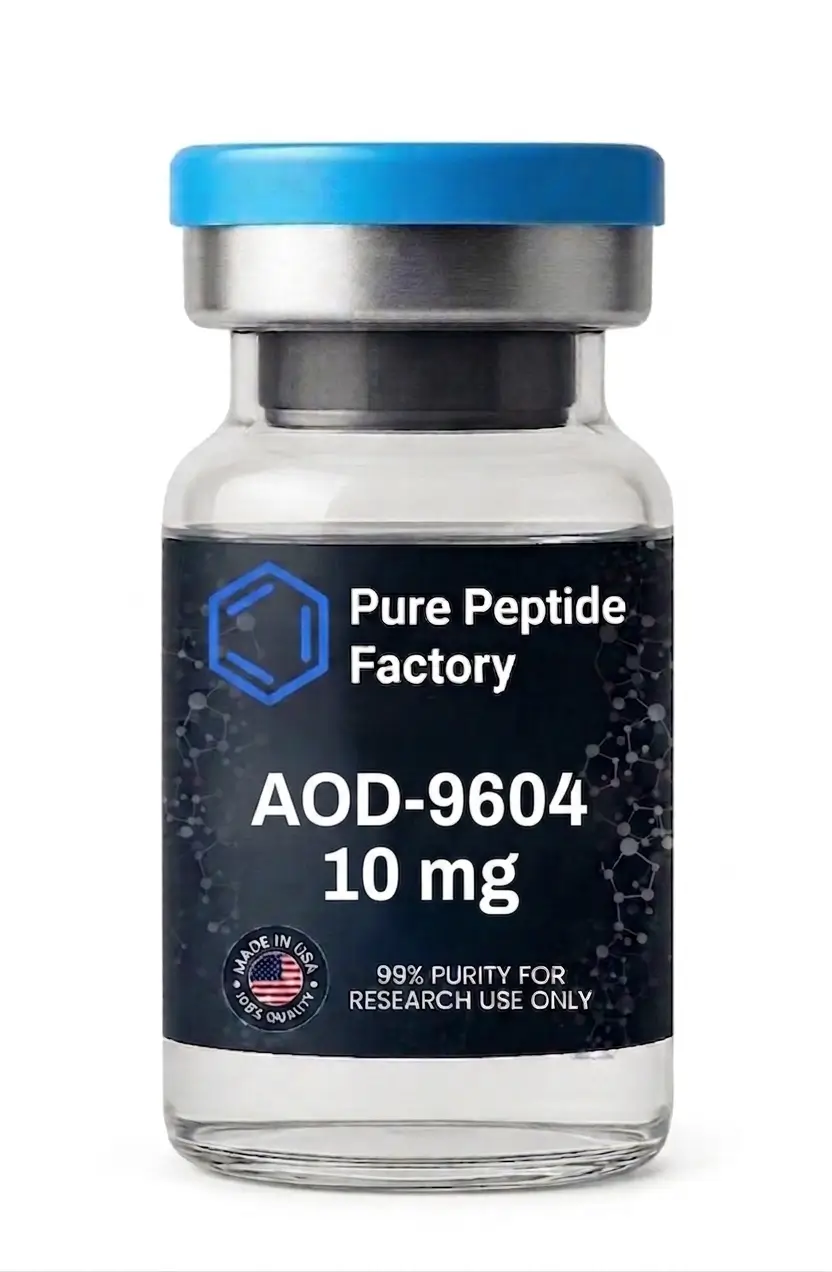
AOD 9604 10mg
$55.00 $150.00Price range: $55.00 through $150.00
Buy AOD 9604 at Pure Peptide Factory in research-grade 2mg, 5mg, and 10mg configurations. Specifically, AOD 9604 is a synthetic 16-amino-acid peptide corresponding to residues 176-191 of human growth hormone with an N-terminal tyrosine added for stability. Frank Ng and colleagues at Monash University developed the compound through Metabolic Pharmaceuticals to capture growth hormone’s lipolytic activity without IGF-1 stimulation. The peptide upregulates β3-adrenergic receptors and inhibits lipoprotein lipase. HPLC verified at 98% minimum purity, batch-specific COA. 2mg, 5mg, and 10mg vials. Research use only.
Buy AOD 9604: The Lipolytic GH Fragment 176-191 with Australian Academic Origins
In the 1990s, Frank M. Ng and his research team at Monash University in Melbourne, Australia identified the specific region of the human growth hormone molecule responsible for fat metabolism. Specifically, they isolated residues 176-191 — the C-terminal fragment of GH — and demonstrated that this region carried the lipolytic effects of the parent hormone without the growth-promoting actions. Furthermore, by adding a tyrosine residue to the N-terminus for structural stability, the team produced AOD 9604, a 16-amino-acid synthetic analog that became the foundation of Metabolic Pharmaceuticals’ anti-obesity development program.
The pharmacological premise was elegant: capture growth hormone’s documented fat-burning effects without elevating IGF-1, without insulin resistance, and without organ growth. AOD 9604 advanced through multiple Phase 2 trials, with the most notable outcome being a 12-week study in 300 obese subjects showing minor improvements in cholesterol profiles and glucose tolerance. However, the larger Phase 2b obesity trial in 2007 (502 patients, 12 months) did not demonstrate weight loss statistically distinct from placebo. As a result, Metabolic Pharmaceuticals discontinued the obesity development program, and the FDA later granted GRAS (Generally Recognized As Safe) status to AOD 9604 as a dietary supplement ingredient rather than a pharmaceutical compound.
For researchers studying lipolytic GH biology, β3-adrenergic receptor pharmacology, GH fragment activity in cartilage and bone regeneration, or the comparative pharmacology of weight-management research compounds, AOD 9604 remains a relevant research tool with a well-characterized mechanism. Pure Peptide Factory stocks research-grade AOD 9604 in 2mg, 5mg, and 10mg configurations with domestic cold-chain shipping and batch-specific HPLC documentation.
Why Researchers Buy AOD 9604 from Pure Peptide Factory
Documentation for a Disulfide-Bridged Peptide
AOD 9604 contains two cysteine residues at positions 7 and 14 of the 16-amino-acid sequence that form an intramolecular disulfide bridge essential for the compound’s three-dimensional structure and biological activity. Specifically, improperly synthesized AOD 9604 with reduced or scrambled disulfide bonds shows reduced lipolytic activity. Therefore, every batch we ship includes a lot-specific HPLC chromatogram and mass spectrometry report verifying the 1815.12 g/mol molecular weight target with disulfide bridge integrity confirmation. The Certificate of Analysis is downloadable before your compound ships.
Domestic Cold-Chain Shipping for Research Reproducibility
AOD 9604’s stability profile favors lyophilized storage, but reconstituted solution handling matters significantly for research data integrity. Furthermore, AOD 9604 is one of the peptides that can exhibit gelling or solubility problems with standard bacteriostatic water, which we address in detail in the reconstitution section below. We ship from domestic cold-storage using phase-change cooling rated for 96-hour protection. Consequently, most orders reach your lab within 1 to 3 business days.
Three Configurations for Research Protocol Flexibility
We stock AOD 9604 in 2mg, 5mg, and 10mg vials. Specifically, the 2mg configuration accommodates pilot studies and small-scale receptor pharmacology work, the 5mg vial matches the standard published research dose, and the 10mg configuration supports extended dosing protocols including the 19-day Zucker rat protocol from the foundational Ng 2000 publication. Therefore, researchers can match vial size to protocol scale without splitting vials or compromising reconstituted solution freshness.
Synthesis Logs Archived for 24 Months
We document and archive every batch. Therefore, if your IRB or compliance office requests chain-of-custody records or synthesis documentation, we can provide them on demand.
What Is AOD 9604?
A Modified C-Terminal Fragment of Human Growth Hormone
AOD 9604 is a synthetic 16-amino-acid peptide corresponding to residues 176-191 of human growth hormone with an additional tyrosine at the N-terminus for structural stability. Specifically, the compound captures the C-terminal lipolytic region of GH while excluding the N-terminal region (residues 1-43) responsible for insulin-potentiating actions and the central region (residues 108-129) responsible for mitogenic responses. Frank Ng and colleagues at Monash University identified this functional segregation, demonstrating that GH’s lipolytic activity could be isolated from its growth-promoting and metabolic side effects.
The compound’s name reflects its development origin: “AOD” stands for “Anti-Obesity Drug,” reflecting Metabolic Pharmaceuticals’ original therapeutic intent, while “9604” was the internal compound identifier within the company’s development pipeline.
Molecular Profile:
- Type: Synthetic 16-amino-acid lipolytic GH fragment
- Sequence: Tyr-Leu-Arg-Ile-Val-Gln-Cys-Arg-Ser-Val-Glu-Gly-Ser-Cys-Gly-Phe (with Cys7-Cys14 disulfide bridge)
- Origin: Modified hGH residues 177-191 (with N-terminal tyrosine addition)
- Molecular Formula: C78H123N23O23S2
- Molecular Weight: 1815.12 g/mol
- CAS: 221231-10-3
- PubChem CID: 71300630
- Synonyms: Tyr-hGH Fragment 177-191, GH 176-191 modified, AOD-9604, Tyr-Frag 176-191
- Developer: Frank M. Ng, Monash University / Metabolic Pharmaceuticals (Australia)
How AOD 9604 Works: Two Complementary Lipolytic Mechanisms
The Heffernan 2001 paper “The Effects of Human GH and Its Lipolytic Fragment (AOD 9604) on Lipid Metabolism Following Chronic Treatment in Obese Mice and β3-AR Knock-Out Mice” (Endocrinology, 142(12):5182-5189) established the mechanistic framework that subsequent research has confirmed and extended. Specifically, AOD 9604 operates through two complementary pathways:
β3-Adrenergic Receptor Upregulation. AOD 9604 increases β3-adrenergic receptor (β3-AR) RNA expression in adipocytes. β3-AR is the primary lipolytic receptor in fat cells, and its activation increases intracellular cAMP, which activates protein kinase A. Subsequently, hormone-sensitive lipase becomes phosphorylated and active, initiating the breakdown of stored triglycerides into free fatty acids and glycerol. Importantly, when Heffernan and colleagues administered AOD 9604 to β3-AR knockout mice, the compound still produced lipolytic effects, demonstrating that β3-AR upregulation contributes to but does not solely explain AOD 9604’s mechanism.
Lipoprotein Lipase Inhibition. AOD 9604 directly inhibits adipose tissue lipoprotein lipase (LPL) activity. LPL is the enzyme responsible for hydrolyzing triglycerides from circulating lipoproteins for adipose tissue uptake and storage. By inhibiting LPL, AOD 9604 shifts the metabolic balance from fat storage toward fat mobilization, which complements the β3-AR-mediated lipolysis.
Why IGF-1 Sparing Matters. Unlike full growth hormone, AOD 9604 does not stimulate insulin-like growth factor 1 (IGF-1) production. Specifically, the GH regions responsible for IGF-1 stimulation reside in the N-terminal portion of the molecule (residues 1-43), which AOD 9604 does not contain. As a result, AOD 9604 produces lipolytic effects without the insulin resistance, joint pain, edema, or potential mitogenic concerns that limit therapeutic GH use. This mechanistic separation is the foundational research interest in AOD 9604 as a lipolysis-only research tool.
Energy Expenditure and Fat Oxidation. Beyond receptor pharmacology, AOD 9604 increases energy expenditure and fat oxidation in research models. The Ng 2000 study in obese Zucker rats documented over 50% reduction in weight gain compared to placebo over 19 consecutive days of administration, with adipose tissue showing increased lipolytic activity and no insulin sensitivity disruption.
AOD 9604 Research Applications
Lipolysis and Adipose Tissue Research
The foundational research applications for AOD 9604 center on adipose tissue biology. Specifically, the Heffernan 2001 Endocrinology study used C57BL/6J lean mice and ob/ob obese mice across multiple treatment groups to characterize the compound’s effects on lipid metabolism. AOD 9604 at 250 µg/kg/day intraperitoneally produced reduction in body weight and improvement in body composition without altering serum IGF-1 levels, distinguishing it from full hGH (administered at 1 mg/kg/day) which produced both lipolytic effects and IGF-1 elevation.
Research endpoints include:
- β3-AR mRNA quantification in adipose tissue
- Lipoprotein lipase activity assays in adipose tissue homogenates
- Hormone-sensitive lipase phosphorylation profiling
- Free fatty acid mobilization measurements
- Indirect calorimetry for energy expenditure in metabolic chambers
- Fat mass quantification by DEXA or MRI
Obesity Research Models
The Ng 2000 obese Zucker rat study (Hormone Research, February 2000) established AOD 9604’s research framework for genetic obesity models. Specifically, daily subcutaneous administration for 19 consecutive days produced over 50% reduction in weight gain compared to placebo controls, with documented improvements in adipose tissue lipolytic activity and preserved insulin sensitivity. As a result, researchers studying genetic obesity (Zucker rats, ob/ob mice, db/db mice) and diet-induced obesity models use AOD 9604 to dissect lipolytic mechanisms from broader metabolic effects.
Cartilage Regeneration and Osteoarthritis Research
A surprising research application emerged from the Kwon and Park 2015 study “Effect of Intra-articular Injection of AOD 9604 with or without Hyaluronic Acid in Rabbit Osteoarthritis Model” (Annals of Clinical and Laboratory Science, 45). Specifically, the researchers divided 32 white rabbits into four groups receiving placebo, AOD 9604 alone, hyaluronic acid alone, or AOD 9604 combined with hyaluronic acid. After 4-7 weeks, morphological and histopathological analysis demonstrated that the AOD 9604 + hyaluronic acid combination produced the least cartilage degeneration in the collagenase-induced osteoarthritis model.
Furthermore, in vitro work demonstrated that AOD 9604 enhances differentiation of adipose-derived mesenchymal stem cells into bone cells, increases proteoglycan and collagen production in isolated bovine chondrocytes, and supports myoblast differentiation into C2C12 muscle cells. As a result, AOD 9604 research has expanded beyond pure adipose tissue applications into:
- Collagenase-induced osteoarthritis rabbit models
- Adipose-derived stem cell differentiation protocols
- Chondrocyte proteoglycan and collagen synthesis assays
- Cartilage repair and tissue engineering research
- Combination protocols with hyaluronic acid
Cancer Cell Research and Drug Delivery
The 2022 Habibullah et al. paper “Human Growth Hormone Fragment 176-191 Peptide Enhances the Toxicity of Doxorubicin-Loaded Chitosan Nanoparticles Against MCF-7 Breast Cancer Cells” (Drug Design, Development and Therapy, 16:1963-1974) opened a research direction that distinguishes AOD 9604 from most lipolytic peptides. Specifically, the researchers demonstrated that AOD 9604 binding to tumor-related proteins enhances doxorubicin accumulation and cytotoxicity in MCF-7 breast cancer cells. As a result, the chitosan-doxorubicin-AOD 9604 nanoparticle formulation produced greater anti-proliferative activity against MCF-7 cells than chitosan-doxorubicin alone.
This application represents a research frontier where AOD 9604 functions not as a lipolytic agent but as a tumor-targeting moiety that enhances chemotherapeutic delivery. Therefore, drug delivery system researchers and cancer biology investigators have begun examining AOD 9604 within nanoparticle formulation contexts.
Energy Expenditure and Metabolic Rate Research
Beyond direct lipolysis, AOD 9604 increases energy expenditure and fat oxidation in research models independently of its β3-AR upregulation effects. Specifically, β3-AR knockout mice still showed AOD 9604-induced lipolysis, suggesting that energy expenditure pathways operate as a parallel mechanism rather than a downstream consequence of β3-AR activation. As a result, indirect calorimetry research, brown adipose tissue activation studies, and substrate utilization investigations all use AOD 9604 as a research tool for examining lipolysis-energy expenditure coupling.
AOD 9604 vs Tesamorelin: Comparing GH-Based Fat Loss Research Compounds
The AOD 9604 vs Tesamorelin comparison is one of the most-searched questions in this keyword cluster. Both compounds derive from growth hormone biology but operate through fundamentally different mechanisms:
| Feature | AOD 9604 | Tesamorelin |
|---|---|---|
| Type | 16-aa synthetic GH fragment (residues 176-191) | 44-aa synthetic GHRH analog |
| Mechanism | Direct lipolytic via β3-AR upregulation + LPL inhibition | Indirect via stimulating endogenous GH release |
| Receptor target | β3-adrenergic receptors in adipocytes | GHRH receptor on pituitary somatotrophs |
| IGF-1 elevation | None (fragment lacks N-terminal IGF-1-stimulating region) | Yes (elevates IGF-1 through GH stimulation) |
| Insulin resistance risk | Minimal | Possible (GH-mediated) |
| FDA approval status | Not approved (failed Phase 2b for obesity) | Approved as Egrifta for HIV-associated lipodystrophy |
| Clinical development | Discontinued for obesity; GRAS supplement status | Active clinical use, ongoing research expansion |
| Half-life | ~2 hours plasma (subcutaneous) | ~26 minutes plasma |
| Best for studying | Direct β3-AR/LPL adipose pharmacology | GHRH receptor signaling, somatotrope function |
The mechanistic distinction matters for research design. Tesamorelin requires intact pituitary GH release machinery and produces both lipolytic and IGF-1-mediated effects. By contrast, AOD 9604 acts directly on adipose tissue without engaging the GH-IGF-1 axis. Therefore, researchers studying lipolysis in pituitary-suppressed models, GH-receptor knockout animals, or in vitro adipocyte cultures use AOD 9604, while researchers requiring intact GH axis function use Tesamorelin.
For comparative research protocols, our facility stocks both compounds under identical handling conditions to eliminate batch variability across experiments.
AOD 9604 vs Tirzepatide and GLP-1 Agonists: Different Mechanisms, Different Research Questions
Researchers comparing AOD 9604 to modern GLP-1 receptor agonists like Tirzepatide, Semaglutide, Mazdutide, or Survodutide are asking a question with a clear mechanistic answer:
| Feature | AOD 9604 | GLP-1 Agonists (Tirzepatide, etc.) |
|---|---|---|
| Type | GH fragment (lipolytic) | Incretin receptor agonists |
| Primary mechanism | Direct adipose tissue lipolysis | Appetite suppression + insulin secretion + GI motility |
| Effect on food intake | Minimal | Substantial reduction |
| Weight loss in research | Modest (failed Phase 2b for obesity) | Substantial (15-25% in clinical trials) |
| FDA approval | Not approved | Multiple approvals (Mounjaro, Ozempic, Zepbound) |
| Clinical pipeline | Largely discontinued | Active expansion |
| Side effect profile (in human use) | Generally favorable | GI effects, pancreatitis risk, gastroparesis |
| Best for studying | Adipose tissue receptor pharmacology | Glucose-insulin axis, appetite regulation |
The honest research summary: AOD 9604 and GLP-1 agonists answer different research questions and operate through completely different molecular pathways. Furthermore, the clinical development trajectories diverged dramatically — GLP-1 agonists became the dominant pharmacological approach to weight management while AOD 9604 development ended after the 2007 Phase 2b obesity trial failure. Therefore, researchers using AOD 9604 today are studying adipose tissue receptor pharmacology and lipolytic mechanisms specifically, not seeking a substitute for GLP-1-class compounds.
AOD 9604 vs HGH Fragment 176-191: What’s Actually Different
The “AOD 9604 vs Frag 176-191” question reflects researcher confusion about whether these are the same compound. The answer is that they are closely related but structurally distinct:
| Feature | HGH Fragment 176-191 | AOD 9604 |
|---|---|---|
| Length | 16 amino acids | 16 amino acids |
| Sequence | Native hGH residues 176-191 (Tyr-Leu-Arg-Ile-Val-Gln-Cys-Arg-Ser-Val-Glu-Gly-Ser-Cys-Gly-Phe) | Modified hGH residues 177-191 + N-terminal tyrosine |
| First residue | Tyr (native position 176) | Tyr (added for stability) |
| Disulfide bridge | Cys7-Cys14 | Cys7-Cys14 |
| Stability | Less stable | Improved stability via N-terminal modification |
| Developer | Generic GH research framework | Frank Ng / Metabolic Pharmaceuticals (Australia) |
| Patent status | None (sequence is native hGH) | Patented through Metabolic Pharmaceuticals |
In practical research terms, AOD 9604 and HGH Fragment 176-191 produce similar lipolytic effects through the same mechanistic pathways. However, AOD 9604 was specifically engineered as a stabilized version intended for clinical development, while HGH Fragment 176-191 represents the unmodified native sequence used in earlier research. Therefore, contemporary research protocols typically use AOD 9604 as the standard form, while HGH Fragment 176-191 appears in legacy literature and some lower-cost research compound listings.
AOD 9604 vs MOTS-C: Different Mitochondrial vs Adipose Strategies
Researchers comparing AOD 9604 to MOTS-C are asking about two fundamentally different metabolic research approaches:
| Feature | AOD 9604 | MOTS-C |
|---|---|---|
| Type | GH fragment | Mitochondrial-derived peptide (16 aa) |
| Origin | hGH residues 176-191 | Mitochondrial 12S rRNA-encoded peptide |
| Primary target | Adipocyte β3-AR + LPL | AMPK pathway in skeletal muscle |
| Site of action | Adipose tissue | Skeletal muscle (primary), systemic |
| Mechanism | Direct lipolysis stimulation | Mitochondrial biogenesis, fatty acid oxidation |
| Research applications | Obesity, cartilage regeneration, drug delivery | Aging, exercise mimetics, metabolic syndrome |
| FDA status | GRAS supplement, no drug approval | Investigational |
The compounds answer different research questions. Specifically, AOD 9604 addresses adipose tissue receptor pharmacology, while MOTS-C addresses muscle mitochondrial biology. Researchers running combination protocols sometimes use both compounds to model coordinated metabolic interventions, although peer-reviewed comparative research is limited.
AOD 9604 with Tirzepatide or Ozempic: Combination Research Considerations
The “AOD 9604 with Tirzepatide” and “AOD 9604 with Ozempic” search queries reflect researcher interest in combination protocols. Specifically, the mechanistic rationale combines AOD 9604’s direct adipose tissue lipolysis with GLP-1 agonists’ appetite suppression and insulin secretion effects. Theoretically, the combination addresses fat metabolism at two complementary levels: substrate mobilization (AOD 9604) and substrate intake reduction (GLP-1 agonists).
However, peer-reviewed research on this specific combination is limited. Furthermore, because both compounds individually produce significant metabolic effects, combination protocols require careful design including:
- Independent control arms for each compound
- Staggered dosing to isolate kinetic interactions
- Insulin sensitivity monitoring (despite AOD 9604’s IGF-1-sparing profile, GLP-1 agonist effects on glucose homeostasis remain)
- Weight loss endpoint quantification with body composition analysis
We do not provide human dosing recommendations for the combination. Research protocol design should isolate each compound’s contribution before drawing mechanistic conclusions about synergy or additivity.
How to Reconstitute AOD 9604
The AOD 9604 Solubility Issue
AOD 9604 is one of the research peptides that frequently exhibits solubility problems in standard bacteriostatic water reconstitution. Specifically, researchers often report that reconstituted AOD 9604 forms gel-like aggregates, cloudy solutions, or fails to dissolve completely. This occurs because the compound’s amphipathic structure and disulfide-bridged conformation can drive self-association in low ionic strength diluents.
The solution most vendors don’t discuss: dilute acetic acid (typically 0.6% or 1% in water) improves AOD 9604 solubility significantly compared to bacteriostatic water alone. Specifically, the slightly acidic environment prevents the self-association that produces gelling. After dissolution in acetic acid solution, the reconstituted peptide can be diluted further with bacteriostatic water or PBS for working concentrations.
Step-by-Step Laboratory Protocol
For standard reconstitution:
- Sanitize the vial stopper with 70% isopropyl alcohol
- Inject bacteriostatic water slowly against the vial wall
- Allow the lyophilized powder to dissolve without agitation for 3 to 5 minutes
- Gently swirl until the solution clears. Do not shake (vigorous agitation can promote aggregation)
- Inspect for clarity. If gelling or cloudiness occurs, switch to acetic acid reconstitution (below)
For acetic acid reconstitution (if standard reconstitution produces gelling):
- Prepare 0.6% acetic acid solution in sterile water (or use commercially available 0.1M acetic acid)
- Inject the acetic acid solution slowly against the vial wall
- Allow dissolution for 3 to 5 minutes with gentle swirling
- Verify clear solution
- For working dilutions, dilute the acetic acid stock with bacteriostatic water to target concentration
Concentration reference for 2mg vial:
- 2mg vial + 1mL diluent = 2mg/mL
- 2mg vial + 2mL diluent = 1mg/mL
Concentration reference for 5mg vial:
- 5mg vial + 1mL diluent = 5mg/mL
- 5mg vial + 2.5mL diluent = 2mg/mL
- 5mg vial + 5mL diluent = 1mg/mL
Concentration reference for 10mg vial:
- 10mg vial + 1mL diluent = 10mg/mL
- 10mg vial + 2mL diluent = 5mg/mL
- 10mg vial + 5mL diluent = 2mg/mL
- 10mg vial + 10mL diluent = 1mg/mL
Storage Requirements
- Lyophilized powder: 24 months at -20°C, protected from light and moisture
- Reconstituted solution: 14 days at 2 to 8°C. Do not freeze reconstituted AOD 9604
- Because AOD 9604 contains a critical disulfide bridge between Cys7 and Cys14, freeze-thaw cycles may reduce activity through bridge reduction or scrambling
- Working dilutions should be prepared fresh for studies where reproducibility matters
AOD 9604 Pharmacokinetics
AOD 9604 has a plasma half-life of approximately 2 hours following subcutaneous administration in research models. By contrast, oral administration in obese Zucker rats at 500 µg/kg achieved systemic exposure with a >50% reduction in weight gain over 19 days, demonstrating effective gastrointestinal absorption despite the compound’s peptide structure. As a result, both injection and oral administration routes appear in published research protocols.
The relatively short plasma half-life means daily administration represents the standard research dosing frequency in the foundational Heffernan 2001 and Ng 2000 protocols. Longer-acting AOD 9604 derivatives have not progressed through clinical development, although the original compound’s stability profile in lyophilized form supports practical research use.
AOD 9604 Forms and Administration Routes
The “AOD 9604 troche,” “AOD 9604 oral,” “AOD 9604 nasal spray,” and “AOD 9604 capsules” keyword cluster reflects researcher interest in alternative administration routes beyond subcutaneous injection. Below is honest framing of the research context for each:
Subcutaneous injection is the primary route in published preclinical research. Specifically, the Heffernan 2001 protocol used intraperitoneal administration in mice, while Ng 2000 used daily injection in Zucker rats. Subcutaneous injection produces predictable pharmacokinetics matching the published research framework.
Oral administration has documented bioavailability in research models, with the 500 µg/kg/day Zucker rat protocol demonstrating systemic exposure and lipolytic effects. As a result, troche, capsule, and tablet formulations appear in some compounding pharmacy and consumer-research vendor offerings, although bioavailability is lower than injection.
Nasal spray formulations are sold by some vendors as alternative delivery routes. Specifically, intranasal administration theoretically bypasses first-pass metabolism, although peer-reviewed pharmacokinetic data on intranasal AOD 9604 is limited. Research applications for intranasal AOD 9604 remain investigational.
Sublingual troches offer another alternative format with theoretical advantages including bypassing gastric degradation. However, the lipolytic peptide mechanism requires systemic exposure to adipose tissue, which sublingual absorption may or may not achieve adequately depending on formulation.
For laboratory research purposes, subcutaneous or intraperitoneal injection remains the route best supported by published literature.
AOD 9604 Research Dosing Framework
Published preclinical research dosing across major studies:
| Research Context | Dose | Route | Frequency | Reference |
|---|---|---|---|---|
| C57BL/6J mouse lipid metabolism | 250 µg/kg/day | Intraperitoneal | Daily | Heffernan 2001 |
| ob/ob obese mouse | 250 µg/kg/day | Intraperitoneal | Daily | Heffernan 2001 |
| β3-AR knockout mouse | 250 µg/kg/day | Intraperitoneal | Daily | Heffernan 2001 |
| Obese Zucker rat oral | 500 µg/kg | Oral | Daily x 19 days | Ng 2000 |
| Phase 2 obesity trial (12 weeks) | Per protocol | Subcutaneous | Daily | Metabolic Pharma 2004 |
| Rabbit OA model intra-articular | Per protocol | Intra-articular injection | Per study | Kwon 2015 |
| MCF-7 cancer cell culture | Nanomolar | Cell culture | Per assay | Habibullah 2022 |
We do not provide human dosing recommendations. The dosing references above synthesize peer-reviewed preclinical and clinical research and serve only as laboratory research design context.
Buy AOD 9604: Regulatory Context
Clinical Development History
AOD 9604 advanced through multiple Phase 2 clinical trials for obesity. Specifically, a 2004 Phase 2 trial in 300 obese subjects over 12 weeks documented minor improvements in cholesterol profiles and glucose tolerance. However, the larger Phase 2b trial (502 patients, 12 months, 2007) did not produce weight loss statistically distinct from placebo. As a result, Metabolic Pharmaceuticals discontinued the obesity development program. Subsequent investigation explored osteoarthritis applications based on the Kwon 2015 cartilage regeneration findings.
Current Regulatory Status
The FDA granted GRAS (Generally Recognized As Safe) status to AOD 9604 in the 2010s, classifying it as a dietary supplement ingredient rather than a pharmaceutical compound. By contrast, the Therapeutic Goods Administration (TGA) in Australia, where the compound was originally developed, did not approve AOD 9604 as a therapeutic. Therefore, AOD 9604 is not FDA-approved as a drug for any indication.
Research Use Only
Research-grade AOD 9604 is available for laboratory procurement under research-use-only terms without a prescription. This compound is not for human consumption, veterinary use, or diagnostic application. You must agree to research-use-only terms at checkout.
Product Specifications
Available Configurations
AOD 9604 is available in 2mg, 5mg, and 10mg vials. Select your configuration from the product options above based on protocol scale.
Quality Verification
- Purity: 98% minimum (HPLC verified)
- Identity: Mass spectrometry confirmed against the 1815.12 g/mol target with disulfide bridge integrity verification
- Sequence: Tyr-Leu-Arg-Ile-Val-Gln-Cys-Arg-Ser-Val-Glu-Gly-Ser-Cys-Gly-Phe verified
- Endotoxin: Less than 0.1 EU/mL
- Sterility: Verified per USP 71
- Form: Lyophilized powder, white to off-white
- Storage: -20°C long-term, 2 to 8°C short-term after reconstitution
Current Batch: #PPF-AOD-0426 Purity: 98.7% Download: HPLC Certificate | MS Report
FAQ
What is AOD 9604 used for in research?
Researchers use AOD 9604 in lipolysis and adipose tissue biology research, β3-adrenergic receptor pharmacology, obesity research models (genetic and diet-induced), cartilage regeneration and osteoarthritis research (per the Kwon 2015 rabbit study framework), adipose-derived stem cell differentiation protocols, cancer cell research as a tumor-targeting moiety in nanoparticle drug delivery (per the 2022 Habibullah breast cancer study), and energy expenditure investigations.
Where can I buy AOD 9604 for research?
Pure Peptide Factory stocks research-grade AOD 9604 in 2mg, 5mg, and 10mg vials with batch-specific HPLC and mass spectrometry documentation. Furthermore, domestic cold-chain shipping delivers most orders within 1 to 3 business days.
What are AOD 9604 benefits in research models?
Published research documents reduced body weight and excess fat in obese mouse and rat models, increased β3-adrenergic receptor expression in adipocytes, lipoprotein lipase inhibition, increased energy expenditure and fat oxidation, preserved insulin sensitivity (no glucose homeostasis disruption), and IGF-1-sparing lipolytic effects. Furthermore, applications in cartilage regeneration, stem cell differentiation, and cancer cell drug delivery research have emerged in subsequent literature.
How does AOD 9604 differ from full growth hormone?
AOD 9604 is a 16-amino-acid synthetic fragment corresponding to GH residues 176-191 with an N-terminal tyrosine added. Specifically, the compound contains only the C-terminal lipolytic region of GH, omitting the N-terminal region (residues 1-43) that drives IGF-1 stimulation and the central region (residues 108-129) that produces mitogenic effects. As a result, AOD 9604 produces lipolytic effects without elevating IGF-1, causing insulin resistance, or driving organ growth.
Is AOD 9604 the same as HGH Fragment 176-191?
They are closely related but structurally distinct. Specifically, HGH Fragment 176-191 represents the native hGH sequence at those positions, while AOD 9604 has an N-terminal tyrosine added for improved stability. Furthermore, AOD 9604 was patented through Metabolic Pharmaceuticals as a stabilized clinical development candidate, while HGH Fragment 176-191 is the generic native sequence used in earlier research.
How does AOD 9604 compare to Tesamorelin?
AOD 9604 is a 16-aa GH fragment that acts directly on adipose tissue β3-AR and LPL. Tesamorelin is a 44-aa GHRH analog that stimulates pituitary GH release. Specifically, AOD 9604 produces lipolysis without IGF-1 elevation, while Tesamorelin elevates both GH and IGF-1 through pituitary stimulation. Furthermore, Tesamorelin is FDA-approved as Egrifta for HIV-associated lipodystrophy, while AOD 9604 development for obesity was discontinued. See the comparison table above for full details.
Did AOD 9604 fail clinical trials?
Yes, partially. Specifically, the 2007 Phase 2b obesity trial in 502 patients over 12 months did not demonstrate weight loss statistically distinct from placebo. As a result, Metabolic Pharmaceuticals discontinued the obesity development program. By contrast, earlier Phase 2 work in 300 subjects over 12 weeks documented minor improvements in cholesterol and glucose tolerance, and subsequent research has expanded into osteoarthritis, cartilage regeneration, and cancer drug delivery applications.
Is AOD 9604 FDA approved?
AOD 9604 is not FDA approved as a pharmaceutical drug. However, the FDA granted GRAS (Generally Recognized As Safe) status to AOD 9604 in the 2010s, classifying it as a dietary supplement ingredient. Furthermore, the TGA in Australia did not approve AOD 9604 as a therapeutic. Research-grade AOD 9604 is legally available for laboratory procurement under research-use-only provisions.
How should AOD 9604 be reconstituted?
AOD 9604 sometimes exhibits solubility problems in standard bacteriostatic water due to its amphipathic structure. Specifically, if gelling or cloudiness occurs, dilute acetic acid solution (0.6% in water) provides better dissolution before further dilution with bacteriostatic water or PBS. See the reconstitution section above for the full step-by-step protocol.
What is the AOD 9604 mechanism of action?
AOD 9604 operates through two complementary mechanisms. First, the compound upregulates β3-adrenergic receptor expression in adipocytes, increasing intracellular cAMP and activating hormone-sensitive lipase for fatty-acid mobilization. Second, AOD 9604 directly inhibits adipose tissue lipoprotein lipase activity, shifting the metabolic balance from fat storage toward fat breakdown. Furthermore, the compound increases energy expenditure and fat oxidation through mechanisms that operate independently of β3-AR upregulation.
What is AOD 9604’s half-life?
AOD 9604 has a plasma half-life of approximately 2 hours following subcutaneous administration in research models. As a result, daily administration represents the standard research dosing frequency in published preclinical protocols. By contrast, oral administration achieves systemic exposure but with lower bioavailability than injection routes.
How should AOD 9604 be stored?
Lyophilized powder stores at -20°C for up to 24 months protected from light and moisture. Reconstituted solution stores at 2 to 8°C for up to 14 days. Do not freeze reconstituted AOD 9604 because the disulfide bridge between Cys7 and Cys14 may degrade through freeze-thaw cycles.
Order AOD 9604 for Research
Secure Checkout
- Credit card, cryptocurrency, or wire transfer
- Same-day dispatch for orders placed before 2 PM EST
- Cold-chain packaging with phase-change cooling
- Discreet labeling with full tracking
Institutional Accounts
Net-30 terms and purchase order acceptance available for universities and pharmaceutical companies. Furthermore, contact us for bulk pricing on 50 vials or more, including matched bulk orders for AOD 9604 alongside Tesamorelin and MOTS-C for comparative metabolic peptide research protocols.
Add to cart and get research-grade AOD 9604 delivered with the documentation your lipolytic GH biology, β3-AR pharmacology, or comparative metabolic research requires.