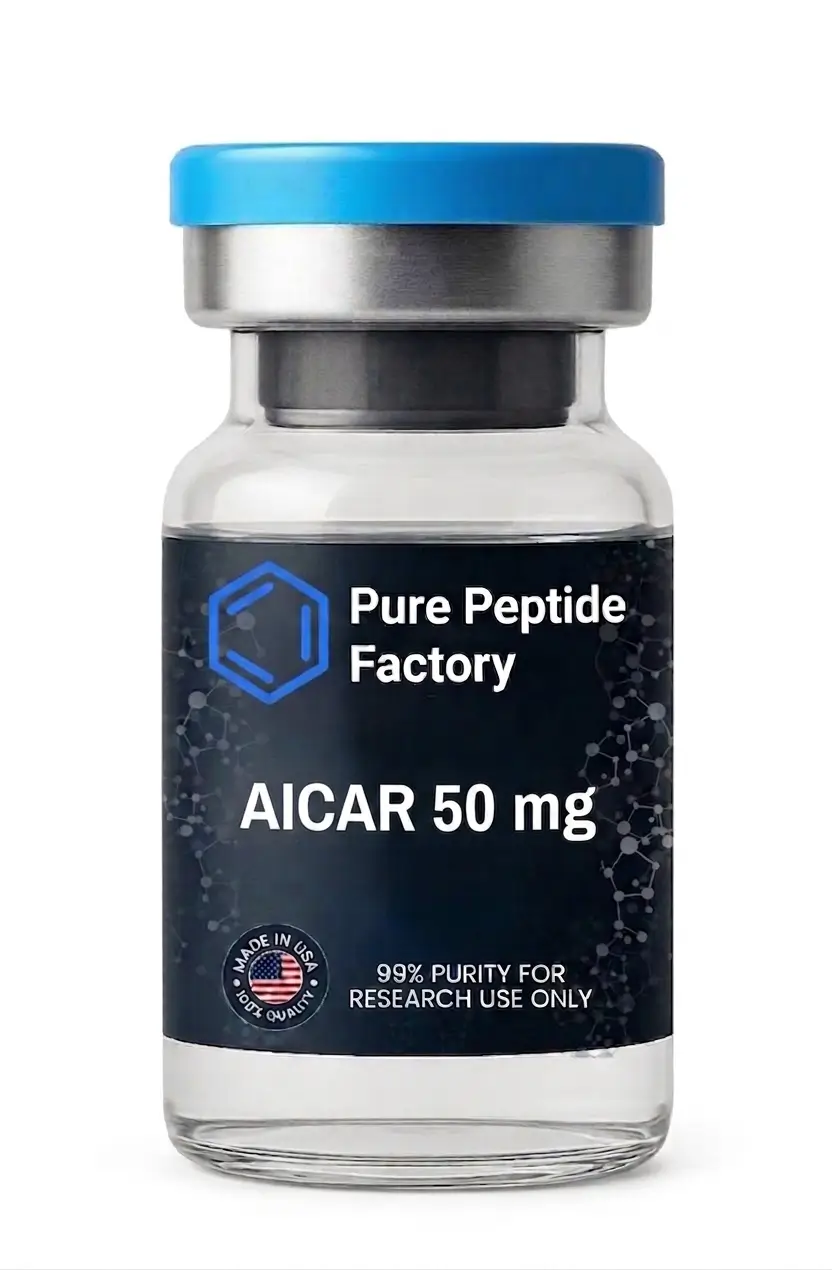
AICAR 50mg
$60.00 $70.00Price range: $60.00 through $70.00
AICAR — available in multiple dosages. For research use only.
AICAR for Sale: The AMPK Activator That Researchers Cannot Find in Stock
AICAR is one of the most studied AMPK activating compounds in metabolic research. It sits at the intersection of exercise physiology, cardiovascular protection, insulin sensitivity, and oncology, making it useful across more research disciplines than almost any other compound in this category. The problem is availability. The largest competing supplier is currently out of stock. Pure Peptide Factory has AICAR in stock in 50mg and 100mg configurations, ships same-day from domestic cold-storage, and backs every vial with batch-specific HPLC documentation.
If you have been searching for AICAR for sale from a supplier that actually has it, this is where your search ends.
Why Researchers Buy AICAR from Pure Peptide Factory
In Stock When Competitors Are Not
Supply chain disruptions have left several major AICAR suppliers either out of stock or shipping from overseas with no delivery guarantee. We maintain dedicated domestic inventory in both 50mg and 100mg vials. Your protocol does not have to wait on a restock timeline that may be weeks away.
Batch-Specific Purity Documentation
Every vial ships with a lot-specific HPLC chromatogram and mass spectrometry confirmation. You can verify the molecular weight against the published value of 338.21 g/mol and confirm compound identity before running a single assay. Generic certificates copied across thousands of vials tell you nothing about your specific batch. Ours do.
Two Configurations for Any Protocol Scale
The 50mg vial suits pilot studies, dose-finding work, and cell culture protocols. The 100mg vial is built for extended animal studies and institutional research programs running multiple cohorts. One supplier, two sizes, no splitting and recalculating.
Domestic Cold-Chain From Our Facility to Your Lab
AICAR is stable as a lyophilized powder but degrades under improper storage conditions. We store at -20°C and ship with phase-change cooling. Most orders arrive within 1 to 3 business days. International sourcing cannot match that reliability or timeline.
The AMPK Research Stack
We stock AICAR alongside MOTS-C and Humanin, the two other primary compounds researchers use to study AMPK-related mitochondrial signaling. All three are stored under identical conditions. Researchers running multi-compound AMPK pathway studies can source the entire stack from one supplier with consistent batch handling across all three compounds.
What Is AICAR?
The AMPK Activating Nucleotide Analog
AICAR, formally known as 5-Aminoimidazole-4-carboxamide ribonucleotide and also called acadesine or AICA ribonucleotide, is an analog of adenosine monophosphate (AMP). It is not technically a peptide despite appearing alongside peptides in research catalogs. It is a nucleoside metabolite that enters cells and is phosphorylated to its active intracellular form ZMP (AICA ribotide), which then mimics the effects of AMP on AMPK.
AMPK is the cell’s master energy sensor. When the AMP to ATP ratio rises, signaling low energy availability, AMPK activates and triggers a cascade that switches the cell from energy-consuming to energy-producing processes. AICAR provides a pharmacological route to activate this same cascade without requiring actual energy depletion, making it one of the most precise tools available for studying AMPK-dependent biology.
Molecular Profile:
- Molecular Formula: C9H14N4O8P
- Molecular Weight: 338.21 g/mol
- CAS: 2627-69-2
- Also known as: Acadesine, AICA riboside, AICA ribonucleotide, ZMP precursor
How AICAR Works at the Cellular Level
Once inside the cell, AICAR is phosphorylated to ZMP by adenosine kinase. ZMP accumulates intracellularly and allosterically activates AMPK by mimicking AMP. From that activation point, AMPK phosphorylates dozens of downstream targets, producing effects across multiple tissue types simultaneously:
- Inhibition of anabolic pathways: fatty acid synthesis, cholesterol synthesis, protein synthesis
- Activation of catabolic pathways: glucose uptake, fatty acid oxidation, glycolysis
- Promotion of mitochondrial biogenesis through PGC-1alpha activation
- Regulation of autophagy, inflammation, and cellular stress responses
- Activation of PPARdelta, which regulates gene expression for oxidative metabolism
Critically, AICAR also has AMPK-independent effects that researchers must account for in protocol design. A 2021 systematic review published in Cells catalogued multiple AICAR actions that persist even when AMPK is pharmacologically inhibited, making it a compound with broader biological reach than simple AMPK agonism.
AICAR Peptide Benefits: Research Applications
Cardiovascular and Ischemia Protection
AICAR has one of the strongest evidence bases in cardiovascular research of any compound in this class. A meta-analysis of five randomized placebo-controlled double-blind clinical studies found that AICAR reduced myocardial tissue infarction size, decreased cardiac cell death, and improved overall cardiovascular outcomes. The mechanism involves AMPK-dependent glycogenolysis in myocardial tissue, increasing glucose availability for anaerobic energy production during ischemic conditions.
The intracellular form ZMP allosterically activates glycogen phosphorylase, driving glycogen breakdown in intact hearts to provide glucose that cells can use under low-oxygen conditions. This mechanism explains why AICAR has been studied specifically for perioperative cardiac protection in high-risk surgical patients, with clinical trial data supporting reduced adverse cardiovascular outcomes.
Researchers using AICAR for cardiovascular work examine:
- Myocardial infarction size reduction in ischemia-reperfusion models
- Glycogenolysis regulation through AMPK-dependent and independent pathways
- Cardioprotective windows for pre-ischemic administration
- Cardiac AMPK phosphorylation dynamics under metabolic stress
Insulin Sensitivity and Glucose Metabolism
AICAR improves insulin sensitivity through multiple converging mechanisms. In skeletal muscle, AMPK activation increases glucose transporter expression, specifically upregulating GLUT8 protein and driving glucose into muscle cells. In hepatic tissue, AICAR reduces glucose output, stimulates fatty acid oxidation, and inhibits lipolysis, lowering plasma free fatty acid availability.
In type 2 diabetic patients, intravenous AICAR administration reduced hepatic glucose output and inhibited whole-body lipolysis, effects observed alongside increased acetyl-CoA carboxylase phosphorylation. This inactivation of ACC decreases fatty acid synthesis and increases fatty acid oxidation, shifting the metabolic balance toward catabolism. Researchers studying type 2 diabetes models, insulin resistance mechanisms, and hepatic glucose regulation use AICAR to probe these pathways with precision.
Endurance and Exercise Biology
The most cited AICAR finding in exercise research comes from a 2008 Cell study examining AMPK and PPARdelta agonists in sedentary murine models. AICAR administration induced metabolic gene expression and enhanced running endurance by 44% without any exercise training. The mechanism involves AMPK-PPARdelta pathway activation, which promotes mitochondrial biogenesis and shifts skeletal muscle fiber composition toward oxidative, fatigue-resistant types.
The same pathway responsible for exercise-induced adaptation can be partially engaged pharmacologically through AICAR. This makes the compound central to research on exercise mimetics, mitochondrial biogenesis, muscle fiber plasticity, and endurance adaptation. Further studies in Duchenne muscular dystrophy models showed AICAR enhanced the effects of exercise and improved muscle function by stimulating autophagy, clearing damaged cellular components and preserving muscle integrity.
AICAR also increases forearm blood flow through nitric oxide-dependent mechanisms. Intra-arterial AICA-riboside administration induced NO-dependent vasodilation in human skeletal muscle, a finding with implications for blood flow research and NO pathway studies in exercise physiology.
Liver Protection and Fatty Liver Models
In ethanol-induced hepatic steatosis models, AICAR attenuated fatty liver development through AMPK activation. It decreased expression of SREBP-1c, the transcription factor regulating lipogenic gene expression, and reduced fatty acid synthase enzyme levels, cutting triglyceride synthesis in liver tissue. This dual action on lipogenic gene regulation makes AICAR valuable for researchers studying non-alcoholic fatty liver disease, alcohol-related liver damage, and hepatic lipid metabolism.
Cancer Cell Biology
AICAR triggers apoptosis in B-cell chronic lymphocytic leukemia (B-CLL) cells through caspase-3, -8, and -9 activation alongside cytochrome C release. The mechanism requires cellular uptake of AICAR and conversion to ZMP, which then activates AMPK phosphorylation in these cells. Normal B lymphocytes showed similar sensitivity to AICAR-induced apoptosis, while T cells from B-CLL patients showed only minor sensitivity and did not exhibit AMPK phosphorylation, suggesting cell-type-specific responses.
The apoptosis mechanism operates independently of p53 status, making AICAR relevant for research on p53-independent cancer cell death pathways. Researchers studying leukemia models, cancer cell metabolism, and AMPK-dependent apoptosis incorporate AICAR as a tool for probing these mechanisms.
AICAR and the AMPK Research Stack
How AICAR Compares to Other AMPK Pathway Compounds
Researchers studying AMPK signaling often use AICAR alongside MOTS-C and other mitochondrial-derived peptides that converge on the same pathway. Understanding where each compound sits in that landscape is essential for protocol design:
| Feature | AICAR | MOTS-C | Humanin |
|---|---|---|---|
| Compound class | Nucleoside analog | Mitochondrial peptide | Mitochondrial peptide |
| Primary mechanism | Direct ZMP-mediated AMPK activation | Folate cycle suppression leading to AMPK | STAT3, Bax inhibition |
| AMPK dependence | Primary but not exclusive | Primary mechanism | Indirect |
| Main research areas | Cardiovascular, exercise, metabolism, cancer | Metabolism, aging, exercise | Neuroprotection, longevity, insulin |
| Tissue specificity | Broad multi-tissue | Skeletal muscle, adipose, bone | Brain, pancreas, heart |
| AMPK-independent effects | Documented and significant | Minimal | Minimal |
AICAR activates AMPK more directly than MOTS-C, making it the preferred tool when researchers need acute, controllable AMPK engagement. MOTS-C is better positioned for studying physiologically relevant mitochondrial signaling over extended periods. Running both in parallel allows researchers to distinguish direct AMPK pharmacology from mitochondria-mediated AMPK regulation.
AICAR and WADA: What Researchers Need to Know
Prohibited Status in Sport
AICAR is listed on the World Anti-Doping Agency Prohibited List as a metabolic modulator under Section S4. It has been banned in competitive sports since 2011 following the publication of the exercise mimetic data demonstrating enhanced endurance without training. Detection methods using dried blood spot testing were developed and validated specifically for AICAR following its prohibition.
For research purposes this prohibition is irrelevant to procurement or laboratory use. It is relevant context for researchers designing studies that involve athletic populations or for institutions with athletics-related funding sensitivities. AICAR is legally purchasable and usable in laboratory research under research-use-only terms.
AICAR Peptide Dosage: Published Research Protocols
Animal Model Protocols
Researchers searching for AICAR peptide dosage information have more peer-reviewed protocols to draw from than most compounds in this category. Published animal model dosing includes:
- Exercise mimetic and endurance studies: 500mg/kg daily intraperitoneal injection in murine models, as used in the landmark 2008 Cell study
- Cardiac protection studies: 0.5mg/kg/min intravenous infusion during ischemia protocols in rodent models
- Insulin sensitivity studies: 250mg/kg intraperitoneal injection in metabolic disease murine models
- Hepatic steatosis studies: 500mg/kg daily intraperitoneal injection in rat models
Human Clinical Data
AICAR has been tested in human clinical trials primarily in cardiovascular contexts. The perioperative cardiac protection studies used intravenous infusion protocols. Intra-arterial AICA-riboside administration for blood flow studies used lower doses in forearm perfusion models. These human data exist in published literature and provide reference points for researchers designing translational protocols.
We do not provide human dosage recommendations. AICAR is sold strictly for research purposes and is not approved for human therapeutic use.
How to Reconstitute AICAR
Step-by-Step Laboratory Protocol
AICAR is considerably more water-soluble than most peptides, which simplifies reconstitution significantly.
- Sanitize the vial stopper with 70% isopropyl alcohol
- Inject sterile water or bacteriostatic water slowly against the vial wall
- AICAR dissolves rapidly at room temperature without agitation. Gentle swirling accelerates full dissolution if needed
- Do not heat. Do not sonicate
- Inspect for clarity and label with date and concentration before storage
Concentration reference:
For 50mg vial:
- 50mg + 5mL water = 10mg/mL
- 50mg + 10mL water = 5mg/mL
- 50mg + 2mL water = 25mg/mL
For 100mg vial:
- 100mg + 10mL water = 10mg/mL
- 100mg + 20mL water = 5mg/mL
- 100mg + 4mL water = 25mg/mL
Adjust to your protocol’s required working concentration. AICAR’s high water solubility allows concentrated stock solutions that are not practical with standard peptides.
Storage Requirements
- Lyophilized powder: 24 months at -20°C, protected from light
- Reconstituted solution: 14 days at 2 to 8°C under sterile conditions. Do not freeze reconstituted solution
- AICAR is more stable in solution than most peptides due to its nucleoside backbone, but proper storage still protects long-term activity
- Label every reconstituted vial with date and final concentration
Regulatory Context
Research Use Status
AICAR is not FDA approved for any therapeutic indication. It has undergone human clinical trials in cardiovascular contexts but has not completed regulatory review for any approved indication. It is not scheduled under the Controlled Substances Act. It is available for laboratory research under research-use-only terms without a prescription.
You must agree to research-use-only terms at checkout. This compound is not for human consumption, veterinary use, or diagnostic application of any kind.
Is AICAR the Same as Acadesine?
Yes. Acadesine is the International Nonproprietary Name (INN) for AICAR. AICA ribonucleotide, AICA riboside, and acadesine are all names for the same compound. Some literature uses ZMP to refer specifically to the active intracellular phosphorylated form, which is distinct from AICAR itself but the direct downstream product once AICAR enters cells.
Product Specifications
Available Configurations
AICAR is available in 50mg and 100mg vials. Select your configuration from the product options above.
Quality Verification
- Purity: 99% minimum (HPLC verified)
- Identity: Mass spectrometry confirmed at 338.21 g/mol
- Endotoxin: Less than 0.1 EU/mL
- Sterility: Verified per USP 71
- Form: Lyophilized powder
- Storage: -20°C long-term, 2 to 8°C short-term
Current Batch: #PPF-AIC-0426 Purity: 99.3% Download: HPLC Certificate | MS Report
FAQ
What is AICAR used for in research?
AICAR is used to study AMPK activation, cardiovascular ischemia protection, insulin sensitivity, endurance and exercise biology, hepatic lipid metabolism, mitochondrial biogenesis, and cancer cell apoptosis. It is one of the broadest-spectrum AMPK research tools available.
What are the benefits of AICAR in research models?
Published studies show 44% improvement in running endurance in sedentary mice, reduced myocardial infarction size in ischemia models, improved insulin sensitivity in skeletal muscle and liver, reduced hepatic fat accumulation in fatty liver models, and selective apoptosis induction in B-CLL cancer cells.
Is AICAR a peptide?
Technically no. AICAR is a nucleoside analog, not a peptide. It is an analog of adenosine monophosphate (AMP) rather than a chain of amino acids. It appears alongside peptides in research catalogs because it is studied in similar metabolic research contexts, particularly around AMPK activation and exercise biology.
What is AICAR peptide dosage in animal models?
Published rodent protocols use 500mg/kg daily intraperitoneal injection for exercise and metabolic studies, and lower doses for cardiac protection work. Human clinical trials have used intravenous infusion protocols in cardiovascular contexts. All dosing should be based on published protocols appropriate to your specific model and endpoints.
What does Reddit say about AICAR?
Reddit discussions on AICAR reflect its dual reputation as an exercise biology research compound and a WADA-banned substance. Most research community discussions focus on the AMPK activation mechanism, comparison with other exercise mimetics, and sourcing reliability. Purity verification comes up consistently as a concern because of variability between suppliers.
How does AICAR relate to MOTS-C?
Both AICAR and MOTS-C activate AMPK, but through completely different mechanisms. AICAR works through direct ZMP-mediated AMPK activation after phosphorylation inside the cell. MOTS-C activates AMPK through suppression of the folate cycle and de novo purine biosynthesis, leading to AICAR accumulation naturally. Interestingly, MOTS-C’s mechanism partly works through endogenous AICAR production, making these compounds mechanistically linked. We stock both for researchers studying this pathway.
Is AICAR banned by WADA?
Yes. AICAR has been on the WADA Prohibited List as a metabolic modulator since 2011. This does not affect laboratory research procurement or use. It is relevant for researchers working with athletic populations or institutions with sport-related funding.
Can I buy AICA ribonucleotide for research?
Yes. AICA ribonucleotide is another name for AICAR. Pure Peptide Factory stocks both 50mg and 100mg vials with domestic shipping and same-day dispatch for orders placed before 2 PM EST.
Where can I find AICAR for sale in stock?
Pure Peptide Factory currently has AICAR in stock in both 50mg and 100mg configurations. Orders ship same-day from domestic cold-storage facilities.
Order AICAR for Research
Secure Checkout
- Credit card, cryptocurrency, or wire transfer
- Same-day dispatch for orders placed before 2 PM EST
- Cold-chain packaging with phase-change cooling
- Discreet labeling and full tracking
Institutional Accounts
Net-30 terms and purchase order acceptance available for universities and pharmaceutical companies. Contact us for bulk pricing on 50 vials or more.
Add to cart and get the AMPK research compound that is in stock, verified, and ready to ship today.