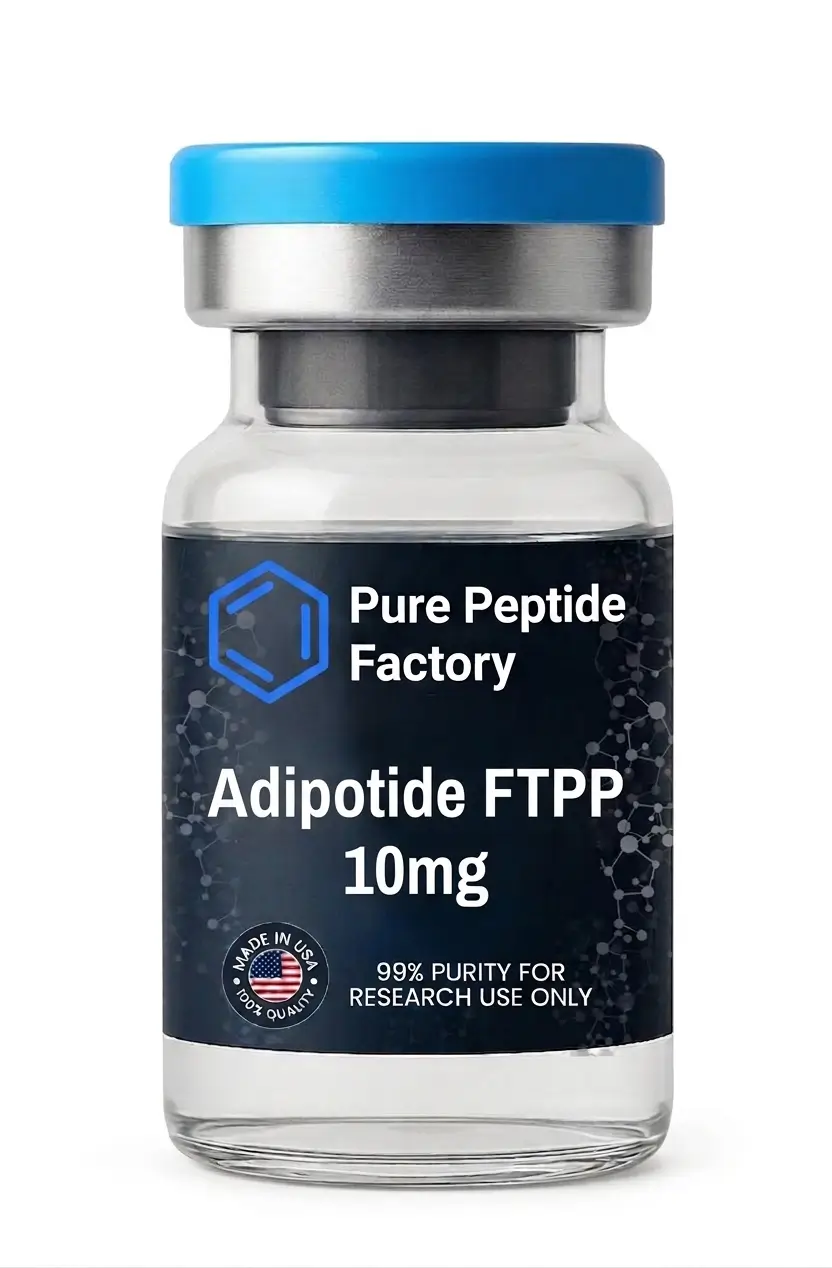
Adipotide FTPP 10mg
$30.00 $70.00Price range: $30.00 through $70.00
Adipotide — available in multiple dosages. For research use only.
Adipotide FTPP 10mg Research Peptide: Prohibitin Targeting Compound
Adipotide FTPP, also designated as Fat-Targeted Proapoptotic Peptide or Prohibitin-TP01, is a synthetic peptidomimetic compound developed for research into white adipose tissue metabolism and angiogenesis inhibition. This 10mg research vial contains the sequence CKGGRAKDC fused to a proapoptotic motif, creating a dual-action compound that targets specific vascular markers found in fatty tissue.
Molecular Profile Molecular Formula: C152H252N44O42
Molecular Weight: 2611.41 g/mol
Sequence Homology: Targeting peptide homologous to white adipose tissue vasculature
Synonyms: FTPP, Prohibitin Targeting Peptide 1, Adipotide
Molecular Weight: 2611.41 g/mol
Sequence Homology: Targeting peptide homologous to white adipose tissue vasculature
Synonyms: FTPP, Prohibitin Targeting Peptide 1, Adipotide
Mechanism of Action Research
Adipotide functions through prohibitin targeting. Prohibitin (PHB1) serves as a vascular marker specific to white adipose tissue endothelium. The compound binds to these surface receptors, potentially disrupting mitochondrial membranes through its internalized d-enantiomer D(KLAKLAK)2 sequence. This action may trigger apoptosis in the targeted vasculature while leaving surrounding tissue unaffected.
Research suggests Adipotide may also interact with annexin A2 (ANX2), disrupting the ANX2-prohibitin-CD36 complex responsible for fatty acid transport from endothelium into adipocytes. This triple-target mechanism differentiates it from metabolic stimulants or appetite suppressants studied in obesity research.
Preclinical Research Findings
Primate studies conducted over four-week protocols demonstrated significant findings. Research models showed approximately 11% reduction in total body weight and 39% decrease in fat deposits compared to baseline measurements, achieved without dietary modification or exercise intervention. Notably, renal function markers remained stable throughout the study period with return to baseline after washout.
Glucose metabolism research indicates rapid improvements in insulin sensitivity. Murine models exhibited enhanced glucose tolerance within 48-72 hours of administration, accompanied by decreased triglyceride levels. Microarray analysis revealed altered gene expression in pathways related to mitochondrial function, oxidative phosphorylation, and amino acid degradation within white adipose tissue.
Research Applications
Laboratory investigations utilize Adipotide FTPP for:
-
White adipose tissue vasculature studies
-
Metabolic disease model research
-
Angiogenesis inhibition protocols
-
Fatty acid transport mechanism analysis
-
Mitochondrial membrane disruption studies
-
Obesity-related glucose tolerance research
Product Specifications
Purity: 99% minimum (HPLC verified)
Form: Lyophilized powder
Quantity: 10mg per vial
Packaging: 10 vials per research kit
Storage: -20°C, protected from light
Stability: 24 months when stored properly
Solubility: Reconstitute with bacteriostatic water or acetic acid solution
Form: Lyophilized powder
Quantity: 10mg per vial
Packaging: 10 vials per research kit
Storage: -20°C, protected from light
Stability: 24 months when stored properly
Solubility: Reconstitute with bacteriostatic water or acetic acid solution
Research Use Only
Adipotide FTPP 10mg is sold strictly for in vitro research and laboratory experimentation. Not for human consumption, veterinary use, or diagnostic purposes. Researchers must comply with institutional biosafety protocols and applicable regulations regarding synthetic peptide handling. This compound is not FDA approved and has not completed clinical trials for human safety or efficacy.
FAQ
What is another name for Adipotide?
Adipotide is also known as FTPP (Fat-Targeted Proapoptotic Peptide), Prohibitin-TP01, or prohibitin targeting peptide 1. Some research literature refers to it by its sequence designation CKGGRAKDC-D(KLAKLAK)2.
Adipotide is also known as FTPP (Fat-Targeted Proapoptotic Peptide), Prohibitin-TP01, or prohibitin targeting peptide 1. Some research literature refers to it by its sequence designation CKGGRAKDC-D(KLAKLAK)2.
How does Adipotide work?
Adipotide targets prohibitin (PHB1) receptors found specifically on the surface of blood vessels supplying white adipose tissue. Once bound, the compound internalizes and may disrupt mitochondrial membranes through its proapoptotic domain, potentially triggering apoptosis in the targeted vascular cells. This mechanism differs from metabolic stimulants or hormone-based compounds.
Adipotide targets prohibitin (PHB1) receptors found specifically on the surface of blood vessels supplying white adipose tissue. Once bound, the compound internalizes and may disrupt mitochondrial membranes through its proapoptotic domain, potentially triggering apoptosis in the targeted vascular cells. This mechanism differs from metabolic stimulants or hormone-based compounds.
How long does Adipotide take to work in research models?
Preclinical studies observed measurable changes within 2-3 days, with significant effects apparent at 2-4 weeks of consistent administration. Primate research demonstrated substantial fat mass reduction over 28-day protocols. Timeline varies by research model and specific endpoints measured.
Preclinical studies observed measurable changes within 2-3 days, with significant effects apparent at 2-4 weeks of consistent administration. Primate research demonstrated substantial fat mass reduction over 28-day protocols. Timeline varies by research model and specific endpoints measured.
What peptides are used for obesity research?
Researchers investigating obesity and metabolic disease study various compounds including Adipotide FTPP, AOD-9604, Tirzepatide, Retatrutide, CJC-1295, and Ipamorelin. Each operates through distinct mechanisms ranging from angiogenesis inhibition to GLP-1 receptor agonism or growth hormone stimulation.
Researchers investigating obesity and metabolic disease study various compounds including Adipotide FTPP, AOD-9604, Tirzepatide, Retatrutide, CJC-1295, and Ipamorelin. Each operates through distinct mechanisms ranging from angiogenesis inhibition to GLP-1 receptor agonism or growth hormone stimulation.
What is the best peptide for belly fat research?
For visceral adipose tissue specifically, Adipotide FTPP is unique in targeting the vascular supply to fat cells rather than acting through endocrine pathways. AOD-9604 and GLP-1 agonists like Tirzepatide are also widely studied for abdominal fat reduction in metabolic research.
For visceral adipose tissue specifically, Adipotide FTPP is unique in targeting the vascular supply to fat cells rather than acting through endocrine pathways. AOD-9604 and GLP-1 agonists like Tirzepatide are also widely studied for abdominal fat reduction in metabolic research.
Is peptide therapy like Ozempic?
Ozempic (semaglutide) is a GLP-1 receptor agonist that affects appetite and gastric emptying. Adipotide is not a GLP-1 agonist and does not function through the same pathway. They represent entirely different classes of compounds with distinct mechanisms of action in metabolic research.
Ozempic (semaglutide) is a GLP-1 receptor agonist that affects appetite and gastric emptying. Adipotide is not a GLP-1 agonist and does not function through the same pathway. They represent entirely different classes of compounds with distinct mechanisms of action in metabolic research.
How much does Adipotide cost for research?
Research-grade Adipotide FTPP 10mg typically ranges from $70-150 per vial depending on supplier, purity verification, and quantity purchased. Always verify HPLC certificates and third-party testing documentation when sourcing research peptides.
Research-grade Adipotide FTPP 10mg typically ranges from $70-150 per vial depending on supplier, purity verification, and quantity purchased. Always verify HPLC certificates and third-party testing documentation when sourcing research peptides.
Can fat return after fat dissolving in research models?
Research indicates that if the underlying metabolic conditions persist, adipose tissue can regenerate over time. Adipotide research focuses on the vascular component of fat tissue, but long-term maintenance of body composition depends on sustained caloric balance and metabolic factors.
Research indicates that if the underlying metabolic conditions persist, adipose tissue can regenerate over time. Adipotide research focuses on the vascular component of fat tissue, but long-term maintenance of body composition depends on sustained caloric balance and metabolic factors.
What research has been done on Adipotide?
Key studies include the 2011 primate trial published in Science Translational Medicine, 2012 glucose tolerance research in Diabetes journal, and ongoing investigations into prohibitin targeting for cancer angiogenesis inhibition. The compound has been studied at institutions including MD Anderson Cancer Center.
Key studies include the 2011 primate trial published in Science Translational Medicine, 2012 glucose tolerance research in Diabetes journal, and ongoing investigations into prohibitin targeting for cancer angiogenesis inhibition. The compound has been studied at institutions including MD Anderson Cancer Center.
Does Adipotide increase blood pressure?
Research does not indicate hypertensive effects. Unlike stimulant compounds, Adipotide does not activate adrenergic receptors or cause vasoconstriction. Primate studies monitored cardiovascular markers without significant elevation in blood pressure parameters.
Research does not indicate hypertensive effects. Unlike stimulant compounds, Adipotide does not activate adrenergic receptors or cause vasoconstriction. Primate studies monitored cardiovascular markers without significant elevation in blood pressure parameters.
Related products
-
SLU-PP-322 10 mg
$90.00