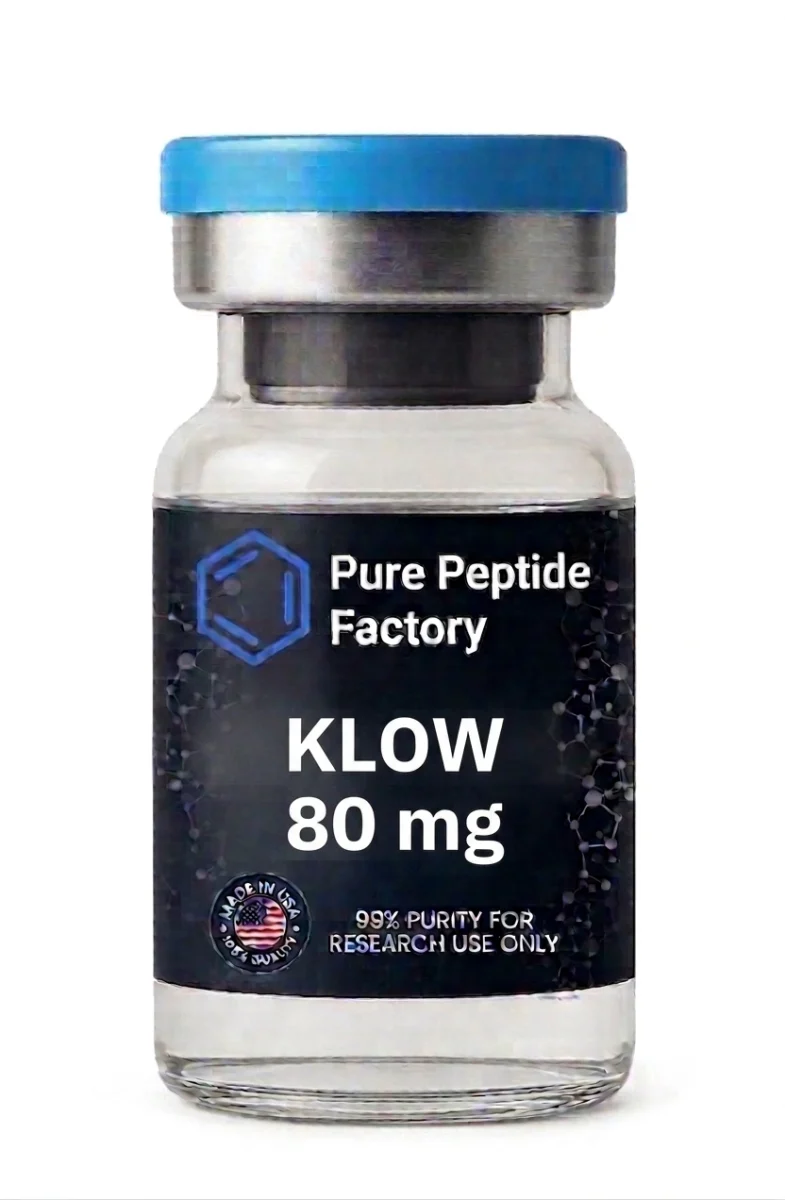
KLOW peptide is a research-grade quad-peptide blend combining four independently characterized healing peptides — GHK-Cu, BPC-157, TB-500, and KPV — into a single 80mg lyophilized vial. Researchers studying multi-phase tissue repair, wound healing, gastrointestinal protection, or systemic recovery protocols have driven significant search volume around this blend. Furthermore, this guide answers the most searched questions about klow peptide with an honest assessment of what the published evidence supports and what remains unknown. For researchers ready to source the blend, KLOW peptide 80mg research vials are available from Pure Peptide Factory with batch-specific HPLC documentation and domestic cold-chain shipping.
What Is KLOW Peptide?
KLOW peptide is a quad-peptide research blend containing GHK-Cu (Copper Tripeptide-1, 50mg), BPC-157 (Body Protection Compound-157, 10mg), TB-500 (Thymosin Beta-4 fragment, 10mg), and KPV (Lys-Pro-Val, 10mg) in an 80mg total peptide configuration. It expands on the GLOW stack (GHK-Cu, BPC-157, TB-500) by adding KPV for melanocortin pathway-mediated anti-inflammatory signaling.
A point of necessary honesty: the acronym “KLOW” does not cleanly map to the first letters of its four components. The origin of each letter varies across vendors, and researchers should verify composition through batch-specific documentation rather than relying on the acronym. Different suppliers define KLOW differently — some formulations include LL-37 or omit KPV. Our 80mg KLOW blend uses the GHK-Cu, BPC-157, TB-500, and KPV configuration with lot-specific analytical verification of each component.
KLOW vs GLOW: What Is the Difference?
The most common comparison question about klow blend peptide is how it differs from the GLOW stack. Both are multi-peptide healing blends, but they differ in component count and mechanistic coverage:
| Feature | KLOW Peptide (80mg) | GLOW Blend | Individual Peptides |
|---|---|---|---|
| Components | GHK-Cu + BPC-157 + TB-500 + KPV | GHK-Cu + BPC-157 + TB-500 | Single peptide per vial |
| Total peptide per vial | 80mg | Varies (typically 30-70mg) | Varies by peptide |
| Anti-inflammatory mechanism | Yes — KPV via melanocortin pathway | Indirect — through GHK-Cu and BPC-157 | Peptide-dependent |
| Angiogenesis support | Yes — BPC-157 + TB-500 | Yes — BPC-157 + TB-500 | Peptide-dependent |
| Collagen synthesis | Yes — GHK-Cu | Yes — GHK-Cu | GHK-Cu only |
| Vial configuration | Single pre-mixed vial | Single pre-mixed vial | Individual vials |
| Best for studying | Multi-phase healing with targeted anti-inflammatory component | Three-pathway tissue repair without melanocortin modulation | Isolating single-mechanism effects |
| Protocol complexity | One reconstitution | One reconstitution | Multiple reconstitutions |
Choose KLOW when your protocol requires the added anti-inflammatory dimension that KPV provides through the melanocortin pathway. Choose GLOW when studying the core healing triad without KPV’s additional signaling. Choose individual peptides when your hypothesis requires isolating a single mechanism. All options are available from our catalog for controlled comparison studies.
KLOW Peptide Benefits: What the Research Shows
The documented benefits of this quad-peptide blend in preclinical research arise from the combined action of its four components. Each peptide has an independent research literature; the combination has not been studied as a single formulation in a randomized controlled trial. The following reflects what published studies demonstrate for each component individually.
GHK-Cu Supports Collagen Synthesis and Wound Remodeling
GHK-Cu is a naturally occurring copper-binding tripeptide first isolated from human plasma. Research demonstrates that it modulates extracellular matrix remodeling by promoting collagen synthesis, stimulating glycosaminoglycan production, and functioning as a chemoattractant for macrophages and endothelial cells during wound repair. Its biological activity depends on copper delivery to the injury site, making the copper complex the functional form (1).
BPC-157 Drives Angiogenesis and Tissue Repair Signaling
BPC-157 is a pentadecapeptide (GEPPPGKPADDAGLV, MW 1419.5 g/mol) studied extensively in rodent models by the laboratory of Predrag Sikiric and colleagues in Croatia. Within the preclinical literature, BPC-157 upregulates VEGF receptors, modulates nitric oxide production, and accelerates fibroblast migration. Additionally, it has demonstrated protective effects on gastrointestinal mucosa and promoted tendon and ligament healing in animal models. However, researchers should note that almost all published BPC-157 research comes from a single laboratory, and independent replication remains limited (2).
TB-500 Facilitates Cell Migration and Actin Regulation
TB-500 is a synthetic fragment of Thymosin Beta-4 that binds G-actin monomers, regulating the cytoskeletal dynamics required for cell migration, division, and tissue remodeling. Preclinical studies document that TB-500 promotes endothelial cell migration and tube formation in angiogenesis assays and accelerates keratinocyte migration in wound healing models. Many mechanistic claims about TB-500 are extrapolated from parent Thymosin Beta-4 research rather than from direct studies of the TB-500 fragment (3).
KPV Provides Melanocortin Pathway Anti-Inflammatory Activity
KPV (Lys-Pro-Val) is the C-terminal tripeptide of alpha-MSH. Getting and colleagues demonstrated that KPV exerts anti-inflammatory effects through a mechanism independent of classical melanocortin receptors (4). Furthermore, Kannengiesser and colleagues showed that KPV reduced inflammatory infiltrates and accelerated recovery in two murine colitis models, with effects persisting in mice with nonfunctional MC1R receptors (5). This component distinguishes KLOW from the GLOW triple-stack.
KLOW Peptide Dosage: Published Research Ranges
Researchers searching for dosage data on this blend should note that published studies examined each component individually. The following reference ranges come from peer-reviewed preclinical literature:
| Component | Published Preclinical Dose Range | Route | Frequency | Key Reference |
|---|---|---|---|---|
| GHK-Cu | 0.1-10 mg/kg | Subcutaneous, topical | Daily | Pickart et al. |
| BPC-157 | 10-50 mcg/kg | Subcutaneous, oral, IP | Daily | Sikiric et al. |
| TB-500 | 100-500 mcg/kg | Subcutaneous, IP | Every 2-3 days | Goldstein et al. |
| KPV | 50-200 mcg/kg | Subcutaneous, IP | Daily | Getting et al.; Kannengiesser et al. |
For the combined KLOW blend, the pre-formulated 80mg vial delivers all four peptides in a fixed ratio with each administration. Researchers should consult lot-specific documentation for exact component ratios. Total peptide dose depends on reconstitution volume.
All dosing parameters are for laboratory research reference only. We do not provide human dosing recommendations. KLOW peptide is not FDA approved for any indication.
KLOW Peptide Side Effects and Safety Considerations
Published preclinical data on the individual components supports a generally favorable safety profile, but important limitations in the evidence base must be acknowledged when designing protocols:
- GHK-Cu: As an endogenous plasma peptide, GHK-Cu is well-characterized. Mild injection site reactions have been reported.
- BPC-157: Rodent studies report no significant systemic toxicity, but almost all safety data come from a single Croatian research group. The FDA has cited insufficient safety information to determine whether BPC-157 would cause harm when administered to humans. In 2023, the FDA prohibited compounding pharmacies from supplying BPC-157 to patients.
- TB-500: Reasonable safety profile in published preclinical studies. Injection site reactions and transient flushing are the most commonly reported effects.
- KPV: As a small tripeptide, KPV is rapidly cleared and demonstrates minimal off-target effects in published studies.
- Combination safety: The safety profile of the four-peptide blend has not been specifically studied. Potential interactions between components — including whether KPV’s anti-inflammatory activity might attenuate the early inflammatory signals required for BPC-157 and GHK-Cu to initiate repair — have not been systematically investigated.
As with all research compounds, institutional biosafety oversight and IACUC approval are required for any in vivo work. This product is strictly for laboratory research and is not for human consumption.
How to Design a KLOW Peptide Research Protocol
Researchers planning to incorporate this quad-peptide blend into their studies should consider these methodological factors:
- Include single-component control arms. Without individual peptide arms, you cannot determine whether any observed effect comes from one dominant component or the combination. The synergy hypothesis is plausible but untested in a controlled format.
- Match the route to the research question. BPC-157 is stable in gastric juice, supporting oral administration for GI endpoints. For systemic or musculoskeletal protocols, subcutaneous injection is standard.
- Account for different pharmacokinetics. The four peptides have markedly different half-lives. Daily dosing provides sustained exposure to all four, but researchers should note that pharmacokinetic profiles differ significantly.
- Verify component identity through analytical documentation. A 2026 Janoshik analysis noted that peptide purity cannot be accurately measured in blends because impurities of mixed peptides obscure each other. Request batch-specific documentation confirming the presence and approximate quantity of each component.
- Select endpoints that match mechanistic coverage. Wound closure rate, collagen organization, tensile strength, and inflammatory cytokine levels for wound studies. Lesion area, mucosal thickness, and inflammatory infiltrate quantification for GI studies.
For researchers ready to source the quad-peptide blend with verified component documentation, KLOW peptide 80mg research vials ship same-day with cold-chain integrity from Pure Peptide Factory.
Frequently Asked Questions About KLOW Peptide
What is KLOW peptide?
KLOW peptide is a research-grade quad-peptide blend containing GHK-Cu (50mg), BPC-157 (10mg), TB-500 (10mg), and KPV (10mg) in a single 80mg lyophilized vial. It extends the GLOW stack by adding KPV for melanocortin pathway anti-inflammatory signaling. The acronym does not cleanly map to the first letters of each component, so researchers should verify composition through batch-specific documentation rather than relying on naming conventions alone.
What are the KLOW peptide benefits in research?
Published preclinical studies on the individual components document collagen synthesis and extracellular matrix remodeling (GHK-Cu), angiogenesis and tissue repair signaling (BPC-157), cell migration and actin regulation (TB-500), and melanocortin pathway anti-inflammatory activity (KPV). The combination has not been studied as a single formulation in a controlled trial, but the mechanistic rationale for combining the four peptides is supported by their complementary roles across the inflammatory, proliferative, and remodeling phases of tissue repair.
What is the KLOW peptide dosage in preclinical research?
Published individual-component doses are: GHK-Cu 0.1-10 mg/kg, BPC-157 10-50 mcg/kg, TB-500 100-500 mcg/kg, and KPV 50-200 mcg/kg. The pre-formulated 80mg KLOW vial delivers all four peptides in a fixed ratio with each administration. Total peptide dose depends on reconstitution volume. All dosing must follow species-specific validation and institutional protocols. We do not provide human dosing recommendations.
What are the KLOW peptide side effects?
Individual components have generally favorable preclinical safety profiles. BPC-157 safety data come primarily from a single Croatian research group, and independent replication is limited. The FDA has cited insufficient safety information for BPC-157 in humans. TB-500 and GHK-Cu are endogenous protein fragments with reasonable safety profiles. KPV is a small tripeptide with rapid clearance. The safety of the four-peptide combination has not been specifically studied, and researchers should include appropriate monitoring in any in vivo protocol.
How does KLOW differ from the GLOW blend?
GLOW contains three peptides: GHK-Cu, BPC-157, and TB-500. KLOW adds KPV as a fourth component, introducing melanocortin pathway-mediated anti-inflammatory signaling. The GLOW stack addresses angiogenesis, structural repair, and cytoprotection. KLOW adds a targeted anti-inflammatory dimension that GLOW does not directly provide. See the comparison table above for a full feature breakdown.
Is KLOW peptide safe for research models?
Each individual component has a preclinical safety literature supporting its use in standard research models. The combination has not been systematically studied for safety, and potential component interactions have not been investigated. Researchers should include single-component control arms, monitor for unexpected effects, and ensure all in vivo work has IACUC approval. This product is strictly for laboratory research and is not for human consumption.
Where can I buy KLOW peptide for research?
Pure Peptide Factory supplies research-grade KLOW peptide in 80mg lyophilized vials with batch-specific documentation, domestic cold-chain shipping, and same-day dispatch for orders placed before 2 PM EST. Each vial includes analytical verification of all four components. Visit the KLOW peptide product page to order. Research use only.
